

TL;DR: A predictive dialer dials several numbers ahead of your agents and connects a rep only after someone says hello, so it maximizes dials but abandons calls and creates dead air. A power dialer dials one number at a time, only when a rep is ready, so every connection lands on a live person with zero abandonment. For most SMB and mid-market outbound teams, the power dialer wins on connect quality, compliance, and long-term number reputation. Choose predictive only when you are running very high-volume, low-value list campaigns and can absorb the abandonment and carrier-flagging risk.
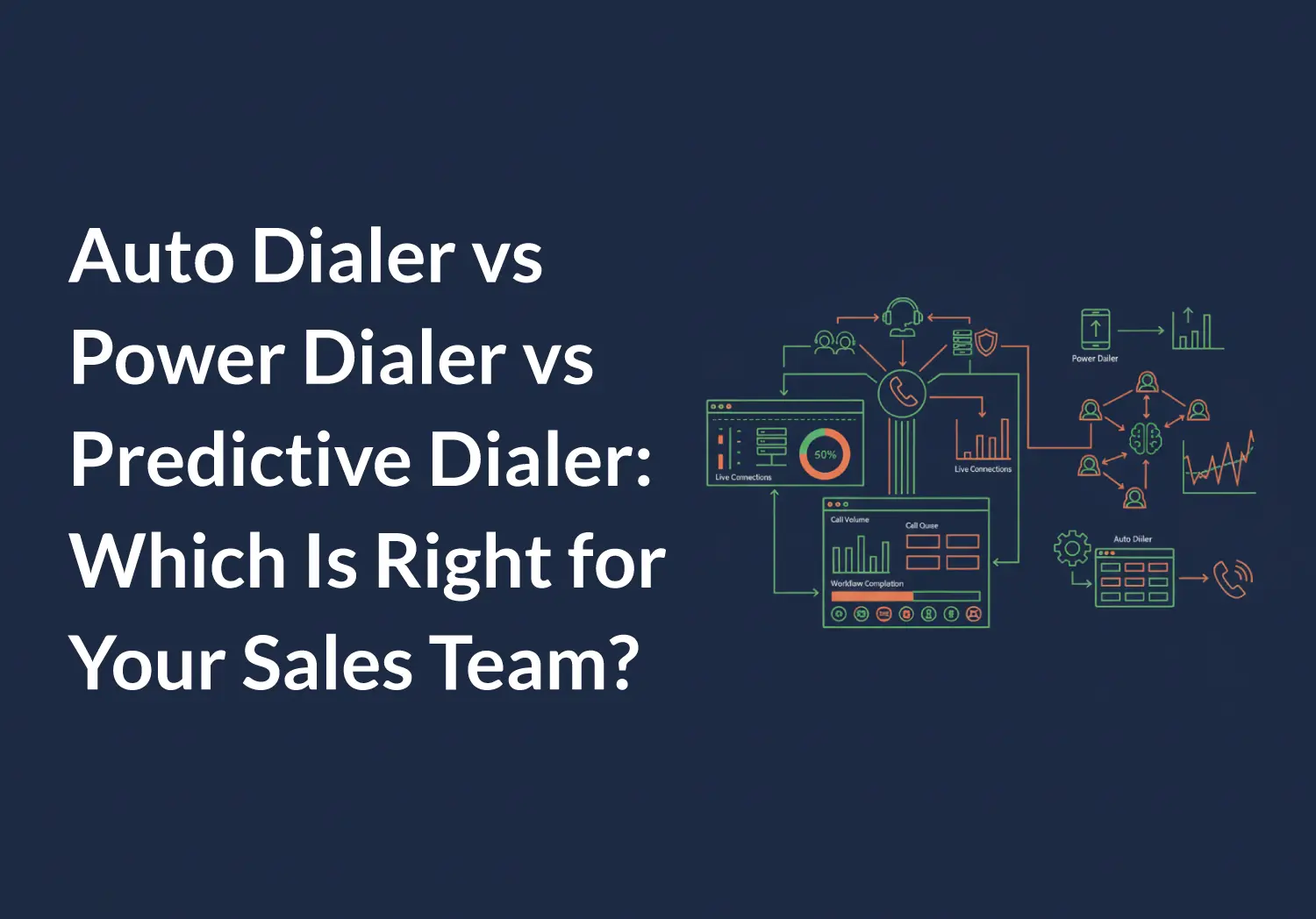
- Predictive dialer: multi-line, dials ahead of agent availability, connects whoever answers first. Built for raw volume.
- Power dialer: single-line, 1:1, dials the next contact only when a rep is free. Built for connected conversations.
- The compliance line: the FTC Telemarketing Sales Rule caps abandoned calls at 3% of calls answered by a person. Predictive dialing is the mode that produces abandonment; power dialing structurally cannot abandon a call.
- The reputation cost: the 1 to 3 second silence gap predictive dialers create at pickup is a signature carriers use to flag numbers "Spam Likely."
- Where Aloware lands: a 1:1 Power Dialer, plus Progressive and Preview dialing for teams that want them, and a deliberate decision to skip predictive and parallel dialing.
If you manage an outbound team, you have felt the tradeoff. Push for more dials and your reps burn through lists, but half the answered calls open with silence and the other half are people who never wanted the call. Slow down to protect quality and the activity numbers drop. The dialer you pick decides which of those problems you live with. Here is how predictive and power dialers actually differ, and how to choose the one that fits the way your team sells.
What is a predictive dialer?
A predictive dialer is an automated calling system that dials multiple phone numbers at once, ahead of agent availability, and connects a rep only after a person answers. A pacing algorithm watches average talk time and agent idle rates, then predicts when the next rep will free up and dials enough lines to have a live human waiting the moment they do.
The goal is agent utilization. Keep every rep talking, minimize the gap between calls, and squeeze the most dials out of every hour. On paper that sounds efficient. In practice the machine dials faster than your reps can pick up, which is exactly where the problems start.
When the algorithm guesses wrong and more people answer than there are free agents, the extra answered calls get dropped or parked in silence. That is an abandoned call. The person hears nothing, waits a beat, and hangs up. Do that at scale and you are training an entire market to distrust your number.
Key takeaway: A predictive dialer optimizes for dials per hour by dialing ahead of your agents, which means abandoned calls and dead air are built into how it works, not a bug you can tune away.

What is a power dialer?
A power dialer is an automated calling system that dials one contact at a time from a list, and only places the next call when a rep is available and ready. There is no dialing ahead and no pool of extra lines ringing in the background. One rep, one live call, then the next.
Because a rep is already on the line before the contact picks up, a power dialer cannot abandon a call. There is no silence gap, because there is no waiting for an agent to be transferred in. The person answers and a human is already there. The tradeoff is honest: you get fewer raw dials per hour than a predictive system, and in exchange every connection is a real, staffed conversation.
This is the difference between chasing dials and chasing conversations. A real estate team working 200 warm inbound inquiries does not need to blast 2,000 numbers an hour. It needs every one of those 200 leads to reach a rep who is present and prepared. A power dialer is built for that.
Key takeaway: A power dialer trades peak call volume for guaranteed live connections, zero abandonment, and no dead air, because the rep is on the line before the phone is answered.
Predictive dialer vs power dialer: the head-to-head
The two tools solve different problems. Line them up on the dimensions that actually decide outbound outcomes.
DimensionPredictive dialerPower dialerDialing modelMulti-line, dials ahead of agentsSingle-line, 1:1, dials when rep is readyOptimizes forDials per hour, agent utilizationConnected conversations per repAbandoned callsStructural. Happens whenever answers outrun free agentsNone. A rep is already on the lineSilence gap at pickup1 to 3 seconds while a rep is connectedZero. Live human answersCompliance exposureGoverned by the FTC 3% abandonment ruleMinimal. No abandonment to manageCarrier reputation riskHigh. Dead air is a spam-flag signatureLow. Calls behave like human dialingBest fitVery high volume, low-value list blastingWarm leads, higher-value B2B, most SMB and mid-market teams
Key takeaway: Predictive wins on raw dial count and nothing else. On abandonment, compliance, connect quality, and number reputation, the power dialer wins for any team whose leads are worth a real conversation.
How does the 3% abandonment rule change the math?
This is the part most volume-first teams underestimate. Under the FTC Telemarketing Sales Rule, a call is abandoned if a person answers and the telemarketer does not connect them to a live representative within two seconds of their completed greeting. The safe harbor requires abandoning no more than three percent of all calls answered by a person, measured over a single calling campaign if it runs under 30 days, or over each successive 30-day period (16 CFR 310.4).
Read that again through the lens of how a predictive dialer works. The whole point of dialing ahead is to sometimes have more answers than free agents. Every time that happens and no rep connects in two seconds, that is an abandoned call counting against your 3% ceiling. Run predictive aggressively and you either throttle the pacing until it behaves like a power dialer anyway, or you drift over the line.
A power dialer sidesteps the entire question. There is no dialing ahead, so there is no scenario where an answered call has no rep. You cannot abandon a call you never placed without a rep already on it. For a mortgage team or an insurance agency working regulated verticals, that structural safety is worth more than a higher dials-per-hour number on a dashboard.
Key takeaway: The 3% abandonment rule taxes the exact behavior a predictive dialer is designed to do. A power dialer has nothing to measure against the cap, because it never abandons.
Why does predictive dialing get your numbers flagged?
Compliance is the legal risk. Carrier reputation is the operational one, and it is the quieter killer of outbound teams. The two systems are separate, and predictive dialing loses on both.
Here is the mechanism. A predictive dialer connects a rep only after the person answers, so the first 1 to 3 seconds of the call are silent while the transfer happens.
❌ Predictive pattern: the consumer picks up, hears dead air, recognizes it as an auto-dialer, and hangs up. The carrier's analytics detect that same silence-gap signature across thousands of short, dropped calls and automatically tag the number "Spam Likely."
✅ Power dialer pattern: the consumer picks up and a real person is already speaking. The call reads as human dialing to the carrier, the call durations look normal, and the number keeps its reputation.
A solar or home-services team that burns three local numbers a month to spam flags is not just losing those numbers. It is losing the connect rate on every number that follows, because a flagged caller ID gets fewer answers before anyone even says a word. That is the compounding cost predictive volume hides.
Key takeaway: Branded caller ID and spam labeling are two separate carrier systems, and no amount of branding overrides a bad reputation. The dead air from predictive dialing is a spam-flag signature. Power dialing avoids the signature entirely.

When should you use each one?
Match the tool to the list, not to a dials-per-hour target.
Choose a predictive dialer if: you run genuinely massive, low-value campaigns where contact-level quality does not matter, you have the staffing to keep abandonment under 3%, and you accept the carrier-reputation cost as a cost of doing business. Think large-scale survey or collections shops built around raw throughput.
Choose a power dialer if: your leads are worth a real conversation, you sell into regulated or relationship-driven verticals, or you want your caller IDs to keep answering rates high over time. This is most SMB and mid-market sales and support teams, and it is where a progressive or preview dialer often fits even better.
Progressive and preview dialing sit between the two extremes. Both are still 1:1 and still safe on abandonment. A preview dialer shows the rep the contact record before the call fires, so an insurance rep can read the policy history or a SaaS SDR can scan the account before the person picks up. Progressive dialing keeps the automation of a power dialer while pacing through a sequence. You get automation without dialing ahead of your people.
Key takeaway: Predictive dialing fits a narrow band of very high-volume, low-value work. For everyone else, a power, progressive, or preview dialer delivers better conversations without the compliance and reputation tax.
Where Aloware lands on dialing
Aloware built its outbound motion around the 1:1 Power Dialer, and skips predictive and parallel dialing on purpose. The reasoning is everything above: multi-line dial-ahead pacing manufactures the abandoned calls, dead air, and short dropped connections that trip the FTC 3% rule and train carriers to flag your numbers. Aloware engineers answer rate at the reputation layer instead of forcing volume through the dialer.
For teams that want more automation than a straight power dialer, Aloware also supports Progressive Dialer and Preview Dialer, set up through Aloware Sequences and enabled per account. Both stay 1:1 and both stay safe on abandonment. What Aloware deliberately does not sell is a predictive or parallel dialer, because the pacing that makes those tools fast is the same pacing that burns your numbers.
The result is a dialer that behaves like a person on the line: no silence gap, no abandoned calls to manage, and caller IDs that keep answering. Pair that with number-reputation monitoring and your connect rate compounds up instead of decaying down.
Key takeaway: Aloware's Power Dialer is single-line by design, backed by Progressive and Preview modes, with predictive and parallel dialing left out on purpose so your numbers stay trusted and your reps stay talking to real people.
The bottom line
Predictive dialers optimize for the one number that looks good on a dashboard and costs you everywhere else: dials per hour. Power dialers optimize for the number that actually pays, which is connected conversations that a live rep is present for. The volume you gain from dialing ahead of your agents gets clawed back by abandoned calls, the 3% ceiling, and a caller ID that answering machines and carriers have learned to distrust. Pick the dialer that keeps a human on the line, and your team spends its hours talking instead of chasing dead air.
See how Aloware's Power Dialer keeps your reps connected.
Frequently Asked Questions
What is the difference between a predictive dialer and a power dialer?
A predictive dialer dials multiple numbers ahead of your agents and connects a rep only after a person answers, so it maximizes dials but can abandon calls when more people pick up than there are free agents. A power dialer dials one number at a time and only places the next call when a rep is available, so a live person is always on the line and no call gets abandoned. Predictive optimizes for dials per hour; power optimizes for connected conversations.
Is a power dialer better than a predictive dialer?
For most SMB and mid-market outbound teams, yes. A power dialer connects every answered call to a live rep, produces no abandoned calls, and avoids the 1 to 3 second silence gap that gets numbers flagged as spam. A predictive dialer only wins on raw dial count, and that volume comes with abandonment under the FTC 3% rule and faster caller-ID reputation decay. If your leads are worth a real conversation, the power dialer is the better tool.
Are predictive dialers legal?
Predictive dialing is permitted but regulated. Under the FTC Telemarketing Sales Rule (16 CFR 310.4), a telemarketer using a predictive or auto-dialer must abandon no more than 3% of calls answered by a person, measured over a single campaign under 30 days or over each 30-day period, and must connect the person to a live rep within two seconds of their greeting or play a compliant recorded message. Staying inside those limits is the operational requirement; running predictive pacing aggressively is what pushes teams over the line.
What is the 3% call abandonment rule?
The 3% abandonment rule is an FTC Telemarketing Sales Rule safe harbor (16 CFR 310.4). A call is 'abandoned' if a person answers and the telemarketer does not connect them to a live representative within two seconds of their completed greeting. To stay in the safe harbor, a caller must abandon no more than three percent of all calls answered by a person, measured over the duration of a single calling campaign if it runs less than 30 days, or over each successive 30-day period. Predictive dialers are the mode this rule targets, because dialing ahead of agents is what creates abandoned calls.
Why do predictive dialers get flagged as spam?
A predictive dialer connects a rep only after the person answers, so the first 1 to 3 seconds of the call are silent while the transfer happens. Consumers recognize that dead air as an auto-dialer and hang up. Carriers run analytics that detect the same silence-gap signature across thousands of short, dropped calls and automatically tag the number 'Spam Likely.' Spam labeling and branded caller ID are two separate carrier systems, so branding a flagged number does not fix the reputation. A power dialer avoids the signature entirely because a live rep is already speaking when the call is answered.
Does Aloware have a predictive dialer?
No, and that is deliberate. Aloware built its outbound motion around a single-line 1:1 Power Dialer and does not offer predictive or parallel (multi-line dial-ahead) dialing, because that pacing manufactures the abandoned calls, dead air, and short dropped connections that trip the FTC 3% rule and get numbers flagged by carriers. For teams that want more automation, Aloware also supports Progressive and Preview dialing, set up through Aloware Sequences and enabled per account. Both stay 1:1 and safe on abandonment.
What is the difference between a progressive dialer and a preview dialer?
Both are 1:1 dialers that never dial ahead of your agents, so neither abandons calls. A progressive dialer automatically paces through a contact list or sequence and places the next call once the rep is free, keeping the automation of a power dialer. A preview dialer adds a step: it shows the rep the full contact record before the call fires, so they can read the account history, policy details, or prior notes and tailor the opening. Preview trades a little speed for a better-prepared conversation, which suits higher-value or relationship-driven selling.
When should you use a predictive dialer?
Use a predictive dialer only when you are running very high-volume, low-value campaigns where contact-level quality does not matter, you have enough agents to keep abandonment under the FTC 3% cap, and you accept the carrier-reputation cost. Large survey or collections operations built around raw throughput are the classic fit. For warm leads, regulated verticals, or any team that needs its caller IDs to keep answering over time, a power, progressive, or preview dialer delivers better conversations without the compliance and reputation tax.
.png)

Ruby Kootval is Head of Product Marketing at Aloware. She has 12 years in digital marketing, including 8 in B2B SaaS and 5 in telecom, and writes about AI voice agents, dialers, CRM integrations, and contact center operations.
.webp)