

.png)
TL;DR: How to Create an Automated Sales Funnel
An automated sales funnel uses technology — like CRM software, SMS sequences, power dialers, email automation, and AI voice agents — to move prospects from awareness to purchase without manual effort at every step. Instead of your sales team chasing every lead by hand, automation handles follow-ups, lead scoring, nurturing, and routing so reps focus on closing deals.
Here's the quick version:
The biggest mistake most businesses make? They automate email only and ignore phone and SMS — the two channels with the highest response rates. The companies winning in 2026 are running multi-channel funnels that combine calls, texts, email, and AI across every stage.
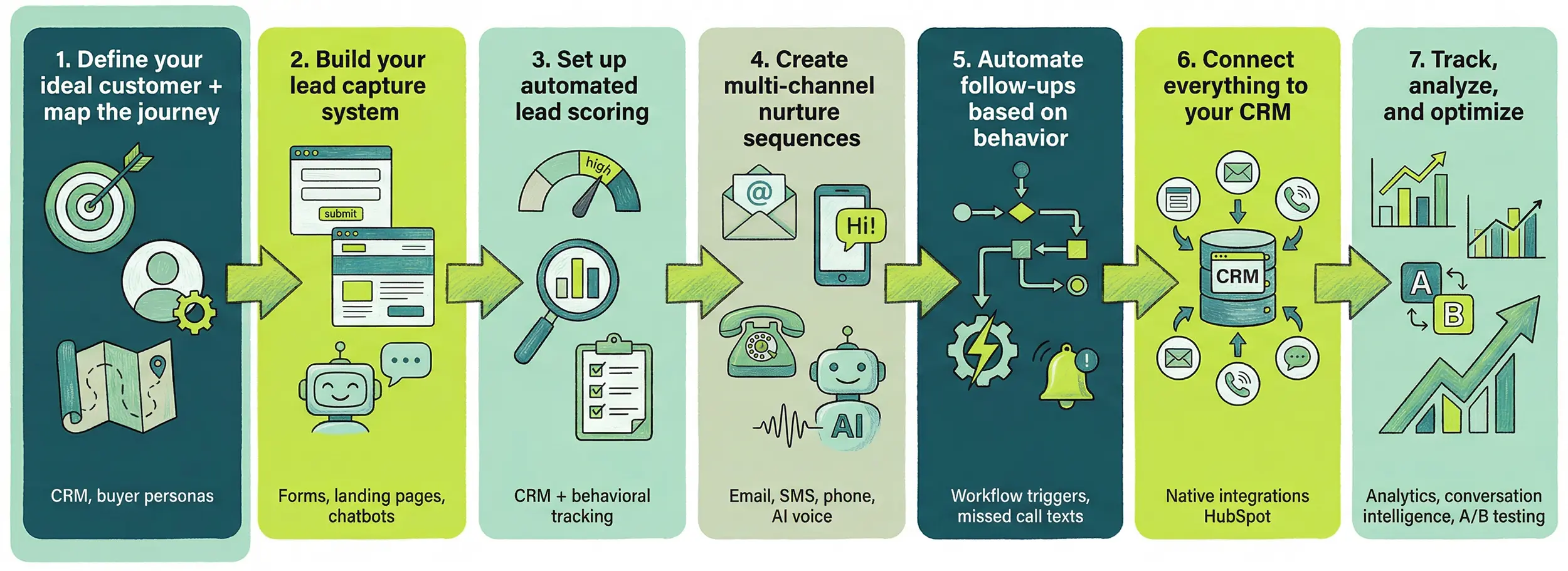
Keep reading for the full step-by-step playbook, tool recommendations, and real workflows you can steal.
What Is an Automated Sales Funnel?
An automated sales funnel is a system that guides prospects from their first interaction with your brand to becoming a paying customer — using software to handle repetitive tasks instead of relying on manual effort. It combines tools like email automation, SMS campaigns, power dialers, AI voice agents, and CRM workflows to nurture leads at each stage of the buying journey, ensuring no prospect slips through the cracks while your sales team focuses on high-value conversations that close deals.
Think of it as a machine that runs 24/7: capturing leads, qualifying them, sending the right messages at the right time, and handing off the hottest prospects to your reps when they're ready to buy.
The 4 Stages of a Sales Funnel
Most sales funnels follow the AIDA framework, which has been the backbone of sales strategy for over a century:
The difference between a manual funnel and an automated one is simple: in a manual funnel, a human has to trigger every touchpoint. In an automated funnel, the system handles the repetitive work — and your reps step in only when it matters most.
Why Automate Your Sales Funnel? (The Numbers Don't Lie)
If you're still running a manual sales process, you're leaving money on the table. Here's the data that makes the case:
Speed wins deals. Research from InsideSales.com and MIT shows that 35-50% of sales go to the business that responds first. Responding to a lead within 5 minutes makes you 21x more likely to qualify that lead compared to waiting 30 minutes. Automation makes that instant response possible — even at 2 AM on a Saturday.
Follow-ups make or break your pipeline. On average, it takes at least 5 follow-up attempts to connect with a prospect. But 44% of sales reps give up after just one follow-up. Automated sequences ensure your team never drops the ball.
Manual work kills productivity. According to Salesforce research, sales reps spend only about 28% of their time actually selling. The rest goes to data entry, scheduling, research, and administrative tasks. Automation reclaims those hours.
The bottom line: automating your sales funnel isn't a luxury anymore. It's table stakes for any business that wants to compete in 2026.
How to Create an Automated Sales Funnel: 7 Steps
Here's the step-by-step playbook for building a sales funnel that runs on autopilot.
Step 1: Define Your Ideal Customer and Map the Buying Journey
Before you automate anything, you need to know who you're selling to and how they buy.
Start by building an ideal customer profile (ICP). Ask yourself: What industries do your best customers come from? What's their company size? Who's the decision-maker? What problem are they trying to solve? What's their budget range?
Then map out the buying journey from their perspective — not yours. Identify every touchpoint where a prospect interacts with your brand: the blog post they read, the form they fill out, the demo they book, the follow-up call they receive.
The ROI is measurable. Companies that implement marketing automation see a 451% increase in qualified leads, according to the Annuitas Group. Meanwhile, B2B SaaS companies using SEO and content automation report 702% ROI with a 7-month breakeven period.
Once you've mapped the journey, segment your prospects. Not everyone in your funnel should get the same messaging. A real estate investor needs different nurturing than a healthcare practice manager. Segmentation lets you personalize at scale — which is exactly what automation makes possible.
Step 2: Build Your Lead Capture System
Your funnel is only as good as the leads entering it. You need a capture system that works across multiple entry points.
Landing pages and forms are the foundation. Every campaign — whether it's a paid ad, blog post, or social media post — should drive traffic to a dedicated landing page with a clear value proposition and a form that captures the right information.
Here's where most companies stop. They capture the lead and then... wait. Maybe someone checks the inbox an hour later. Maybe a rep calls back the next day. By then, the prospect has already moved on to a competitor.
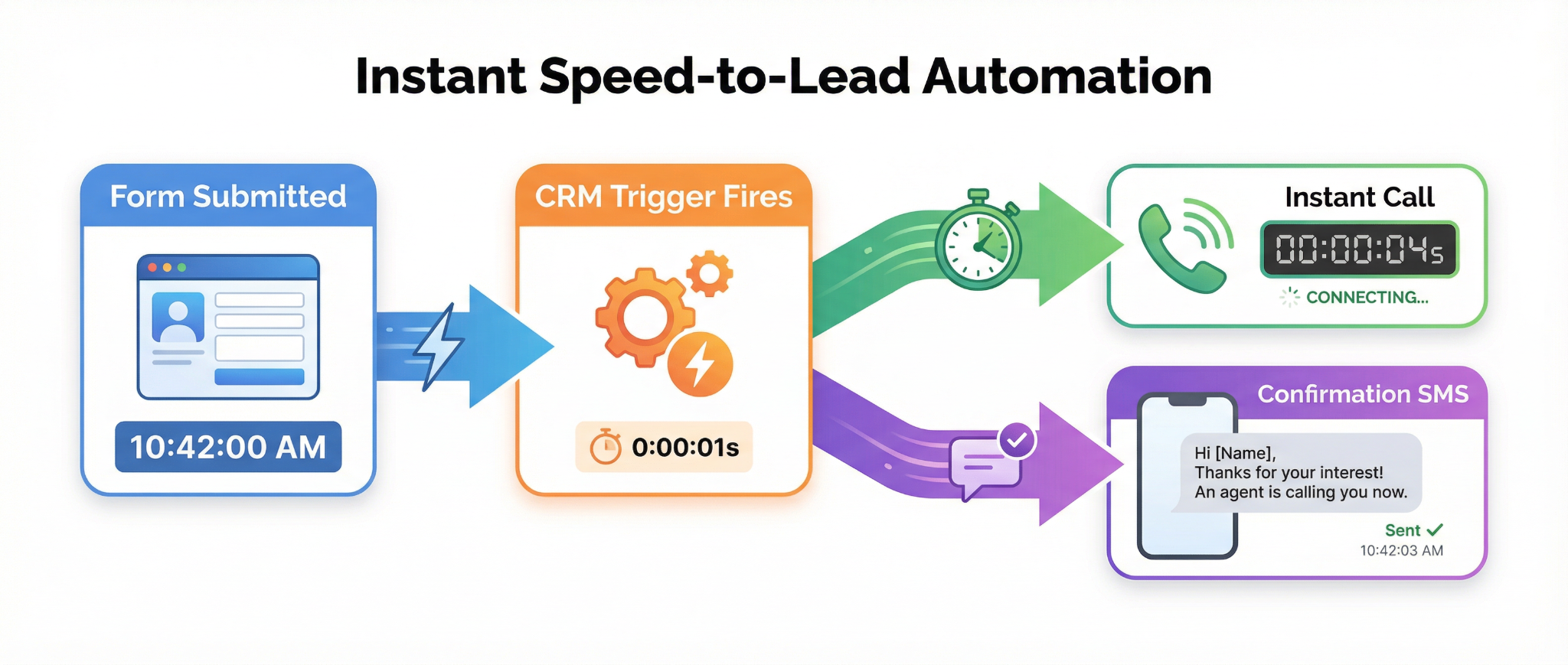
The fix? Instant engagement. Tools like Aloware's Form2Call automatically trigger a phone call to a sales rep the moment a prospect submits a form — connecting your team with the lead while they're still on your website, still engaged, still thinking about your solution. Similarly, Form2Text sends an immediate SMS confirmation, so the prospect knows you received their inquiry and someone is reaching out.
Other lead capture channels to automate:
- Chatbots on your website for 24/7 engagement
- Lead magnets (guides, templates, calculators) gated behind email capture
- Webinar registrations that trigger nurture sequences
- Social media lead ads that sync directly to your CRM
Step 3: Set Up Automated Lead Scoring
Not all leads are created equal. A VP who visited your pricing page three times this week is a very different prospect than someone who downloaded a blog PDF six months ago.
Lead scoring assigns a numerical value to each prospect based on two factors:
Demographic fit — Does this person match your ICP? Consider their job title, company size, industry, and location.
Behavioral engagement — What actions have they taken? Pages visited, emails opened, forms submitted, calls answered, demos requested.
Most modern CRMs — including HubSpot, Salesforce, and Zoho — let you set up lead scoring rules that calculate automatically. When a lead crosses your threshold (say, 50 points), the system alerts your sales team or automatically enrolls the prospect in a high-touch outreach sequence.
With Aloware's native CRM integrations, lead scores sync in real time. When a contact hits your threshold in HubSpot, it can automatically trigger a power dialer session or SMS sequence in Aloware — no manual handoff needed.
Step 4: Create Multi-Channel Nurture Sequences
This is where most businesses get it wrong. They set up an email drip and call it a day.
The problem? Email open rates average around 20%. That means 80% of your prospects never see your message. Meanwhile, SMS open rates exceed 90%, and phone calls create real human connection that email simply can't replicate.
The most effective automated sales funnels in 2026 use a multi-channel approach — combining email, SMS, phone, and AI across every funnel stage.
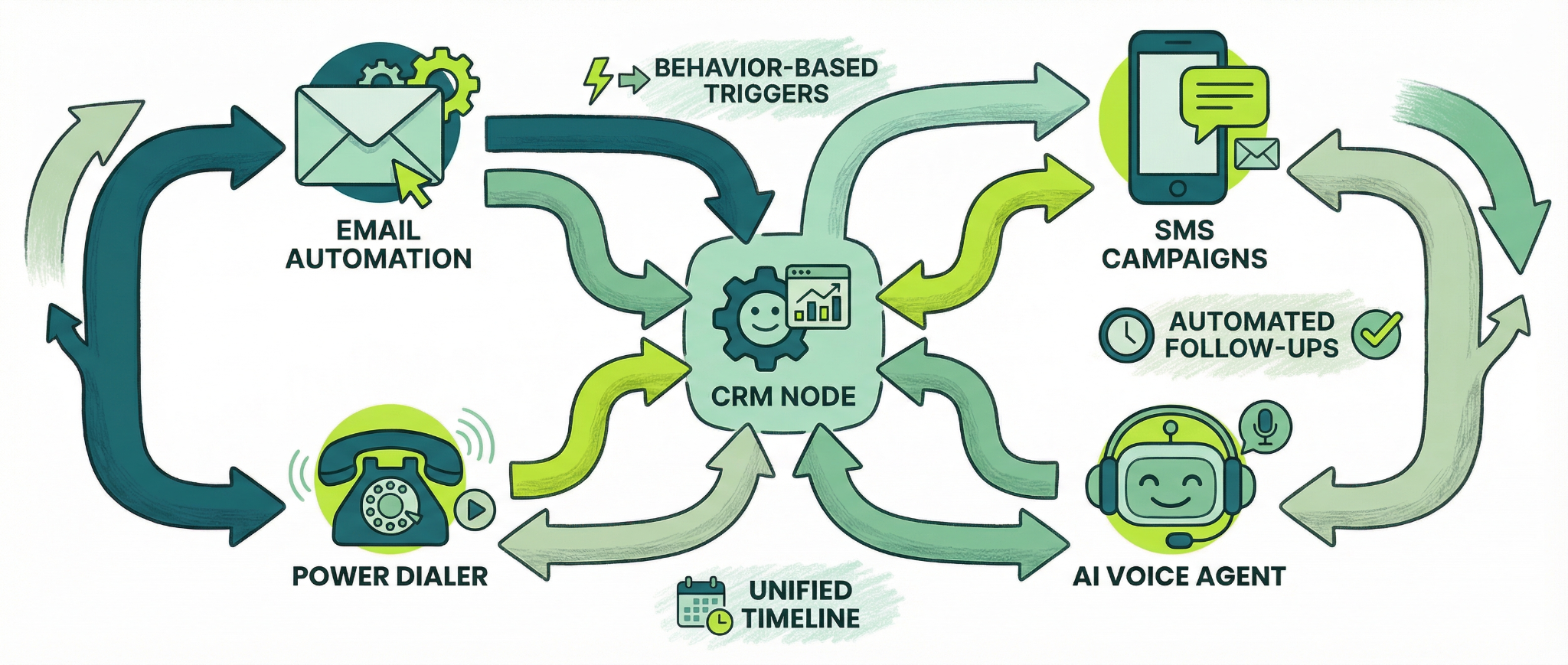
Email Automation
Email is still the backbone of most nurture sequences, and for good reason. It's great for delivering longer-form content like case studies, educational resources, and product comparisons.
Set up automated email sequences for key triggers:
- New lead captured → Welcome series (3-5 emails introducing your brand and value proposition)
- Visited pricing page → Send comparison content and ROI data
- Downloaded content → Follow up with related resources
- Demo completed → Send recap email + proposal
- Gone quiet for 14+ days → Re-engagement sequence
SMS Campaigns
Text messaging is the most underutilized channel in sales automation — and it's arguably the most effective for time-sensitive communication.
With business SMS tools, you can automate texts triggered by specific actions:
- Form submitted → Instant confirmation text: "Hey [Name], thanks for reaching out! A rep will call you shortly."
- Appointment booked → Reminder text 24 hours before and 1 hour before
- Missed call → Automatic text: "Sorry we missed you! When's a good time to call back?"
- Post-demo → Follow-up text with a link to book next steps
- Abandoned cart / stalled deal → Nudge text with urgency
Aloware's SMS sequences let you enroll contacts in multi-step text campaigns triggered by CRM actions, form submissions, or call outcomes. You can send bulk SMS campaigns to segmented lists while staying compliant with A2P 10DLC regulations — a critical requirement that many businesses overlook until they get their messages blocked.
Important: If you're sending business text messages in the United States, you need to register for A2P 10DLC. This is a carrier-mandated compliance framework that verifies your business identity and message use case. Skipping this step can result in blocked messages and fines. Aloware handles 10DLC registration and compliant calling as part of the platform.
Phone Automation
Phone calls convert better than any other channel — but they're also the hardest to scale manually. That's where automation comes in.
A power dialer automates the dialing process so your reps spend more time talking and less time punching in numbers. Instead of manually dialing 30-40 calls per day, a rep using a power dialer can reach 80-100+ contacts — with automatic call logging, voicemail drop, and disposition tracking built in.
Here's how phone automation fits into your funnel:
- Top of funnel: Power dial through cold or warm lead lists sourced from marketing campaigns
- Mid-funnel: Auto-call prospects who just opened an email or visited your pricing page
- Bottom of funnel: Trigger a call when a high-scoring lead takes a buying action (requested pricing, started a free trial)
With Aloware, reps can launch power dialer sessions directly from HubSpot contact lists or Salesforce views — and every call, recording, and outcome syncs back to the CRM automatically.
AI Voice Agents
This is the channel that's changing the game in 2026. AI voice agents handle phone conversations — qualifying leads, answering FAQs, routing calls, and even booking meetings — without a human on the line.
Think about the leads you're losing outside business hours. Someone fills out a form at 9 PM, but nobody calls until the next morning. By then, they've already talked to two competitors. An AI voice agent responds in seconds, anytime.
Aloware's Intelligent Voice Assistant (IVA) handles inbound calls with natural-sounding AI conversation. It can:
- Qualify leads by asking screening questions
- Answer common questions about pricing, features, and availability
- Route calls to the right department or rep based on caller intent
- Schedule appointments directly on your team's calendar
- Handle after-hours and overflow calls so you never miss an opportunity
And when a live rep is needed, IVA transfers the call seamlessly with full context — so the prospect doesn't have to repeat themselves.
Putting It All Together: A Sample Multi-Channel Sequence
Here's what an automated nurture sequence looks like when you combine all four channels:
This kind of multi-touch, multi-channel sequence dramatically increases your contact rate and keeps prospects warm throughout the buying process.
Step 5: Automate Follow-Ups Based on Behavior
Static, time-based sequences are a starting point — but the real power comes from behavioral automation. This means triggering specific actions based on what the prospect actually does.
Examples of behavior-based triggers:
- Missed call → Aloware's AI Missed Call Handler automatically sends a text to the caller: "Sorry we missed your call! Here's a link to schedule a callback: [link]"
- Visited pricing page 3+ times → Alert the assigned rep and trigger a phone call
- Opened proposal email but didn't sign → Send SMS reminder after 48 hours
- Demo completed, no follow-up action → Enroll in a 5-touch sequence mixing calls and texts
- Customer satisfaction survey response is negative → Route to account manager immediately
The key is connecting your communication tools to your CRM so that data flows in both directions. When a prospect takes an action in HubSpot, it triggers outreach in Aloware. When a call or text happens in Aloware, it logs back to HubSpot. This creates a closed loop where nothing falls through the cracks.
Step 6: Connect Everything to Your CRM
Your CRM is the single source of truth for your sales funnel. Every tool in your automation stack needs to feed data into it — and pull data from it.
Without proper CRM integration, you get data silos: your email tool has one set of engagement data, your phone system has another, and your SMS platform has a third. Your reps end up switching between tabs, manually logging notes, and losing track of where each prospect stands.
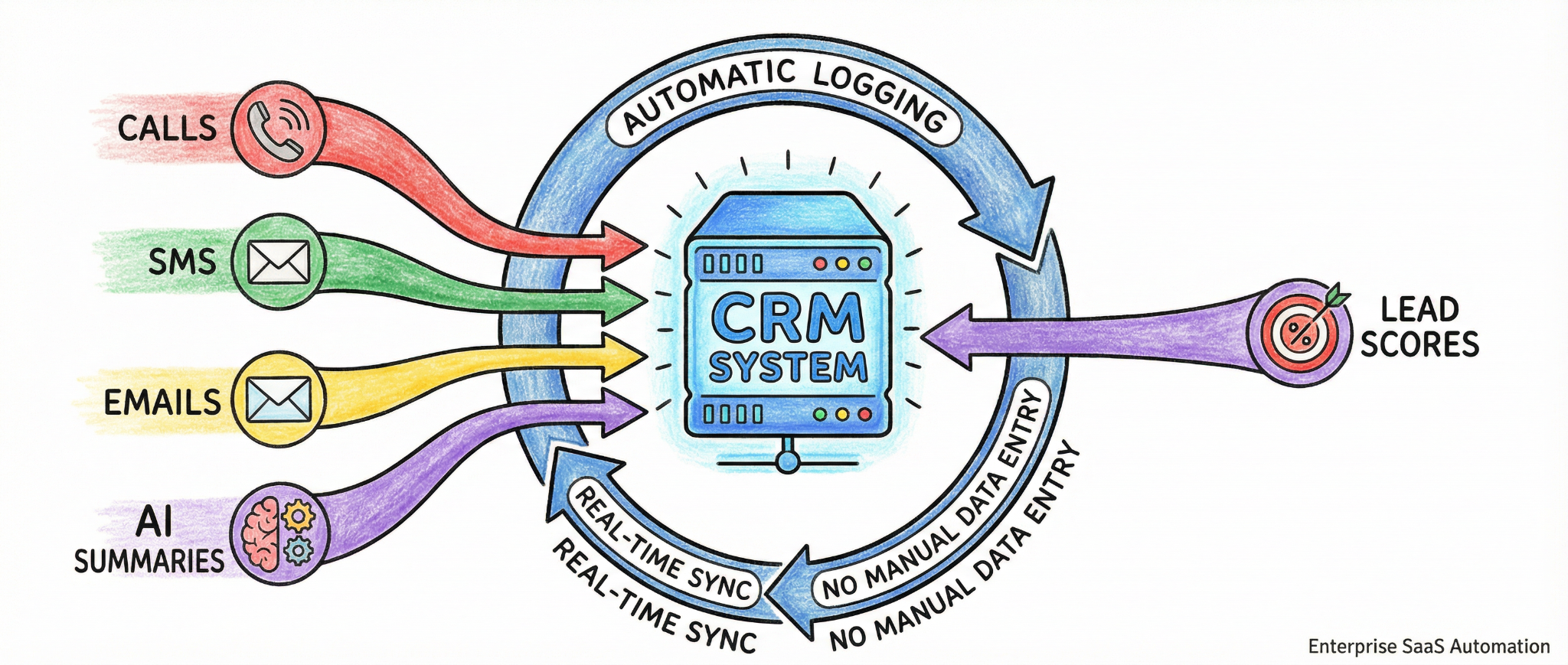
Aloware integrates natively with the CRMs most sales teams already use:
The goal is zero manual data entry. Every call made, text sent, voicemail left, and conversation recorded should automatically appear in the contact's CRM timeline. This gives reps complete context before every interaction and gives managers full visibility into pipeline health.
Step 7: Track, Analyze, and Optimize
An automated sales funnel isn't a "set it and forget it" system. The best-performing teams treat it as a living process that gets refined continuously.
Key metrics to track:
How to optimize:
- A/B test your messaging. Test different SMS copy, email subject lines, voicemail scripts, and call times. Small changes compound over time.
- Analyze by channel. If SMS follow-ups drive 3x the callback rate of email, shift more of your sequence to text. If morning calls connect better than afternoon, adjust your dialer schedules.
- Listen to your calls. Tools like Aloware's AI Conversation Intelligence transcribe calls and use AI to identify winning talk tracks, common objections, and coaching opportunities. Instead of guessing why deals stall, you can see exactly where conversations break down.
- Measure customer satisfaction. Use post-interaction CSAT surveys to track how prospects and customers feel about their experience. Low scores at specific funnel stages point to where your process needs work.
- Review weekly, optimize monthly. Check your funnel metrics weekly to spot anomalies, but make strategic changes monthly based on statistically meaningful data.
What Tools Do You Need for Sales Funnel Automation?
The best tool stack depends on your team size, budget, and which channels matter most to your business. Here's a breakdown by funnel function:
For teams that rely heavily on phone and SMS (sales teams, call centers, real estate, home services, financial services, recruitment), a platform like Aloware combines calling, texting, AI voice agents, and CRM integration into a single platform starting at $30/agent/month — instead of stitching together 5-6 different tools.
For teams that are primarily email-driven (SaaS, e-commerce, content marketing), tools like HubSpot, ActiveCampaign, or Mailchimp are strong choices for the email layer, while Aloware can handle the phone and SMS channels that email can't cover.
5 Common Mistakes That Kill Automated Sales Funnels
Even well-built funnels fail if you make these mistakes:
1. Only Automating Email
Email is one channel. Your prospects live across multiple channels — and they respond differently on each one. A prospect who ignores three emails might respond to a single text message in 30 seconds. If your funnel only sends emails, you're leaving 80% of your contact potential untapped. Build multi-channel sequences that combine email, SMS, phone, and AI voice.
2. Slow Response Times
Harvard Business Review research found that companies that contact leads within an hour are 7x more likely to qualify them than those who wait even one hour. Wait 24 hours, and your odds drop to nearly zero. Use automation — like Form2Call or AI voice agents — to eliminate response delays entirely.
3. Sending Generic, One-Size-Fits-All Messages
"Hi, thanks for your interest" is not a nurture strategy. Prospects expect personalized communication that reflects their specific situation, industry, and stage in the buying process. Use segmentation and behavioral triggers to tailor every message.
4. Ignoring Compliance
If you're making calls or sending texts to prospects, compliance isn't optional. A2P 10DLC registration is required for business SMS in the U.S. TCPA regulations govern how and when you can call. Branded calling helps ensure your caller ID displays your business name instead of an unknown number — increasing pick-up rates while maintaining trust. Ignore compliance and you'll face blocked messages, fines, and damaged sender reputation.
5. Not Connecting Tools to Your CRM
If your phone system, SMS tool, and email platform don't sync to your CRM, your reps are flying blind. They won't know what messages a prospect already received, what calls were made, or what stage the lead is in. Every tool in your stack needs to feed data into one central system.
What's Next: Build Your Automated Sales Funnel Today
Creating an automated sales funnel isn't a one-time project — it's an ongoing system that compounds over time. Every sequence you build, every trigger you configure, and every optimization you make creates a machine that generates revenue more efficiently than manual effort ever could.
The companies winning in 2026 aren't just automating email. They're building multi-channel funnels that combine phone, SMS, email, and AI to reach prospects wherever they are, whenever they're ready to engage.
If your team relies on phone and SMS as primary sales channels, Aloware gives you the complete toolkit — power dialer, SMS automation, AI voice agents, branded calling, and native CRM integration — in one platform, starting at $30/agent/month.
Book a demo to see how Aloware can automate your sales funnel from first touch to closed deal.
Start your free trial and build your first automated sequence today.
Frequently Asked Questions
What is an automated sales funnel?
An automated sales funnel is a technology-driven system that guides prospects through the buying journey — from initial awareness to final purchase — using automated tools instead of manual processes. It typically combines email sequences, SMS campaigns, phone automation (like power dialers), AI voice agents, lead scoring, and CRM workflows to capture, qualify, nurture, and convert leads with minimal human intervention for repetitive tasks.
What is the best software for sales funnel automation?
The best software depends on your primary sales channels. For teams that rely on phone and SMS outreach, platforms like Aloware offer power dialers, SMS sequences, AI voice agents, and native CRM integrations in one platform. For email-focused funnels, HubSpot, ActiveCampaign, and Mailchimp are popular choices. For AI-powered lead scoring and pipeline management, CRMs like Salesforce and HubSpot provide built-in automation. Most businesses benefit from combining a CRM with a multi-channel communication platform.
How much does sales funnel automation cost?
Costs vary based on team size and features. Here's a general range:
Can AI replace salespeople in the funnel?
No — and it shouldn't. AI handles repetitive, time-sensitive tasks that don't require human judgment: qualifying leads based on predefined criteria, sending follow-up messages, scoring prospects, routing calls, and booking meetings. But human reps are essential for complex conversations, objection handling, relationship building, and negotiation. The best approach in 2026 is AI + human, not AI versus human. AI handles the volume work so your reps can focus on the conversations that actually close deals.
How long does it take to set up an automated sales funnel?
A basic funnel with email and SMS automation can be operational within 1-2 weeks. A full multi-channel funnel — including power dialer configuration, AI voice agent training, CRM integration, lead scoring rules, and multi-step sequences — typically takes 4-8 weeks to build and optimize. The setup time depends on the complexity of your sales process, the number of tools being integrated, and how much existing content (emails, scripts, workflows) you have to work with.
What's the difference between a sales funnel and a marketing funnel?
A marketing funnel focuses on generating awareness and capturing leads — getting people interested in your brand through content, ads, and social media. A sales funnel picks up where marketing leaves off, focusing on qualifying, nurturing, and converting those leads into paying customers through direct outreach, demos, proposals, and closing conversations. In practice, the two funnels overlap significantly. Sales funnel automation often includes marketing activities (like email nurture) alongside sales-specific activities (like power dialing and proposal follow-ups).
How do I automate my sales funnel with HubSpot?
HubSpot provides built-in email sequences, lead scoring, and workflow automation. To add phone and SMS automation, you can integrate Aloware directly with HubSpot — enabling power dialer sessions from HubSpot contact lists, SMS steps inside HubSpot workflows, and automatic call/text logging in the HubSpot timeline. This gives you a complete multi-channel funnel without leaving your CRM.
What's the most important metric for an automated sales funnel?
Speed to lead — how quickly you respond to a new inquiry — is the single most impactful metric for most businesses. After that, focus on contact rate (are you actually reaching people?), conversion rate by channel (what's working?), and cost per acquisition (is your funnel efficient?). Avoid vanity metrics like open rates in isolation — always connect your metrics back to pipeline and revenue.
.png)

Ruby Kootval is Head of Product Marketing at Aloware. She has 12 years in digital marketing, including 8 in B2B SaaS and 5 in telecom, and writes about AI voice agents, dialers, CRM integrations, and contact center operations.