

.webp)
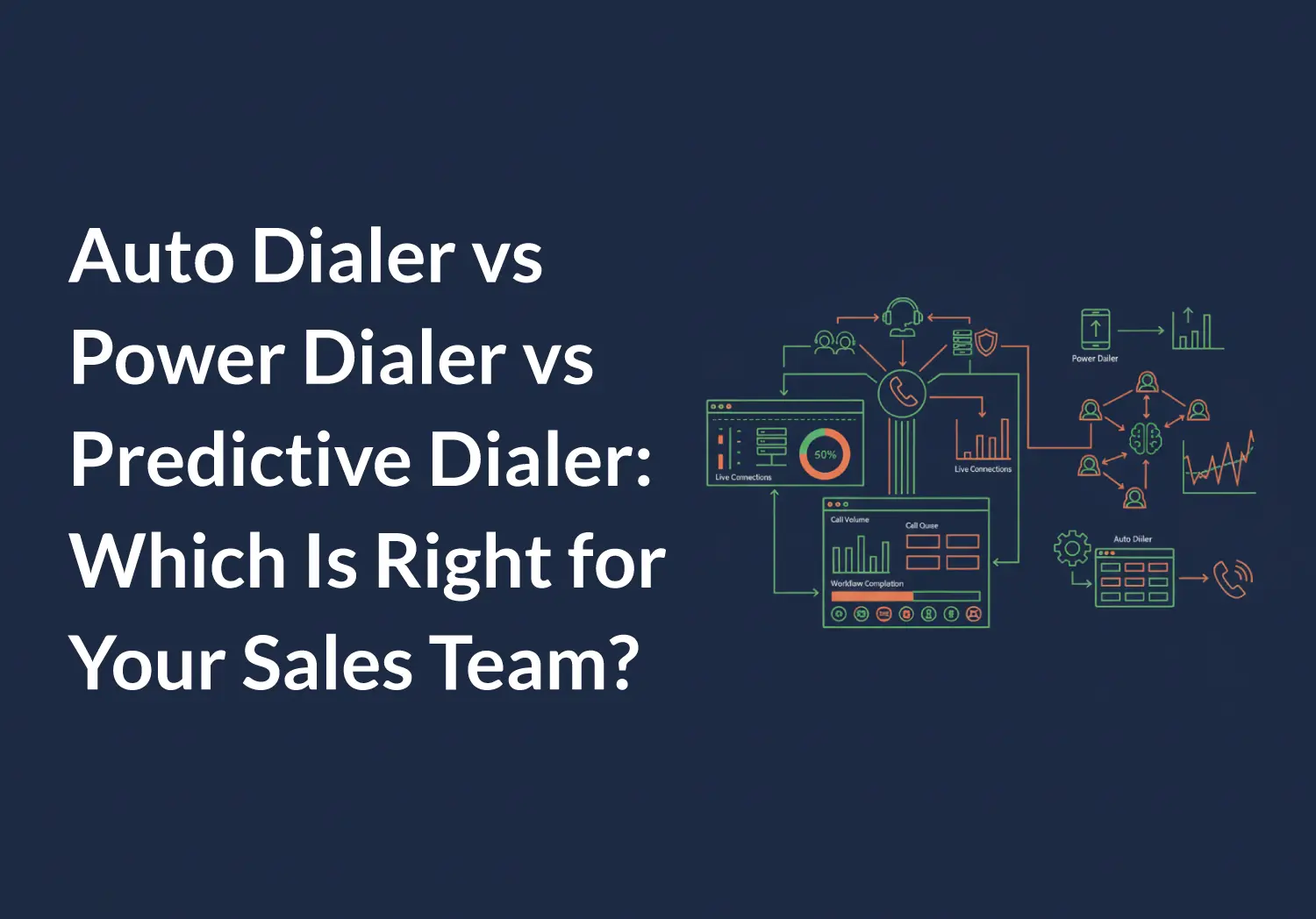
TL;DR: A Zoho dialer is software that works through a list of Zoho CRM contacts automatically, and that calling queue always runs in a product attached to Zoho CRM, never inside Zoho CRM itself. Zoho sells one, Zoho Voice, on a separate subscription wired in through Zoho Telephony (PhoneBridge), and third-party dialers connect the same way. So the buying decision is not whether to add a second product. It is which one, and how much of each conversation it writes back onto the Zoho record.
- What Zoho CRM does on its own: you can call a contact from a record. Working a list automatically is a job for an attached product, whether that is Zoho Voice or a third-party dialer.
- What the dialer does: holds the queue, dials one contact at a time, advances the moment a call ends, and puts a live rep on every answer.
- What syncs back: calls land in the Zoho contact's Activities, texts land in Notes, both appear on the Timeline, and the call detail carries a recording link and a call summary.
- The part buying guides skip: dial count is not the constraint. 86% of unknown calls go unanswered, so answer rate is a separate layer you buy separately.
- Plan note: the Power Dialer comes with uPro + AI and above. iPro + AI includes the Zoho integration but not the Power Dialer.
Your reps are not slow. Your list is unordered.
Watch a Zoho team run outbound for an hour. A rep opens a filtered list view, scans for a name they recognize, clicks the phone icon, waits, gets voicemail, hangs up, types a note, goes back to the list, and starts scanning again. Nobody is loafing. The motion itself is the problem: most of the hour goes to choosing and logging, and very little of it to talking.
In July we read 221 recorded sales calls, about 107 of them real prospect and customer conversations. Two complaints kept surfacing from CRM-centric teams, Zoho shops among them: reps retyping call notes because their dialer did not log to the CRM, and reps making manual calls through the CRM one record at a time. Neither team needed faster reps. They needed the queue taken off the rep.
The numbers around that admin drag are not soft. In a July 2026 Pipedrive survey of 1,000 working professionals, nearly 58% said they lose at least three hours a week to administrative work that pulls them directly off customer time, and 47.2% said follow-ups or CRM updates take more than 24 hours to complete. A day-old follow-up on a lead that raised its hand this morning is a cold lead.
This guide covers what a Zoho dialer actually is, what Zoho gives you natively, what a connected dialer adds, exactly what lands back in your Zoho records, and the one thing that decides whether any of it produces revenue. If you are still narrowing the field, our guide to how to pick a dialer that won't burn your numbers covers the category-level tradeoffs.
What is a Zoho dialer?
A Zoho dialer is software that places outbound calls to contacts in Zoho CRM and logs the results back to the Zoho record. The term covers two very different things, and conflating them is why buyers end up disappointed.
Dialing from Zoho is one call at a time, chosen by a human. You are looking at a record, you click a phone icon, a call goes out. Zoho CRM handles this through connected telephony, and so does every dialer in its ecosystem.
Dialing through a Zoho list is a queue. Contacts move from Zoho into a dialer, and the software works the list in order without the rep picking who is next or typing the number. This is power dialing, and it is a different product category. It is also the only one of the two that changes how many conversations a rep has in a day.
Does Zoho CRM have a built-in power dialer?
Not in Zoho CRM itself, and the distinction is worth getting right because it decides what you end up buying.
Zoho CRM handles calls through connected telephony, and that layer is built around calls that are already happening or already arrived. It has no calling queue that decides who to dial next.
Zoho does sell a power dialer. It sits in Zoho Voice, which Zoho describes as a cloud dialer that automates outbound calls and imports and consolidates contacts to remove wait time between calls. Zoho Voice is a separate product with its own subscription, and it connects to the CRM through Zoho Telephony, the PhoneBridge layer that also connects third-party telephony providers.
That holds no matter which vendor you pick: the calling queue always lives outside Zoho CRM. The decision is which product runs it, and how much of each conversation it puts back on the Zoho record. You can see how our own pieces attach on the Zoho integration page.
How does power dialing with Zoho actually work?
Most pages selling a Zoho dialer imply the calling queue lives inside Zoho CRM. It does not, Zoho Voice included, and expecting otherwise is what makes buyers feel misled after signing. There are three moving parts.
1. Zoho stays the record. Contacts and leads sync two ways between Zoho and the dialing platform, so the people you call are the people in your CRM, with current data. The synced field set is fixed: first name, last name, email, website, company, phone number, lead source, lead status, contact owner and contact notes. You choose whether new records land in Zoho's Contacts module or its Leads module.
2. The dialer runs the queue. The calling list is built and sorted inside the dialer. Aloware's Power Dialer works a list one contact at a time, so every record gets addressed and a rep is free the moment someone answers. One line, in order, no skipping the uncomfortable names. You can sort a list by column and that sort order becomes the dialing order, so an insurance agency can work by lead status while a staffing firm works by contact owner.
The gap most likely to bite you is how a Zoho list gets into the queue. Aloware documents a one-step import: in the Power Dialer, choose Add contacts, then Import from integration, and pick the Zoho custom view you want to work. What is not documented for Zoho is a live-syncing list of the kind HubSpot dynamic lists provide, where the queue refreshes itself as records change, so ask on the demo how a changed view gets back into the queue. Custom Zoho fields also sit outside the synced field set, so any sort you plan has to run on the standard fields listed above.
3. Everything writes itself back. Call and text activity logs into the Zoho record in real time, which is the half that kills the manual-entry complaint.
Know this before a demo, because it will come up. Aloware's in-session CRM view, where the rep sees the live CRM record, timeline and properties without leaving the call, exists for HubSpot, Salesforce and HighLevel. It is not available for Zoho today. For a Zoho team the dialer runs the queue and the write-back is automatic, but during the call the rep sees the Aloware contact record instead of the Zoho one. The step-by-step Zoho setup guide in our help center covers the connection itself.
What actually lands back in Zoho after the call?
This is the question to press hardest on, because "syncs with Zoho" is the vaguest phrase in the category. Here is the specific behavior, and it is worth checking line by line against any tool you evaluate.
Calls log into the Zoho contact's Activities. Texts log into the contact's Notes. Both surface on the Zoho Timeline. The call detail itself carries a call recording link and a call summary, written into the call's description field, so a manager reviewing a record sees what was said without opening another system. Lead statuses pull from Zoho into the dialer, so a rep working the queue sees the current status.
You also control what syncs. Filters cover direction (inbound or outbound), type (calls, SMS, RVM, email, notes, appointments, reminders), disposition status (completed, abandoned, missed, failed, placed), which contacts are included, which lines to skip, and a minimum call duration. That last one matters more than it sounds. Without a duration filter, every four-second misdial and dead-air hangup becomes an activity on a contact record, and six weeks later the Zoho timeline is noise nobody trusts. Set a minimum-duration floor and only calls long enough to be a conversation get logged, so the record stays readable and call reporting stops counting misdials as outreach.
The same before and after shows up in the rep's day. Before a queue, the bulk of a calling block goes to choosing who is next and typing up what just happened. After, both of those are handled and the same block is spent talking.
The compounding benefit is portability. Because activity is written into Zoho itself and does not live only in the dialer, an insurance agency or a real estate brokerage that later changes systems still has its call and text history sitting in the CRM.
A limit you will find eventually: texts are logged into Zoho, but you send them from Aloware, since Zoho gets no in-CRM messaging surface of the kind HubSpot has. If texting your Zoho contacts is central to the motion, read texting your Zoho contacts before you buy on the calling story alone.
Why dial volume is not your real constraint
Here is where most Zoho dialer guides stop, and it is the part that decides whether the purchase pays for itself.
A power dialer multiplies attempts. It does nothing to the percentage of those attempts that get answered. And that percentage is now the binding constraint: per Hiya's State of the Call 2026, 86% of unknown calls go unanswered. Triple the dials against that number and you have tripled voicemails.
Answer rate is its own layer, and it is built from three things that have nothing to do with dialing speed. Number reputation has to be monitored continuously, because a number that connects fine in week one decays as carriers accumulate signals about it. Branded calling puts your company name on the screen before the prospect decides. Local presence matches the outgoing area code to the person you are calling. At Aloware these are NumberGuard, Branded Calling and Local Presence, and together we call them the Pickup Stack.
The Pickup Stack is priced separately from your seat plan and is never bundled into it. It is also the part that makes the results hold: without it a fresh number connects for a few weeks, then reputation decays and pickup collapses. You buy it on top.
Vendors garble two mechanics here. STIR/SHAKEN authentication happens at the originating voice service provider, so no dialer "signs" your calls. And branded display and spam labeling are two separate carrier systems: getting your name to appear does not remove a "Spam Likely" tag, which is why reputation monitoring and branded display are bought together. Our breakdown of why your calls land in spam covers the carrier side in depth.
Key takeaway: a dialer buys you attempts. The carrier trust layer buys you conversations. Buying the first without the second is how teams end up with beautiful activity reports and a flat pipeline.
Why we don't offer a predictive or parallel dialer
Somewhere in your evaluation a vendor will offer multi-line dialing: three, five, ten simultaneous calls, connecting a rep only once a human says hello. On a spreadsheet it looks like the obvious upgrade. We do not build it, and the reason is mechanical.
Dialing ahead of your available reps means some answered calls have nobody to connect to. The person picks up, hears a beat of silence, and hangs up. That pattern, high volume plus dead air plus very short calls, is precisely the signature carrier analytics use to classify a number as a robocaller. The dialing strategy degrades the number reputation the whole operation depends on.
There is a regulatory edge too. Federal rules cap abandoned telemarketing calls at 3% of calls answered live by a person, measured over a 30-day period, and abandonment is a thing predictive dialing produces structurally. One-at-a-time power dialing cannot abandon a call, because the rep is already on the line.
Buyers whose single requirement is maximum simultaneous dials go with a vendor built for that, which is a reasonable choice for a low-value, high-volume list where the number burn is priced in. For a Zoho team calling qualified leads that cost real money to generate, burning the number that reaches them is the more expensive mistake. Aloware does support progressive dialing (enabled per account after vetting) and preview dialing through Sequences on uPro + AI and xPro + AI, if you want pacing between manual dialing and a full queue.
If you want to see this against your own Zoho data, book a 20-minute demo and we will run a list of your synced Zoho contacts through the Power Dialer and show you what lands back on the Zoho record.
What should you check before buying a dialer for Zoho?
Run this list on any demo, ours included. Every item is something teams discover after signing.
- Make them dial a real list, live. Not a slide. Load 20 of your own Zoho contacts and watch the queue advance between calls.
- Name the objects. Ask which Zoho object each activity type writes to. Calls to Activities and texts to Notes is a real answer; "full Zoho sync" is not.
- Open the record afterward. Go into Zoho and confirm the recording link and call summary are actually on the call, without anyone clicking save.
- Ask what syncs and what you can suppress. If you cannot filter by disposition and minimum duration, your CRM timeline will fill with misdials.
- Check the desktop requirement. Click-to-call from Zoho runs through the Aloware Talk desktop app with the rep logged into both systems. If your team is Chromebook-only or browser-only, surface that before rollout.
- Confirm the plan tier in writing. The Power Dialer is a uPro + AI feature and above, at $60 per user per month billed quarterly ($70 monthly), and it is included on the Startup packages. iPro + AI at $30 per user per month billed quarterly ($40 monthly) includes the Zoho integration but not the Power Dialer. This is the single most common surprise in this category.
- Price the answer-rate layer separately. Reputation monitoring, branded calling and local presence are add-ons. Get them quoted up front so the total is not a second conversation.
- Ask how numbers get rotated and remediated. Any vendor without a specific answer is selling you dial volume and leaving the consequences with you.
Fix the queue and the answer rate together
Zoho CRM is a capable system of record with capable connected telephony. The calling queue lives elsewhere. Once your team is working lists instead of individual records, you are running a division of labor whether you name it or not: Zoho holds the truth, a dialer holds the queue, and the integration is judged entirely by how much lands back on the record without anyone typing.
Get that architecture right and reps stop being list managers. Get the second half right, the part about whether anyone answers, and the extra conversations are real instead of theoretical. A dialer that triples your dials is worth nothing on numbers people decline. Fix the queue and the answer rate together, or you have automated your way to a bigger pile of voicemails.
Want to see it against your own pipeline? Book a 20-minute demo and we will connect Zoho, run a live call block over your synced contacts through Aloware's power dialer, and show you the Zoho record updating as the calls happen.

Frequently Asked Questions
Does Zoho CRM have a built-in dialer?
Zoho CRM handles calls through connected telephony, and that layer is built around calls that are already happening or already arrived, with no calling queue that works through a list on its own. Zoho does sell a power dialer, but it lives in Zoho Voice, a separate product with its own subscription that connects to the CRM through Zoho Telephony, the PhoneBridge layer that also connects third-party providers. The practical point for a buyer is that the calling queue always sits outside Zoho CRM. Your choice is which dialing product to attach, and how much of each conversation it writes back onto the Zoho record.
What is a Zoho power dialer?
A Zoho power dialer is software that works through a list of Zoho CRM contacts one call at a time, advancing automatically as each call ends, so a rep is live on the line the moment someone answers. It differs from clicking to call a single record because the queue and the dialing order are handled by the software instead of the rep. In practice it runs as a division of labor: Zoho remains the system of record and supplies the contacts, a separate dialing product holds and paces the calling queue, and the integration writes each call and text back onto the Zoho contact automatically. Note that a Zoho list view becoming a dialer campaign in one click is not a documented capability of the Zoho integration, the way HubSpot dynamic lists are for HubSpot; contacts sync first, then the calling list is built and sorted in Aloware.
Can Aloware dial from inside Zoho CRM?
Yes, for outbound calls. With the Aloware Talk desktop app installed and the user signed in to both Zoho CRM and Aloware Talk, a phone icon appears next to phone numbers in Zoho's Contacts, Leads and filtered list views. Clicking it opens the Aloware Talk dialer pre-filled with that number, and you place the call from there. Mac users may be prompted to choose Aloware Talk as the app that handles the call. Note that this covers outbound click-to-call; native inbound call handling inside the Zoho interface is not a documented capability of the integration.
Do calls and texts log automatically into Zoho?
Yes, in real time. Calls log into the Zoho contact's Activities and texts log into the contact's Notes, and both appear on the Zoho Timeline. The call detail itself carries a call recording link and a call summary written into the call's description field, so a manager can review what happened without leaving Zoho. You can also filter what syncs instead of logging everything, using direction, activity type, disposition status, which contacts are included, which lines to skip, and a minimum call duration so short misdials never reach the record.
What contact data syncs between Aloware and Zoho?
A fixed field set syncs two ways: first name, last name, email, website, company, phone number, lead source, lead status, contact owner and contact notes. Updates made in either system are mirrored in the other. An admin sets a default Zoho module that determines whether new records land in Zoho's Contacts module or its Leads module, and one-time push and pull actions move contacts in either direction during setup. Custom-field mapping is not a documented part of the Zoho integration, so if you rely on custom properties in your dialing workflow, confirm that specifically before rollout.
Which Aloware plan includes the Power Dialer?
The Power Dialer is included on uPro + AI at $60 per user per month billed quarterly, and on xPro + AI above it. It is also included on the Startup packages. It is not included on iPro + AI at $30 per user per month billed quarterly ($40 monthly), which does include the Zoho integration, calling and texting but not the Power Dialer. This is the most common surprise in this category, so confirm the tier in writing before you sign. The Pickup Stack features that protect your answer rate are add-on services priced separately from every seat plan.
Does Aloware offer a predictive or parallel dialer for Zoho?
No, and that is deliberate. Predictive and parallel dialing place more simultaneous calls than reps can take, which means some answered calls meet a beat of silence before anyone connects. High volume plus dead air plus very short calls is the exact pattern carrier analytics use to classify a number as a robocaller, so the dialing strategy erodes the number reputation your connect rate depends on. There is regulatory exposure too: federal rules cap abandoned telemarketing calls at three percent of calls answered live by a person over a 30-day period. Aloware does support progressive dialing (enabled per account after vetting) and preview dialing through Sequences on uPro + AI and xPro + AI.
Can I send SMS from inside the Zoho interface?
Sending a text from within the Zoho UI is not a documented capability of the Zoho integration. Texts you send through Aloware are logged into the Zoho contact's Notes and appear on the Zoho Timeline, so the conversation history lives in the CRM, but composing and sending from inside a Zoho record is not the same in-CRM messaging surface available for some other CRMs. If texting is central to your follow-up motion, raise it explicitly during evaluation instead of assuming parity with the calling integration.
Will a power dialer improve my connect rate?
Not by itself. A power dialer increases how many calls a rep places per hour; it does not change the share of those calls that get answered. Per Hiya's State of the Call 2026, 86% of unknown calls go unanswered, so tripling dials against an unprotected number mostly triples voicemails. Answer rate is a separate layer built from continuous number-reputation monitoring, branded calling so your company name appears before the prospect decides, and local presence so the area code matches the person you are calling. Budget for the dialer and that layer together, because the dialer alone will show more activity without more conversations.
What happens to our call history if we stop using Zoho?
It stays in Zoho. Because calls, texts, recording links and call summaries are written into the Zoho record as activity and do not live only inside the dialing platform, that history remains in Zoho as a record of what happened even if the business later migrates to a different CRM. This is a practical reason to insist on genuine activity write-back during evaluation instead of accepting a tool that keeps call history in its own separate reporting layer, where it is much harder to take with you.
.png)

Ruby Kootval is Head of Product Marketing at Aloware. She has 12 years in digital marketing, including 8 in B2B SaaS and 5 in telecom, and writes about AI voice agents, dialers, CRM integrations, and contact center operations.

-.webp)