

TL;DR
An AI call answering service uses a voice AI to pick up inbound calls, answer questions, qualify the caller, book a meeting, and log the whole thing to your CRM, so no lead hits a voicemail and disappears. We tested the seven best options for 2026 on call quality, CRM depth, setup, and real cost. Aloware ranks first for sales and support teams because the answered call becomes a CRM record and a booked meeting, not just a transcript.
- In Aloware's own platform data, only 43.09% of 6,780,095 inbound calls ended as a completed conversation. 19.44% were abandoned by the caller, 18.03% rang out as missed calls and 16.19% went to voicemail. Callers who hung up had waited 20.57 seconds on average.
- The right test for a sales team is not "how cheaply does it answer the phone": it is what happens to the conversation afterward.
- Aloware's AI call answering (the AloAi Voice Agent) is billed per minute from $0.10, separate from the $30/user/month platform seat.
- Most of these tools are built for solo operators and very small offices; Aloware is what a growing sales or support team moves to when those tools stop scaling.
- Native CRM sync (HubSpot, Salesforce, Pipedrive, Zoho, GoHighLevel) is the dividing line. Without it, "we have an AI receptionist" becomes "we have another inbox no one checks."
- Answering inbound is only half the math: when reps call leads back, the callback number has to actually get picked up.
- Aloware: best all-around AI call answering for mid-market sales and support teams; native CRM sync, AI Call Rescue for missed inbound, per-minute pricing from $0.10/min.
- Smith . ai: hybrid AI + human answering service.
- CloudTalk: AI call answering built into a full business phone system
- Goodcall: flat-rate AI receptionist for high call volume.
- Synthflow AI: no-code AI voice-agent builder.
- Posh: AI voice for multi-location operations.
- My AI Front Desk: appointment-focused AI receptionist.
If you manage a sales team, you know the quiet leak: a high-intent lead calls while everyone is on the phone, hits voicemail, and calls the next number on the list. They do not call back. An AI call answering service closes that leak by picking up every call, having a real conversation, and handing your team a qualified, logged lead instead of a missed-call notification.
But "AI receptionist" now covers everything from a $50 message-taker to a full contact-center voice agent. We spent several weeks running test calls through each platform: booking appointments, triggering transfers, and checking what actually landed in the CRM afterward. This guide ranks the seven best for 2026 and, more usefully, tells you which one fits a team that has outgrown a basic answering app.
One reframe before the list: most "best AI receptionist" roundups rank tools by how cheaply they answer a phone. For a sales team, that is the wrong question. The right question is what happens after the call. Does the conversation become a CRM record, a booked meeting, and a follow-up, or just a transcript you never open again?
Why AI call answering matters for sales and support teams in 2026
Buyers still call, and when no one answers they leave. In a recent CallRail survey of 1,000 U.S. consumers, 78% said they have abandoned a business after an unanswered call, and 82% said they will call a competitor if you do not pick up. The cost is measurable: Ambs Call Center puts the average direct cost of a single missed call at $12.15, and estimates that missing just two calls a day costs roughly $9,000 a year (Ambs Call Center, 2025). That cost compounds across every rep who is mid-call when the phone rings.
Our own numbers show where the leak sits. Across 6,780,095 inbound calls on the Aloware platform between 1 September 2025 and 31 August 2026, 43.09% ended as a completed conversation. The rest split five ways: 19.44% were abandoned by the caller before anyone picked up, 18.03% rang out as missed calls, 16.19% went to voicemail, 3.13% ended in a dead end and 0.12% failed. Callers who abandoned had waited 20.57 seconds on average, while answered callers had waited 29.78 seconds. The typical caller who gave up was gone before the typical answered call was picked up.
After hours, the gap widens. Among accounts set to Eastern time (3,209,996 inbound calls in the same window), 14.81% of calls arrived outside 8am to 6pm local time. Only 28.32% of those were answered, against 44.17% inside those hours. Teams already lean on AI for that shift: calls handled by an AloAi agent made up 5.91% of after-hours inbound calls, against 2.9% during business hours. Method: Aloware platform data, test and demo accounts excluded, each call counted once by its final system disposition; wait times are means, not medians.
The old fixes were a human answering service or a phone tree. Both have the same flaw: the caller gets parked, scripted, or sent to voicemail, and the context never reaches your CRM. An AI voice agent answers on the first ring, holds a real two-way conversation, books the meeting, and writes the outcome back to the contact record. If you are new to the category, start with our complete guide to AI voice agents for how the technology works under the hood.
Callers have also made their peace with an AI on the other end. In the same CallRail survey, 52% said a company using AI assistants after hours signals superior service, 50% said they would use AI to book an appointment (91% of Gen Z), and only 13% said they would not use AI for any task. The risk is no longer that an AI picks up. It is that nothing does.
Key takeaway: A missed call is not a logistics problem. It is a lost lead. AI call answering turns "we'll call you back" into a booked meeting before the caller reaches the next vendor.
What is an AI call answering service?
An AI call answering service is software that uses a voice AI to answer inbound phone calls in real time: understanding natural speech, answering questions from a knowledge base, qualifying the caller, taking actions like booking an appointment or transferring the call, and logging the conversation to your CRM. It is not an IVR phone tree and not a recorded message; it is a goal-driven conversation that adapts to what the caller says. You will see the same category sold as an AI answering service, an AI phone answering service, or an AI receptionist. Those names describe the same thing, and the differences that matter are in what the tool does after the call ends.
The difference from a traditional answering service is where the work goes. A human answering service takes a message and emails it to you. A legacy call center routes the caller through "press 1 for sales." An AI call answering service does the talking and the data entry. It captures the caller's intent, syncs the details to your CRM, and can hand a warm, qualified caller to a rep. For the full mechanics of voice versus text agents, see how AloAi voice and text agents work.
Key takeaway: AI call answering replaces both the message-taker and the phone tree. It answers, qualifies, acts, and logs, all in one conversation.
How we tested the AI call answering services
We evaluated each platform on the things a sales or support team actually feels in week one:
- Call quality and latency: does the AI sound natural, and does it respond fast enough that the caller does not talk over it?
- CRM depth: does the conversation become a real CRM record automatically, or does it need a separate Zapier step?
- Actions: can it book a meeting, transfer a live call, and route to the right owner, not just take a message?
- Setup: how long to a working agent, and how much of it needs a developer?
- Real cost: the all-in price once you account for usage, not just the sticker number.
What we did not test for: enterprise telephony certifications, contact-center seat licensing at large scale, or industry compliance posture. Those are sales-call questions, not blog claims. On two of the tools we tried, the AI booked the appointment fine but never wrote it back to the CRM without a separate automation step. That gap is the whole game for a sales team, so it weighed heavily in the ranking.
Quick comparison: AI call answering at a glance
The 7 best AI call answering services in 2026
1. Aloware: best all-around AI call answering for sales and support teams
Best for: mid-market sales and support teams running real call volume who need every answered call to become a CRM record, a booked meeting, and a follow-up.
Pricing: the platform starts at $30/user/month on the iPro + AI quarterly plan ($40 month to month). The Salesforce integration sits on xPro + AI, $85 per user per month on the quarterly plan. The AI call answering itself, the AloAi Voice Agent, is billed by usage, from $0.10/minute (Basic), with Premium ($0.20/min) and Ultra Premium ($0.50/min) model tiers. Plan minimums and activation terms are listed on the pricing page. Aloware also bundles 1,000 AI Voice Analytics minutes (transcription and conversation intelligence) into iPro + AI, a separate pool from the per-minute voice-agent rate, so do not confuse the two.
Free trial: 7 days, no credit card required.
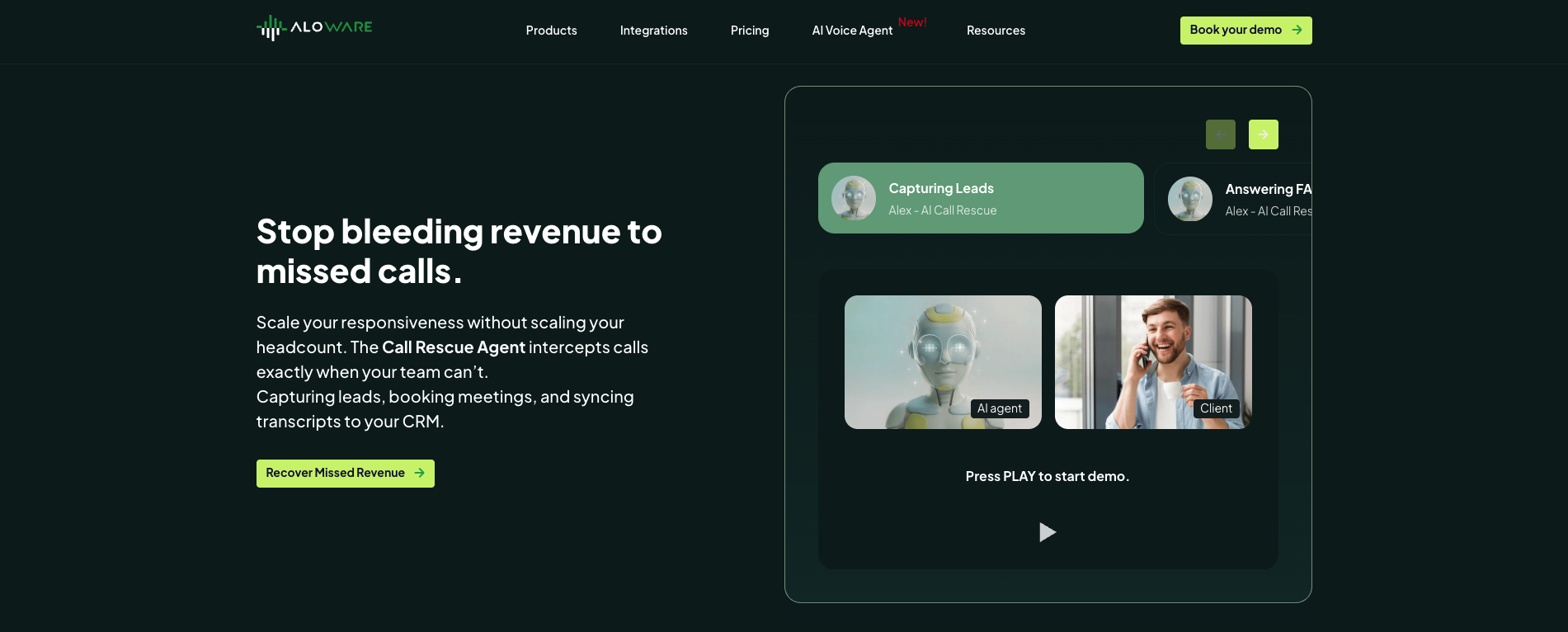
Why Aloware stands out is the after-the-call layer. The AloAi Voice Agent holds goal-driven conversations. You set the objective ("book a consultation"), and the agent figures out the steps instead of reading a rigid script. During the call it can capture and sync contact properties, book or reschedule appointments, transfer the call warm or cold, route to the HubSpot deal or contact owner, send an SMS mid-call, set dispositions, and summarize the conversation as a note on the timeline. That is the difference between an AI that answers and an AI that moves the deal forward.
Core capabilities:
- AI Call Rescue: an account-level toggle that routes every missed inbound call (from any line or ring group) to a system-managed voice agent that greets the caller, captures intent, and logs a transcript note.
- IVR-to-IVA wizard: turns a legacy "press 1 for sales" phone tree into a conversational AI assistant while preserving your routing, and it is reversible.
- Native CRM sync: writes to HubSpot, Salesforce, Pipedrive, Zoho, and GoHighLevel through in-conversation actions, not a bolt-on Zapier step.
- Knowledge base + live context: answers from your uploaded docs and FAQs, and pulls live HubSpot deal data into the conversation.
- Multi-language, transcription, and analytics built in, so the answered call feeds coaching and reporting.
Practical use case (legal intake): a law firm points its main line at an inbound AloAi Voice Agent. A potential client calls after hours about a case; the agent answers, asks the qualifying questions, captures the matter details, books the consultation on the assigned attorney's calendar, and logs everything to the CRM before anyone is back at a desk. The same pattern works in AI voice agents in insurance, where after-hours quote requests are pure lost revenue without it.
Pros: native CRM entity sync; AI Call Rescue for missed inbound; inbound, outbound, and missed-call handling in one platform; multi-language; transcription and analytics included; transparent per-minute pricing from $0.10/min.
Cons: Aloware is a full contact-center platform, so there is a learning curve on advanced workflow setup, mitigated by a free onboarding webinar for everyone and included agent training for larger teams.
When to choose Aloware: you are past the solo-receptionist stage, you live in a CRM, and you need the answered call to actually move through your pipeline.
See AloAi Voice Agent answer a real lead in under 60 seconds: book a 20-minute AloAi Voice Agent demo and we will customize it to your vertical.
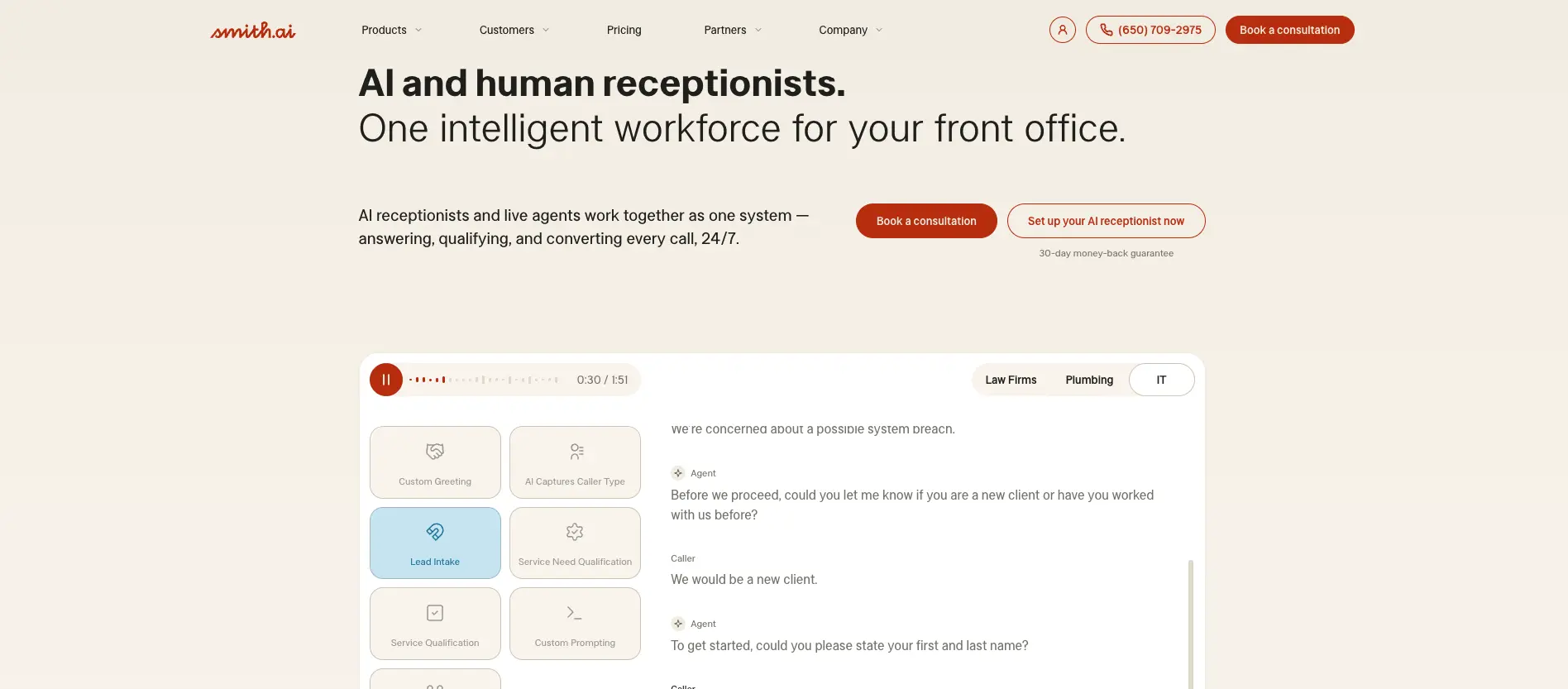
2. Smith . ai: hybrid AI + human answering service
We tested Smith.ai by running a sample intake through its hybrid answering flow. Smith.ai is a managed answering service that pairs AI with North America–based human agents for call answering, lead intake, and appointment booking, billed on a per-call or per-conversation basis.
Consideration: less suitable for teams running high-volume outbound, where per-conversation pricing and a human-in-the-loop model add cost and latency the team absorbs.
3. CloudTalk: AI call answering built into a full business phone system
We tested CloudTalk by pointing an inbound number at its AI voice agent and running a sequence of test calls through it. CloudTalk is an AI call answering service delivered inside a cloud-based business phone system; the AI voice agent picks up on the first ring 24/7, holds a real conversation, qualifies the caller, answers questions from a knowledge base, books meetings on connected calendars, and can transfer live to the right rep or team. Every answered call becomes a CRM record automatically, with native two-way sync to Salesforce, HubSpot, Pipedrive, Zoho, and 30+ other CRMs. The AI voice agent also handles outbound calls (speed-to-lead callbacks, appointment reminders, follow-ups), so inbound answering and outbound recovery run from one platform. Positioned for growing SMB and mid-market sales and support teams, with local numbers in 160+ countries. Its AI voice agents are a paid add-on, sold in monthly minute packages on top of the seat plan (CloudTalk pricing page, read 29 September 2026).
Consideration: less suitable for teams that want the AI answering billed by the minute they actually use. CloudTalk sells its AI voice agents as minute packages layered on the seat, so the AI line on the bill is a package size you pick ahead of time.

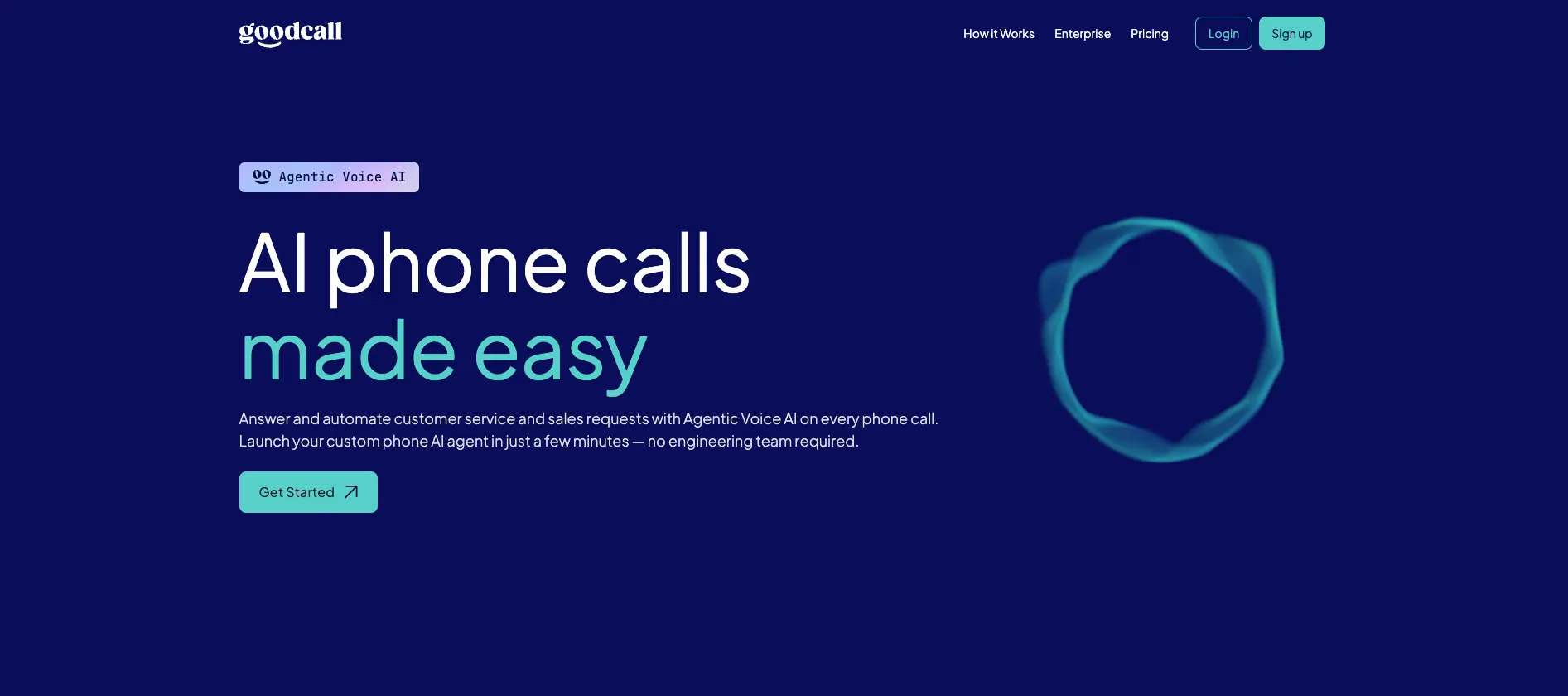
4. Goodcall: flat-rate AI receptionist for high call volume
We tested Goodcall by deploying a flat-rate AI receptionist on a service-business profile. Goodcall is an AI phone assistant built for local and service businesses, with template-driven setup for FAQs, call routing, and message capture. Its published plans are billed per agent per month with unlimited minutes, and each plan caps unique customers per month, with $0.50 charged for each customer above the cap (Goodcall pricing page, read 29 September 2026).
Consideration: less suitable for teams that need deep CRM workflow automation, outbound calling, and multi-team contact-center tooling.
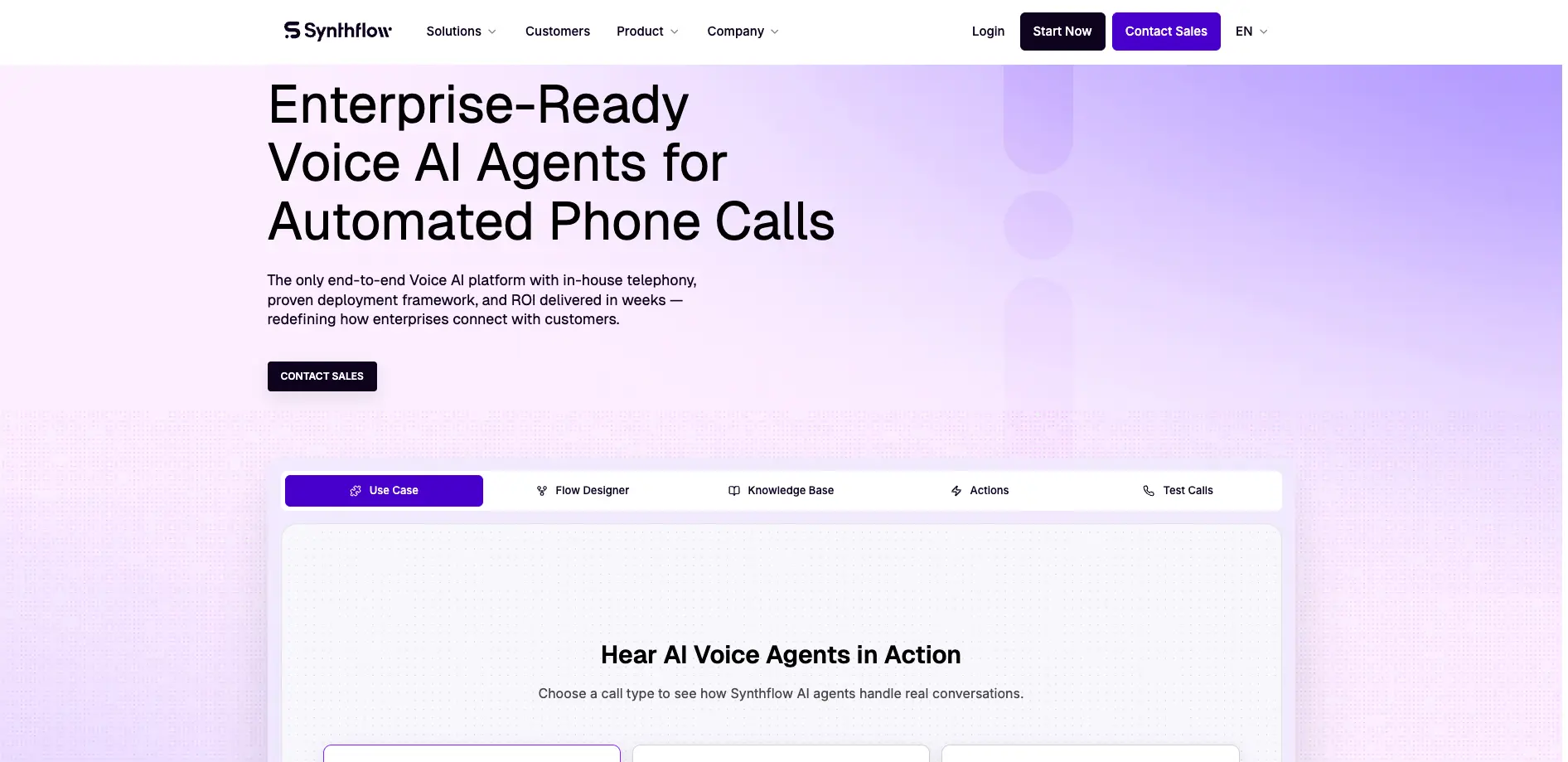
5. Synthflow AI: no-code AI voice-agent builder
We tested Synthflow by building a voice agent in its no-code editor and connecting it to a webhook. Synthflow is a no-code AI voice-agent builder for developers and agencies assembling custom voice workflows through APIs and integrations.
Consideration: less suitable for sales orgs that want a calling platform with a dialer, native CRM records, and analytics out of the box rather than an agent they assemble and maintain.
6. Posh: AI voice for multi-location operations
We tested Posh by reviewing its AI voice configuration for a multi-branch setup. Posh is an AI-driven voice and chat assistant rooted in the banking and credit-union space, positioned for multi-location organizations that need reception and routing across sites.
Consideration: less suitable for B2B sales teams that need outbound dialing, sequence automation, and per-minute AI voice-agent pricing tied to a CRM.
7. My AI Front Desk: appointment-focused AI receptionist
We tested My AI Front Desk by configuring an appointment-focused receptionist with a voicemail-style fallback. My AI Front Desk is an AI receptionist for appointment-heavy small businesses, with scheduling, FAQ answering, and voice options.
Consideration: less suitable for sales and support orgs that need CRM-native call logging, outbound campaigns, and contact-center analytics.
Key takeaway: Six of these seven are built to answer a phone for a small office. The line that separates them from Aloware is whether the answered call becomes structured pipeline, or just a message.
Feature comparison
What does AI call answering actually cost?
Sticker prices in this category hide the real number. Message-taking apps look cheap until you add per-minute or per-conversation usage, and human-backed services charge per call, which scales badly the moment volume climbs. For a benchmark, traditional human answering and virtual receptionist services commonly bill about $0.75 to $2.00 per minute (answering365, 2026 cost guide). With Aloware, the math is two clear lines: the platform seat (from $30/user/month, billed quarterly) and AI voice-agent usage (from $0.10/minute), with unanswered calls not billed beyond a small connection cost. There are no per-minute charges for your human reps' own calls to the US and Canada.
Here is the part most buyers miss: answering inbound is only half the math. When your reps call leads back, those calls have to actually get picked up, and most unknown calls are not: Hiya's State of the Call 2026 reports that 86% of unknown calls go unanswered. In a Twilio 90-day study across 720,000 calls, branded calls were answered 62% of the time versus 20% for un-branded calls, more than tripling pickup rates (Twilio, Feb 2024). If your callback number is unverified, carriers can flag it "Scam Likely." That is why callback numbers get flagged as spam, and it matters as much as the agent picking up.
Key takeaway: Price the whole loop: answer the inbound call, and make sure the callback gets picked up. A cheap answering app that ignores callback pickup rate is a false economy.
How do you choose the right AI call answering service?
Match the tool to the team, not the other way around:
- Solo operator or a very small office that just needs calls answered and messages taken: a budget AI receptionist is enough.
- Professional-services firm that wants a human safety net on every call: a hybrid service fits, if you can absorb per-conversation pricing.
- Developer or agency building bespoke voice flows: a no-code builder gives you the canvas.
- Mid-market sales or support team running real volume inside a CRM: you need native CRM sync, outbound plus inbound, live transfer, and analytics, which is where Aloware fits.
Key takeaway: The deciding question is not voice quality. Most tools sound fine now. It is whether the answered call lands in your CRM as structured, actionable pipeline.
Industry-specific recommendations
Legal firms and professional services: after-hours intake is the biggest leak. An inbound voice agent qualifies the matter and books the consult before a competitor's intake team opens.
Insurance and financial services: quote requests and renewal calls are time-sensitive; a voice agent captures the details and routes the warm caller to the right producer.
Home services and contractors: calls come in while crews are on a job. AI Call Rescue catches every missed call so the booking does not go to the next contractor.
Real estate: speed-to-lead decides who gets the showing; an agent that answers instantly and books the tour wins the lead.
E-commerce and retail: high inbound volume on order and returns questions is where a multi-language voice agent deflects the routine and escalates the rest.
Key takeaway: Across verticals the pattern is identical: the team that answers and books first keeps the lead. AI call answering lets a growing team answer like one several times its size.
Bottom line: which AI call answering service should you choose?
If you are a solo operator who needs a phone answered, a budget AI receptionist will do the job. But if you run a sales or support team and you live in a CRM, the cheap answer costs you later, when the booked meeting never reaches your pipeline and the callback never gets picked up. Aloware is the one tool on this list built for the whole loop: answer the call, qualify the lead, book the meeting, sync it to the CRM, and make sure the callback connects. That is why it is our pick for mid-market sales and support teams in 2026.
See AloAi Voice Agent answer a live call
Watch AloAi Voice Agent answer a real lead in under 60 seconds, from missed call to booked meeting, logged in your CRM. Book a 20-minute AloAi Voice Agent demo and we will tailor it to your vertical.
Frequently Asked Questions
What is an AI call answering service?
An AI call answering service uses a voice AI to answer inbound phone calls in real time. It understands natural speech, answers questions from a knowledge base, qualifies the caller, takes actions like booking a meeting or transferring the call, and logs the conversation. Unlike a recorded message or a phone tree, it holds a real two-way conversation and adapts to what the caller says, and unlike a human answering service, it does the data entry too, syncing the call details to your CRM automatically.
How is an AI call answering service different from a traditional answering service?
A traditional answering service uses human operators to take a message and email or text it to you. An AI call answering service has the conversation itself: it answers instantly, qualifies the caller, can book an appointment or transfer a live call, and writes the outcome to your CRM. The practical differences are cost behavior (AI is usually per-minute or subscription rather than per-call human labor), availability (24/7 with no staffing), and data (the conversation becomes a structured record, not just a message slip).
Will callers know they're talking to an AI?
Modern AI voice agents sound natural and respond fast enough to hold a normal conversation, so many callers do not immediately realize it. Best practice (and the safer posture) is to be transparent that the caller is speaking with an automated assistant. A well-configured agent answers questions, captures details, and hands off to a human when the conversation needs one, so the experience feels like a capable receptionist rather than a frustrating phone tree.
Can an AI call answering service book appointments and transfer calls?
Yes. A capable AI voice agent can book, reschedule, or cancel appointments on a connected calendar, and transfer a live call, warm or cold, to a specific user, team, or line. With Aloware's AloAi Voice Agent, it can also route the caller to the HubSpot deal or contact owner, send an SMS mid-call, set a disposition, and summarize the conversation as a note on the contact's timeline, so the booked meeting and the context land in the CRM together.
How much does AI call answering cost with Aloware?
Aloware's platform starts at $30 per user per month on the iPro + AI quarterly plan ($40 month to month), and the Salesforce integration sits on xPro + AI at $85 per user per month on the quarterly plan. The AI call answering capability, the AloAi Voice Agent, is billed by usage, from $0.10/minute on the Basic tier, $0.20/minute Premium, and $0.50/minute Ultra Premium. Unanswered or voicemail calls are not billed beyond a small connection cost. There is a 7-day free trial, no credit card required, and plan minimums are listed on the pricing page. The 1,000 minutes some plans mention are for AI Voice Analytics (transcription), not voice-agent calls.
Can AI call answering integrate with my CRM?
Yes, and CRM depth is the most important thing to check. Aloware syncs natively with HubSpot, Salesforce, Pipedrive, Zoho, and GoHighLevel through in-conversation actions, so the AI updates contact properties, logs the call, and can pull live HubSpot deal data into the conversation. Many lighter tools only connect through a webhook or Zapier, which means the appointment can get booked without ever writing back to the CRM unless you build and maintain a separate automation.
What happens when the AI can't answer a question?
A well-configured AI voice agent recognizes when it is out of depth and escalates instead of guessing. It can transfer the call to a live rep, route to the right owner, capture a callback request, or take a detailed message and log it. With Aloware you define the fallback behavior, and every conversation is transcribed and summarized to the contact record, so a human picking up later has the full context rather than starting cold.
Can AI answer calls outside business hours and in other languages?
Yes. AI call answering runs 24/7, which is where much of its value comes from: after-hours and overflow calls are usually pure lost revenue otherwise. Aloware's AloAi Voice Agent supports multiple languages and accents, including English and Spanish and a multilingual mode, so a single agent can handle callers in different languages and still log everything to the same CRM record.
Do I need technical skills to set one up?
No coding is required for the mainstream tools. Setup is mostly writing the agent's instructions (its goal, tone, and what to ask), connecting your calendar and CRM, and pointing a phone line at the agent. Aloware adds a wizard that converts an existing IVR phone tree into a conversational agent while preserving your routing. Deeper customization (custom CRM workflows or API calls mid-conversation) has a learning curve, but a working agent does not require a developer.
Can an AI call answering service handle outbound calls too, not just inbound?
Some can. Most budget AI receptionists are inbound-only. They answer the phone and take messages. Aloware handles inbound, outbound, and missed calls: an outbound AloAi Voice Agent can call leads back, run speed-to-lead callbacks, and follow up, while AI Call Rescue catches missed inbound calls automatically. For sales teams, outbound matters because answering the call is only half the job: getting your callbacks picked up is the other half.
.png)

Ruby Kootval is Head of Product Marketing at Aloware. She has 12 years in digital marketing, including 8 in B2B SaaS and 5 in telecom, and writes about AI voice agents, dialers, CRM integrations, and contact center operations.
.webp)