

IVR vs IVA has become a defining question for enterprises modernizing their telephony stack.
For decades, Interactive Voice Response (IVR) systems relied on keypad-based menus—“Press 1 for Sales, Press 2 for Support”—to route calls efficiently. This DTMF-based architecture was designed for stability and predictability, and it succeeded at call distribution. It was never designed to resolve problems.
As customer expectations shift toward faster, more conversational experiences, that limitation is becoming untenable. Salesforce predicts that by 2027, AI will handle 50% of all customer service interactions, signaling a structural shift from call routing to call resolution. Gartner similarly reports that the majority of customer service organizations are actively piloting or deploying conversational GenAI, reflecting accelerating adoption across enterprise environments.
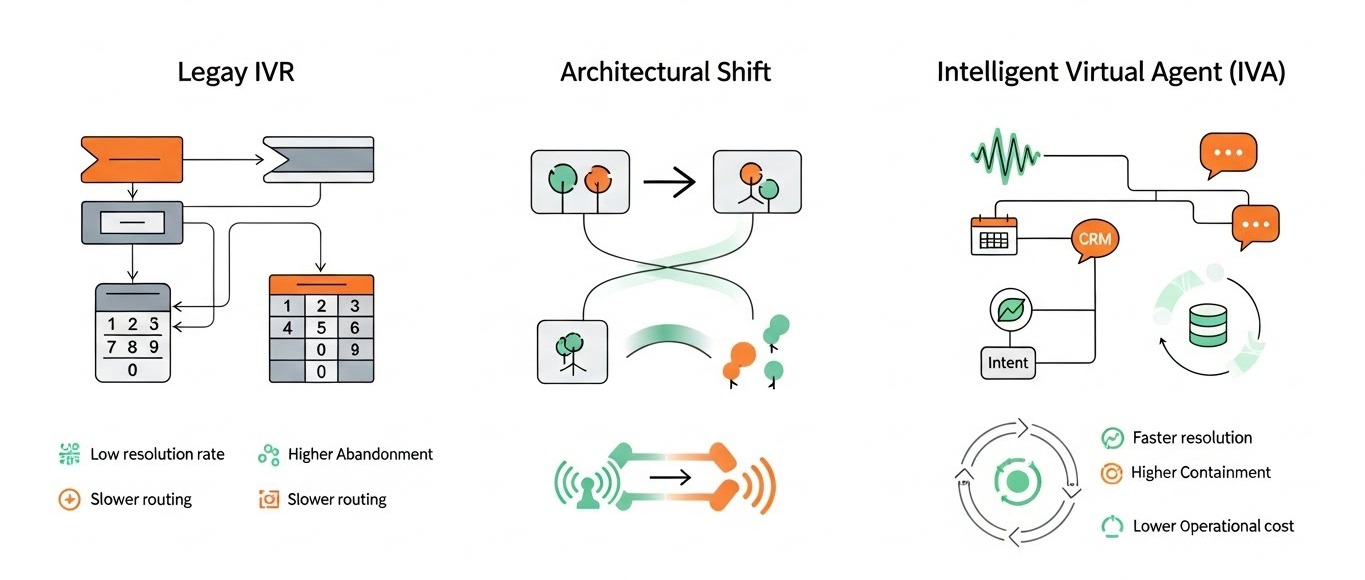
Intelligent Virtual Agents (IVAs) represent a fundamental architectural shift. Instead of forcing callers through rigid decision trees, IVAs use natural language understanding to identify intent, access enterprise systems, and resolve requests in real time. This transition—from IVR to IVA—is not simply a UX upgrade, but a redefinition of how voice infrastructure operates at scale.
This guide explains the technical differences between IVR and IVA, where IVAs deliver measurable business impact, and how enterprises can migrate safely from legacy IVR without disrupting live operations. The implication is clear: voice is not going away—but menu-driven telephony is.
This guide explains:
- What an Intelligent Virtual Agent (IVA) actually is
- How IVA architecture differs fundamentally from legacy IVR
- Where IVAs deliver the highest business impact
- How enterprises can migrate safely—without risking uptime or call flow integrity
1. What Is an Intelligent Virtual Agent (IVA)?
An Intelligent Virtual Agent (IVA) is an AI-powered voice system that understands natural speech and can complete tasks autonomously—rather than forcing callers through keypad menus or static call trees.
IVR vs. IVA: The Core Architectural Difference
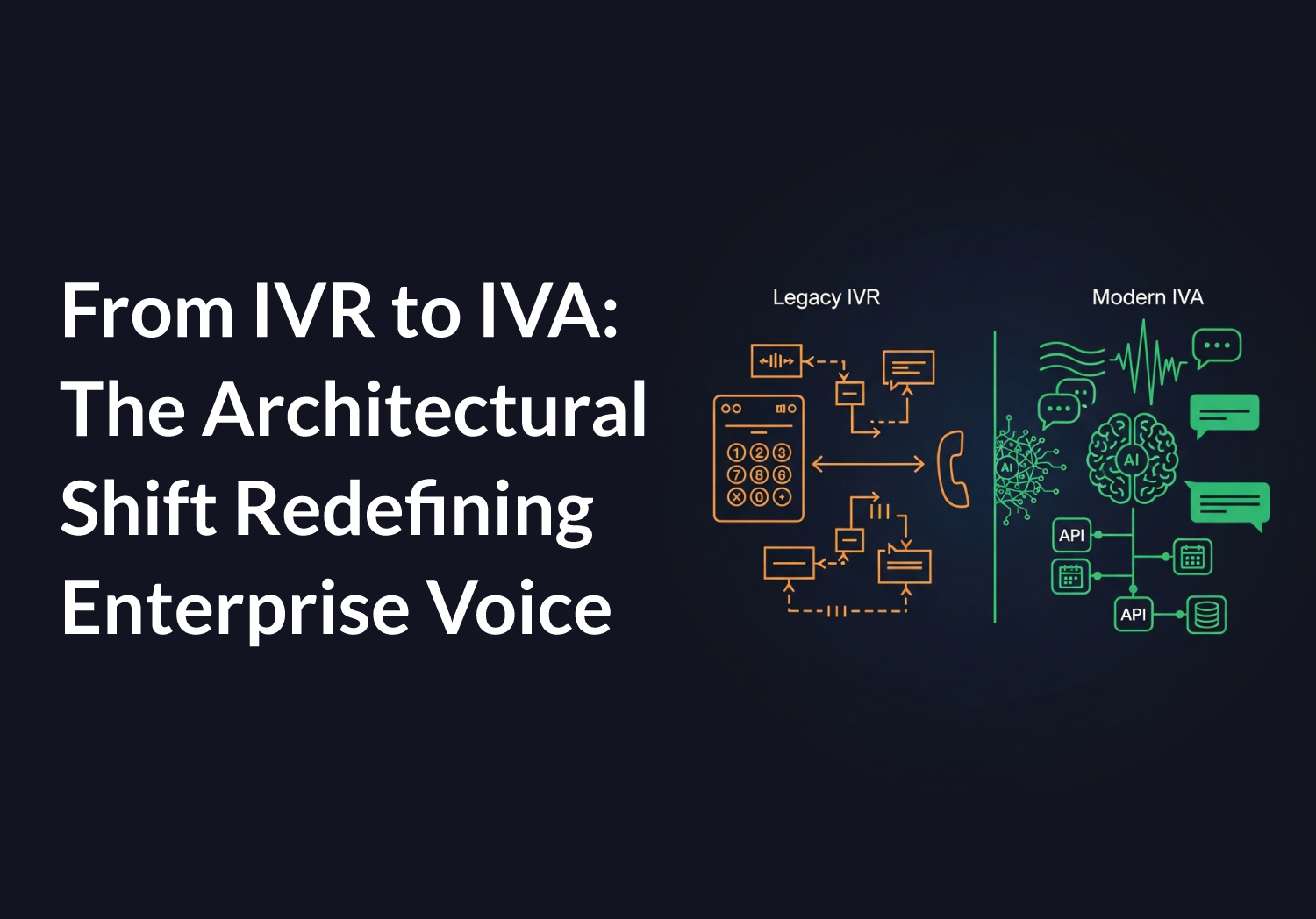
The difference between IVR and IVA is not cosmetic. It is architectural.
- IVR is based on signal detection
Callers press digits. The system reacts. - IVA is based on intent recognition
Callers speak naturally. The system understands meaning, context, and desired outcomes.
This shift—from detecting inputs to interpreting intent—is what enables IVAs to resolve issues instead of merely routing them.
2. The Standard IVA Architecture
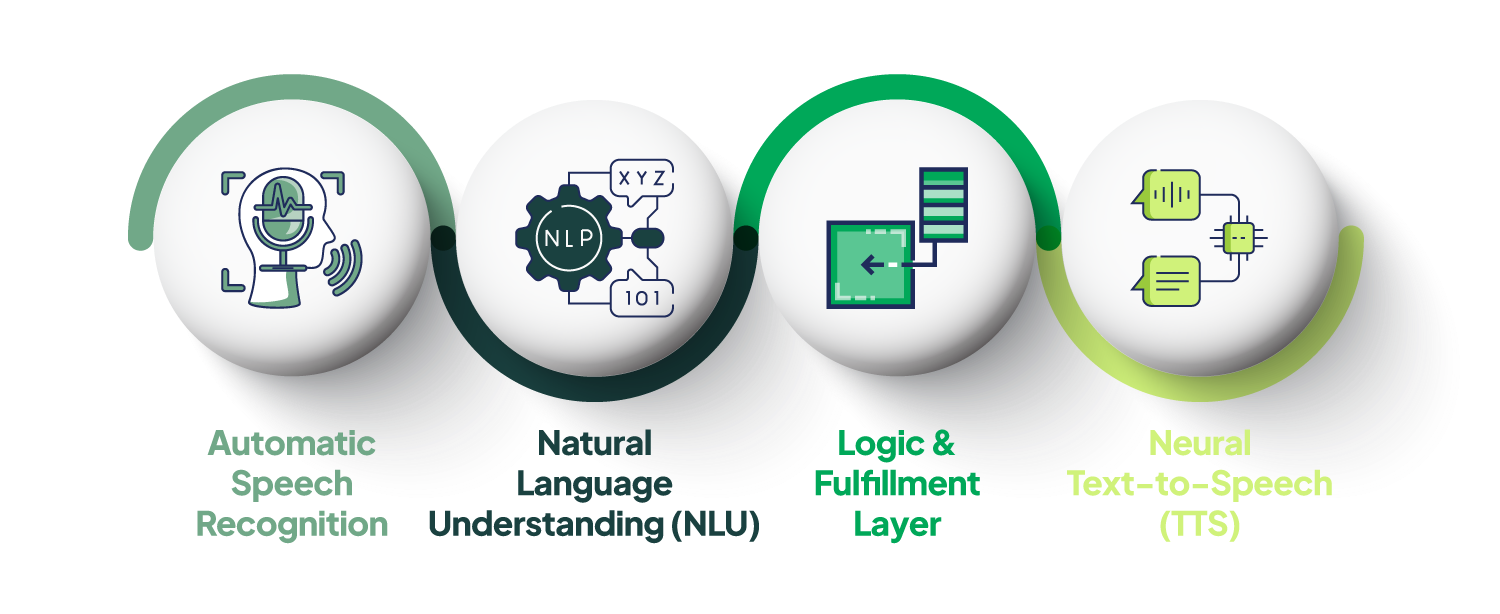
As of 2026, a production-grade IVA follows a consistent architectural pattern. While implementations vary, this four-layer pipeline has become the industry standard.
1. Automatic Speech Recognition (ASR)
Purpose: Convert live audio into text in real time.
Modern IVA platforms use neural ASR models capable of handling accents, background noise, and conversational speech. In favorable conditions, these systems achieve near-human transcription accuracy and support real-time interaction through streaming audio pipelines (e.g., SIP/RTP with streaming inference layers).
Why it matters:
Accurate transcription is the foundation for everything that follows.
2. Natural Language Understanding (NLU)
Purpose: Determine what the caller means, not just what they say.
Legacy systems relied on keyword spotting. Modern IVAs use large language models to extract:
- Intent (what the caller wants to do)
- Entities (dates, names, symptoms, order numbers, locations)
- Context (what has already happened in the conversation)
Example:
“I’m not sure I want to keep this subscription anymore.”
This is correctly classified as Churn Risk, even without the word “cancel.”
3. Logic & Fulfillment Layer
Purpose: Connect conversation to action.
This layer integrates the IVA with enterprise systems such as:
- CRMs (HubSpot, Salesforce)
- Scheduling tools
- Databases
- Case management systems
At this stage, the IVA stops being conversational and becomes operational—executing API calls, updating records, and triggering workflows.
4. Neural Text-to-Speech (TTS)
Purpose: Convert responses back into natural-sounding voice.
Modern enterprises now expect neural voice synthesis that includes:
- Natural pacing
- Breath pauses
- Pitch variation
- Human-like prosody
This reduces caller fatigue and increases trust—particularly in longer interactions.
3. High-Impact IVA Use Cases
IVAs deliver the most value when they handle decision-heavy, time-sensitive, or repetitive interactions.
Below are use cases where enterprises consistently see measurable gains.
A. Healthcare: Patient Triage & Call Prioritization
Problem: High call volume obscures clinical urgency.
IVA Workflow:
- Verifies patient identity
- Analyzes spoken symptoms
- Detects urgency signals
- Routes emergencies directly to clinical staff with full context
Result:
Critical cases bypass general queues, while routine requests are handled autonomously—improving safety and staff efficiency.
B. B2B Sales: Inbound Lead Acceleration
Problem: Inbound interest decays rapidly.
IVA Workflow:
- Identifies caller intent immediately
- Checks CRM context in real time
- Routes high-intent prospects directly to the correct sales owner
Result:
Faster response times and higher conversion rates—one reason CX leaders report strong ROI from GenAI-driven call handling.
C. Property Management & Field Services
Problem: After-hours emergencies get buried in voicemail.
IVA Workflow:
- Detects emergency language
- Identifies on-call staff
- Dispatches alerts via SMS
- Confirms action to the caller
Result:
Faster resolution, reduced escalation failures, and better tenant experience.
D. Legal & Professional Services
Problem: High-value professionals lose time to routine status inquiries.
IVA Workflow:
- Authenticates caller
- Queries case data
- Delivers factual updates
- Offers follow-up via SMS
Result:
More billable hours preserved, without degrading client experience.
E. E-commerce: Order Resolution & Support Deflection
Problem:
High volumes of order-related calls overwhelm support teams, especially during peak sales periods.
IVA Workflow:
- Identifies the caller using order number or phone match
- Retrieves order, payment, and shipment status in real time
- Resolves common requests (order status, delivery updates, address changes) autonomously
- Escalates exceptions or high-value orders to a live agent with full context
Result:
Lower inbound support volume, faster issue resolution, and improved post-purchase experience—without increasing support headcount.
4. When to Use IVR vs. IVA (Decision Framework)
IVR is still appropriate when:
- Call flows are extremely simple
- No data access is required
- Caller expectations are minimal
- Cost sensitivity outweighs experience
IVA is the better choice when:
- Callers ask open-ended questions
- Context matters
- Data lookups or actions are required
- Speed, containment, and experience drive ROI
For most enterprises, IVA now serves as the first line of engagement, with humans handling only escalated or complex cases.
5. Migrating Safely from Legacy IVR to IVA
The primary barrier to IVA adoption is not technology—it is risk.
Enterprise administrators cannot afford broken call flows or downtime. Modern migration strategies address this directly.
The Safe Migration Model
- Ingest existing IVR prompts (audio or scripts)
- Convert menu logic into intent-based rules
- Deploy in draft or shadow mode
- Test internally without affecting live traffic
- Activate with instant rollback available
This approach treats the existing IVR as a blueprint, not a system to discard.
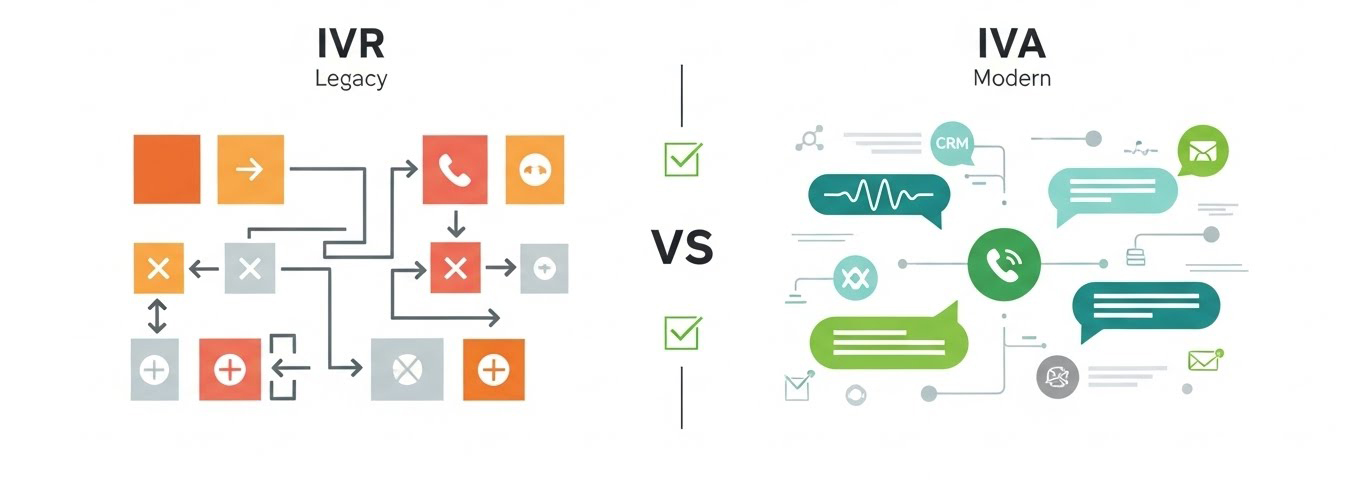
6. Legacy IVR vs. IVA
| Capability | Legacy IVR | Intelligent Virtual Agent |
|---|---|---|
| Input | Keypad (DTMF) | Natural speech |
| Logic | Static decision tree | Semantic intent mapping |
| Context | Stateless | Context-aware |
| Data access | None | CRM & API connected |
| Resolution | Rare | Common |
| Experience | Menu fatigue | Conversational |
| Scalability | Linear | Elastic |
7. The Future of Voice Architecture
Voice remains the most trusted channel for complex issues—especially in regulated or high-stakes environments.
The future architecture is hybrid:
- IVAs handle authentication, data gathering, and tier-one resolution
- Humans handle exceptions, judgment calls, and relationship-building
By the time a human joins the call, they are speaking to an informed, verified, and prepared customer.
That is the real promise of IVA:
not replacing people, but protecting their time.
Aloware is preparing to release its upcoming Intelligent Virtual Agent (IVA), designed to support enterprises transitioning from traditional IVR-based call handling to conversational voice architecture. The solution is being developed with a focus on intent recognition, real-time interaction with telephony infrastructure, and deep integration with CRM and operational systems.
Rather than replacing existing call flows abruptly, Aloware’s IVA is intended to work alongside legacy IVR environments, enabling controlled, reversible migration and incremental adoption
Frequently Asked Questions
What is the difference between IVR and IVA?
IVR (Interactive Voice Response) routes calls using keypad inputs and fixed menus.
IVA (Intelligent Virtual Agent) understands natural speech, detects caller intent, and can complete tasks or resolve issues without human intervention.
Can an IVA integrate with enterprise systems like CRMs and databases?
Yes. Enterprise IVAs are API-connected and can read from and write to systems such as CRMs, scheduling tools, and internal databases in real time. This allows the IVA to retrieve account details, update records, book appointments, and trigger workflows during the call.
Is migrating from IVR to IVA risky for live call operations?
No—when done correctly. Modern IVA platforms support draft or shadow deployment modes, allowing teams to test AI call handling without affecting live traffic. Most systems also include instant rollback options to revert to legacy IVR if needed.
How does an IVA handle security, authentication, and compliance?
Enterprise-grade IVAs support secure caller verification through data matching (such as account details or date of birth) and integrate with compliance controls for standards like HIPAA, SOC 2, and PCI. Sensitive data can be redacted from transcripts, and all interactions are logged for auditability.
What metrics should enterprises use to measure IVA success?
Key metrics include call containment rate, reduction in average handle time (AHT), speed to resolution, escalation accuracy, and customer satisfaction (CSAT). Many organizations also track cost per resolved call and intent-level resolution rates to quantify ROI.
What happens if the IVA cannot understand the caller?
IVAs use confidence thresholds to detect uncertainty. If the system cannot reliably determine intent, it automatically escalates the call to a human agent and passes the full conversation context, preventing callers from repeating themselves.
.png)

Ruby Kootval is Head of Product Marketing at Aloware. She has 12 years in digital marketing, including 8 in B2B SaaS and 5 in telecom, and writes about AI voice agents, dialers, CRM integrations, and contact center operations.
%20(1).webp)