

Your connect rates are down. Your texts are going unread. And your team is frustrated.
It’s the nightmare scenario for any Sales Director: you invest in a lead list, craft the perfect outreach sequence, and hit "send", only to find that your messages are landing in the "Junk" folder or, worse, being actively reported by customers.
When a customer hits "Report Junk," it’s not just a lost lead. It’s a strike against your brand’s reputation with carriers like AT&T and T-Mobile. Enough strikes, and your entire number gets burned.
The solution isn't just "better copywriting." To stop customers from marking your texts as spam in 2025, you must solve the root cause: Identity Crisis.
How do I stop my texts from going to spam?
To stop customers from marking your texts as spam, you must move beyond standard numbers and adopt Verified Identity. By upgrading to RCS (Rich Communication Services) or a Dedicated Shortcode, your messages arrive with your brand name and logo displayed, proving legitimacy before the customer even opens the text. Combine this with strict A2P 10DLC registration to ensure carriers recognize your traffic as valid business communications.
The Root Cause: Why Do People Hit "Report Junk"?
It’s rarely because they hate your product. It’s because of Stranger Danger.
When a lead receives a text from an unknown 10-digit number that says "Hey, saw you were interested in...", their brain instantly categorizes it alongside the scam texts they get about extended car warranties.
- The "Unsolicited" Reflex: Without a brand name attached to the number, you look like a bot.
- The Filter Feedback Loop: When one user marks you as spam, carriers use that data to block you for other users. It is a viral death spiral for your deliverability.
To fix this, you need to prove you are who you say you are before they read the message.
The Technical Solution: Verified Identity (The Aloware Mix)
You cannot rely on luck to get into the inbox. You need infrastructure that signals trust. While standard 10DLC is the baseline, businesses facing high spam complaints should upgrade to Verified Identity.
Here are the three tiers of verification Aloware offers to immunize your numbers against spam reports.
1. The Baseline: A2P 10DLC (Start Here)
If you are sending texts from a local number without A2P 10DLC registration, you are likely already blocked.
- Best for: 2-way conversational texting and local presence.
- The Aloware Fix: The Compliance Wizard. Instead of navigating complex carrier forms, Aloware’s in-app wizard walks you through brand registration step-by-step. This ensures you never route traffic through "grey routes" that get flagged instantly.
2. The Trust Upgrade: RCS & Branded Texting (Recommended)
- What is RCS (Rich Communication Services)? Think of RCS as "SMS 2.0." It upgrades standard text messaging into a rich, app-like experience on the user's phone. Unlike standard SMS, which only supports text and links, RCS supports high-res images, carousels, and—most importantly—verified sender profiles.
- Why you should switch: This is the ultimate weapon against spam reports. RCS (Rich Communication Services) replaces the cryptic phone number with your Brand Name, Logo, and a Verified Checkmark right in the inbox.
- The Impact: Users literally cannot mistake you for a random spammer because the verified shield is visible. It changes the interaction from "Who is this?" to "Oh, it's [Company Name]."
- The Aloware Fix: RCS Broadcasting. We enable you to send rich media, carousels, and fully branded texts that feel like an app experience.
3. The Volume Upgrade: Dedicated Shortcodes
- Why you should switch: If you are sending thousands of alerts or notifications, local numbers look suspicious to carriers. A 5 or 6-digit number (e.g., 223-45) signals that you are a large, vetted organization.
- The Impact: Scammers don't use Shortcodes because they are expensive and rigorously vetted. When a customer sees a Shortcode, they subconsciously signal "safe/institutional," dramatically reducing spam reports.
- The Aloware Fix: Dedicated Shortcode Provisioning. We handle the 6-8 week vetting process for you, leasing a dedicated number that is exclusive to your brand.
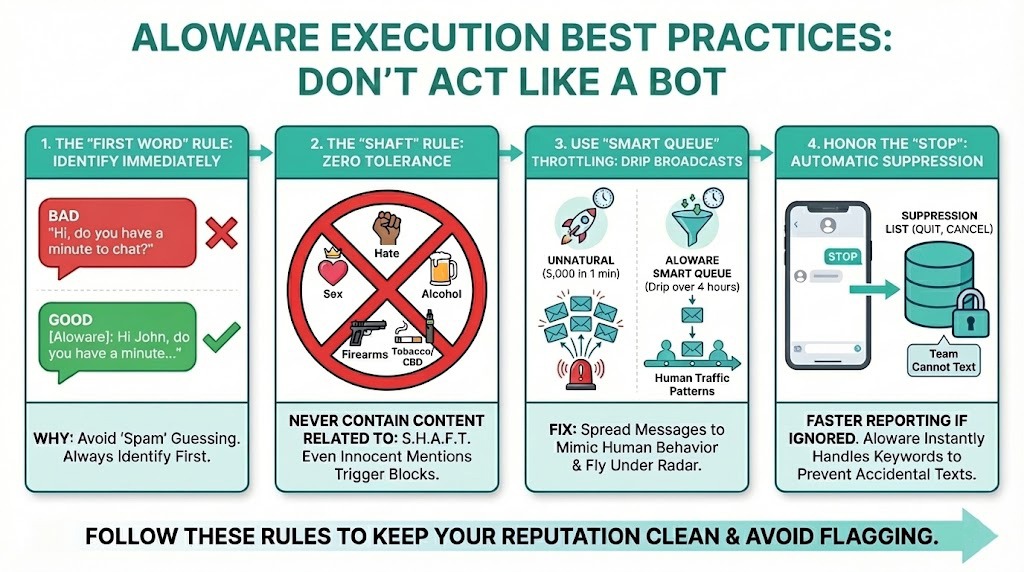
Execution Best Practices: Don't Act Like a Bot
Even with Verified Identity, you can still get flagged if you act like spam. Follow these execution rules inside Aloware to keep your reputation clean.
1. The "First Word" Rule
If you aren't using RCS, you must identify yourself immediately.
- Bad: "Hi, do you have a minute to chat?"
- Good: "[Aloware]: Hi John, do you have a minute..."
- Why: If the user has to guess who you are, they will guess "Spam."
2. The "SHAFT" Rule
Carriers have a zero-tolerance policy for specific topics. Ensure your scripts never contain content related to Sex, Hate, Alcohol, Firearms, or Tobacco (including CBD/Vaping). Even innocent mentions can trigger a carrier-level block.
3. Use "Smart Queue" Throttling
Sending 5,000 texts in one minute is unnatural behavior that triggers carrier alarms.
- The Aloware Fix: Use Aloware’s Smart Queue to "drip" your broadcasts. Spread your 5,000 messages over 4 hours. This mimics human traffic patterns and flies under the carrier's radar.
4. Honor the "STOP"
There is no faster way to get reported than texting someone who already opted out. Aloware automatically handles keywords like STOP, QUIT, and CANCEL, instantly adding them to a suppression list so your team cannot accidentally text them again.
Stop Playing Guessing Games with Deliverability
Don't let your legitimate sales outreach get treated like a scam. It’s time to upgrade your infrastructure.
Whether you need the authority of a Shortcode, the verified trust of RCS, or just a clean A2P 10DLC registration, Aloware has the toolkit to get your messages read.
Frequently Asked Questions
Can I remove a spam report on my text number?
No. Once a user marks a message as spam, that data is sent to the carrier and cannot be undone. This is why prevention (using RCS or Shortcodes) is the only viable strategy.
Does RCS improve text deliverability?
Yes. Because RCS requires deep business vetting (verifying your EIN, address, and use case), carriers trust this traffic significantly more than standard SMS, leading to higher inbox placement.
What is the difference between Shortcode and 10DLC?
10DLC is a standard 10-digit local number (good for 2-way conversation). A Shortcode is a 5-6 digit dedicated number (best for high-volume alerts and one-way notifications). Shortcodes generally have higher throughput limits than 10DLC.
.png)

Ruby Kootval is Head of Product Marketing at Aloware. She has 12 years in digital marketing, including 8 in B2B SaaS and 5 in telecom, and writes about AI voice agents, dialers, CRM integrations, and contact center operations.