

TL;DR: SMS marketing achieves a 98% open rate and delivers a $71 return for every $1 spent. Success requires proper Application-to-Person 10-Digit Long Code (A2P 10DLC) registration (a process that verifies business messaging through standard phone numbers), explicit opt-in consent, strategic message timing (9 AM-12 PM and 5-9 PM on weekdays), personalization, and frequency management (1-2 messages weekly). Critical compliance includes adherence to the Telephone Consumer Protection Act (TCPA), automated opt-out processing, and maintaining proof of consent. Top-performing strategies include automated flows (which generate 30 times more revenue than one-off campaigns), audience segmentation, two-way conversational messaging, and integration with Customer Relationship Management (CRM) systems. Avoid common mistakes such as excessive messaging frequency, unclear sender identification, and non-mobile-optimized landing pages. The most effective approach combines SMS for immediacy with email for detailed content.
What is SMS Marketing?
SMS marketing is sending promotional or transactional text messages to customers who have explicitly opted in to receive communications from your business. Messages deliver directly to recipients' lock screens with near-instant visibility, creating an unmatched direct communication channel that doesn't compete with email inboxes or social media algorithms.
Why SMS Marketing Delivers Exceptional Results in 2026
SMS marketing generates exceptional returns because it reaches customers where they already are. Americans check their phones 96 times daily and respond to text messages within 90 seconds on average. Messages achieve a 98% open rate compared to email's 21% average.
The channel delivers measurable revenue impact. Businesses report $71 average return for every $1 spent on SMS marketing, with conservative estimates ranging between $21-$41 ROI per dollar invested. 72% of consumers have made purchases after receiving brand text messages, and 86% made multiple purchases via SMS in the past year.
The most successful businesses use SMS for time-sensitive offers, appointment reminders (reducing no-shows by 80%), order updates, and exclusive promotions that create urgency and drive immediate action.
SMS vs Email Marketing: Understanding the Differences
While both channels drive revenue, their strengths differ significantly. Understanding when to use each maximizes marketing effectiveness.
Performance Comparison Table
| Metric | SMS Marketing | Email Marketing |
|---|---|---|
| Open Rate | 98% | 20-21% Source: OptiMonk |
| Read Time | Within 3 minutes | Hours to days |
| Click-Through Rate | 19-36% | 0.77-4.36% Source: OptiMonk |
| Response Rate | 45% | 6-10% Source: OptiMonk |
| Conversion Rate | 21-32% | 12-15% Source: Omnisend |
| Opt-Out Rate | Under 3.5% | 1.35% Source: Omnisend |
| Character Limit | 160 (SMS) / 1600 (MMS) | Unlimited Industry Standard |
| Average Response Time | 90 seconds | 90 minutes Source: Mozeo |
| Cost per Message | $0.01–$0.05 | $0.10–$0.30 Industry Average |
| Best Use Case | Urgent, time-sensitive offers | Detailed content, storytelling |
| Performance Data | n/a | |
When to Use SMS
SMS excels for immediate engagement and time-sensitive communications. Use SMS when you need recipients to take action quickly: flash sales, appointment reminders, abandoned cart recovery, order status updates, limited-time offers, two-factor authentication, or urgent customer service updates.
When to Use Email
Email works best for detailed information that doesn't require immediate action. Choose email for comprehensive product launches, monthly newsletters, educational content, detailed product information, complex promotions with multiple offers, visual-heavy content, or long-form storytelling.
The Most Effective Strategy
87% of SMS subscribers also receive emails from the same brands, demonstrating that these channels complement rather than compete. The winning approach integrates both: use email for detailed product information and brand storytelling, then follow with SMS for time-sensitive reminders and urgent calls-to-action.
Essential SMS Marketing Compliance: Non-Negotiable Requirements
Compliance protects your business from fines up to $1,500 per violation while ensuring message deliverability. Four requirements are mandatory before sending any campaign.
1. Obtain Explicit Written Consent
Federal law requires explicit written consent before sending promotional SMS. Your opt-in process must clearly state subscribers will receive marketing messages and provide easy opt-out instructions.
Best practice: Implement double opt-in where subscribers confirm signup by replying "YES" after initially providing their phone number. This protects your business and ensures genuine interest while improving campaign performance.
Acceptable opt-in methods include:
- Website forms with clear SMS opt-in checkboxes
- Text-to-join keywords (text "JOIN" to receive offers)
- QR codes linking to opt-in landing pages
- Point-of-sale signup during checkout
- Voice call consent with recorded agreement
2. Complete A2P 10DLC Registration
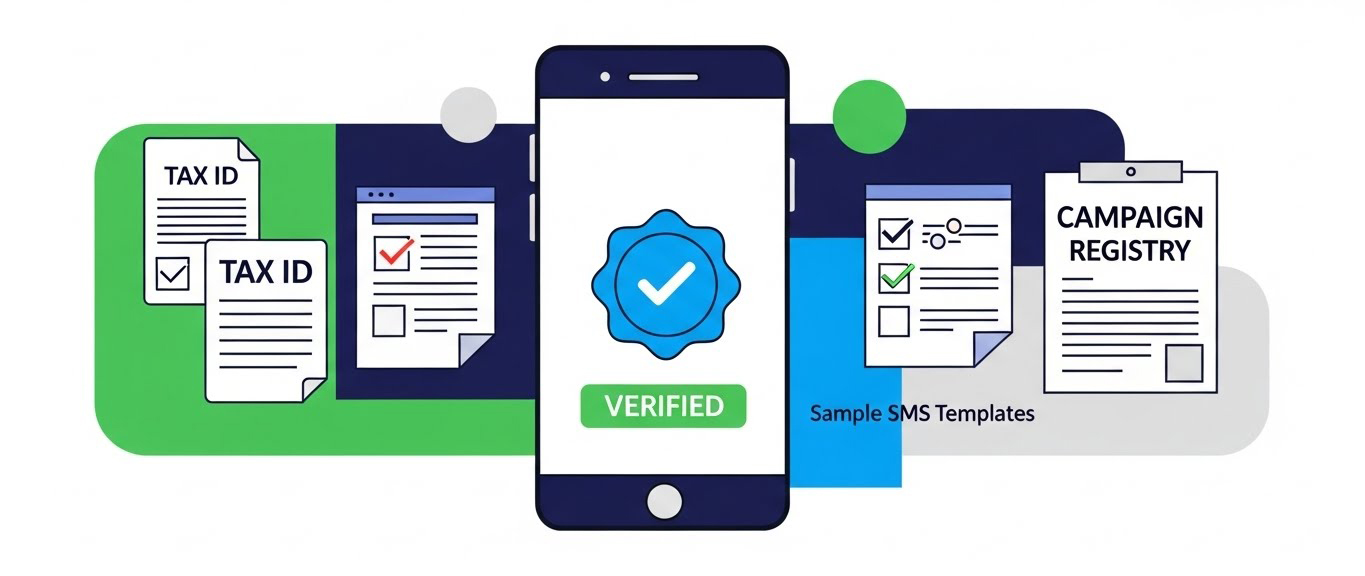
Application-to-Person 10-Digit Long Code registration is mandatory for businesses sending SMS from standard phone numbers to U.S. recipients. A2P 10DLC verifies business identity through The Campaign Registry, improving message deliverability and compliance.
Registration requires:
- Valid business tax ID (EIN)
- Working business website with published privacy policy
- Detailed campaign use case description
- Sample message templates
- Documentation of opt-in collection methods
Unregistered traffic faces severe consequences: blocked messages, throttled delivery (limiting messages per second), carrier-level filtering preventing texts from reaching customers, and potential fines. Most messaging platforms handle registration on your behalf, though approval typically takes 1-5 business days.
Registration process:
- Brand registration (verifying business legitimacy)
- Campaign registration (specifying messaging use cases)
- Number assignment (linking phone numbers to approved campaigns)
3. Follow TCPA and CTIA Guidelines
The Telephone Consumer Protection Act and Cellular Telecommunications Industry Association standards govern all commercial texting.
Key requirements:
- Contact customers only between 8 AM-9 PM in their local time zone
- Include clear opt-out instructions in every promotional message
- Process opt-out requests immediately (within minutes, not days)
- Maintain separate consent for transactional vs promotional messages
- Store proof of consent with timestamps for every subscriber
- Never share subscriber lists with third parties without explicit consent
4. Maintain Opt-Out Compliance
Your SMS platform must automatically process opt-out keywords including STOP, UNSUBSCRIBE, CANCEL, END, and QUIT. Include opt-out instructions at least once monthly in promotional messages: "Reply STOP to opt out. Msg & data rates may apply."
When someone opts out, immediately stop all promotional messages to that number. You may send one final confirmation message confirming their opt-out request, then remove them from all marketing lists.
Core SMS Marketing Best Practices for Maximum Engagement
Keep Messages Concise and Action-Oriented
Effective SMS messages contain 160 characters or less for standard SMS (1,600 characters for MMS). Lead with value in the first five words. Your offer, discount, or key benefit drives whether recipients continue reading or ignore your message.
Character count best practices:
- State the offer immediately (first 5-7 words)
- Include one clear call-to-action
- Add opt-out instructions
- Use shortened URLs to save characters
- Consider MMS for content requiring more detail
High-performing message examples:
✅ Good: "Flash Sale! 30% off all jackets. Ends tonight at 9 PM. Shop now: [link] Reply STOP to opt out"
❌ Bad: "Hi there! We wanted to reach out and let you know that we're having an amazing sale on our entire collection of winter jackets..."
Personalize Every Message
Personalized SMS achieves 14% higher conversion rates than generic blasts. Use recipient names, purchase history, location data, browsing behavior, and lifecycle stage to create relevant messages that feel like personal conversations rather than mass marketing.
Personalization elements that drive results:
- First name in greeting
- Recent browsing or cart items
- Purchase history and preferences
- Location-based offers matching customer's area
- Birthday or anniversary promotions
- VIP status acknowledgment
- Replenishment reminders based on previous order timing
Example: "Hi Sarah! Those sneakers you viewed are now 25% off. Size 8 still in stock. Grab yours: [link]"
Time Your Messages Strategically
Timing dramatically impacts engagement. Weekdays between 9 AM-12 PM and 5 PM-9 PM generate the highest response rates. These windows align with when people actively use phones for shopping and decision-making: morning routines and evening relaxation.
Optimal send times by message type:
- Promotional offers: Tuesday-Thursday, 10 AM-12 PM or 6-8 PM
- Appointment reminders: 24 hours before appointment
- Abandoned cart recovery: 1 hour, then 24 hours after abandonment
- Order updates: Immediately upon status change
- Flash sales: Early morning (9-10 AM) for day-long sales
Avoid sending messages during early mornings (before 8 AM), late nights (after 9 PM), traditional meal times (12-1 PM, 6-7 PM), or holidays unless your business operates in hospitality or food delivery. Always respect local time zones. A message sent at 10 AM EST arrives at 7 AM PST.
Segment Your Audience
List segmentation improves campaign performance by targeting subscribers with content matching their interests and behavior. Create segments based on purchase behavior, engagement level, geographic location, customer lifecycle stage, product category preferences, or average order value.
High-impact segmentation strategies:
Purchase behavior segments:
- Recent purchasers (last 30 days)
- Lapsed customers (no purchase in 90+ days)
- High-value customers (top 20% by revenue)
- First-time buyers
- Repeat customers (3+ purchases)
Engagement-based segments:
- Active clickers (opened last 3 messages)
- Non-engagers (no opens in 60 days)
- Recently joined (last 14 days)
Example campaign: Send VIP customers early access to sales 24 hours before general announcement, while targeting inactive subscribers with re-engagement offers featuring higher discounts.
Create Urgency with Limited-Time Offers
Fear of missing out drives immediate action. 67% of European consumers bought earlier than planned due to SMS urgency. Use time-sensitive language like "Ends Tonight," "Only 3 Hours Left," "Final Day," or "Last Chance" to motivate quick responses.
Effective urgency tactics:
- Countdown timers: "Sale ends in 6 hours"
- Limited quantities: "Only 15 left in stock"
- Exclusive access windows: "VIP early access - 24 hours only"
- Flash sales: "Next 2 hours only"
- Expiring discounts: "Code expires midnight"
Use Shortcode and Longcode Strategically
Shortcodes (5-6 digit numbers like "12345") work best for high-volume marketing campaigns, text-to-win contests, voting campaigns, and mass broadcast messages. They're instantly recognizable and handle high message throughput but cost $1,000-$10,000 monthly.
Longcodes (standard 10-digit numbers) excel for two-way conversations, customer service interactions, appointment reminders, and personalized communications. They appear as local phone numbers, building trust and enabling voice calls. Longcodes require A2P 10DLC registration but cost significantly less.
Local presence features match your phone number's area code to recipients' locations. This increases answer rates and builds trust. People are more likely to engage with familiar area codes than unknown numbers. Aloware's local presence automatically adjusts sending numbers based on recipient location.
Integrate SMS with Your CRM and Marketing Stack
Integration eliminates manual data entry while enabling sophisticated automation. Sync contact lists from HubSpot, Salesforce, Pipedrive, or Zoho with one click. All SMS interactions automatically log to your CRM, maintaining complete conversation history for every customer touchpoint.
Key integration benefits:
- Unified customer profiles across all channels
- Triggered workflows based on CRM data changes
- Automatic contact syncing and updates
- Closed-loop attribution tracking SMS-driven revenue
- Centralized reporting dashboards
- Consistent customer experience across touchpoints
Test Message Variations
A/B testing reveals what resonates with your specific audience. Test different offer amounts (15% off vs $10 off), message length (short vs detailed), call-to-action wording ("Shop Now" vs "Claim Offer"), send times, personalization elements, or urgency language.
Testing best practices:
- Test one variable at a time for clear insights
- Use statistically significant sample sizes (minimum 100 recipients per variation)
- Run tests for full business cycles (account for weekly patterns)
- Document results and apply learnings to future campaigns
- Retest winning variations periodically as audience preferences evolve
Start with small test segments (5-10% of list) before rolling out winning variations to your full audience.
Monitor Key Performance Metrics
Track essential KPIs to optimize campaigns and prove ROI:
Delivery rate: Percentage of messages successfully delivered (should exceed 95%). Low delivery rates indicate list quality issues or compliance problems.
Open rate: Should consistently exceed 90%. While most SMS messages are "opened" automatically, this metric helps identify potential deliverability issues.
Click-through rate: Industry average is 19-20%. Higher rates indicate compelling offers and strong calls-to-action.
Conversion rate: Percentage of clicks resulting in desired action. SMS campaigns convert at 21-32% on average.
Opt-out rate: Should remain under 5%. Higher rates signal excessive messaging frequency or irrelevant content.
Revenue per recipient (RPR): Total revenue generated divided by number of recipients. Tracks direct revenue impact.
Response rate: For two-way messaging, aim for 2-5% response rates. Higher rates indicate engaging conversational content.
Advanced SMS Marketing Strategies That Drive Revenue
Implement Automated SMS Sequences
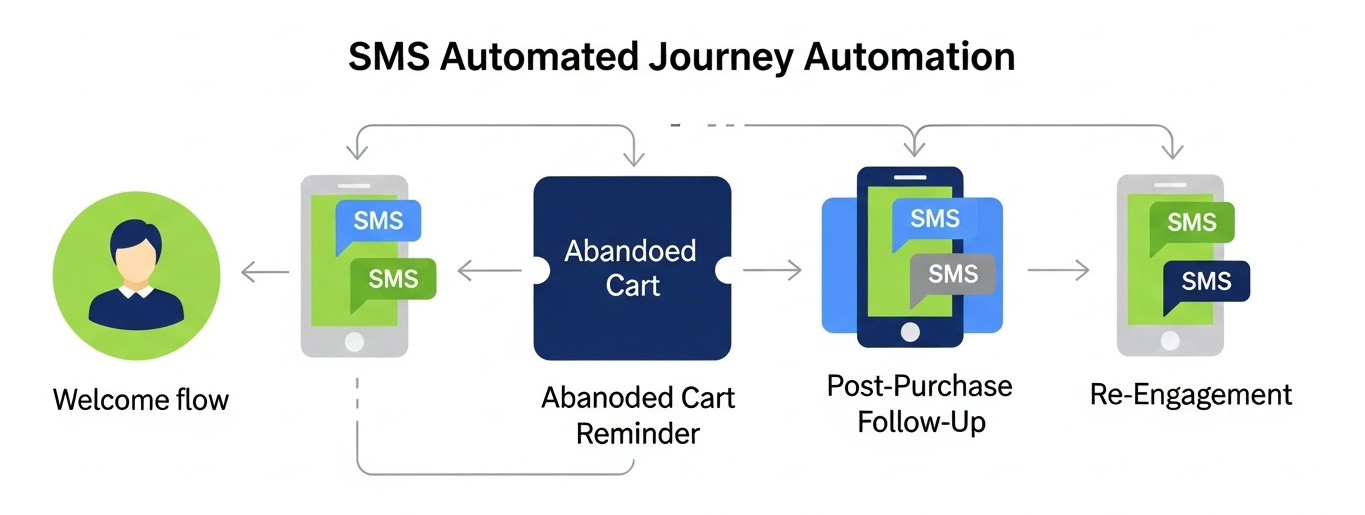
Automated flows deliver personalized messages triggered by customer actions, generating up to 30x more revenue per recipient than one-off campaigns.
Welcome series: Greet new subscribers, set messaging frequency expectations, and offer first-purchase incentives. Send first message immediately upon opt-in, followed by educational content at 3 days, then promotional offer at 7 days.
Abandoned cart recovery: Remind customers about items left in cart, achieving 24.6-39.4% conversion rates. Send first reminder 1 hour after abandonment, second reminder at 24 hours with urgency messaging, final reminder at 72 hours with enhanced discount.
Post-purchase follow-up: Request reviews, offer complementary products, or provide usage tips. Achieves 14.6-33.3% conversion rates for cross-sell and upsell opportunities.
Re-engagement campaigns: Win back inactive customers with special offers. Target customers with no purchase in 90+ days, offering increasingly compelling incentives over 3-4 touchpoints.
Replenishment reminders: Notify customers when it's time to reorder consumable products based on typical usage cycles.
Leverage Conversational Two-Way Messaging
Two-way SMS builds stronger relationships than one-way broadcasts. 62% of consumers say two-way texting improves brand perception, and 24% report it could directly increase purchases.
Enable customers to ask questions, confirm appointments, provide feedback, or make purchases through text conversations. This creates genuine dialogue rather than one-directional broadcasting.
AI-powered SMS chatbots handle common inquiries 24/7, qualifying leads and answering questions without human intervention. 81% of businesses report AI has improved their SMS marketing success, with most saving 4-6 hours weekly. Complex requests automatically route to live representatives.
Aloware's AI SMS bots understand natural language, provide instant responses to frequently asked questions, qualify leads through conversational forms, schedule appointments automatically, and escalate complex issues to human agents seamlessly.
Use MMS for Rich Media When Appropriate
Multimedia Messaging Service extends beyond plain text with images, GIFs, videos, and longer text (up to 1,600 characters). Rich media achieves higher engagement: interactive messages convert at 70% compared to 36% for static texts.
Effective MMS use cases:
- Product launch announcements with hero images
- Visual promotions requiring product photography
- Before/after transformations
- Menu items for restaurants
- Property photos for real estate
- Tutorial videos or how-to GIFs
- Event invitations with venue photos
However, MMS costs 2-3x more per message and consumes more recipient data. Reserve rich media for high-impact campaigns like major product launches, visual promotions, or educational content where images add significant value.
Implement Proper List Hygiene
Clean lists improve deliverability and protect sender reputation. Maintain list quality by:
Regular list cleaning:
- Remove unengaged subscribers after 6-12 months of inactivity
- Validate phone numbers before adding to database
- Remove bounced or invalid numbers immediately
- Cross-reference against National Do Not Call registries
- Suppress duplicates to avoid double-messaging
Re-engagement before removal: Before removing inactive subscribers, send re-engagement campaign offering compelling incentive to remain subscribed. This often reactivates 10-15% of inactive subscribers while confirming others prefer to opt out.
Integrate SMS with Email for Multi-Touch Campaigns
The most sophisticated marketers use both channels together, leveraging each medium's strengths. 87% of SMS subscribers also receive emails from the same brands.
Example multi-touch workflow:
Day 1 (Email): Send detailed product launch announcement with full product information, specifications, pricing, and lifestyle imagery.
Day 2 (SMS): Send brief reminder with exclusive SMS-only early access link.
Day 5 (Email): Send customer testimonials and detailed use cases.
Day 6 (SMS): Send limited-time discount code creating urgency ("24 hours left").
This approach reinforces messaging across channels, reaches customers on their preferred platform, and uses email for detail while SMS drives immediate action.
Run SMS Surveys to Close the Feedback Loop
Most post-purchase surveys die at the click. You email a link, the customer opens it on a phone, waits for a form to load, and abandons. The same question sent as a text gets answered in one keystroke, because the reply happens inside a thread the customer already opted into.
Keep the format strict. Ask one question, not five. Use a 1 to 5 reply scale instead of a link so nobody has to load a page or sign in. Send it immediately after the moment you are measuring, a delivered order, a resolved support ticket, a completed demo, while the experience is still specific in the customer’s memory.
What separates a survey program that works from one that burns the list:
- Route low scores to a person. A 1 or 2 reply should open a real conversation in the same inbox, not fire an autoresponder. Recovery revenue lives here.
- Survey the same contact rarely. Frequency, not wording, is what drives opt-outs on a survey program.
- Treat it as a marketing message. A survey text needs the same consent basis as a promotion, honors STOP the same way, and respects the recipient’s local sending window.
- Close the loop out loud. When feedback actually changes something, text the people who flagged it. It is the cheapest retention message you will ever send.
Common SMS Marketing Mistakes to Avoid
Sending Too Many Messages
The fastest way to increase opt-outs is messaging too frequently. 60% of subscribers disable notifications when brands send excessive messages. Most consumers tolerate 1-2 messages per week maximum for promotional content.
Frequency guidelines:
- 1-2 promotional messages weekly for most audiences
- 3-4 messages monthly for conservative approach
- Transactional updates (order confirmations, shipping notifications) don't count toward promotional frequency
- VIP segments may accept higher frequency with proven value delivery
Monitor opt-out rates closely. If they exceed 5%, reduce messaging frequency immediately.
Neglecting Compliance Documentation
Store proof of consent, opt-in records, message logs, and opt-out requests for every subscriber. Documentation protects your business during audits or legal challenges. Implement systems that automatically capture and archive:
- Timestamp of initial opt-in
- Method of consent (website form, text keyword, verbal, etc.)
- IP address or device information where applicable
- Copy of consent language shown to user
- All messages sent to the subscriber
- Timestamp of any opt-out request
- Confirmation of opt-out processing
Retain records for minimum 5 years to ensure compliance coverage.
Using Unclear Sender Identification
Recipients should immediately recognize your business. Use consistent branding across all messages and ensure your registered business name appears as sender ID where carriers support it. Generic sender names like "12345" or "Unknown" reduce trust and engagement.
Best practices:
- Register your business name as sender ID
- Use consistent from-name across all campaigns
- Include brand name in first line of message when sender ID isn't supported
- Never use misleading sender information
Burying the Value Proposition
Don't waste precious characters on filler language. Skip phrases like "Hi there!" or "We wanted to reach out" or "Hope you're having a great day!" Lead immediately with your offer, benefit, or call-to-action.
❌ Bad: "Hi! We hope you're having a wonderful day! We wanted to reach out and let you know about our sale..."
✅ Good: "Flash Sale: 40% off running shoes. Today only. Shop: [link]"
Every character counts in SMS. Get to the point immediately.
Ignoring Mobile-Optimized Landing Pages
When 29% of recipients click SMS links, they expect fast-loading, mobile-friendly destinations. Slow or desktop-only pages kill conversions and frustrate customers.
Mobile landing page requirements:
- Responsive design adapting to all screen sizes
- Load time under 3 seconds
- Large tap-friendly buttons (minimum 44x44 pixels)
- Simplified navigation with minimal clicks to conversion
- Single-column layouts for easy scrolling
- Clear headlines and concise copy
- Autofill-enabled form fields
- One-click checkout options where possible
Test landing pages on multiple devices before launching campaigns.
Failing to Track Campaign Attribution
Without proper tracking, you can't prove SMS ROI or optimize future campaigns. Implement UTM parameters in all links, track conversions in analytics platforms, assign unique promo codes per campaign, and monitor revenue per recipient.
Attribution best practices:
- Use unique URLs for each SMS campaign
- Implement SMS-specific promo codes
- Track assisted conversions (SMS touchpoint in customer journey)
- Calculate incremental revenue from SMS vs other channels
- Monitor time-to-conversion from message send
SMS Marketing Trends Shaping 2026
AI-Powered Personalization and Optimization
Artificial intelligence analyzes customer behavior to optimize send times, predict engagement likelihood, and generate message variants automatically. 81% of businesses say AI has improved their SMS marketing success, with most saving 4-6 hours weekly.
AI capabilities now include:
- Predictive send time optimization (delivering messages when each individual is most likely to engage)
- Dynamic content selection based on customer preferences
- Automatic A/B test creation and winner selection
- Churn prediction identifying at-risk subscribers
- Next-best-action recommendations for customer lifecycle stage
Platforms with AI automatically route messages through each customer's preferred channel based on historical engagement patterns.
.jpg)
Rich Communication Services (RCS) Adoption
RCS brings app-like experiences to native messaging with high-resolution images, video carousels, interactive buttons, verified sender badges, and read receipts. RCS campaigns achieve engagement rates up to 50%, doubling traditional SMS performance.
Apple's RCS support drove 500% growth in global RCS traffic during 2024, with active users projected to reach 2.1 billion by 2026. As adoption continues accelerating, brands gain access to:
- Branded sender profiles with logos
- Rich media without MMS costs
- Interactive carousels showcasing multiple products
- Location sharing and appointment scheduling
- Real-time typing indicators
- Read receipts confirming message viewing
Aloware is adding RCS support soon, enabling customers to leverage these advanced capabilities.
Conversational Commerce
Brands increasingly enable customers to browse products, place orders, and complete purchases entirely through text conversations. This friction-free buying experience meets consumers where they spend time, reducing checkout abandonment.
Conversational commerce capabilities:
- Product browsing via text commands
- In-message checkout without visiting websites
- Order status checking through SMS
- Customer service via text conversations
- Appointment scheduling through automated flows
This approach achieves higher conversion rates by eliminating app downloads, website navigation, and multi-step checkouts.
Privacy-First Consent Models
Stricter regulations require one-to-one consent specific to each brand. Blanket "partner marketing" clauses no longer satisfy legal requirements. Transparent opt-in processes and clear data usage policies build customer trust while ensuring compliance.
2026 consent requirements:
- Brand-specific opt-in (can't transfer consent between brands)
- Clear disclosure of message frequency
- Explicit description of message types
- Prominent opt-out instructions at enrollment
- Double opt-in verification for high-value lists
- Regular consent reconfirmation for long-inactive subscribers
Integration with Marketing Technology Stacks
SMS data now syncs seamlessly with CRM systems, loyalty platforms, ecommerce engines, and analytics suites. This integration enables sophisticated personalization, triggers automated workflows, provides unified customer views, and improves attribution accuracy across all touchpoints.
Modern SMS platforms like Aloware integrate with HubSpot, Salesforce, Pipedrive, Zoho, and other major platforms, automatically syncing contacts, logging all message interactions, and triggering workflows based on SMS engagement.
How Aloware Powers SMS Marketing Success
Aloware is an omnichannel phone system providing every feature needed for SMS marketing success, except RCS, which is coming soon. The platform combines shortcode SMS, longcode SMS, MMS, and AI-powered SMS bots in a unified system integrated with your existing business tools.
Built-In Compliance Management
Aloware handles A2P 10DLC registration, carrier approval, and TCPA compliance automatically. The platform includes automated opt-out management, scheduling tools respecting quiet hours, automatic message throttling meeting carrier limits, consent tracking with timestamped records, and compliance reporting for audit requirements.
Seamless CRM Integration
Pull contact lists directly from HubSpot, Salesforce, Pipedrive, or Zoho with one click. All SMS interactions automatically log to your CRM, maintaining complete conversation history without manual data entry. Customer profiles update in real-time across all systems.
Integration benefits:
- Bidirectional contact syncing
- Automatic activity logging
- Workflow triggers based on SMS engagement
- Unified customer view across all channels
- Custom field mapping between systems
Local Presence Capabilities
Aloware's local presence feature automatically matches your sending number's area code to each recipient's location, increasing trust and response rates without managing multiple phone numbers. Recipients see familiar local numbers rather than unknown out-of-state codes.
AI SMS Chatbots
AI-powered bots handle initial customer responses, answer common questions, qualify leads, and escalate complex inquiries 24/7. This ensures customers receive timely assistance while freeing your team to focus on high-value conversations requiring human expertise.
AI bot capabilities:
- Natural language understanding
- Instant responses to frequently asked questions
- Lead qualification through conversational forms
- Appointment scheduling with calendar integration
- Intelligent routing to appropriate team members
- Learning from interactions to improve over time
Real-Time Campaign Analytics
Track delivery rates, engagement metrics, conversion tracking, and ROI in real-time dashboards. Identify which campaigns drive revenue, which segments respond best, and where optimization opportunities exist.
Available analytics:
- Message delivery and failure rates
- Open and click-through rates by campaign
- Conversion tracking with revenue attribution
- Opt-out rate monitoring
- Response time metrics
- Campaign comparison reports
- Segment performance analysis
Shortcode and Longcode Support
Unlike limited platforms supporting only one message type, Aloware provides both shortcode for high-volume campaigns and longcode for personalized conversations. This flexibility lets you choose the right tool for each campaign's specific needs.
Shortcode advantages:
- High message throughput (100+ messages per second)
- Memorable numbers for text-to-join campaigns
- Ideal for mass marketing campaigns
Longcode advantages:
- Local phone number appearance
- Two-way conversational messaging
- Voice calling capability on same number
- Lower monthly costs
MMS Support with Rich Media
Send images, videos, and longer messages through MMS when visual content enhances your message. Share product photos, promotional graphics, how-to videos, or event invitations that drive higher engagement than text-only messages.
Omnichannel Communication Hub
While SMS drives immediate engagement, Aloware's omnichannel approach integrates voice calling, and messaging in one platform. This unified system enables sophisticated workflows like texting call lists before phone outreach to boost answer rates, or seamlessly transitioning text conversations to voice calls when needed.
Getting Started with SMS Marketing
Begin your SMS marketing program with these steps:
1. Choose a compliant SMS platform that handles A2P 10DLC registration and provides CRM integration. Aloware manages compliance automatically while integrating with your existing tools.
2. Build your opt-in list through multiple channels. Add SMS opt-in checkboxes to website forms, use QR codes on physical marketing materials, offer SMS signup at checkout, promote text-to-join keywords in advertising, and create exclusive SMS-only offers incentivizing signups.
3. Complete A2P 10DLC registration through your SMS platform. Provide business information, describe campaign use cases, submit sample messages, and document opt-in collection methods.
4. Segment your audience based on behavior, preferences, or lifecycle stage. Start with basic segments like new vs returning customers, then add sophistication over time.
5. Create message templates for common campaigns while maintaining personalization. Develop templates for welcome messages, abandoned cart reminders, shipping updates, promotional offers, and customer service responses.
6. Set up automated workflows for welcome series, cart abandonment recovery, post-purchase follow-up, and re-engagement campaigns. Automated flows generate 30x more revenue per recipient than one-off campaigns.
7. Test and optimize campaigns regularly based on performance data. Start with small test segments, implement winners broadly, and continuously refine based on results.
8. Monitor compliance continuously to maintain sender reputation. Review opt-out rates, update privacy policies, maintain consent records, and ensure all messages include required opt-out instructions.
Conclusion: Building Your SMS Marketing Strategy
SMS marketing delivers unmatched engagement and ROI when executed with strategic planning and compliance awareness. Success requires balancing regulatory requirements, personalization, timing optimization, and value delivery. The brands winning in 2026 treat SMS as a relationship channel for meaningful customer engagement rather than a broadcast medium for promotional spam.
Start by ensuring compliance through proper A2P 10DLC registration and explicit consent collection. Build a quality opt-in list through multiple touchpoints, segment audiences for relevance, and create campaigns providing genuine value to subscribers. Use automation to scale personal touches, test continuously to improve performance, and integrate SMS with your broader omnichannel marketing strategy.
The data speaks clearly: 98% open rates, 90-second response times, and $71 ROI per dollar spent demonstrate SMS's power to drive immediate customer action and measurable business results.
Ready to Transform Your Customer Engagement?
Aloware's omnichannel phone system provides everything you need for SMS marketing success: shortcode and longcode support, MMS capabilities, AI-powered chatbots, seamless CRM integration, and built-in compliance management.
Start driving exceptional results with SMS marketing:
Explore Aloware's SMS Features | Schedule a Demo | Start Free Trial
Frequently Asked Questions
What is the average SMS marketing open rate?
SMS marketing achieves a 98% open rate, significantly higher than email's 21.5% average. Most text messages are read within three minutes of delivery, with 82% of consumers checking texts within five minutes.
How much does SMS marketing cost?
SMS costs typically range from $0.01 to $0.05 per message depending on volume, destination, and whether you send standard SMS or multimedia MMS. Most platforms offer monthly plans with included message credits or pay-as-you-go pricing for flexibility.
What is A2P 10DLC and why is it required?
A2P 10DLC is the system allowing businesses to send application-to-person messages using standard 10-digit phone numbers. U.S. carriers require registration through The Campaign Registry to verify business identity, improve deliverability, and reduce spam. Unregistered traffic gets blocked or severely throttled, preventing messages from reaching customers.
Can you text customers without permission?
No. Federal law requires explicit written consent before sending promotional SMS. The TCPA mandates prior express written consent, and violations result in fines up to $1,500 per message. Only transactional messages initiated by customer actions (order confirmations, shipping updates, appointment confirmations) require less stringent consent.
How often should businesses send marketing texts?
Most customers prefer 1-2 marketing messages per week. Survey data shows 72% of SMS subscribers expect messages at least weekly, with 45% comfortable receiving texts multiple times per week. However, 60% of subscribers disable notifications when brands send excessive messages. Let value and relevance guide frequency rather than arbitrary schedules.
What's the difference between SMS and MMS?
SMS sends text-only messages up to 160 characters. MMS supports multimedia content including images, GIFs, videos, and up to 1,600 characters of text. MMS costs 2-3x more per message but achieves higher engagement for visual campaigns—interactive messages convert at 70% compared to 36% for static texts.
Do SMS marketing messages work for B2B?
Yes. SMS works effectively for B2B appointment reminders, event notifications, webinar confirmations, and time-sensitive updates. However, B2B SMS requires stronger consent practices and more conservative messaging frequency than B2C. Focus on transactional and value-added content rather than aggressive promotions.
What is the best day to send marketing texts?
Tuesday through Thursday between 10 AM-12 PM or 6-8 PM typically achieve highest engagement. Avoid Mondays (people are busy catching up), weekends (people protect personal time), and late nights (after 9 PM is illegal in many jurisdictions). Test different days with your specific audience to find optimal timing.
How do shortcodes differ from longcodes?
Shortcodes are 5-6 digit numbers (like "12345") designed for high-volume, one-way marketing campaigns. They're instantly recognizable and handle mass messaging but cost $1,000-$10,000 monthly. Longcodes are standard 10-digit phone numbers enabling two-way conversations, appearing as local numbers, and supporting voice calls at much lower costs. Longcodes require A2P 10DLC registration.
Can SMS marketing integrate with my CRM?
Yes. Modern SMS platforms like Aloware integrate seamlessly with major CRM systems including HubSpot, Salesforce, Pipedrive, and Zoho. Integration automatically syncs contacts, logs message interactions, triggers workflows based on SMS engagement, and provides unified customer views across all channels.
What happens if someone replies STOP to my SMS?
Your platform must immediately process the opt-out request and stop sending all promotional messages to that number. You may send one final confirmation message acknowledging their opt-out, then remove them from all marketing lists. Continuing to message after opt-out violates TCPA regulations and risks fines up to $1,500 per message.
How do I measure SMS marketing ROI?
Calculate ROI by dividing total revenue generated by campaign costs. Track direct conversions through unique SMS links or promo codes, monitor assisted conversions where SMS touched the customer journey, and calculate incremental revenue from SMS compared to other channels. Industry average ROI is $21-$71 per $1 spent.
.png)

Ruby Kootval is Head of Product Marketing at Aloware. She has 12 years in digital marketing, including 8 in B2B SaaS and 5 in telecom, and writes about AI voice agents, dialers, CRM integrations, and contact center operations.