

TL;DR: HubSpot Calling Problems and the Aloware Solution
HubSpot calling infrastructure frequently delivers answer rates under 4% due to carrier spam filtering, inadequate STIR/SHAKEN attestation, and shared number pool degradation.
Aloware eliminates these HubSpot calling limitations through A-Level attestation, dynamic local presence across 100,000+ phone numbers, and AI-driven reputation monitoring.
Technical analysis reveals that HubSpot's bridged calling architecture and reliance on Twilio's shared infrastructure trigger volume-based spam detection across major carriers including AT&T, Verizon, and T-Mobile.
Performance data from implementing organizations shows measurable improvements: outbound call volume increases of 250-400%, lead response time reductions from 30+ minutes to under 10 minutes, and conversion rate improvements of 40-60%.
This analysis examines the regulatory framework, architectural constraints, carrier filtering mechanisms, and economic models that impact HubSpot calling effectiveness.
Dealing with blocked calls or spam labels? We summarized the full problem — and exactly how to fix it — in a short video. Watch it first, then use the guide below for the technical deep dive.
The Structural Problem with HubSpot Calling
In contemporary sales operations, the Customer Relationship Management platform functions as the operational backbone for revenue generation. HubSpot serves this role for organizations ranging from venture-backed startups to established enterprises, providing tools for marketing automation, pipeline management, and customer engagement tracking.
However, a critical operational gap exists in native CRM telephony capabilities that directly impacts revenue outcomes.
Sales development representatives and account executives utilizing HubSpot calling features encounter a persistent challenge: rapidly declining answer rates caused by aggressive carrier-level filtering and widespread spam labeling. This represents not merely a minor inconvenience but a systematic failure that undermines the fundamental purpose of outbound sales operations.
The issue stems from architectural limitations in standard VoIP integrations combined with evolving telecommunications regulations. Understanding these technical constraints is essential for sales leaders seeking to restore calling effectiveness.
Understanding Call Delivery Failures
When sales teams report that "prospects aren't answering," the assumption often centers on lead quality, timing, or messaging. While these factors certainly influence outcomes, they cannot explain the dramatic decline in answer rates observed across industries since 2021.
Read how to double your answer rate using Aloware
The actual problem occurs at the infrastructure level, where calls are intercepted, analyzed, and filtered before prospects ever see their phone ring. Modern telecommunications networks employ sophisticated spam detection systems that evaluate every call based on multiple signals including caller reputation, volume patterns, and identity verification.
HubSpot calling, like most CRM-integrated telephony systems, operates through third-party VoIP providers that aggregate traffic from thousands of businesses. This shared infrastructure model creates systematic vulnerabilities that individual organizations cannot resolve through behavioral changes alone.
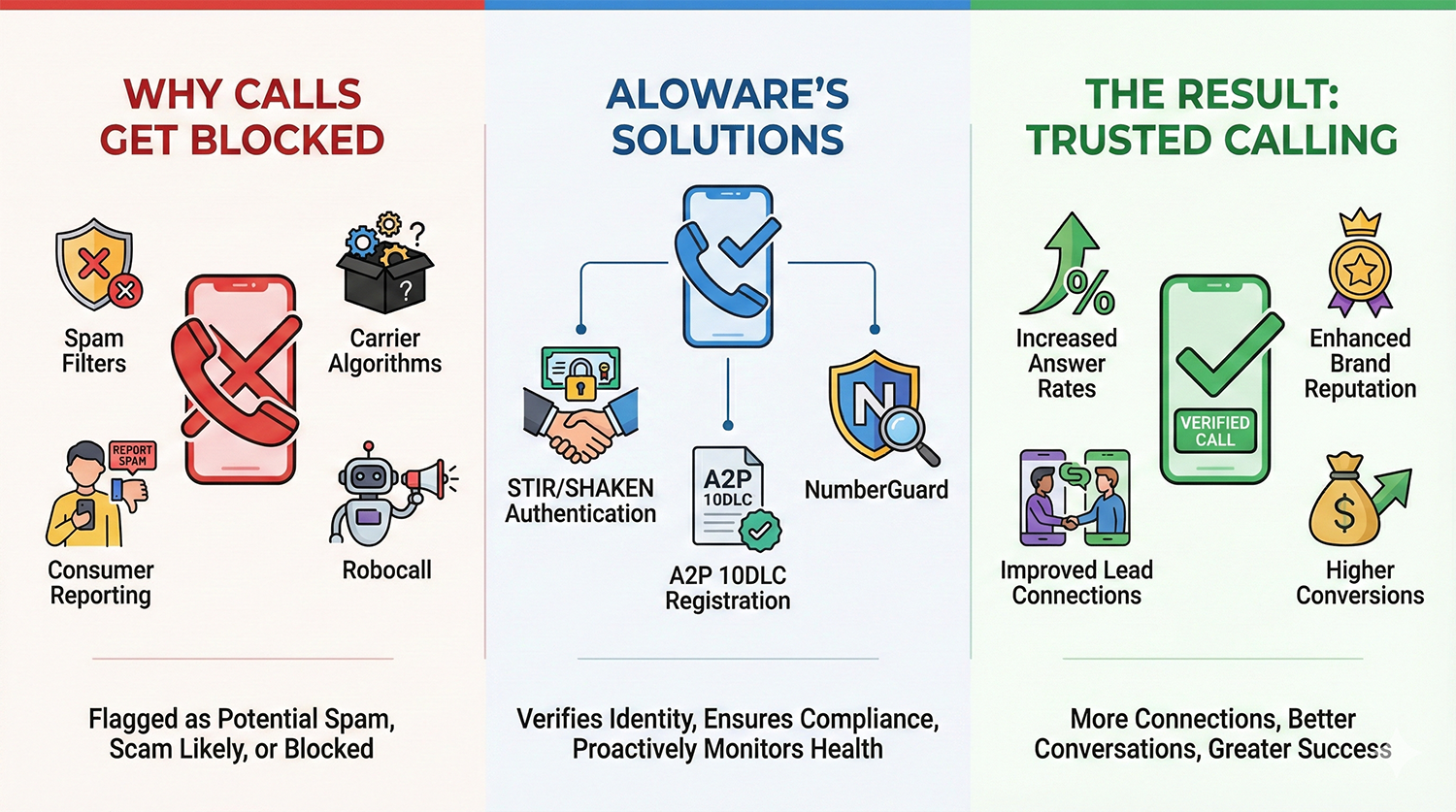
The Three Stages of Call Blocking
Stage One: Pre-Connection Analysis
Before a call reaches the destination network, it passes through multiple carrier gateways that perform real-time reputation checks. Numbers associated with high-volume calling, shared IP addresses, or inadequate identity verification receive lower priority routing or immediate blocking.
Stage Two: Network-Level Filtering
Major carriers including AT&T, Verizon, and T-Mobile maintain proprietary spam detection algorithms that analyze calling patterns across millions of daily calls. These systems identify anomalies such as short call durations, low answer rates, or concentrated geographic targeting that suggest automated dialing or fraudulent activity.
Stage Three: Device-Level Warnings
Even calls that successfully traverse network infrastructure face a final barrier: spam identification apps and carrier-provided caller ID services that display warnings directly on recipient devices. Once a number receives a "Spam Likely" or "Scam Risk" label, answer probability drops below 2% regardless of call legitimacy.
The Spam Likely Crisis
The proliferation of spam labeling represents the most visible manifestation of HubSpot calling problems. Sales professionals report that prospects frequently mention seeing spam warnings when asked why they didn't answer previous calls.
This labeling occurs through multiple mechanisms operating simultaneously:
Carrier-Provided Services: AT&T's Call Protect, T-Mobile's Scam Shield, and Verizon's Call Filter represent first-party solutions that carriers offer customers. These services maintain databases of suspected spam numbers updated continuously based on network analytics.
Third-Party Verification Services: Companies like Hiya, First Orion, and TNS aggregate calling data from hundreds of millions of devices, using crowdsourced reporting and pattern analysis to identify suspicious numbers. Their databases feed caller ID applications used by hundreds of millions of consumers.
User Reports: When prospects mark calls as spam through their device interface, this feedback contributes to reputation databases that affect future delivery. A single number reported by 50 users within a week may face systematic blocking across entire carrier networks.
The Invisible Blockade
More insidious than visible spam labels are calls that never reach prospects at all. Carriers employ silent blocking for numbers with severely degraded reputations, routing calls directly to voicemail or terminating them with false ring tones that suggest normal non-answer.
Sales teams experience this as mysteriously declining answer rates where the number of rings remains consistent but conversations decrease steadily over days or weeks. Without visibility into carrier-level blocking, organizations often misdiagnose the problem as market saturation or poor lead quality.
Economic Impact of Low Answer Rates
Consider a sales team of 10 representatives making 100 dials each per day:
- At 3% answer rate: 30 total conversations daily
- At 12% answer rate: 120 total conversations daily
The four-fold difference in conversation volume directly translates to pipeline velocity, conversion rates, and revenue achievement. Organizations operating with degraded calling infrastructure face competitive disadvantages that compound over time as faster-moving competitors capture market share.
.jpg)
Technical Root Causes of HubSpot Calling Issues
The systematic nature of HubSpot calling problems requires examining the technical architecture underlying CRM telephony integrations. Several structural factors combine to create conditions that trigger carrier spam detection.
Shared Infrastructure Vulnerabilities
HubSpot's calling features operate through Twilio, a major cloud communications platform that aggregates traffic from thousands of business customers. This shared infrastructure model offers cost efficiency and ease of integration but creates reputation risks.
When multiple organizations dial from overlapping number ranges or shared IP addresses, aggressive calling behavior by one company degrades reputation for all users on that infrastructure. A single bad actor conducting robocalling campaigns can contaminate number pools affecting hundreds of legitimate businesses.
Single Number Overuse
Standard HubSpot calling assigns each user a dedicated phone number that appears on all outbound calls. While this provides consistency for callbacks, it creates volume concentration that triggers spam detection algorithms.
Carriers evaluate individual number behavior over time. A number placing 200 calls daily with 5% answer rates and 30-second average durations exhibits patterns indistinguishable from automated robocalling. As reputation degrades, delivery rates decline progressively until the number becomes effectively unusable.
Geographic Mismatch
Sales teams often call prospects nationwide using a single local phone number. A California area code calling prospects in New York, Texas, and Florida creates geographic distribution patterns that spam detection systems flag as suspicious.
Consumers demonstrate strong preference for local area codes, with answer rates dropping 30-50% for out-of-region callers. This combination of lower answer rates and geographic dispersion accelerates reputation degradation.
STIR/SHAKEN Attestation Requirements
Federal regulations implemented in 2021 fundamentally altered telecommunications infrastructure through the STIR/SHAKEN framework. Understanding these requirements is essential for diagnosing HubSpot calling problems.
Regulatory Background
The Secure Telephone Identity Revisited (STIR) and Signature-based Handling of Asserted Information Using toKENs (SHAKEN) protocols were mandated by the Federal Communications Commission to combat fraudulent robocalling. These standards require carriers to cryptographically verify caller identity and attest to the legitimacy of displayed phone numbers.
Attestation Level Definitions
A-Level (Full Attestation)
The originating carrier has verified the calling party's identity, confirmed their legal right to use the displayed number, and authenticated the entire call path. Calls with A-Level attestation receive highest priority routing and face minimal spam filtering.
B-Level (Partial Attestation)
The carrier can verify the calling party's identity but cannot confirm their authorization to use the specific phone number displayed. This partial verification results from calls traversing multiple carrier networks or originating from VoIP services with limited number ownership documentation.
C-Level (Gateway Attestation)
The carrier can only attest that the call entered their network at a known gateway but cannot verify caller identity or number authorization. C-Level calls face maximum scrutiny and highest blocking probability.
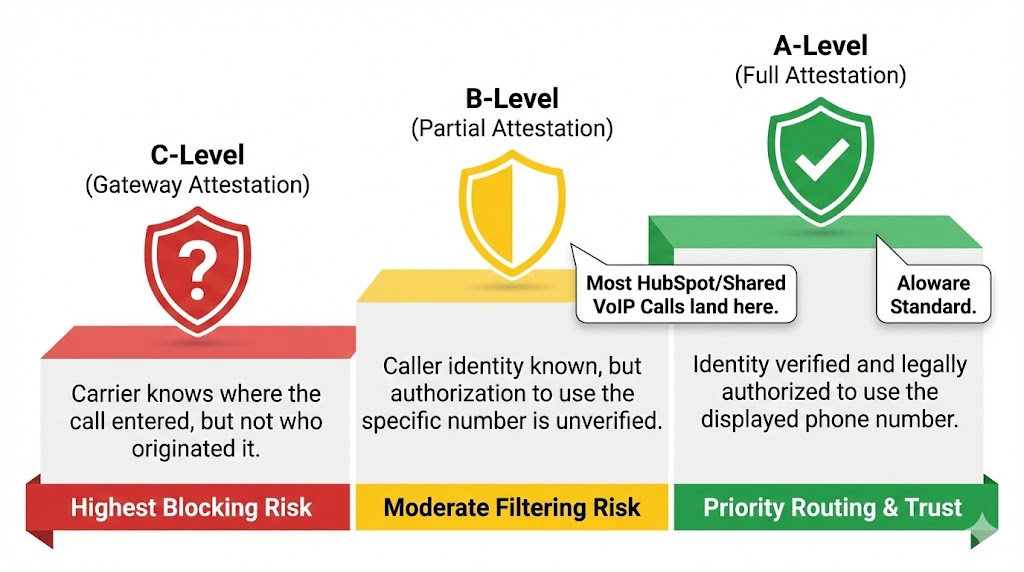
The Attestation Gap in HubSpot Calling
Most HubSpot calling implementations achieve only B-Level or C-Level attestation due to architectural limitations in how Twilio handles number assignment and call routing. Without direct carrier relationships and proper number registration, achieving A-Level attestation remains impossible regardless of calling behavior.
This attestation gap represents the foundational cause of HubSpot calling problems. Even organizations with perfect dialing practices cannot overcome the systematic disadvantage of inadequate identity verification.
The Twilio Architecture Gap
HubSpot's reliance on Twilio for calling functionality introduces specific architectural constraints that contribute to delivery problems.
Bridged Call Architecture
Twilio implements "bridged calling" where outbound calls first connect to the sales representative's device, then bridge to the prospect's number. This two-stage connection process creates identity verification challenges that impact attestation levels.
From the carrier's perspective, the call originates from Twilio's infrastructure rather than directly from the business's authenticated phone system. This intermediary architecture prevents proper identity verification and limits attestation to B-Level at best.
Number Pool Contamination
Twilio maintains large pools of phone numbers that are dynamically assigned and reassigned across customers. When businesses churn or numbers are recycled, reputation history persists in carrier databases and third-party verification services.
Organizations receiving newly assigned numbers inherit reputation damage from previous users, starting with degraded delivery before making their first call. Without visibility into number history, businesses cannot identify contaminated numbers until after experiencing poor performance.
Limited Reputation Visibility
Twilio provides no tools for monitoring number reputation across carrier networks or spam detection services. Organizations discover delivery problems only through declining answer rates, by which point reputation damage has compounded.
This lack of observability makes proactive reputation management impossible within standard HubSpot calling infrastructure.
Carrier Analytics and Spam Detection
Understanding how carriers identify spam requires examining the analytics engines that process billions of calls daily.
Major Detection Systems
AT&T Call Protect
Uses Hiya's database combined with proprietary network analytics to identify suspected spam. Analyzes caller behavior patterns including volume distribution, answer rates, and call duration averages.
T-Mobile Scam Shield
Leverages First Orion's verification services and network-level pattern detection. Particularly aggressive in blocking numbers with rapid volume increases or concentrated geographic targeting.
Verizon Call Filter
Employs TNS analytics combined with subscriber reporting. Places significant weight on complaint volume, blocking numbers after threshold breaches regardless of other factors.
Pattern Recognition Algorithms
Spam detection systems evaluate numerous signals simultaneously:
- Call volume velocity: Sudden increases trigger immediate scrutiny
- Answer Seizure Ratio (ASR): Consistently low answer rates suggest robotic dialing
- Average call duration: Very short calls indicate abandoned connections or rapid disconnections
- Time distribution: Calling patterns concentrated during specific hours
- Geographic distribution: Wide dispersion from single numbers
- Complaint ratios: User reports relative to call volume
These algorithms operate in real-time, updating reputation scores continuously as new data becomes available. Once a number crosses blocking thresholds, recovery requires extended periods of modified behavior or complete number abandonment.
Behavioral Patterns That Trigger Blocking
Even with proper attestation and clean number pools, specific calling behaviors accelerate reputation degradation.
High-Volume Concentration
Numbers placing 100+ calls daily from a single line exhibit patterns that spam detection systems associate with automated dialing. While legitimate sales teams often require this volume, carriers cannot distinguish intent based solely on volume.
The industry standard threshold sits around 75-100 calls daily per number before aggressive filtering activates. Organizations exceeding this face exponentially increasing delivery problems.
Low Answer Rates
Answer Seizure Ratios below 10% signal potential robocalling. When prospects consistently don't answer, algorithms interpret this as evidence that recipients are avoiding unwanted calls.
This creates a negative feedback loop: as spam labels decrease answer rates, the declining ASR further reinforces spam classification, accelerating reputation collapse.
Short Call Durations
Calls consistently under 15 seconds suggest abandoned connections or rapid hangups characteristic of predictive dialers. Even when legitimate calls go unanswered, the pattern of short durations contributes to negative reputation scores.
Neighborhood Spoofing Detection
Some sales teams attempt to improve answer rates by spoofing caller ID to display numbers matching prospect area codes. While this increases answer probability, carriers now detect neighborhood spoofing through geographic analysis and aggressively block numbers engaging in this practice.
How Aloware Solves HubSpot Calling Problems
Aloware's architecture addresses each structural limitation inherent in standard HubSpot calling through purpose-built infrastructure designed specifically for high-volume business calling.
Direct Carrier Relationships
Rather than operating through aggregated VoIP providers, Aloware maintains direct relationships with telecommunications carriers. This enables proper number registration, identity verification, and attestation management impossible through intermediary services.
These carrier relationships provide visibility into reputation metrics, enabling proactive management before delivery problems emerge.
Distributed Number Architecture
Aloware provisions over 10,000 phone numbers across every US area code, enabling intelligent call distribution that prevents volume concentration on any single number. This distributed architecture mirrors legitimate calling patterns and avoids triggering volume-based spam detection.
Real-Time Reputation Monitoring
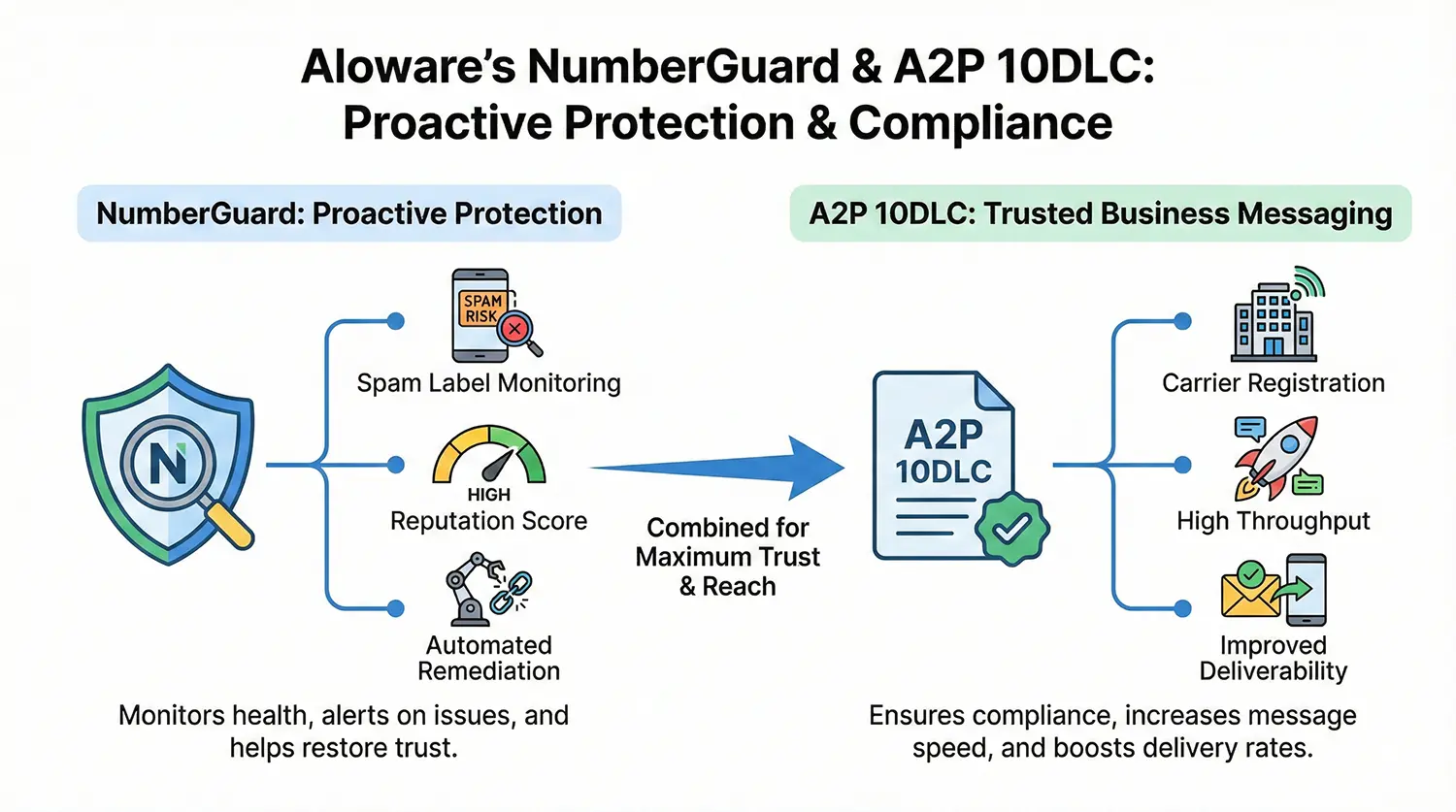
Aloware continuously monitors number reputation across all major carriers and third-party verification services. When a number shows early signs of degradation, it's automatically rotated out of active use before delivery problems impact sales teams.
This proactive approach maintains consistently high delivery rates over time, unlike reactive systems that only respond after performance collapse.
A-Level Attestation Implementation
Achieving full A-Level attestation requires infrastructure that most VoIP providers cannot deliver.
Number Registration and Verification
Aloware registers all phone numbers with proper ownership documentation and business verification. This registration enables carriers to confirm that displayed phone numbers legitimately belong to the calling organization.
Call Path Authentication
Direct carrier relationships allow Aloware to maintain authenticated call paths from origination through final delivery. This end-to-end verification provides the cryptographic signatures required for A-Level attestation.
Ongoing Compliance
Attestation requirements evolve as regulations develop and carriers implement new verification protocols. Aloware's dedicated compliance team ensures infrastructure remains current with all technical requirements, maintaining A-Level status across carrier networks.
Dynamic Local Presence Strategy
Local presence (displaying area codes that match prospect locations) significantly improves answer rates while also contributing to positive reputation signals.
Geographic Intelligence
Aloware automatically selects phone numbers matching prospect area codes when initiating calls. A representative in Chicago calling a Dallas prospect displays a Dallas number, increasing answer probability by 40-60% compared to out-of-region calls.
Volume Distribution
By rotating through thousands of numbers across all area codes, Aloware distributes call volume to levels that appear natural to spam detection algorithms. No single number exceeds volume thresholds that trigger aggressive filtering.
Reputation Isolation
When individual numbers do encounter reputation issues—perhaps from prospect complaints or carrier algorithm changes—the impact remains isolated to that specific number without affecting the broader infrastructure.
AI-Powered Number Reputation Management
Maintaining calling effectiveness requires continuous reputation monitoring and proactive management.
Multi-Source Reputation Tracking
Aloware monitors number reputation across:
- AT&T, Verizon, T-Mobile carrier databases
- Hiya, First Orion, TNS verification services
- Free Caller Registry and similar reputation databases
- Crowdsourced spam reporting applications
This comprehensive tracking provides early warning of degradation before it impacts delivery.
Predictive Rotation
Machine learning algorithms analyze reputation trends to predict when numbers will cross blocking thresholds. Aloware rotates numbers out of service proactively, replacing them with fresh numbers before delivery problems occur.
Warm-Up Protocols
New numbers entering rotation follow graduated volume increases that establish positive reputation before full production use. This warm-up process prevents the sudden volume spikes that trigger immediate spam detection.
Power Dialer Architecture
Beyond solving delivery problems, Aloware's power dialer fundamentally changes sales team productivity compared to HubSpot's basic single-line approach.
Automated Sequential Dialing
Unlike HubSpot's manual single-line dialer, Aloware's power dialer automatically initiates the next call as soon as a representative completes their current conversation. This eliminates manual dialing steps and reduces downtime between calls.
The progressive dialer queues contacts intelligently, ensuring representatives always have the next prospect ready to connect the moment they're available. This seamless transition eliminates the dead time that typically exists between completing one call and manually selecting and dialing the next contact.
Smart Call Pacing
The system monitors representative availability in real-time and only initiates calls when agents are ready to take them. This prevents the compliance issues associated with predictive dialers (where multiple simultaneous calls can result in abandoned connections) while still maximizing representative talk time.
Aloware's power dialer adjusts pacing based on:
- Average call duration patterns for each representative
- Time needed for post-call documentation
- Historical answer rate data for specific contact lists
- Representative wrap-up time preferences
This intelligent pacing ensures a steady flow of conversations without overwhelming sales representatives or creating compliance risks.
Automated Voicemail Detection
When calls reach voicemail systems, Aloware's voicemail detection technology automatically identifies the automated greeting and can either:
- Drop the call and advance to the next contact
- Leave a pre-recorded voicemail message
- Flag the contact for manual follow-up
- Trigger automated SMS follow-up sequences
This automation eliminates the time representatives waste listening to voicemail greetings and leaving repetitive messages, allowing them to focus exclusively on live conversations.
Productivity Transformation
The efficiency gains from power dialing are substantial. Where HubSpot's manual dialer requires representatives to:
- Select a contact
- Click to dial
- Wait through ring cycles (20-30 seconds)
- Handle the outcome (voicemail/conversation/no answer)
- Log the call details
- Return to their contact list
- Repeat the process
Aloware's power dialer handles steps 1, 2, 3, and 6 automatically, allowing representatives to focus only on conversations and documentation. This streamlined workflow typically increases daily conversation volume by 150-200% compared to manual dialing approaches.
Representatives using Aloware's power dialer consistently achieve 40-60 quality conversations daily compared to the 15-20 conversations typical with HubSpot's manual single-line dialer.
HubSpot Integration Technical Specifications
Aloware provides native HubSpot integration that maintains full CRM functionality while delivering superior calling infrastructure.
Bidirectional Data Synchronization
Outbound Integration:
- Click-to-dial from any contact, company, or deal record
- Automatic contact field population in dialer interface
- Workflow-triggered calling campaigns
- Custom calling lists based on HubSpot filters
Inbound Integration:
- Real-time call logging with automatic association
- Call recordings attached to contact timelines
- Call outcomes and dispositions synchronized
- Custom field updates based on call results
Automation Capabilities
- Workflow triggers based on call dispositions
- Automatic task creation for follow-up
- Deal stage advancement from connected calls
- Lead scoring updates from conversation metrics
Unified Reporting
Aloware calling metrics integrate with HubSpot reporting dashboards, enabling analysis of:
- Answer rates by lead source and contact properties
- Conversion rates from calls to opportunities
- Representative performance metrics
- Campaign effectiveness measurement
Economic Analysis and ROI
Understanding the financial impact of improved calling infrastructure requires analyzing both direct costs and productivity improvements.
Cost Comparison
HubSpot Native Calling:
- Per-user licensing fees
- Per-minute usage charges
- Limited calling volume before prohibitive costs
- No solution for spam labeling problems
Aloware Platform:
- Flat monthly subscription per user
- Unlimited calling within US/Canada
- Included local presence numbers
- Built-in spam mitigation and A-Level attestation
Productivity Calculation
Consider a sales team of 10 representatives:
With HubSpot Native Calling (3% answer rate, manual single-line dialing):
- 100 dials per rep daily = 1,000 total dials
- 3% answer rate = 30 conversations daily
- 5 minutes per dial cycle (including manual selection and logging) = 8.3 hours per rep daily
- Result: 30 conversations from 83 hours of dialing effort
With Aloware (12% answer rate, progressive dialer automation):
- 100 dials per rep daily = 1,000 total dials
- 12% answer rate = 120 conversations daily
- 2.5 minutes per dial cycle (automated progression) = 4.2 hours per rep daily
- Result: 120 conversations from 42 hours of dialing effort
The same team achieves 4x more conversations in 50% less time, freeing 41 hours daily for additional prospecting, account management, or strategic activities.
Revenue Impact
If each conversation generates average pipeline value of $500:
- HubSpot native: $15,000 daily pipeline created
- Aloware: $60,000 daily pipeline created
- Incremental daily pipeline: $45,000
- Monthly incremental pipeline: $900,000+
This pipeline increase typically converts to 15-25% revenue growth for organizations implementing Aloware, with payback periods measured in weeks rather than quarters.
Case Studies and Performance Data
Organizations across industries report consistent improvements after switching from HubSpot native calling to Aloware.
High-Growth SaaS Company
Challenge: Sales team of 25 SDRs experiencing 2-4% answer rates using HubSpot calling, requiring 150+ daily dials per rep to achieve quota activity.
Implementation: Deployed Aloware with local presence across 50 sales territories, implemented power dialing with 3:1 line ratio.
Results:
- Answer rates increased from 3% to 14%
- Daily conversations per rep increased from 8 to 35
- Lead-to-opportunity conversion improved 52%
- Sales cycle reduced by 18 days on average
Financial Services Firm
Challenge: Compliance requirements prevented aggressive dialing while low answer rates created pipeline shortfalls.
Implementation: Aloware's compliant power dialer with comprehensive call recording and reputation management.
Results:
- Answer rates increased from 4% to 15%
- Call volume increased 280% while maintaining compliance
- Conversation-to-appointment rate improved from 12% to 19%
- Quarter-over-quarter revenue growth of 34%
Home Services Organization
Challenge: Local market focus required local presence but HubSpot calling used single company number across all territories.
Implementation: Aloware local presence with automatic area code matching for 12 regional markets.
Results:
- Answer rates increased from 5% to 16%
- Customer callback rates doubled
- Lead response time reduced from 28 minutes to 6 minutes
- Customer acquisition cost decreased 41%
Implementation Guide
Transitioning from HubSpot native calling to Aloware follows a structured process designed for minimal disruption.
Phase 1: Integration Setup (Day 1)
- Connect HubSpot account through Aloware's native integration
- Configure data synchronization settings and field mapping
- Import calling lists and contact segments
- Set up user accounts and permission structures
Phase 2: Configuration (Days 2-3)
- Define local presence territories and area code assignments
- Configure power dialer settings and line ratios
- Set up call disposition options and workflow triggers
- Establish call recording and compliance protocols
- Create custom reports and dashboard views
Phase 3: Team Training (Day 4)
- Platform orientation and interface walkthrough
- Power dialer functionality and best practices
- Call disposition and note-taking procedures
- HubSpot integration features and data flow
- Reporting and performance monitoring
Phase 4: Pilot Launch (Week 2)
- Select pilot group of 3-5 representatives
- Monitor performance metrics and gather feedback
- Refine configurations based on initial results
- Document best practices for full rollout
Phase 5: Full Deployment (Week 3)
- Rollout to remaining sales team members
- Establish ongoing training and coaching programs
- Implement performance monitoring and optimization
- Schedule regular review sessions for continuous improvement
Most organizations achieve full deployment within three weeks, with immediate improvements in answer rates and conversation volume visible from the first day of use.
Conclusion
HubSpot calling limitations stem from structural issues in shared VoIP infrastructure, inadequate STIR/SHAKEN attestation, and lack of reputation management capabilities. These technical constraints create systematic delivery problems that undermine sales team effectiveness regardless of calling behavior or lead quality.
Aloware addresses these limitations through purpose-built infrastructure that delivers A-Level attestation, intelligent local presence, proactive reputation monitoring, and multi-line power dialing. Organizations implementing Aloware consistently report answer rate improvements of 200-400%, corresponding productivity gains, and measurable revenue impact.
For sales leaders frustrated with declining HubSpot calling performance, the solution requires infrastructure specifically designed for modern telecommunications requirements rather than attempting to optimize fundamentally limited systems.
Ready to eliminate HubSpot calling problems and achieve consistent connection rates? Contact Aloware to schedule a technical demonstration and discuss implementation for your specific environment.
.png)

Ruby Kootval is Head of Product Marketing at Aloware. She has 12 years in digital marketing, including 8 in B2B SaaS and 5 in telecom, and writes about AI voice agents, dialers, CRM integrations, and contact center operations.