

TL;DR
What is Contact Center AI? AI-powered systems that automate customer service through chatbots, voice agents, intelligent routing, and real-time analytics—handling routine inquiries while empowering human agents to focus on complex issues.
Why it matters: The contact center AI market is growing 24% annually, reaching $7.08 billion by 2030. Companies using AI see 30-40% reduction in call volume, 15-25% higher customer satisfaction, and $3.50 ROI for every $1 invested.
Key capabilities:
- 24/7 availability
- Instant lead qualification
- Automated call summaries
- Sentiment analysis, predictive analytics
- Intelligent routing
All while reducing costs by up to 40%.
Bottom line: Businesses that respond to leads within 5 minutes are 21x more likely to convert them, yet average response time is 47 hours. Contact center AI eliminates this gap by answering every call instantly and qualifying leads automatically.
Prefer to listen? We turned this guide into a short video — watch it below, or keep reading for the full breakdown.
Contact center AI is reshaping how businesses handle customer interactions. The global contact center AI market reached $2 billion in 2024 and is projected to surge to $7.08 billion by 2030—growing at nearly 24% annually. But this isn't just about market size. It's about survival.
Critical Stat: Companies that respond to leads within 5 minutes are 21 times more likely to qualify them, yet the average response time exceeds 47 hours. That gap represents millions in lost revenue.
Contact center AI bridges it by answering every call instantly, qualifying leads automatically, and routing conversations intelligently—all without adding headcount.
This technology isn't replacing your team. It's multiplying their impact by handling the repetitive work that burns them out, while giving them the insights and tools to deliver exceptional service on complex issues. Whether you're fielding 50 calls a day or 5,000, understanding contact center AI is now essential to staying competitive.
What is Contact Center AI?
Contact Center AI refers to artificial intelligence technologies deployed across customer service operations to automate interactions, support agents, and optimize workflows. Unlike traditional call center software that simply routes calls or logs data, AI-powered systems actively understand, respond to, and learn from customer conversations.
These systems use natural language processing (NLP) to comprehend customer intent, machine learning to improve over time, and conversational AI to hold human-like dialogues. The result: customers get instant, accurate answers to common questions, while agents focus on high-value interactions that require human judgment and empathy.
Modern contact center AI goes beyond basic chatbots. It includes voice agents that answer phone calls, sentiment analysis that detects frustrated customers, predictive analytics that anticipates needs, and intelligent routing that matches customers with the right specialist—all working together in real-time.
The Evolution from Traditional to AI-Powered Contact Centers
Traditional contact centers have relied on rigid systems: interactive voice response (IVR) menus with numbered options, basic automatic call distribution (ACD), and manual quality assurance through random call sampling. These systems served their purpose but struggled with scale, personalization, and efficiency.
Traditional vs. AI-Powered Contact Centers: Key Differences
| Feature | Traditional Contact Centers | AI-Powered Contact Centers |
|---|---|---|
| Call Routing | Basic rules (department, availability) | Intelligent matching (sentiment, history, agent skills, urgency) |
| Availability | Business hours only | 24/7 automated coverage |
| Quality Assurance | 1–3% of calls sampled manually | 100% of interactions analyzed in real time |
| Customer Data | Static CRM lookups | Predictive analytics and proactive insights |
| Agent Support | Written scripts and manuals | Real-time AI copilot with suggestions |
| Response Speed | Minutes to hours (queue times) | Instant (AI answers immediately) |
| Scalability | Hire/train more agents (weeks/months) | Add capacity instantly (minutes) |
| Documentation | Manual after-call summaries (3–5 min) | Automated transcription & summaries (<30 sec) |
| Personalization | Agent memory + notes | Full interaction history + behavioral analysis |
| Cost per Interaction | $5–15+ (human agent) | $0.50–2 (AI-handled) |
The shift to AI represents five fundamental transformations:
Manual to Intelligent Routing: Legacy ACD systems route calls based on simple rules like agent availability or department. AI considers customer personality traits, past interactions, sentiment, urgency, and agent expertise to create optimal matches.
Reactive to Proactive Service: Traditional centers wait for customers to reach out. AI analyzes behavioral patterns to predict issues before they escalate, enabling proactive outreach with solutions.
Sampling to Complete Analysis: Quality assurance teams historically reviewed 1-3% of interactions. AI-powered analytics now process 100% of calls, chats, and emails in real-time, identifying trends, compliance issues, and coaching opportunities instantly.
Static Scripts to Dynamic Conversations: Agents once followed rigid scripts regardless of context. AI copilots now surface relevant information, suggest responses, and adapt recommendations based on the specific customer and situation.
Human Intervention to Human Management: According to Zendesk's 2024 research, 75% of CX leaders believe support teams will look drastically different in three years as agents become AI managers rather than front-line responders. AI handles routine operations while humans oversee, train, and handle escalations.
This evolution hasn't happened overnight. Early chatbots from the 2000s could barely handle FAQs. Today's AI voice agents conduct natural conversations, complete transactions, and seamlessly hand off to human agents when needed—all while maintaining context throughout the journey.
How Contact Center AI Works: Key Technologies
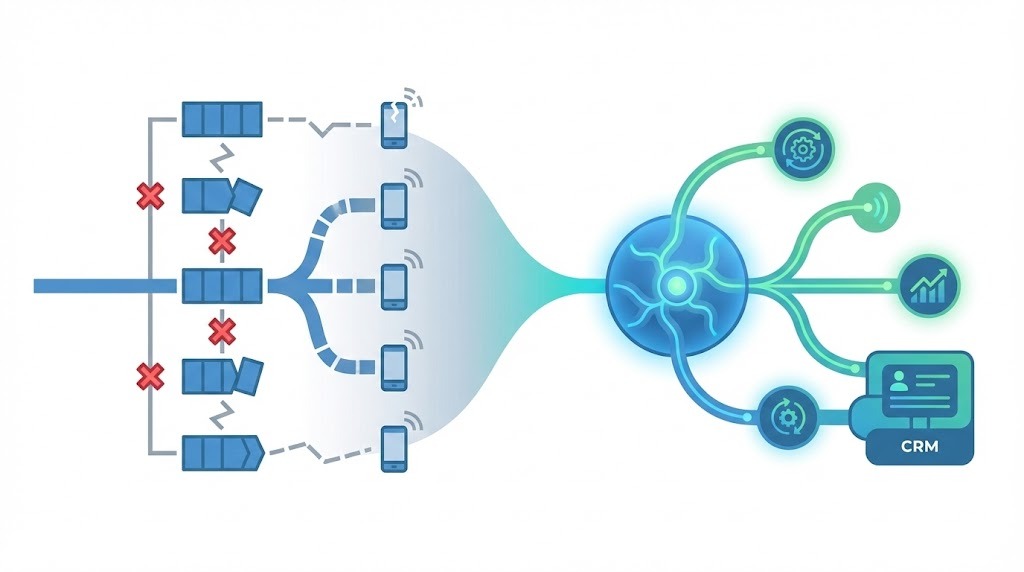
Contact center AI isn't a single technology—it's an orchestrated system of multiple AI capabilities working together. Understanding these components helps you evaluate solutions and set realistic expectations.
Natural Language Processing (NLP)
NLP enables AI to understand human language as we naturally speak it. Instead of forcing customers to navigate menus or use specific keywords, NLP interprets intent from free-form speech or text. It recognizes that "I need to update my payment info," "my credit card changed," and "can you switch my billing method?" all mean the same thing.
Advanced NLP also handles language variations, accents, slang, and even incomplete sentences—making interactions feel natural rather than robotic.
Machine Learning & Predictive Analytics
Machine learning algorithms improve contact center performance by analyzing historical data to predict future patterns. This powers:
- Call volume forecasting: Predicting busy periods to optimize staffing
- Churn prediction: Identifying at-risk customers before they leave
- Intent prediction: Anticipating what customers need based on browsing behavior or account activity
- Next-best-action recommendations: Suggesting the most effective response or offer for each customer
The more data these systems process, the smarter they become—constantly refining predictions without manual programming.
Conversational AI
Conversational AI combines NLP with dialogue management to conduct full conversations, not just answer single questions. These systems remember context throughout an interaction, ask clarifying questions, and handle multi-turn dialogues naturally.
This technology powers both text-based chatbots and voice agents that can book appointments, process returns, gather lead information, or troubleshoot technical issues through natural conversation.
Sentiment Analysis
Sentiment analysis detects emotional tone in customer communications—whether someone is frustrated, satisfied, confused, or angry. This happens in real-time during live interactions and through post-interaction analysis of transcripts.
Contact centers using sentiment analysis can automatically escalate unhappy customers to senior agents, flag potential churn risks, and identify training opportunities by analyzing which interactions led to positive versus negative sentiment.
Intelligent Call Routing (ICR)
Modern ICR goes far beyond "press 1 for sales, 2 for support." AI routing considers:
- Customer value and history
- Agent skills and performance metrics
- Real-time sentiment and urgency signals
- Language preferences
- Previous interaction outcomes
- Current agent workload and stress levels
This ensures customers reach the agent most likely to resolve their issue quickly, reducing transfers and improving first-call resolution rates.
Core Applications of AI in Contact Centers
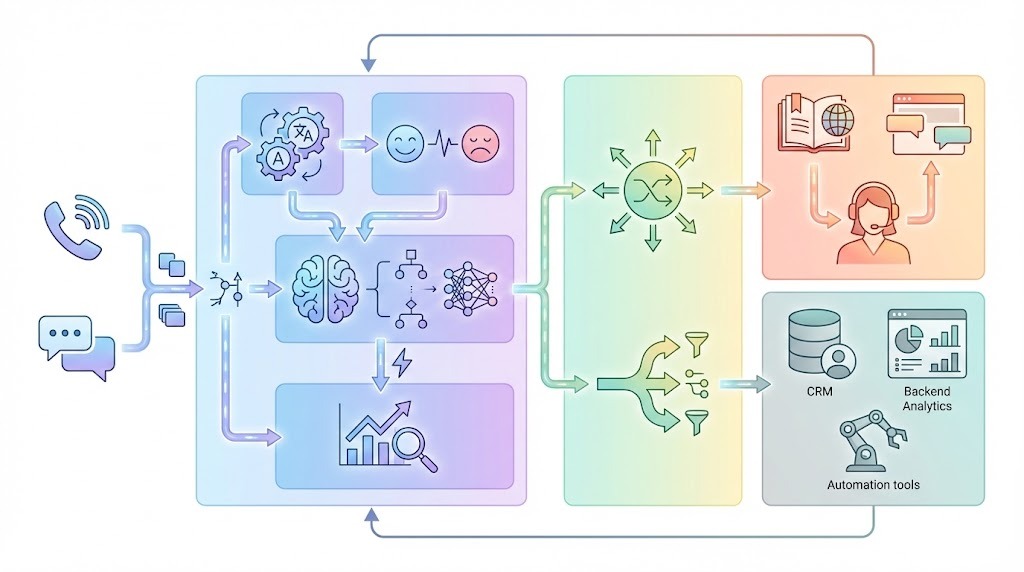
Understanding how these technologies translate into practical applications helps you identify where AI can deliver the most value for your operation.
AI-Powered Chatbots and Voice Agents
Modern AI agents have evolved far beyond simple FAQ bots. They now handle complex, multi-step processes:
- Qualifying inbound leads by asking discovery questions
- Scheduling appointments across multiple calendar systems
- Processing returns and refunds within policy parameters
- Troubleshooting technical issues with guided workflows
- Collecting payments and updating account information
The key difference from older systems: these agents understand context, handle conversational nuances, and know when to escalate to humans. They don't just respond to keywords—they comprehend intent and deliver appropriate solutions.
Voice agents in particular have become remarkably sophisticated. They can detect hesitation in a caller's tone, adjust their speaking pace to match the customer, and even handle interruptions naturally. For businesses, this means 24/7 availability without compromising service quality.
Real-Time Agent Assist
While AI agents handle routine inquiries, AI copilots empower human agents during complex interactions. Real-time agent assist provides:
- Instant knowledge base search: Surfaces relevant articles and solutions as the conversation unfolds
- Response suggestions: Offers pre-written responses to common questions, maintaining consistency
- Cross-sell opportunities: Identifies relevant products or services based on customer needs
- Compliance alerts: Warns agents before they violate regulations or policies
- Sentiment indicators: Alerts agents when customer frustration is rising
This technology effectively gives every agent access to your best performer's knowledge and decision-making, reducing training time and improving outcomes across your team.
Automated Quality Assurance
Manual QA is expensive and incomplete. AI-powered quality assurance automatically evaluates 100% of interactions against your quality standards, checking for:
- Greeting and closing procedures
- Compliance with scripts and regulations
- Tone and professionalism
- Resolution effectiveness
- Cross-sell and upsell execution
- Customer satisfaction indicators
Instead of managers spending hours listening to random calls, AI flags the best examples for training and the problematic interactions that need coaching—with specific timestamps and actionable feedback.
Predictive Call Routing and Workforce Management
AI doesn't just route individual calls better—it optimizes your entire operation:
- Forecasting: Predicts call volumes by hour, day, and season based on historical patterns and external factors (weather, holidays, marketing campaigns)
- Scheduling: Automatically generates optimal agent schedules that match predicted demand
- Skills-based routing: Ensures your most skilled agents handle the most complex or valuable interactions
- Real-time adjustments: Redirects calls when volumes spike or agents become unavailable
This level of optimization was previously only achievable by massive enterprises with dedicated workforce management teams. AI makes it accessible to contact centers of any size.
Automated Summaries and Documentation
Perhaps the most immediate time-saver: AI eliminates after-call work. Instead of agents spending 3-5 minutes summarizing each interaction, AI automatically:
- Transcribes the entire conversation
- Generates a concise summary with key points
- Extracts action items and follow-up tasks
- Updates CRM records with relevant information
- Categorizes the interaction for reporting
This not only saves time but improves accuracy and consistency in your records. Agents can move to the next interaction immediately while AI handles documentation in the background.
Benefits of Implementing Contact Center AI
The business case for contact center AI extends far beyond "cool technology." Here's what the data shows about real-world impact:
Operational Cost Reduction
Gartner projects contact centers will save $80 billion in labor costs by 2025 through AI automation. This happens through:
Real Impact: The cost per customer interaction can drop from $5-15+ to under $1 for AI-handled conversations, while human agents focus on high-value interactions that justify their cost.
- Deflecting routine inquiries to self-service (reducing call volume by 30-40%)
- Decreasing average handle time through agent assist (13.8% improvement on average)
- Reducing after-call work from 3-5 minutes to under 30 seconds
- Optimizing scheduling to eliminate overstaffing
Improved Customer Satisfaction
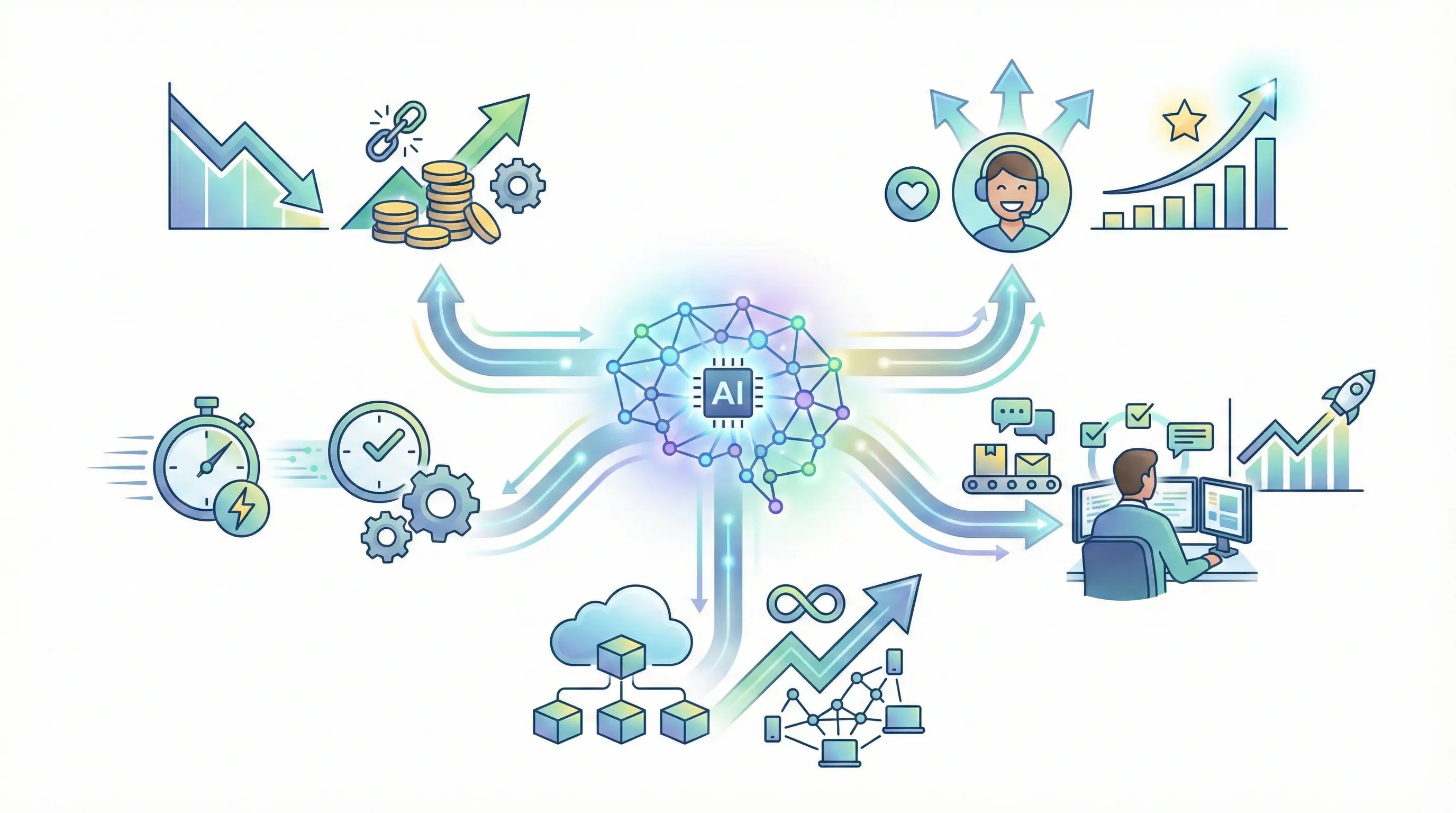
Customer Expectations: Nearly 90% of customers value experience as much as products or services, according to Salesforce.
Contact center AI improves satisfaction by:
- Eliminating hold times for common questions (instant AI response)
- Providing 24/7 availability without quality degradation
- Routing customers to the right specialist on the first try
- Personalizing interactions based on history and preferences
- Reducing repeat contacts through better resolution
Companies implementing AI see customer satisfaction scores increase by 15-25% within the first year, with the most dramatic improvements in response time and first-contact resolution metrics.
Increased Agent Productivity and Satisfaction
AI doesn't just make agents faster—it makes their jobs better:
- Eliminates repetitive questions they've answered a thousand times
- Provides instant access to information without searching multiple systems
- Automates tedious documentation work
- Offers coaching and suggestions in real-time
- Creates more opportunities to solve interesting problems
This matters for retention. Contact center turnover averages 30-45% annually. Organizations using AI report improved agent satisfaction as staff focus on meaningful work rather than mundane tasks.
24/7 Availability and Scalability
Traditional contact centers face a fundamental constraint: they can only handle as many interactions as they have agents. Scaling means hiring, training, and managing more people—a slow, expensive process.
Scale Instantly: Whether you receive 100 or 10,000 calls tomorrow, AI voice agents answer them all. No hiring, no training delays, no quality degradation.
AI scales instantly. This enables businesses to:
- Support customers across global time zones without offshore centers
- Handle unexpected spikes (product launches, service outages) without degradation
- Test new markets or channels without massive upfront investment
- Provide consistent service quality regardless of volume
For growing businesses, this removes a major bottleneck from expansion plans.
Data-Driven Insights and Decision Making
Every AI interaction generates data—and contact center AI turns that data into intelligence:
- Identify common issues before they become crises
- Spot emerging customer needs for product development
- Measure which agents excel at specific interaction types
- Track compliance and quality trends over time
- Calculate ROI of specific service improvements
Contact centers using AI analytics report making faster, more confident decisions because they have comprehensive data rather than anecdotal evidence from sampled interactions.
How Aloware Delivers Contact Center AI That Works
While many platforms bolt on AI as an afterthought, Aloware built its contact center solution with AI at the core, integrated natively with calling, texting, and CRM.
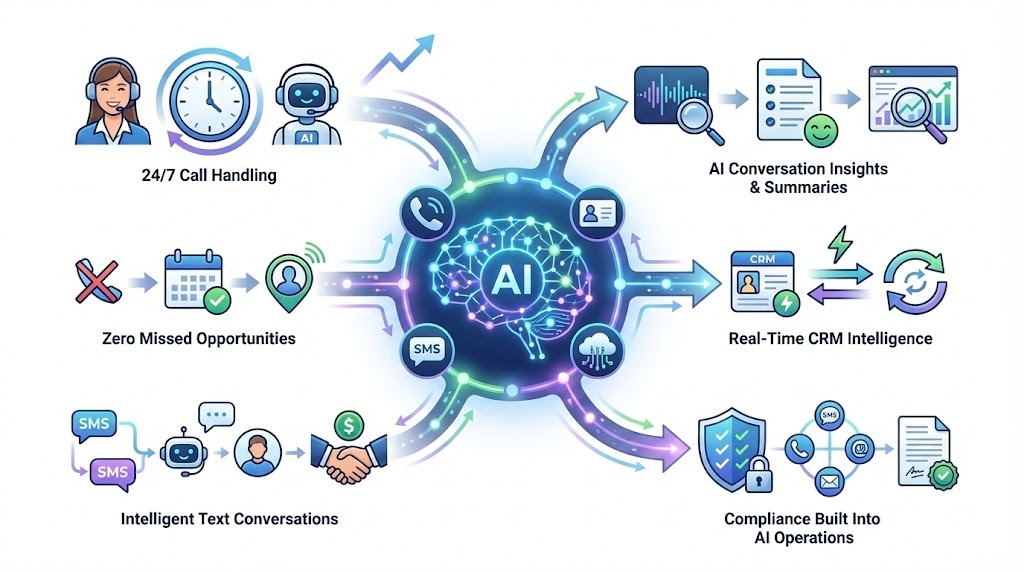
AloAi Voice Agents: 24/7 Call Handling
Aloware's AI voice agents don't just answer phones—they complete tasks. They can qualify leads, schedule appointments, gather customer information, and route urgent issues to human agents, all through natural conversation. Because they're built into the Aloware platform rather than integrated as a third party, they have instant access to your CRM data and call history.
This matters when a prospect calls back after filling out a form. The AI voice agent already knows what they submitted, which email campaigns they've engaged with, and their interaction history—creating a personalized conversation from the first hello.
AI Missed Call Handler: Zero Missed Opportunities (New)
Aloware's AI Missed Call Handler ensures 100% answer rates by automatically catching calls when your team is unavailable. Whether agents are busy, after hours, or at capacity, the AI steps in immediately to engage the caller.
The missed call handler doesn't just take messages—it qualifies leads, answers common questions, schedules callbacks at convenient times, and syncs everything to your CRM. This means the 3 AM website visitor who calls gets the same professional experience as a 2 PM caller, and your team wakes up to qualified leads instead of voicemails.
AloAi SMS Chatbot: Intelligent Text Conversations
Aloware's AI SMS chatbot handles text conversations with the same intelligence as voice interactions. It nurtures leads through automated SMS sequences, responds to inbound texts with context-aware answers, and escalates to human agents when needed.
The SMS bot integrates with your outreach campaigns—if a lead responds "Tell me more" to your promotional text, the AI can answer product questions, share pricing, and book demos automatically. It achieves up to 67% higher connection rates than voice-only outreach by meeting customers in their preferred channel.
AI Conversation Insights and Summaries
Every call through Aloware gets automatically transcribed and analyzed. The AI generates custom summaries tailored to your KPIs—highlighting action items, customer concerns, sentiment, and outcomes without requiring agents to write notes.
Managers can search across all conversations for specific topics, track trends over time, and identify coaching opportunities without listening to hours of recordings. The AI flags exceptional interactions for training examples and problematic ones for review.
Automated Entity Mapping: Real-Time CRM Intelligence
Aloware's Automated Entity Mapping goes beyond basic CRM integration by maintaining real-time bidirectional data flow between your contact center and CRM. When a contact's information updates in your CRM, it's instantly available to agents and AI systems. When an AI voice agent books an appointment or updates a deal stage, it reflects in your CRM immediately.
This eliminates the lag that causes agents to work with outdated information or AI systems to make decisions based on stale data. Entity Sync ensures your AI voice agents always have the latest context—knowing if a lead just became an opportunity, if a customer's subscription is expiring, or if they've already spoken with another team member today.
Seamless CRM Integration with AI Context
Aloware integrates natively with HubSpot, Salesforce, Zoho, Pipedrive, HighLevel, and other popular CRMs. The AI uses this integration to:
- Surface relevant contact information during calls
- Log interactions and outcomes automatically
- Trigger workflows based on conversation outcomes
- Update deal stages and contact properties
- Schedule follow-up tasks for human agents
This eliminates the manual data entry that typically consumes 20-30% of agent time, while ensuring your CRM stays current and accurate.
Compliance Built Into AI Operations
Aloware handles the complex compliance requirements that trip up many businesses using AI:
- A2P 10DLC registration: Simplified campaign registration to maintain high SMS delivery rates
- DNC list management: Automatic filtering to avoid calling numbers on Do Not Call lists
- TCPA compliance: Call recording consent handling and time-zone-aware dialing restrictions
- STIR/SHAKEN verification: Carrier identity verification to prevent spam labeling
The AI works within these compliance guardrails automatically, reducing your legal risk while maintaining operational efficiency.
Challenges and Considerations When Implementing Contact Center AI
While the benefits are substantial, successful implementation requires addressing several common challenges:
Data Privacy and Security
AI systems require access to customer data to function effectively. This raises important questions:
- How is customer data stored and protected?
- Who has access to conversation recordings and transcripts?
- What happens if the AI vendor experiences a breach?
- How do you comply with GDPR, CCPA, and other privacy regulations?
Look for vendors with SOC 2 certification, encrypted data storage, and clear data handling policies. Ensure your AI implementation includes customer consent for recording and analysis where legally required.
Integration Complexity
Legacy contact center infrastructure wasn't built for AI. Integration challenges include:
- Connecting AI systems to existing CRM and business tools
- Maintaining data consistency across multiple systems
- Training AI on company-specific knowledge and policies
- Managing handoffs between AI and human agents
Platforms like Aloware that offer native integrations significantly reduce this complexity compared to stitching together multiple point solutions.
Managing the Human-AI Balance
Over-automation frustrates customers. Under-automation wastes AI investment. Finding the right balance requires:
- Identifying which interactions truly need human touch
- Creating clear escalation paths when AI reaches its limits
- Setting customer expectations about AI versus human service
- Training agents to work alongside AI rather than competing with it
Research shows 62% of customers prefer chatbots for simple questions, but that same majority wants seamless access to humans for complex issues. Design your system to deliver both.
Continuous Training and Optimization
AI isn't a "set it and forget it" solution. It requires:
- Regular review of AI conversation quality
- Updating knowledge bases as products or policies change
- Monitoring for AI errors or inappropriate responses
- Adjusting routing rules based on performance data
- Retraining models as customer needs evolve
Budget time and resources for ongoing optimization, not just initial implementation.
Best Practices for Successful Contact Center AI Adoption
Organizations that successfully implement contact center AI follow these proven approaches:
Start with High-Volume, Low-Complexity Use Cases
Don't try to automate everything on day one. Begin with interactions that are:
- Frequent (hundreds or thousands monthly)
- Straightforward (limited variables and decision trees)
- Well-documented (clear processes and answers)
- Low-risk (not high-value sales or sensitive issues)
Common starting points include appointment scheduling, order status inquiries, password resets, and FAQ responses. Build confidence and gather data before tackling more complex scenarios.
Maintain Human Oversight and Quality Control
Even the best AI makes mistakes. Implement:
- Regular sampling of AI interactions for quality review
- Easy customer access to human agents (one-click escalation)
- Feedback mechanisms to flag AI errors
- Performance metrics tracked alongside human agent metrics
- Rapid response protocols when AI issues arise
Treat AI agents like new hires—close supervision initially, more autonomy as they prove reliable.
Focus on Agent Enablement, Not Replacement
Position AI as a tool that makes agents better, not as a replacement threat. This requires:
- Clear communication about how AI will affect roles
- Training on working effectively with AI assist tools
- Recognition for agents who excel at handling AI escalations
- Career paths that emphasize judgment and relationship skills
- Involving agents in AI implementation and feedback
Organizations that engage agents in the AI adoption process see faster implementation, better utilization, and lower resistance.
Measure What Matters
Define success metrics before implementation:
- Cost per interaction (AI vs. human)
- Customer satisfaction scores (by interaction type)
- First-contact resolution rates
- Average handle time reduction
- Agent utilization and satisfaction
- Return on AI investment
Track these metrics weekly during rollout, then monthly once stable. Use the data to justify expansion, identify issues early, and demonstrate ROI to stakeholders.
Plan for Personalization at Scale
The real power of AI emerges when it delivers personalized experiences to every customer. This requires:
- Rich customer data integration (CRM, purchase history, support history)
- Segmentation strategies (VIP customers, at-risk accounts, new users)
- Customized conversation flows for different customer types
- Dynamic responses based on individual context
- Feedback loops that improve personalization over time
Generic AI interactions feel robotic. Personalized AI interactions feel magical.
The Future of Contact Center AI: What's Coming Next
The pace of AI advancement shows no signs of slowing. Here's what's emerging:
Agentic AI and Multi-Agent Systems
Next-generation AI won't just respond to customer requests—it will take proactive action. Imagine AI that:
- Detects a payment failure and automatically reaches out with resolution options
- Identifies a frustrated customer in your app and initiates a support chat before they complain
- Recognizes cross-sell opportunities and makes personalized recommendations
- Coordinates across multiple AI agents (billing, technical, sales) to resolve complex issues
This "agentic" approach moves AI from reactive to proactive, reducing customer effort while increasing efficiency.
Emotion AI and Advanced Sentiment Analysis
Current sentiment analysis detects basic emotional states (positive, negative, neutral). Emerging emotion AI will recognize nuanced feelings like:
- Confusion versus frustration
- Enthusiasm versus skepticism
- Impatience versus anger
- Sarcasm versus sincerity
This enables more sophisticated response strategies, better escalation decisions, and deeper insights into customer experience quality.
Unified AI Across All Channels
Today's AI often operates in silos—separate systems for phone, chat, email, and social media. The future is unified AI that:
- Maintains context as customers switch channels mid-conversation
- Uses insights from one channel to improve service in another
- Orchestrates consistent experiences regardless of how customers reach out
- Learns from interactions across all channels to improve everywhere
This creates truly omnichannel experiences rather than multi-channel disconnection.
AI-Generated Training and Coaching
AI will soon coach agents in real-time, not just suggest responses:
- Identify specific skill gaps by analyzing interaction patterns
- Generate personalized training modules targeting those gaps
- Provide real-time feedback during conversations (like a coach whispering tips)
- Simulate difficult customer scenarios for practice
- Track improvement over time and adjust coaching accordingly
This creates a continuous improvement loop where every agent has access to expert-level coaching.
Getting Started with Contact Center AI
Contact center AI has matured from experimental technology to business-critical infrastructure. With 95% of customer interactions expected to be AI-powered by 2025, the question isn't whether to adopt AI—it's how quickly you can implement it effectively.
Start by identifying your biggest operational pain points:
- Are missed calls costing you leads?
- Are agents spending too much time on repetitive questions?
- Can't scale support to match business growth?
- Struggling to maintain 24/7 availability?
- Need better insights from customer interactions?
Contact center AI solves these challenges while reducing costs and improving customer satisfaction. The businesses winning in 2026 aren't the ones with the most agents—they're the ones using AI to make every interaction count.
Ready to see how Aloware's AI-powered contact center can transform your customer operations? Start your free trial or book a demo to experience AI voice agents, automated call routing, and CRM-integrated conversations in action.
Frequently Asked Questions
Will AI replace human contact center agents?
No. AI handles routine, repetitive inquiries that don't require human judgment, creativity, or empathy. Human agents focus on complex issues, relationship building, and situations requiring emotional intelligence. The most successful contact centers use AI to augment humans, not replace them. Organizations report that AI improves agent satisfaction by eliminating tedious work and allowing them to do more meaningful tasks.
How long does it take to implement contact center AI?
Implementation timelines vary based on complexity, but most businesses see initial AI capabilities live within 2-4 weeks for basic chatbots or voice agents. Full-featured implementations with CRM integration, custom workflows, and optimized routing typically take 2-3 months. Cloud-based solutions like Aloware deploy faster than on-premises systems that require hardware installation.
What's the typical ROI of contact center AI?
Organizations report an average return of $3.50 for every $1 invested in AI customer service, with leading companies achieving 8x ROI. Returns come from reduced labor costs, improved conversion rates, lower customer churn, and increased agent productivity. Most businesses break even within 6-12 months.
How do customers feel about interacting with AI?
Customer acceptance of AI varies by context. 62% prefer chatbots over waiting for human agents for simple questions, and 74% prefer AI for straightforward inquiries. However, most want easy access to humans for complex or sensitive issues. The key is transparency (don't pretend AI is human), capability (ensure AI works well), and easy escalation (one-click transfer to agents).
What happens when AI doesn't understand a customer's question?
Modern AI systems include fallback protocols. When confidence drops below a threshold, they typically:
- Ask clarifying questions to better understand intent
- Offer multiple options for the customer to choose from
- Seamlessly transfer to a human agent with full context
- Log the interaction for training data to improve future responses
Well-designed systems make these transitions smooth, maintaining customer context so they don't have to repeat themselves.
How secure is contact center AI?
Security depends on the vendor. Look for SOC 2 Type II certification, end-to-end encryption, data residency options, and clear data retention policies. Reputable vendors invest heavily in security because trust is essential. Ask potential vendors about their security practices, breach protocols, and compliance certifications before committing.
Can AI handle multiple languages?
Yes, but capabilities vary. Basic translation features exist in most platforms, but true multilingual support requires AI trained on multiple languages with understanding of cultural context and idioms. Some platforms offer 100+ languages with varying quality levels. If multilingual support is critical, test the AI in your required languages before purchasing.
.png)

Ruby Kootval is Head of Product Marketing at Aloware. She has 12 years in digital marketing, including 8 in B2B SaaS and 5 in telecom, and writes about AI voice agents, dialers, CRM integrations, and contact center operations.