


There’s a version of customer success that looks like this: four browser tabs open, a half-downloaded CSV sitting in your downloads folder, a Jira board you haven’t refreshed in two days, and a nagging feeling that somewhere in your book of business, an account is quietly slipping — and you just don’t know it yet.
Sound familiar? That was us. And honestly, for a while, we just accepted it.
At Aloware, our Customer Success team manages dozens of accounts at a time. Every month, we’d try to do what we call a health audit — a full check-in on each account covering usage data, support activity, open engineering issues, and overall platform engagement. In theory, it was a great process. In practice, it meant manually logging into Metabase, HubSpot, Jira, and Intercom, pulling numbers from each, stitching them together, and writing a note in HubSpot. For 80+ accounts. Every month.
We couldn’t keep up. And the accounts we missed were exactly the ones that could have used our attention most.
The Problem Wasn’t Effort — It Was Bandwidth
Here’s the thing: our CSMs aren’t lazy. They’re just stretched. When you’re managing renewals, onboarding new clients, responding to support escalations, and running QBRs, a four-tab manual audit process doesn’t survive contact with a real workday. We’d fall behind, skip months, or rush through accounts just to say we did it.
“Accounts going red while they’re still labeled green. Customers who needed a proactive outreach getting a reactive one — after the damage was already done.”
What we needed wasn’t more discipline. We needed a smarter process.
What We Built: An AI-Powered Health Card
So we built one. We call it the Account Health Report Card, and it runs entirely inside Claude — Anthropic’s AI — connected directly to the tools we already use every day.
Here’s what happens when a CSM types a single command: Claude simultaneously reaches into four data sources and synthesizes everything into a clean, visual health card in about 30 seconds:
- Metabase — live call and SMS usage data
- HubSpot — plan details, MRR, and audit fields
- Intercom — open and recent support conversations
- Jira — any open engineering issues tied to the account
The card surfaces everything that matters at a glance: agent counts, outbound call and SMS volume per user per day, onboarding progress, credit balance, which agents are most active, and a full summary of recent support activity. It even auto-classifies each account — Green, Yellow, or Red — based on real usage signals, and flags when that classification has changed since the last audit.
↑ Account Health Report Card — data pulled live from Metabase, HubSpot, Intercom & Jira. Account name redacted.
What used to take 20–30 minutes of tab-switching per account now takes seconds. And the information is more complete than what we were doing manually, because no step gets skipped when a machine is doing it.
Human in the Loop — On Purpose
Now, here’s the part that makes this more than just a fancy report: Claude doesn’t just show you the data. It gives you something you can act on and then actually post.
After reviewing a health card, the CSM gets a second tool — the Monthly Audit widget. It pre-fills all seven HubSpot audit fields based on what Claude pulled: churn risk color, signs of abandonment, whether the account is responsive, last audit date, churn risk notes, and a company overview. Everything is editable — because sometimes you know something the data doesn’t. Maybe a client mentioned something in a call last week that changes the picture entirely. The CSM adjusts, adds their notes, and clicks one button.
Claude writes it all back to HubSpot: updates the seven audit fields on the company record and creates a structured monthly health note — automatically, with every data point, timestamp, and next step included.
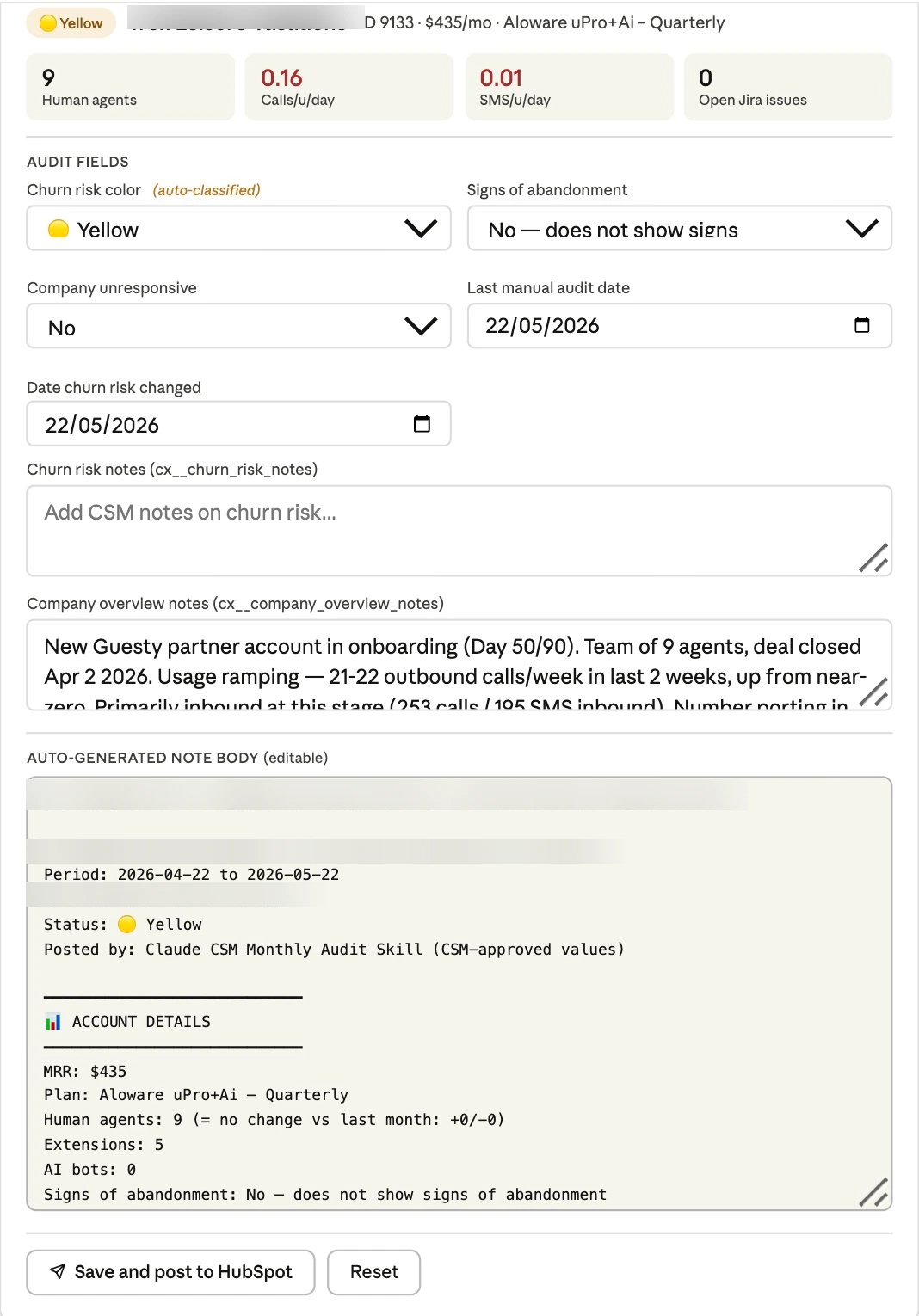
↑ Monthly Audit widget — pre-filled from the health card, fully editable. One click posts to HubSpot. Account name redacted.
“AI is exceptional at gathering and synthesizing information across systems. But judgment — the call about whether an account is truly at risk or just going through a normal ramp — still belongs to the CSM who knows the relationship.”
That “human in the loop” piece is intentional. The tool is designed to inform your judgment, not replace it.
What This Actually Changes
The time savings are real — what used to be a half-day process for a CSM managing 30 accounts now takes a fraction of the time. But the more meaningful shift is behavioral.
When audits are hard, CSMs do them on the accounts they’re already worried about. When audits are easy, they do them on all their accounts — including the quiet ones that look fine on the surface but are slowly drifting. That’s where churn hides.
There’s also a standardization benefit that’s easy to underestimate. Before, every CSM did their audits a little differently. Some were thorough, some were rushed, and all of them looked different. Now every health note that lands in HubSpot follows the same structure, covers the same signals, and is consistent across the whole team. Managers can compare accounts across CSMs and spot patterns they couldn’t see before. That’s genuinely new.
Built by a CSM, Not an Engineer
One more thing worth saying: this wasn’t built by our product or engineering team. It was built by a CSM — someone who manages accounts for a living and got tired of a broken process. No coding background. Just a clear problem and the right tools.
That’s the real story here. The barrier to building AI-powered workflows that solve real operational problems has dropped dramatically. At Aloware, we’re betting on that — and this is just the beginning.
If you’re a customer success team still living in four tabs, there’s a better way. We’re already using it.
.png)

Ruby Kootval is Head of Product Marketing at Aloware. She has 12 years in digital marketing, including 8 in B2B SaaS and 5 in telecom, and writes about AI voice agents, dialers, CRM integrations, and contact center operations.
.png)