.jpeg)


TL;DR
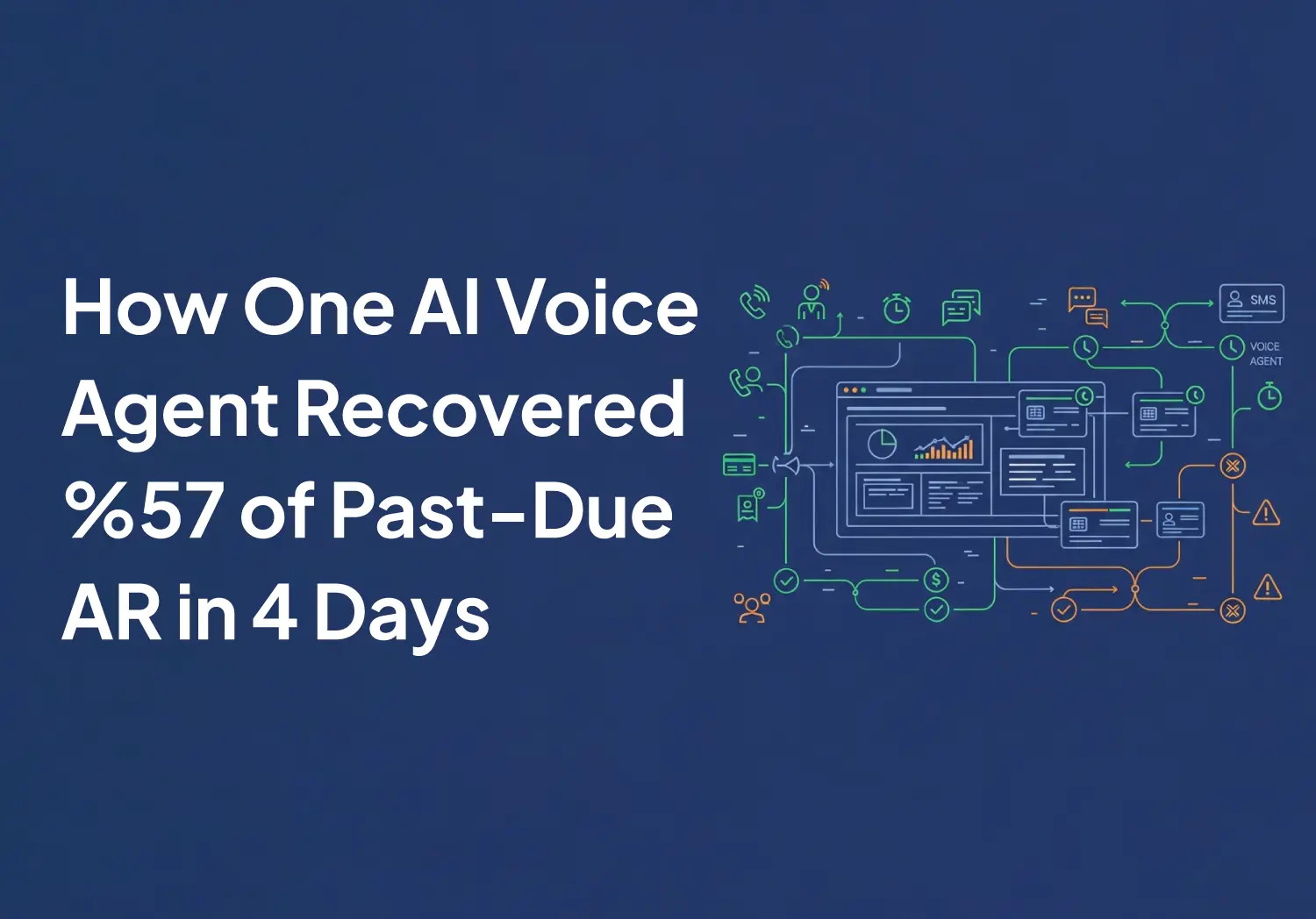
Aloware’s senior director of client experience built an AI voice agent + HubSpot workflow that collected 57% of past-due self-serve payments within 4 days and saved her team 10+ hours a month on manual follow-up.
The setup: one dedicated outbound line, one AI textbot, one AI voice agent, triggered by HubSpot automation. This post walks RevOps leaders through the playbook — and why the long-tail of self-serve AR is where AI pays for itself fastest.
Every RevOps leader running a self-serve or product-led motion knows the math problem.
The top 20% of your ARR gets white-glove treatment — dedicated CSMs, named AEs, executive sponsors. The long tail? It’s a spreadsheet. Hundreds or thousands of smaller MRR accounts that collectively represent real revenue, but individually can’t justify a human touch on every invoice, every renewal, every past-due notice.
And then dunning starts failing. A card expires. A retry hits a daily limit. An invoice slips 15 days past due, then 30, then 45. Your collections process kicks in — which, for self-serve accounts, usually means a shared inbox, a rotating CSM, and a best-effort cadence of emails and calls that nobody’s measuring closely because nobody has time to.
This is the gap Brandy, our senior director of client experience at Aloware, set out to close. Her constraint was simple: recover more of the self-serve AR that was falling through the cracks, without adding headcount and without pulling her team off higher-value work.
Her solution — an Aloware AI voice agent connected to a HubSpot workflow — collected 57% of past-due self-serve payments within four days and gave her team back 10+ hours a month.
Here’s how it works, and why the economics make sense specifically for the long-tail accounts any RevOps team running a subscription billing stack will recognize immediately.
The problem: self-serve collections is an economics problem, not an effort problem
If you run subscription billing at scale, you already know that failed payments and past-due invoices are not rare edge cases. Industry research on SaaS churn consistently puts involuntary churn — churn caused by failed payments rather than customer intent — at 20 to 40 percent of total churn (per ProfitWell research, corroborated by Recurly’s 2025 Churn Report). That’s revenue walking out the door not because customers wanted to leave, but because a card failed and nobody successfully reached them to update it.
Modern subscription billing platforms handle the automated retry logic beautifully — smart retries, dunning email sequences, in-app notifications. What they don’t do, and were never designed to do, is pick up the phone.
And for a meaningful slice of past-due accounts, a phone call is what actually moves the needle. Not because email is dead, but because after three automated emails have gone unanswered, a fourth is unlikely to be what breaks the pattern. A voice conversation — even a short one — does.
The problem is that paying a human to call every past-due self-serve account doesn’t pencil out. When the average past-due invoice is in the low hundreds of dollars and a fully-loaded collections rep costs $40–50 an hour, you can justify maybe 10 to 15 minutes of effort per account before you’re underwater. That’s enough time to dial, leave a voicemail, and send a follow-up text. It’s not enough time to actually have the conversation that resolves the issue.
So the work either doesn’t happen, or it happens badly. Accounts age further past due, write-offs climb, and the CSMs who could be driving expansion are instead triaging invoices.
The playbook: one line, two AI agents, one HubSpot trigger
The architecture Brandy built is deliberately simple. Complexity kills internal adoption of AI tools faster than anything else, so the goal was a workflow a RevOps team could stand up in an afternoon and a collections lead could operate without engineering support.
Step 1: Dedicated outbound line for collections. The first move is organizational, not technical. Create a dedicated phone line — Brandy called hers “outbound collections” — that only handles past-due communications. This matters for three reasons. Routing becomes deterministic. Response monitoring becomes clean. And when you look at your reporting later, every call, text, and voicemail on that line maps back to a single workflow, which makes measuring ROI straightforward.
Step 2: Deploy two AI agents on the line. Two agents, two channels, one purpose.
The first is an outbound AI textbot. It handles the SMS touch — a personalized text that references the specific invoice, offers a direct link to resolve the payment, and invites a reply if the customer has questions. It fires after the automated email that HubSpot already sends, catching customers who missed or ignored the email but will engage with a text. Most self-serve past-due accounts resolve here. A card that failed gets updated, an invoice that was missed gets paid, and the conversation never needs to escalate.
The second is an outbound AI voice agent. This is the third touch — after the email and the SMS have run their course, the voice agent places a live call, delivers the same message conversationally, and can handle objections, clarifications, or route to a human when the situation warrants it. Both AI agents live on the same dedicated line, so from the customer's perspective there's one consistent sender, one phone number to save, one channel to reply to.
Step 3: Trigger the workflow from HubSpot. The automation lives in HubSpot, managed through a past-due list. Accounts enter the list either automatically from your existing dunning rules or manually when a team member flags one — which keeps humans in the loop on exactly who gets worked. List membership triggers the sequence: an automated email first, the AI textbot via SMS second, and if neither resolves the issue, the AI voice agent calls. A CSM can add or remove accounts from the list at any point — pausing the sequence for a customer in an active conversation, or re-enrolling one whose payment failed again. If the voice agent resolves the issue, HubSpot updates and the account exits the list. If it doesn't, the account escalates to a human on the team with full context — transcript, call recording, prior messages — attached.
Once an account is on the list, the workflow runs on its own. No CSM is chasing past-due accounts one by one, no collections rep is deciding which to call next. The automation handles the cadence; humans stay in control of the list.
The results: 57% recovered in 4 days, 10+ hours saved monthly
In May, Brandy’s first full month running this workflow, the numbers came in clean:
• 57% of past-due self-serve accounts paid within 4 days of entering the workflow
• 10+ hours per month of manual follow-up eliminated — calls, texts, and email chasing that was previously spread across multiple team members
• Zero additional headcount required to run the motion
The recovery rate is the headline number, but the time savings is where the second-order value lives. Ten hours a month across a CS team is a CSM-week of capacity returned — capacity that’s now going into onboarding, expansion conversations, and QBRs instead of dunning.
The other thing worth naming: the accounts that didn’t resolve through the AI workflow escalated cleaner. When a human rep picked them up, they had a transcript, a call recording, and a clear sense of what had already been tried. The time-per-account on the hard cases dropped, because the easy cases had already been filtered out.
Why this specifically matters if you run subscription billing
If you’re running modern subscription billing, your dunning is probably already sophisticated on the automated-communication side. Smart retries, in-app banners, a multi-touch email sequence, maybe Slack or webhook notifications to CS when an account hits a specific past-due state.
What those platforms don’t do — and what most RevOps teams paper over with either expensive human effort or accepted write-offs — is the voice and SMS layer after the automated email sequence has exhausted itself.
An AI voice agent plugs into exactly that gap. It’s the layer between “our billing system has done everything it can automatically” and “we’ve given up or written it off.” For a self-serve book of business, that layer is where the largest chunk of recoverable revenue sits, because it’s the layer where the unit economics of human outreach have always broken down.
The integration model is straightforward in practice. Your billing system is the source of truth for past-due status. Your CRM — HubSpot, Salesforce, whatever — is the orchestration layer. The AI voice agent is the execution layer. When those three are wired together, collections becomes a workflow, not a project.
What to watch when you build this
A few honest notes from Brandy’s rollout, because none of this works if you get the fundamentals wrong:
Use a dedicated line. Mixing collections calls onto the same number your CSMs use for onboarding creates brand confusion and degrades answer rates. One number, one purpose.
Keep the opening touch a text, not a call. SMS has higher open rates, lower friction, and for a card-update scenario, the customer can act in the same channel. Voice is the escalation, not the default.
Give the voice agent a clear handoff path. When a conversation gets complex — disputed charge, account change, cancellation request — the agent needs to route to a human cleanly, with context intact. Otherwise you recover the invoice but damage the relationship.
Measure from day one. The reason Brandy can say “57% in 4 days” is that the dedicated line and the HubSpot workflow made the reporting trivial. If you can’t draw a clean line from workflow entry to payment, you can’t optimize, and you can’t defend the program internally when someone asks whether the AI spend is paying for itself.
The bigger shift: collections as a workflow, not a cost center
Most RevOps leaders think about collections defensively — a cost to minimize, a risk to manage, a process to keep out of sight. The teams getting the most out of AI voice agents are the ones reframing it: collections is a revenue motion, and the long tail of self-serve AR is a recovery opportunity that was never properly worked because the economics didn’t support it.
AI changes the economics. At the unit cost of an AI interaction, working a $300 past-due invoice isn’t a losing proposition anymore. You can run the motion on every account, not just the ones big enough to justify human effort, and you can run it faster than a human team could.
57% recovery in 4 days. 10 hours a month returned to the team. No new headcount. That’s what this looks like when the architecture is right.

Frequently Asked Questions
How does an AI voice agent recover past-due payments?
An AI voice agent places automated outbound calls to customers with past-due invoices, delivering a conversational payment reminder, handling objections or questions, and routing to a human when the situation requires it. When paired with an SMS textbot as the opening touch and a CRM workflow as the trigger, it operates as a full collections sequence — resolving most accounts without human involvement and escalating the rest with full context attached.
What percentage of past-due accounts can AI collections recover?
In Aloware’s self-serve collections workflow, 57% of past-due accounts resolved payment within 4 days of entering the AI-driven sequence. Actual recovery rates depend on invoice size, account type, how aged the receivable is, and how well the workflow is tuned, but meaningful double-digit recovery is the realistic expectation for automated outreach on self-serve AR.
Does an AI voice agent replace my collections team?
No. It replaces the repetitive, low-complexity outreach that currently eats your team’s time — the first three touches on a past-due self-serve account, the ones that most often go unanswered or get resolved with a simple card update. Your human team moves up the stack to handle disputes, complex accounts, and relationship-sensitive conversations with full context from the AI agent’s prior interactions.
How does Aloware integrate with my billing platform and HubSpot?
Your subscription billing platform is the source of truth for past-due status. HubSpot orchestrates the workflow — when a contact crosses a past-due threshold, HubSpot enrolls them in an Aloware sequence. Aloware’s AI textbot and voice agent execute the outreach, log every interaction back to HubSpot, and update contact properties based on outcomes. The result is a closed-loop workflow where your billing, CRM, and communication systems share state.
How long does it take to set up AI collections?
A working version of this workflow can be stood up in a single afternoon: one dedicated outbound line, one textbot, one voice agent, one HubSpot automation. Ongoing tuning — script refinement, escalation logic, reporting — happens over the first few weeks as real conversations come in.
What kind of accounts is this best suited for?
Self-serve and long-tail MRR accounts where the unit economics of human outreach are difficult to justify. If your average past-due invoice is small relative to the cost of a collections rep’s time, an AI voice agent is the layer that makes working those accounts economically viable.
.png)

Brandi Rice is the VP of Revenue at Aloware, focused on the operational side of running a contact center: SDR onboarding, connection-rate diagnostics, A2P 10DLC and STIR/SHAKEN compliance, healthy calling behavior, and the KPIs that predict revenue. She writes for sales managers, RevOps leaders, and ops practitioners.
%20(1).webp)