

TL;DR
The right power dialer depends on what "hundreds of leads daily" actually means for your team. If raw dial count is everything, parallel dialers like Orum and Nooks hit 400–800 dials per rep per day. If your priority is conversations that actually land in your CRM and convert, a 1:1 power dialer with a pickup-rate stack outperforms higher dial volumes on pipeline output.
Here are the top power dialers for high-volume sales in 2026:
- Aloware — Best overall for CRM-integrated teams prioritizing conversations-per-hour and pipeline attribution
- Orum — Best for pure parallel dial volume in SaaS SDR environments
- Nooks — Best for parallel dialing with live AI coaching
- Kixie — Best mid-market option balancing volume, integrations, and cost
- JustCall — Best for international teams needing multi-line dialing on a budget
- Dialpad — Best for teams already on Dialpad's unified communications platform
Quick Comparison: Best Power Dialers for High-Volume Calling
How We Evaluated the Best Power Dialers
To build this guide, we analyzed dialing platforms across verified G2, Capterra, and TrustRadius reviews, pricing pages, and direct product testing. Our evaluation criteria:
Dial Volume Capacity: We measured realistic dials-per-rep-per-day under normal working conditions — not vendor marketing maximums.
Conversations-per-Hour: Raw dials don't equal pipeline. We prioritized platforms where pickup rates, caller ID health, and connect quality produce more actual conversations per shift.
CRM Integration Depth: Native integrations with HubSpot, Salesforce, and Pipedrive matter more than Zapier connections. We evaluated automatic call logging, AI summaries, and workflow triggers.
Compliance Architecture: TCPA abandoned-call rate compliance and caller ID reputation management (STIR/SHAKEN, CNAM) affect whether your numbers stay clean over time.
Pricing Transparency: We calculated total cost at realistic usage volumes, including per-minute fees, add-ons, and minimum commitments.
Setup and Ramp Time: A dialer a team can't configure in a week costs more than its monthly fee.
A note on data sources: dial volume ranges, conversation rates, and platform performance figures in this guide are derived from verified user reviews on G2, Capterra, and TrustRadius, supplemented by direct product testing. Competitor pricing is sourced from each vendor's published pricing page where available; platforms without published pricing are noted as "contact sales." Ranges reflect realistic working conditions, not vendor-stated maximums.
Parallel vs. 1:1: What Actually Drives "Hundreds of Leads a Day"
There are two architectures behind high daily dial counts, and they produce meaningfully different outcomes.
Parallel dialers call 3–10 numbers simultaneously and connect a rep to the first human who answers. Unanswered lines drop automatically. This is how SDRs reach 400–800 dials a day — the system absorbs dead time between connections. The tradeoffs: prospects sometimes hear a brief delay or silence during the hand-off, which suppresses pickup rates on connected calls, flags numbers as spam faster, and creates compliance complexity around the FCC's 3% abandoned-call rate threshold under TCPA.
1:1 power dialers call one number at a time. A rep handles every connected call from the first second, which keeps numbers cleaner, preserves pickup quality, and makes every call compliant by default. Daily volume caps at 150–300 dials, but each conversation tends to run longer and produce higher-quality outcomes.
What a rep can realistically do per day:
Note the conversations column. A parallel dialer produces roughly 2–3x more dials than a 1:1 power dialer, but only about 1.5–2x more conversations — because pickup rates drop as numbers get flagged and prospects disconnect during the hand-off delay.
Key takeaway: A parallel dialer doesn't 3x your conversations when it 3x's your dials. The pickup rate gap narrows the real difference significantly.
The 6 Best Power Dialers for High-Volume Sales in 2026
1. Aloware Best for: CRM-integrated teams where conversation quality and pipeline attribution matter more than raw dial count
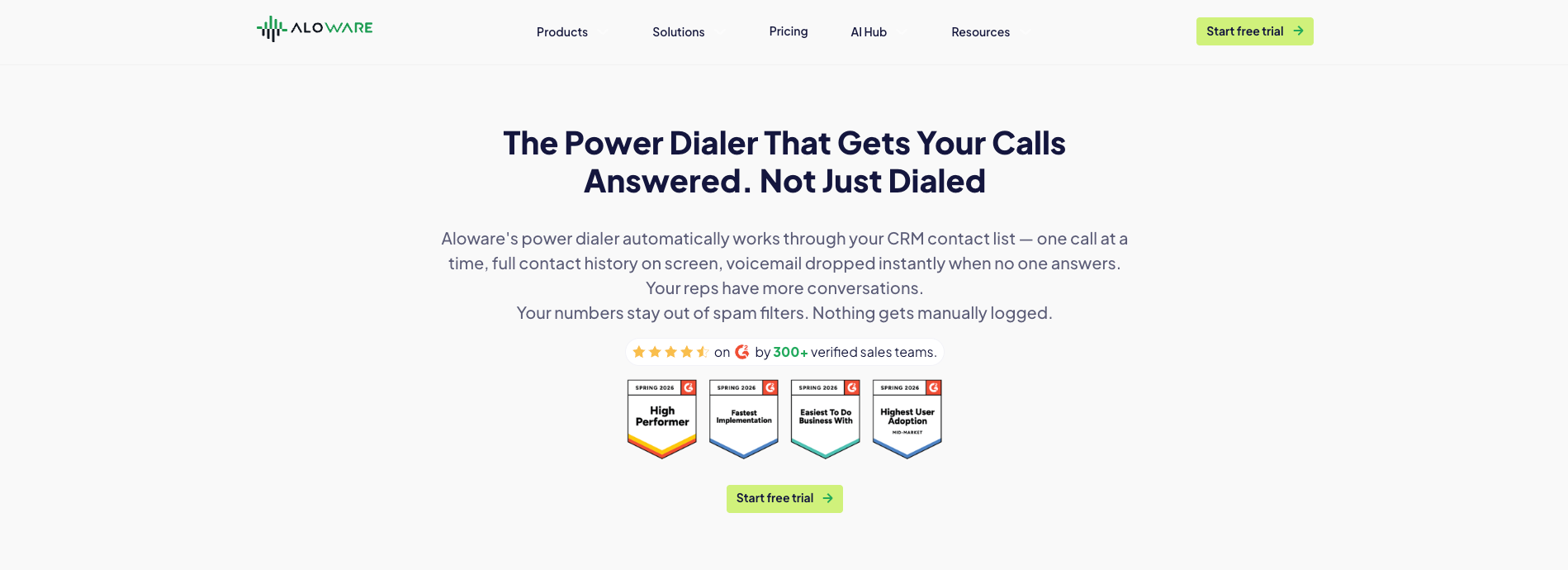
Aloware is a 1:1 power dialer built into a full contact center platform, with native integrations for HubSpot, Salesforce, Pipedrive, and Zoho. Rather than competing on raw dial volume, Aloware competes on what happens to each connected call: full CRM context is available before the rep speaks, AI call summaries log automatically to the contact record after the call ends, and a Pickup Stack (NumberGuard + Branded Calling + local presence dialing) actively defends answer rates so more of those dials turn into real conversations.
For teams where the deal matters — not just the dial — Aloware is the most complete platform on this list.
Key Features:
- 1:1 power dialer with voicemail drop and local presence dialing
- NumberGuard for real-time caller ID reputation monitoring
- Branded Calling to display company name and logo on outbound calls
- AI call summaries auto-logged to HubSpot, Salesforce, Pipedrive, or Zoho
- Native CRM integration (HubSpot Certified Partner)
- Unlimited inbound and outbound agent calling minutes on all plans
- SMS and MMS sequencing within CRM workflows
- TCPA-compliant calling by architecture (1:1 dialing, no abandoned-call exposure)
Integrations: HubSpot (certified partner), Salesforce, Pipedrive, Zoho, GoHighLevel, Guesty, Zapier, Gong
Pricing:
- iPro + AI: $30/user/month (billed quarterly)
- uPro + AI: $60/user/month (billed quarterly)
- xPro + AI: $85/user/month (billed quarterly)
- Unlimited agent-to-consumer calling minutes included on all plans
- 7-day free trial available
Pros:
- Deepest native CRM integrations in this comparison
- Unlimited agent calling minutes — no per-minute billing surprises
- Pickup Stack meaningfully improves answer rates without parallel dialing
- TCPA-compliant architecture with no abandoned-call risk
- All-in-one: dialer, SMS, AI, and analytics in one platform
Cons:
- Daily dial ceiling (150–300) is lower than parallel dialers — not the right pick if raw dial count is the only metric
- Geographic coverage primarily US and Canada
- AI minutes capped on lower tiers; heavy AI usage requires higher plans
- Local presence limited to US numbers
2. Orum
Best for: SaaS SDR teams with strict daily dial quotas and dedicated outbound sequences
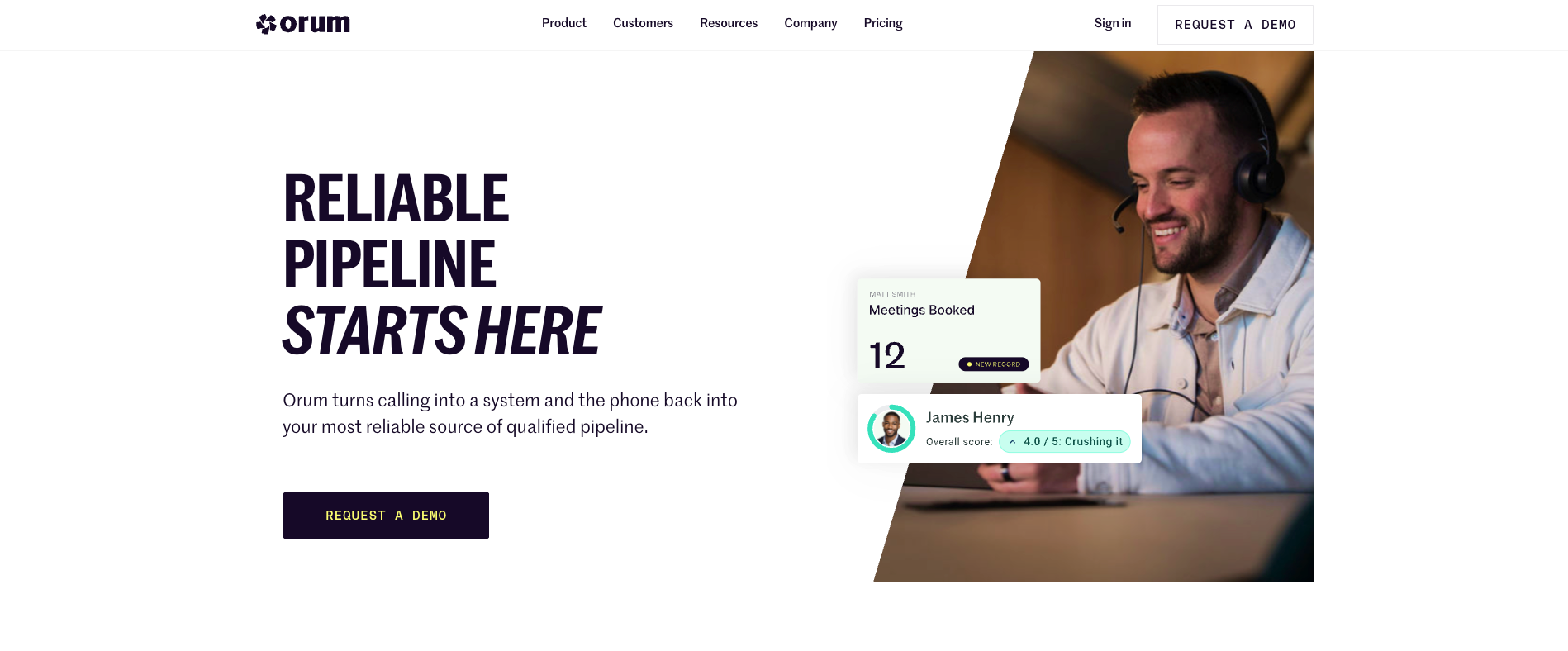
Orum is a parallel dialer purpose-built for outbound volume. It calls up to 10 lines simultaneously, uses AI voice detection to connect reps only when a human answers, and skips voicemails automatically. For teams measured purely on dials per day, Orum pushes the ceiling higher than any other platform on this list.
Key Features:
- Parallel dialing up to 10 simultaneous lines
- AI human/voicemail detection
- Auto-skip of unanswered and voicemail calls
- Integrations with Salesforce, HubSpot, Outreach, and Salesloft at the activity level
- Call coaching and recording
Pricing: Custom pricing — contact Orum sales directly for a quote.
Pros:
- Highest raw dial volume on this list — G2 reviewers consistently report 500–800 dials/rep/day
- Clean integration with major sales engagement platforms
- Effective voicemail skip saves significant rep time
Cons:
- No published pricing — budget visibility requires a sales conversation
- Parallel dialing architecture carries inherent TCPA compliance complexity; abandoned-call rate monitoring is the operator's responsibility across all parallel dialers
- Activity-level CRM sync only — no native deep logging or AI summary push to contact records
- Not an all-in-one platform; requires pairing with a separate contact center tool
3. Nooks
Best for: SDR teams that want parallel dialing plus live AI objection-handling assistance during calls
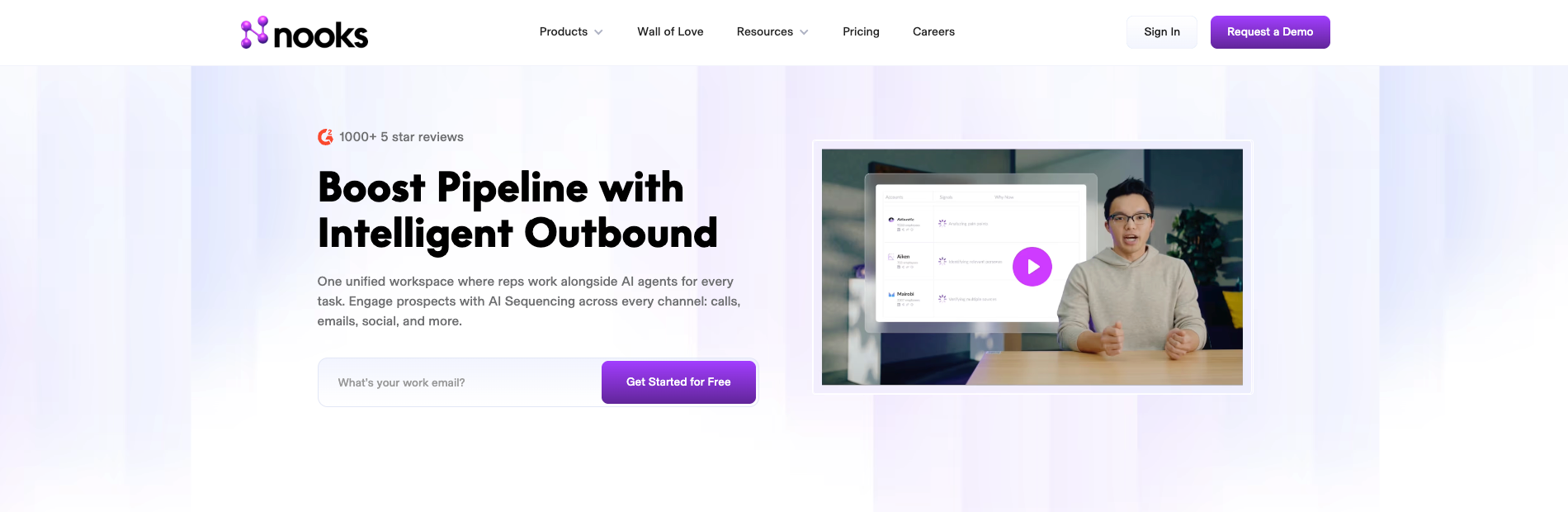
Nooks layers AI call coaching on top of a parallel dialing architecture similar to Orum's. Reps get real-time guidance during live calls alongside the volume benefits of simultaneous outbound lines. The platform is newer with a smaller integration library, but well-regarded in SDR-heavy SaaS environments.
Key Features:
- Parallel dialing with live AI coaching
- AI objection-handling assistance during calls
- Integrations with Salesforce Cadences and Outreach sequences
- Call recording and analytics
Pricing: Custom pricing — contact Nooks sales directly for a quote.
Pros:
- Live AI coaching is a genuine differentiator for training and ramp time
- G2 reviewers report competitive parallel dial volumes in the 400–700/rep/day range
- Good fit for teams already on Outreach or Salesforce Cadences
Cons:
- No published pricing — budget visibility requires a sales conversation
- Newer product with a smaller integration library than Orum
- Same parallel dialing compliance complexity as any parallel architecture — TCPA abandoned-call rate monitoring required
- No built-in SMS, deep CRM logging, or contact center features
4. Kixie
Best for: Mid-market teams wanting progressive multi-line dialing without parallel dialer compliance risk
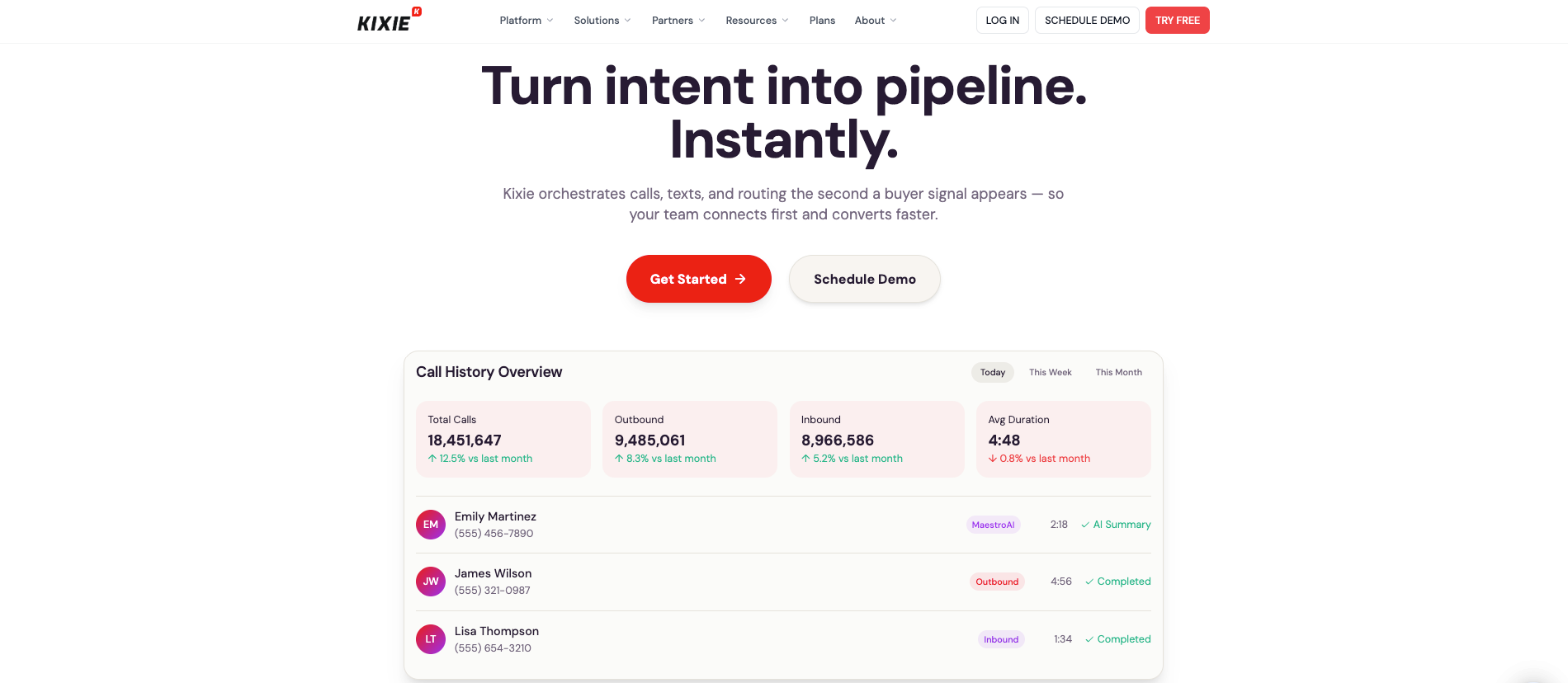
Kixie offers a more balanced calling platform than the dedicated parallel dialers above. Its PowerCall multi-line dialer pushes daily volumes into the 250–450 range based on G2 user reports, with native integrations across HubSpot, Salesforce, Pipedrive, and Zoho. It sits in a sensible middle ground for teams that want more volume than 1:1 dialing but more compliance comfort than full parallel.
Key Features:
- PowerCall multi-line progressive dialer
- Local presence dialing
- Native HubSpot, Salesforce, Pipedrive, and Zoho integrations
- SMS and call automation sequences
- Voicemail drop
Pricing: Starts around $35/user/month; multi-line features available on higher tiers. See Kixie's pricing page for current rates.
Pros:
- Better compliance posture than full parallel dialers
- Reasonable all-in-one capabilities (dialer + SMS + integrations)
- More affordable than Orum or Nooks at similar volume bands
Cons:
- Daily dial ceiling lower than parallel dialers
- HubSpot and Salesforce connections are native but do not include bidirectional workflow triggering at the depth of a certified partner integration
- AI features less developed than dedicated AI-first platforms
- Some G2 reviewers report call quality inconsistencies
5. JustCall
Best for: International teams or budget-conscious buyers needing multi-line dialing across global markets
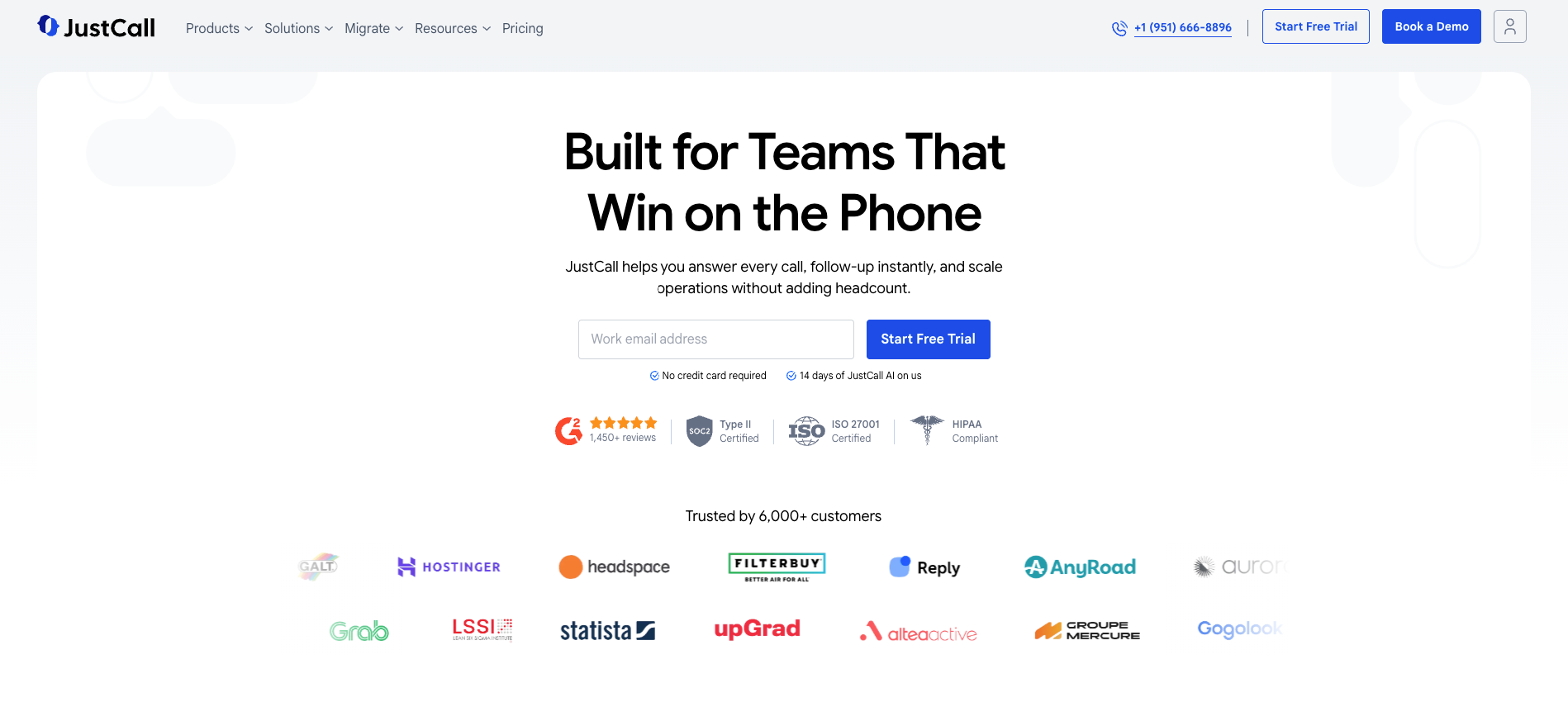
JustCall is a broadly accessible dialing platform with coverage across 70+ countries — a meaningful differentiator for teams working outside North America. Its multi-line dialer pushes 200–400 dials per day based on G2 user reports, with CRM integrations across most major platforms via native connectors and Zapier.
Key Features:
- Multi-line progressive dialer
- 70+ country coverage
- Native integrations with HubSpot, Salesforce, Pipedrive, Zoho, and others
- SMS and MMS automation
- AI call transcription and summaries
Pricing: Starts around $29/user/month; dialer features on mid and upper tiers. See JustCall's pricing page for current rates.
Pros:
- Strongest international coverage on this list
- Accessible pricing with a broad feature set
- AI transcription included at reasonable tiers
Cons:
- Dial volume ceiling lower than dedicated parallel dialers
- HubSpot and Salesforce connections are native but without the bidirectional workflow depth of a certified partner integration
- Some G2 reviewers outside North America note slower support response times — worth evaluating if your team is globally distributed
- AI features are add-on or higher tier only on some plans
6. Dialpad
Best for: Teams already on Dialpad's unified communications platform who want integrated dialing without a separate tool
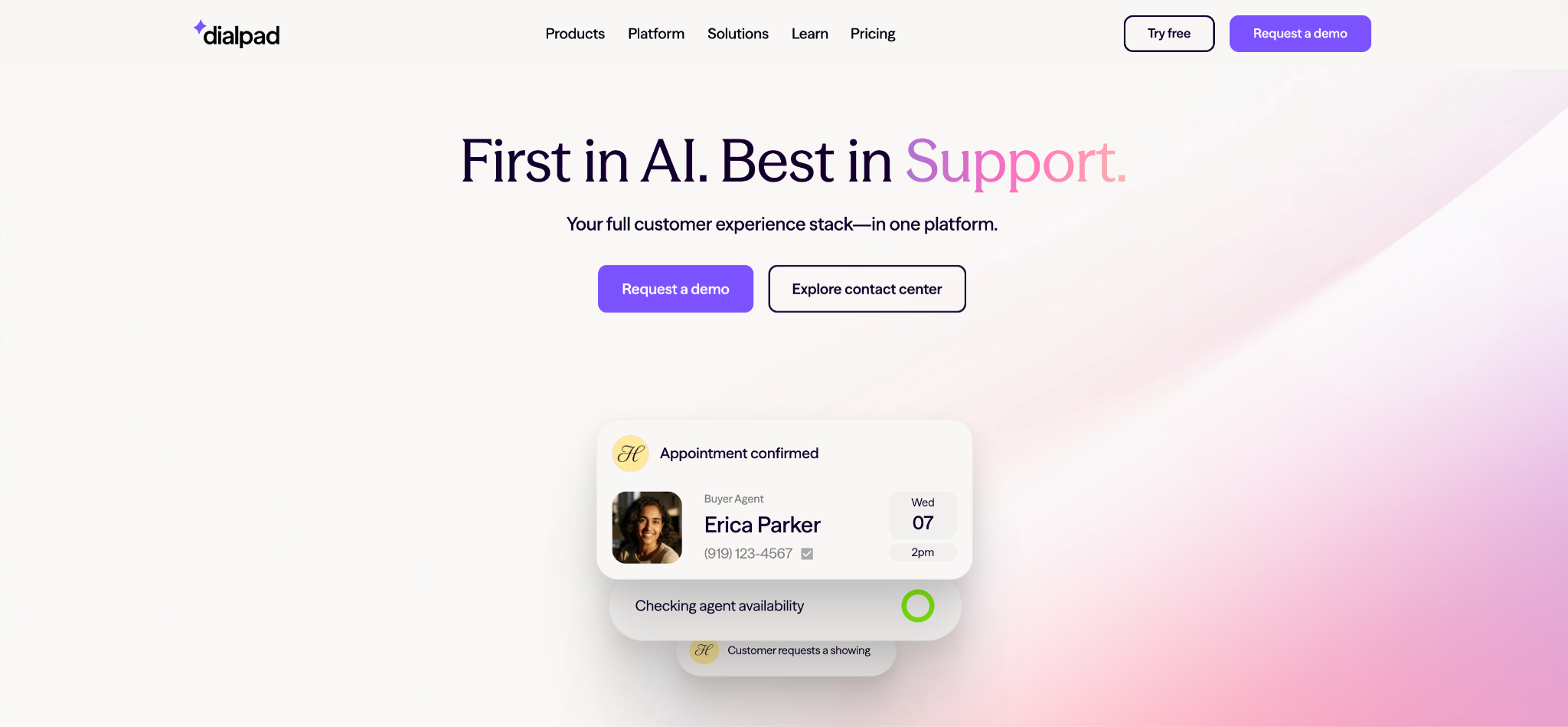
Dialpad's Sell product includes AI-assisted dialing within its broader UCaaS ecosystem. For teams already paying for Dialpad's phone system, adding its dialing capabilities avoids vendor sprawl. Daily volumes top out in the 150–350 range — comparable to 1:1 and light multi-line modes.
Key Features:
- AI-assisted dialing with real-time transcription
- Native Salesforce and HubSpot integrations
- Built-in unified communications (voice, video, messaging)
- AI call summaries and coaching
Pricing: Starts around $27/user/month; dialer features on Sell plans. See Dialpad's pricing page for current rates.
Pros:
- Single platform for UCaaS + dialing — reduces tool count
- Strong real-time AI transcription
- Good Salesforce integration
Cons:
- Not a dedicated dialer — volume ceiling reflects this
- Parallel or high-volume progressive dialing not available
- Can feel over-engineered for pure outbound SDR workflows
- HubSpot integration is native but does not include bidirectional workflow triggering at the depth of a certified partner integration
When Raw Dial Volume Is the Wrong Metric
A team making 600 dials a day with a 2% pickup rate and no CRM sync produces 12 conversations with no pipeline attribution. A team making 250 dials a day with a 10% pickup rate and auto-logged CRM records produces 25 conversations, full deal attribution, and half the number reputation risk.
Before optimizing for dial volume, audit the inputs that actually move pipeline: pickup rate, average talk time, disposition quality, and CRM hygiene. If any of those are broken, a parallel dialer compounds the problem faster.
Key takeaway: Conversations-per-rep-per-day and CRM attribution are the metrics that predict quota attainment. Dials-per-day is a leading indicator, not the outcome.
How to Choose the Right Power Dialer
If your team is measured purely on daily dial quotas: Orum or Nooks. Both require budget for the per-seat cost and operational attention to TCPA compliance.
If your team uses HubSpot or Salesforce and cares about pipeline attribution: Aloware. The native HubSpot integration, unlimited calling minutes, and Pickup Stack combination produces more attributed pipeline per rep than higher-volume alternatives on this list.
If you want more volume than 1:1 dialing without parallel compliance risk: Kixie or JustCall. Both offer multi-line progressive dialing in a more accessible price range.
If you're already on Dialpad: Dialpad Sell adds dialing without adding a vendor, but don't expect parallel-level volume.
Key takeaway: Match the dialer to your team's primary constraint — dial volume, compliance posture, CRM integration, or budget. There is no single best answer.
Frequently Asked Questions
What is the fastest power dialer for high-volume outbound?
The fastest power dialers are parallel dialers like Orum and Nooks, which call multiple numbers simultaneously and can reach 400–800 dials per rep per day. They use AI voice detection to connect reps only when a human answers. The trade-off is higher number reputation risk and compliance complexity compared to 1:1 power dialers.
Can a sales rep really make 500+ calls a day?
Yes, but only with a parallel or AI dialer. A rep using a parallel dialer can reach 500–800 dials per day by letting the system handle multiple simultaneous lines. A 1:1 power dialer caps around 150–300 dials per day because every call is handled sequentially — though each connect tends to be longer and higher quality.
Is a higher dial count always better for sales?
No. Higher dial counts can reduce pipeline if pickup rates drop due to spam flagging, or if CRM records aren't updated for every call. The metric that matters is conversations-per-rep-per-day with full CRM attribution — not dials alone.
Are parallel dialers TCPA-compliant?
Parallel dialers can be compliant, but they require careful configuration. The FCC requires abandoned call rates below 3% under TCPA, and parallel dialers can exceed that threshold when more prospects answer than expected. This is a characteristic of the parallel dialing architecture itself — not specific to any one vendor — and configuration, list hygiene, and consent management are always the operator's responsibility. 1:1 power dialers are inherently compliant by architecture because a rep is always ready on the line.
What's the best way to increase conversations without a parallel dialer?
Focus on pickup rate rather than dial rate. Branded Calling, local presence dialing, and real-time caller ID reputation monitoring via NumberGuard can meaningfully increase answer rates without changing dial volume. Combined with voicemail drop and CRM-aware workflows, a 1:1 power dialer can produce more conversations per day than an unoptimized parallel dialer.
What power dialer works best with HubSpot?
Aloware has the deepest native HubSpot integration on this list as a HubSpot Certified Partner — triggering dialer sequences from HubSpot workflows, logging AI call summaries automatically to contact records, and syncing call dispositions bidirectionally. Other platforms on this list connect via native integrations or Zapier but with less workflow depth.
.png)

Ruby Kootval is Head of Product Marketing at Aloware. She has 12 years in digital marketing, including 8 in B2B SaaS and 5 in telecom, and writes about AI voice agents, dialers, CRM integrations, and contact center operations.
.webp)
.webp)