

TL;DR
Branded calling is a carrier-verified service that displays your business name (and, on richer tiers, your logo and reason for calling) on the recipient's screen before they pick up. It replaces an anonymous 10-digit number with an identity the carrier has checked. In a Twilio study across roughly 720,000 calls, branded calls were answered 62% of the time versus 20% for un-branded calls, more than triple the pickup rate. But here is the part most vendors skip: branded calling does not erase a "Spam Likely" label. Branded display and spam labeling are two separate carrier systems. The fix that actually moves your connect rate is the full Pickup Stack (reputation, branding, and local presence), running on A-level call attestation.
Key facts for mid-market sales teams:
- Branded calls were answered 62% of the time vs. 20% for un-branded calls in a Twilio study across ~720,000 calls, more than tripling pickup rates (Twilio, Feb 2024).
- Branded calling shows your verified identity at ring time on supported US mobile carriers (T-Mobile and Verizon). It applies to outbound mobile calls only.
- STIR/SHAKEN attestation is signed at the originating service provider (the carrier), not the dialer, not the CRM.
- A branded number with a bad reputation still gets flagged "Spam Likely." Display and spam labeling are independent carrier systems.
- Branded calling pays off as one layer of a system, the Pickup Stack: NumberGuard (reputation) + Branded Calling (display) + Local Presence (area-code match).
If you run outbound, you have already felt this. Your reps have a clean list, a sharp script, and a number that nobody picks up. Across Aloware customers who turn on the full Pickup Stack, we see the change inside the first four weeks: connect rates climb about 16%, and reps end up placing fewer calls while having more real conversations. Less dialing. More talking. That is the outcome branded calling gets credit for, and the outcome it can't deliver alone. This guide is the complete picture: what branded calling is, why it works, how it actually works under the hood, how to get it, and where it fits in the stack that makes it pay.
What is branded calling?
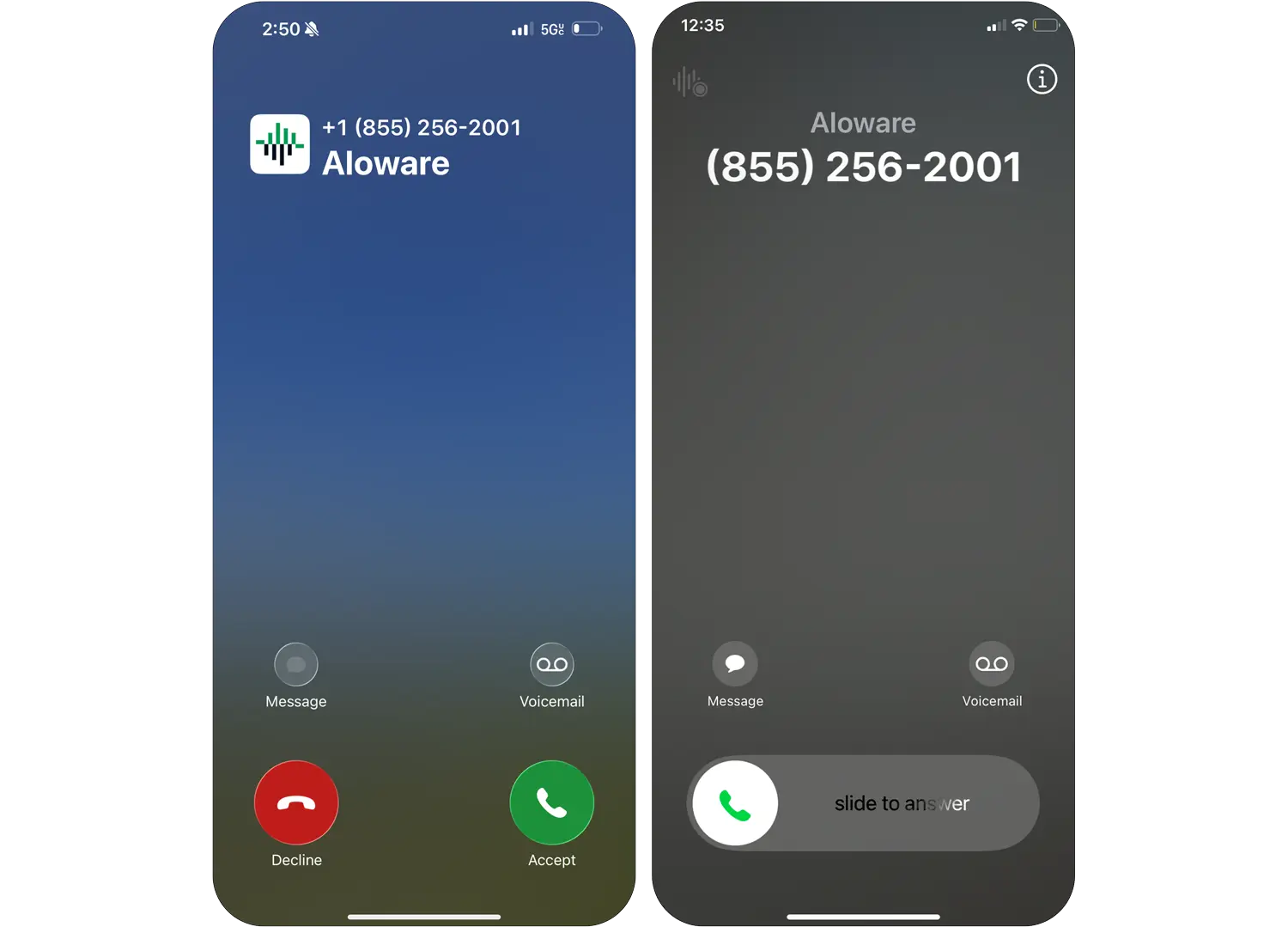
Branded calling is a carrier-level service that displays a verified business identity (your name, and on enhanced tiers your logo and call reason) on the recipient's screen before they answer. Instead of a stranger's area code, the person sees a brand the carrier has already checked is legitimate. You will also see it called "branded caller ID," or BCID for short.
It is not CNAM, and the difference matters. CNAM is the old caller-name system, and it is best-effort: the receiving phone may or may not look it up, and the name often arrives as a generic string or nothing at all. Branded calling is carrier-delivered. The carrier pushes the verified display to the handset, so on supported carriers it is far more reliable than a name you hope CNAM passes through.
One more boundary worth setting early: branded calling is for voice. It does not brand your text messages. Branding for messaging is a separate technology entirely.
BCID, short for Branded Caller ID, is the emerging cross-carrier standard the industry is consolidating around. Underneath it, individual carriers still lean on middleware vendors such as First Orion, Hiya, and TNS to deliver the display. Those specific carrier-to-vendor partnerships shift over time, so the durable way to think about it is simple: carriers verify and render branded identity through registered programs, and BCID is the standard pulling those programs together.
Key takeaway: Branded calling is a carrier-verified display of your business identity at ring time. It is reliable in a way best-effort CNAM never was, it is voice-only, and it is standardizing under BCID.
Why don't your calls get answered anymore?
The number on the screen is now the whole decision. People do not answer numbers they don't recognize, and that instinct has only hardened. An anonymous outbound number is a coin flip at best, and the coin is weighted against you.
The hard proof comes from outside Aloware. In a Twilio study spanning about 720,000 calls, branded calls were answered 62% of the time, while un-branded calls were answered just 20% (Twilio, Feb 2024). That is more than three times the pickup rate, on the same outbound traffic, with the only variable being whether the call carried a verified brand. Read that number the right way: 62% is the share of branded calls that got answered, not a 62% bump. The bump is the jump from 20% to 62%, a tripling.
This lands differently by industry, and the pattern is consistent. An insurance agency calling on a policy renewal. A solar installer following up on a quote. A real estate team confirming a showing. A financial-services advisor returning a form fill. Every one of these is a legitimate, often expected call that dies on the lockscreen because the prospect can't tell it apart from a spam dialer. The work was already done to earn the call. The number throws it away.
Here is what's actually happening when the phone rings. The receiving network makes three decisions in parallel, in milliseconds: Is this call signed and attested? Is this number flagged for spam patterns? Is this number registered to a known brand? A clean, signed call from an un-branded number stays anonymous on the screen. A signed, registered call from a number with a wrecked reputation still gets the spam label. Only the call that clears all three (attested, clean, and branded) gets the full branded display. That is the one your prospect answers. If you want the deeper mechanics of how carrier scoring interacts with caller authentication, we wrote the full breakdown on why your calls land in spam.
Key takeaway: Branded calls were answered 62% of the time vs. 20% un-branded across Twilio's 720,000-call study. Tripling pickup isn't theoretical. It's the mechanical result of a verified identity reaching the screen before the prospect decides.
How does branded calling actually work?
Branded display takes three layers working together, and all three have to be in place or the screen stays blank. This is where most "branded calling" explanations go wrong, so it is worth getting exactly right.
Layer 1: A-level STIR/SHAKEN attestation, signed at the carrier. STIR/SHAKEN is the standard that lets a network vouch for who is really placing a call. The signing happens at the originating service provider, the carrier that puts the call onto the network. It does not happen at the dialer. It does not happen in your CRM. Any tool that claims "our dialer signs your STIR/SHAKEN" has the mechanics wrong, and an experienced telecom buyer will spot it instantly. The dialer originates the call; the carrier attests and signs it.
Layer 2: the attestation level. Attestation comes in three grades, and only the top grade qualifies for branded display on most carrier programs.
Attestation levelWhat it meansBranded displayA (Full)The carrier authenticated the caller and verified they own the number.Allowed by major carriersB (Partial)The carrier authenticated the caller but can't verify number ownership.Blocked on most carriersC (Gateway)The carrier knows where the call entered its network, but not the caller.Blocked on most carriers
Layer 3: branded registration. With attestation in place, you register your brand assets (name, and logo and call reason for enhanced display) with the carrier programs, through middleware vendors or the consolidating BCID flow. Registration is separate from attestation. A fully attested number with no brand registered stays anonymous on the screen. A registered brand with no attestation does not display either. Both have to be present, plus the terminating carrier validating the signed call and rendering the display.
Key takeaway: Branded calling runs on three layers: A-level STIR/SHAKEN attestation signed at the carrier, brand registration, and carrier rendering. The dialer never signs attestation. Miss any layer and the lockscreen stays blank.
Does branded calling stop "Spam Likely" labels?
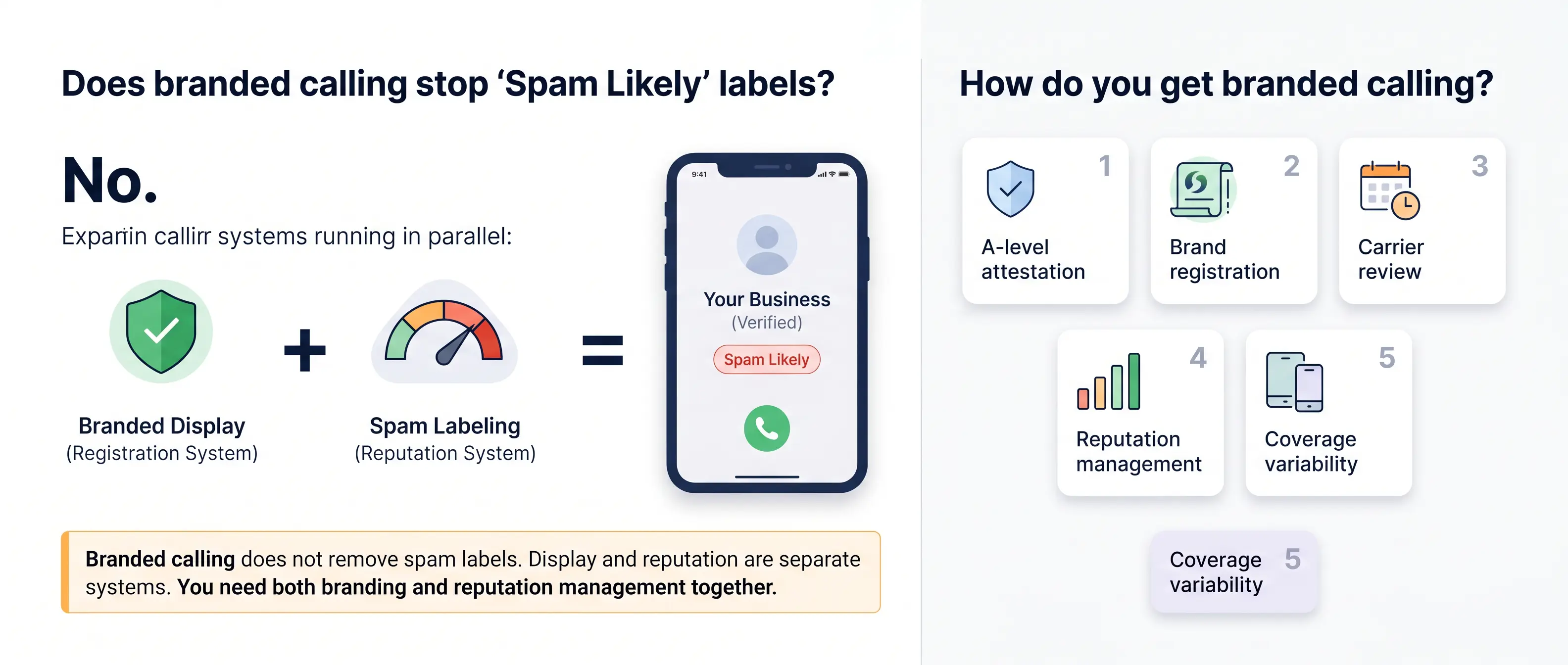
No. And this is the single most important thing to understand before you buy. Branded display and spam labeling are two completely separate carrier systems running in parallel. Registering a brand does not remove a spam label, and clearing a spam label does not create a branded display. They read different inputs and produce different outputs.
Spam labeling runs on carrier-side reputation analytics: call volume, complaint rates, how long calls last, and machine models that watch how your number behaves across the network. Branded display runs on a separate registration program. So you can absolutely have a number that shows your verified brand AND carries a "Spam Likely" tag at the same time, if the reputation underneath has gone bad. Plenty of teams learn this the hard way: they pay for branding, expect the spam labels to vanish, and watch their connect rate barely move because the reputation problem was never touched.
The contrarian truth the category won't say out loud: branded calling, bought on its own as a spam fix, is mostly wasted money. It is a genuine pickup-rate lever, but only when the number reputation underneath it is healthy. That reputation layer is its own discipline. On the Aloware side it is number reputation management: real-device testing, carrier-database validation, mislabel remediation, and caller-ID whitelisting that work upstream to prevent the flag in the first place. Branding earns the recognition; reputation management keeps the spam label off. You need both.
Key takeaway: Branded calling does not remove spam labels. Display and spam labeling are separate carrier systems, so a branded number with bad reputation still gets flagged. Branding plus reputation management is the only combination that holds.
How do you get branded caller ID for your business calls?
With Aloware, you order Branded Caller ID from inside the app as an add-on on any +AI plan. You choose the numbers to brand and supply your business details, and your account team submits the brand for carrier review. It displays when three things line up. The number is a US local or toll-free number on Aloware's carrier, since numbers hosted on another carrier don't qualify. The person you call is on T-Mobile or Verizon. And the call is outbound to a mobile phone.
Know the limits before you buy. AT&T does not show branded calls yet, so some of your prospects will not see your brand however complete your registration is. Landlines keep standard caller-name display. Standard shows your business name. Enhanced adds a logo and a call reason, and asks for extra business verification. Neither tier clears a Spam Likely label, which is why it pairs with reputation management.
Getting branded calling live is less a single purchase and more a short setup project. The steps are predictable, and knowing them keeps your expectations honest.
- Get A-level attestation in place. Your outbound calls need to originate on a carrier path that signs full A-level attestation. Without it, branded display isn't eligible on most carrier programs no matter how perfect your registration is.
- Register your brand assets. Submit your business name (and your logo and call reason if you want enhanced display) to the carrier programs. There are formatting rules, like display-name limits and logo specs, plus a verification step.
- Plan for carrier review. Carriers review and approve branded registrations on their own timeline. Build in a setup window rather than expecting same-day display.
- Manage number reputation in parallel. Branding and reputation are separate, so stand up reputation management at the same time. Turning on branding while your numbers carry spam flags wastes the lift.
- Expect coverage to vary. Display behavior differs by carrier and device. Not every recipient will see branded content identically, and US mobile carriers are at different stages of their programs.
The mistake to avoid here is treating registration as the finish line. Registration is one of three layers. A team that registers a brand, skips attestation discipline, and ignores reputation will conclude branded calling "doesn't work," when what actually happened is they ran one-third of the system.
Key takeaway: Getting branded calling live means A-level attestation, brand registration, a carrier-review window, and reputation management running in parallel. It is not a one-click toggle.
The Pickup Stack: why branded calling only works as a system
Everything above points to one conclusion. Branded calling is a layer, not a solution. The teams that see real movement run all the layers together, in the framework we call the Pickup Stack.
Three layers, each doing a job the others can't:
- NumberGuard, the number-reputation layer. Prevents and remediates the "Spam Likely" flag by managing the reputation signals carriers score. This is the negative the other layers can't fix.
- Branded Calling, the verified-display layer. Puts your recognized identity on the screen so the prospect knows who's calling. This is the positive that earns the answer.
- Local Presence, the area-code-match layer. Matches your outbound number's area code to the recipient's, so a familiar local number lands instead of an out-of-state stranger.
All three sit on top of A-level attestation. Run one alone and you get a fraction of the lift. Run them together and the math compounds: a clean-reputation, branded, locally-matched call clears all three of the carrier's parallel checks at once. That is the call that gets picked up.
This is also where the proof lives. The Twilio study shows what verified branding does to answer rates in isolation. What we see across Aloware customers is what happens when the whole stack runs: inside the first four weeks, connect rates climb about 16%, and the texture of the day changes. Reps place fewer calls while having more real conversations. Fewer dials, more dialogue. For a fuller look at the recognition half of the equation, see how branded caller ID helps you connect with more leads. And because pickup rate is only half the equation (the dialer driving the volume is the other half) it pairs with picking the right outbound dialer for your team.
Aloware is the only platform that runs all three layers as one system: not a reputation tool here and a branding vendor there, but NumberGuard, Branded Calling, and Local Presence in a single stack, on attested origination.
Want to see the Pickup Stack on your own outbound? Book a 20-minute demo and we'll show NumberGuard, Branded Calling, and Local Presence on a live call.
Key takeaway: Branded calling pays off as one layer of the Pickup Stack: reputation, branding, and local presence on A-level attestation. Run together, Aloware customers see connect rates rise about 16% in the first four weeks, with reps placing fewer calls and having more conversations.
Your branded calling readiness checklist
Before you turn branded calling on, audit these. Each one is a layer that has to be real, or the display won't earn its keep.
- Attestation. Are your outbound calls originating on A-level STIR/SHAKEN attestation at the carrier? If you're not sure, you're probably not.
- Number reputation. Are your numbers clean today, and is something actively managing reputation so they stay clean? Branding on flagged numbers is wasted spend.
- Brand registration. Are your name, and logo and call reason if you want enhanced display, registered and approved on the carrier programs you're targeting?
- Local presence. Are you matching outbound area codes to your prospects, so the branded call also looks local?
- The whole stack. Are all of the above running together, on the same outbound path, or are you running one layer and hoping?
Key takeaway: Branded calling is ready when attestation, reputation, registration, and local presence are all live together, not when you've registered a name and called it done.
Bottom line
Branded calling is not a spam eraser, and the vendors selling it that way are why the category has a trust problem. It is the carrier-verified display of your business identity on the screen before the prospect decides: a real, measurable pickup-rate lever, proven by a 720,000-call study to more than triple answer rates. But it only pays off as one layer of a system. Reputation to prevent the spam flag, branding to earn the recognition, local presence to look local, all on attestation signed at the carrier.
Run one layer and you'll conclude branded calling doesn't work. Run the whole Pickup Stack and you'll see what Aloware customers see: connect rates up about 16% in the first four weeks, reps placing fewer calls and having more real conversations. In 2026, an anonymous number is the reason your best leads never hear your pitch. A verified identity, backed by a clean reputation, is the call they answer.
Ready to stop being an unknown number? Book a 20-minute Pickup Stack demo and we'll show NumberGuard, Branded Calling, and Local Presence working together on a live call.

Frequently Asked Questions
What is branded calling?
Branded calling is a carrier-verified service that shows your business name — and, on enhanced tiers, your logo and reason for calling — on the recipient's screen before they answer. It replaces an anonymous 10-digit number with an identity the carrier has checked is legitimate, on supported US mobile carriers. It applies to outbound mobile calls only and is sometimes called branded caller ID or BCID, the emerging cross-carrier standard. It is voice-only and does not brand text messages.
How does branded calling work?
Branded calling works in three layers. First, your outbound calls are signed with A-level STIR/SHAKEN attestation at the originating service provider — the carrier, not the dialer. Second, you register your brand assets (name, and logo and call reason for enhanced display) with the carrier programs, often through middleware vendors or the consolidating BCID flow. Third, the recipient's carrier validates the signed call and renders your branded display. All three layers have to be in place, or the screen stays anonymous.
Does branded calling stop my calls from being marked "Spam Likely"?
No, not by itself. Branded display and spam labeling are two separate carrier systems running in parallel. Spam labeling is driven by carrier reputation analytics — call patterns, complaints, and behavior — while branded display comes from a separate registration program. A branded number with a poor reputation can still be flagged "Spam Likely." Removing spam labels is the job of number reputation management, which works upstream to prevent and remediate flags. You need branding and reputation management together.
How is branded calling different from CNAM?
CNAM is the older caller-name system and it is best-effort — the receiving phone may or may not look it up, and the name often shows as a generic string or nothing at all. Branded calling is carrier-delivered: the carrier pushes your verified display to the handset, so on supported carriers it is far more reliable than a name you hope CNAM passes through. Branded calling can also show a logo and call reason on enhanced tiers, which CNAM cannot.
Does branded calling brand my text messages too?
No. Branded calling is voice-only — it puts your verified identity on outbound phone calls. It does not brand SMS or MMS. Branded, interactive messaging is delivered through a separate technology, not branded calling.
Which carriers support branded calling?
Branded calling runs on supported US mobile carrier programs (the major US carriers operate their own branded calling programs). Coverage and exactly how the display renders vary by carrier and by device, so not every recipient will see branded content identically. Branded calling is US-only and applies to outbound mobile calls; landlines continue to use standard caller-name display.
How do you get branded calling set up?
Getting branded calling live is a short setup project, not a one-click toggle. You need A-level STIR/SHAKEN attestation on your outbound path, your brand assets registered and approved with the carrier programs, and a window for carrier review. Because branded display and spam labeling are separate, you should also stand up number reputation management in parallel so you aren't branding flagged numbers. Plan for coverage to vary by carrier and device.
Is branded calling worth it for sales teams?
For high-volume outbound teams — typically mid-market organizations with 50 or more employees — branded calling is a meaningful pickup-rate lever. A Twilio study across about 720,000 calls found branded calls were answered 62% of the time versus 20% for un-branded calls. But it only delivers as one layer of a system: reputation management to prevent spam flags, branded display to earn recognition, and local presence to look local. Aloware customers running the full Pickup Stack see connect rates rise about 16% within the first four weeks.
What is the difference between branded calling and the Pickup Stack?
Branded calling is one layer — the carrier-verified display of your identity. The Pickup Stack is the complete system: NumberGuard for number reputation (prevents the spam flag), Branded Calling for the verified display (earns the answer), and Local Presence for area-code match (looks local), all running on A-level attestation. Branded calling alone gives a fraction of the lift; the layers compound when they run together, which is why Aloware runs all three as one stack.
Can branded calling guarantee my calls get answered?
No. Nothing can guarantee a call gets answered. Branded calling substantially improves the odds by putting a verified, recognizable identity on the screen before the prospect decides — a Twilio study found branded calls were answered more than three times as often as un-branded ones. But answer rates depend on your number reputation, attestation, carrier coverage, the device, and who you're calling. Branded calling improves the odds; it does not promise a pickup.
.png)

Ruby Kootval is Head of Product Marketing at Aloware. She has 12 years in digital marketing, including 8 in B2B SaaS and 5 in telecom, and writes about AI voice agents, dialers, CRM integrations, and contact center operations.