


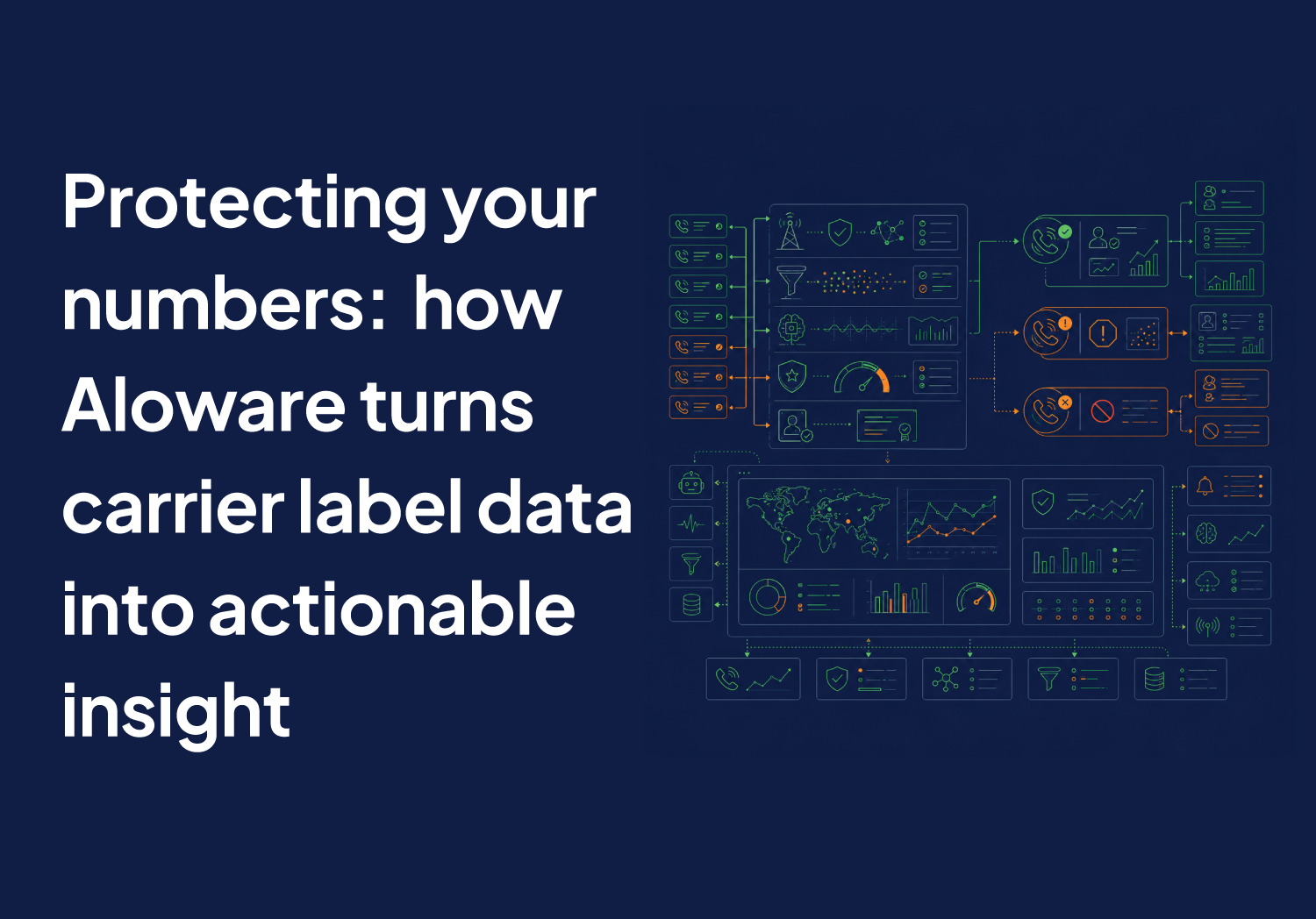
Your phone numbers don't just dial out. They carry a reputation. Every week, AT&T, T-Mobile, and Verizon are quietly making decisions about how your outbound calls show up on a customer's screen, whether that's your company name, "Spam Likely," or nothing at all. The trouble is that nobody tells you when those labels change. A number that connected at 95% last week can quietly slide to 60% this week, and your team won't know why. By the time someone notices the drop, the campaign is already underperforming and revenue is on the line.
The data backs this up. Industry reports show that when a call is flagged as "Spam Likely," roughly 95% of recipients ignore it entirely, and answer rates can drop 20 to 50% overnight after a single labeling event. Across industries, contact rates have fallen nearly 40% in recent years, largely driven by spam labeling and aggressive carrier filtering. Cold-call conversation rates have collapsed from around 4.8% to 2.3% in the same window. And in a recent industry survey, 81% of businesses reported lost revenue due to incorrect spam or scam flagging. If outbound is part of your motion, your carrier reputation isn't a back-office concern, it's a pipeline problem.
Why this is getting harder in 2026
The regulatory and technical landscape is also shifting underneath outbound teams. STIR/SHAKEN, the FCC-mandated framework rolled out under the TRACED Act, verifies that the caller is who they claim to be. That's important, but it's only authentication. It does not decide whether your call is welcome. Carriers layer their own AI and behavioral algorithms on top, looking at call frequency, dialing patterns, and consumer feedback to decide what to label and what to silence. With new iOS call-screening features and stricter automatic filtering from carriers like T-Mobile, calls from any number not already in the recipient's contacts are getting harder and harder to deliver. The FCC has also signaled tighter rules in 2026 around caller ID authentication, rich call data, and provider accountability.
In other words, even if you're doing everything right, your numbers can still be flagged, and the cost of finding out late is measured in missed pickups, missed pipeline, and missed quota.
What NumberGuard does differently
That's the problem NumberGuard is built to solve, and the experience just got better. Behind the scenes, NumberGuard scans your numbers against all three major US carriers every week. Until now, that scan data lived as a raw export, accurate but hard to act on. We've changed that. NumberGuard customers now receive a clean, branded weekly report delivered straight to their inbox, with no portal to log into and no spreadsheets to cross-reference.
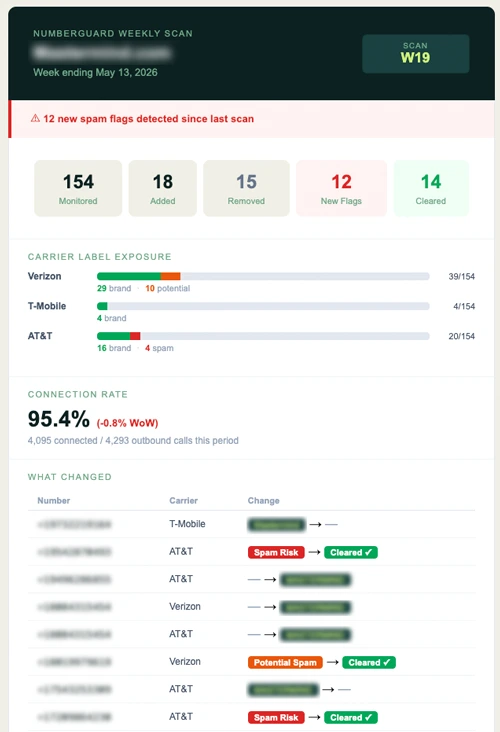
The first report sets your baseline. You see which of your numbers are clean, which are flagged as Spam Likely or Potential Spam, and which are showing up branded to your business on each carrier's network. Every report after that focuses on what changed week over week. New flags get called out at the top. Numbers that were flagged the previous week and have now cleared get their own "wins" section, because watching the system remediate is just as important as catching new issues. The report also pairs label movement with your actual connection-rate trend, so the data isn't abstract. You see exactly how a Spam Likely flag is translating into picked-up calls and answered prospects.
What this means for your team
For a CSM, a sales leader, or an ops team running outbound, the value compounds quickly:
- Fewer surprises. Carrier label changes are caught within days of the scan, not weeks after a campaign tanks.
- Faster remediation. When a number is flagged, you can rotate it out of rotation, swap to a Local Presence number, or kick off a remediation request before it eats into your connect rate.
- Real proof of value. Branded calling and remediation efforts show up as cleared flags in the next week's report, so you can prove the investment is working.
- No more spreadsheet archaeology. The report is customer-ready and lands automatically. Your team gets the signal, not the homework.
The reality of outbound in 2026 is that your numbers are being judged by carriers and by recipients in real time, every single day. You can either find out at the end of the quarter when the pipeline dries up, or you can find out every Thursday morning with a report that tells you exactly what changed and what to do about it.
Ready to see what your numbers really look like out there? Talk to our team about NumberGuard.
.png)

Ruby Kootval is Head of Product Marketing at Aloware. She has 12 years in digital marketing, including 8 in B2B SaaS and 5 in telecom, and writes about AI voice agents, dialers, CRM integrations, and contact center operations.
.webp)

