

What does an AI voice agent do for an eCommerce support line?
TL;DR: An AI voice agent answers the order calls a retail support line gets all day, at any hour, and hands the rest to a person. It can look up an order by number in your order system and read your shipping and return policy back to the caller. It can take a return request with the reason, text the caller a tracking link mid-call, and open a ticket or transfer the call when a human is needed. Every call is transcribed and summarized on the customer record. What it does not do is decide a damaged-item claim or issue a refund on its own; those stay with your team, with the details already captured.
- Where the calls come from: in Aloware's own platform data for the year to August 31, 2026, 17.1% of weekday inbound calls arrived outside 8 a.m. to 6 p.m., and 24.4% once weekends are counted. A quarter of your callers are dialing when nobody is scheduled to answer.
- What a human costs per call: the median customer service representative earned $21.53 an hour in May 2025 (U.S. Bureau of Labor Statistics). A four-minute order-status call is about $1.44 of wages before overhead, and only if a rep is free the moment the phone rings.
- What the agent costs per call: AloAi Voice Agent minutes start at $0.10 per minute on the Basic model tier, so the same four-minute call is about $0.40 in agent minutes, plus carrier minutes.
- Where to start: switch on missed-call rescue first. It only takes the calls that were going to voicemail anyway, so it cannot take a call away from a person who would have answered.
Last updated: September 14, 2026
Why do order-status calls pile up on the phone?
Because the answer changes every hour and lives in a system the caller cannot see. A shopper who wants to know where a package is checks email, then the tracking page, then calls. Salesforce's guide to WISMO calls ("where is my order") puts the agent side of that plainly: in a manual setup, agents spend 60 to 70% of their time looking up tracking numbers and answering repetitive order-status questions. The same guide cites Salesforce's State of Service research that 43% of consumers say a poor customer experience deters them from shopping with a brand again.
The timing makes it worse. People call about orders in the evening and on weekends, after the delivery window they were promised has passed. In our own data, about one inbound call in four lands outside business hours. Those calls hit voicemail, and a voicemail about a late package is a customer you will hear from again, usually less politely.
So the problem has two halves: repetitive questions during the day that keep reps from the calls that need judgment, and a quarter of the volume arriving when nobody is there at all.

Five order calls the agent handles, and where it hands off
An inbound AloAi voice agent is configured with instructions, a knowledge base and a set of actions it may take during the call. Here is what that looks like on the calls a store gets most.
1. Order status
The agent asks for the order number or the phone number on the order. Then it looks the order up through a custom function, an API call to your order system that returns the status and tracking fields into the conversation. It reads back the carrier status and the expected date, and it can text the tracking link to the caller while they are still on the line. If your order system has an API, this works; if it does not, the agent can still answer policy questions and take a callback, but it cannot see the order.
2. Return and exchange requests
The agent reads your return window and conditions from its knowledge base, confirms the order, and captures the item and the reason for the return as contact properties. From there it does one of three things you decide in advance. It opens a return through your system's API if one exists, creates a HubSpot Service Hub ticket with the details filled in, or transfers to a person. Approving a refund, judging a damaged-item claim and handling a high-value exception stay with your team.
3. Policy and product questions
Shipping cutoffs, delivery zones, restock timing, sizing notes: the agent answers from files, FAQ text and web pages you add to its knowledge base. Imported web pages refresh every 12 hours, so a policy page you update on your site updates the agent the same day.
4. Delivery problems
"It says delivered and it is not here" is the call that needs a person. The agent captures the order, the delivery address and what the caller sees, then tags the call. During hours it warm-transfers to your support line; after hours it creates a ticket. The rep who picks it up reads the summary instead of asking the caller to start over.
5. Spanish and other languages
An agent runs in English, Spanish, or a combined English and Spanish mode, plus French, German, Portuguese and a dozen other languages. If your daytime team already takes Spanish calls, the after-hours agent should too.
Everything the agent captures writes back to the contact record. It syncs to HubSpot, Salesforce, Pipedrive, Zoho or HighLevel through the integration you already run. With AloAi Voice Analytics switched on, each call also produces a transcript and a post-call email with the reason for the call, what was offered and what is still open.
Where should the agent sit on your line?
There are three placements, and they are three different decisions.
- In front of the menu. The IVR conversion wizard turns your touch-tone menu into a conversational assistant that routes callers by what they say. Every caller meets it. That makes it the biggest change to the caller experience, and the widest blast radius if the routing is wrong. The original menu is switched off, not deleted, and a revert button restores it.
- On the after-hours window. The agent carries its own schedule in your company time zone, with an option to stand down on US holidays. You pick the shift it owns.
- On overflow. AI Call Rescue is an account-level switch. It sends every missed inbound call, from any line or ring group, to a managed voice agent that greets the caller, captures what they need, and logs a transcript note. Nothing about the daytime flow changes.
Key takeaway: start with overflow. It is the only placement that cannot take a call away from a human who would have answered it, and it shows you within a week what your after-hours callers actually want.
Peak season without peak headcount
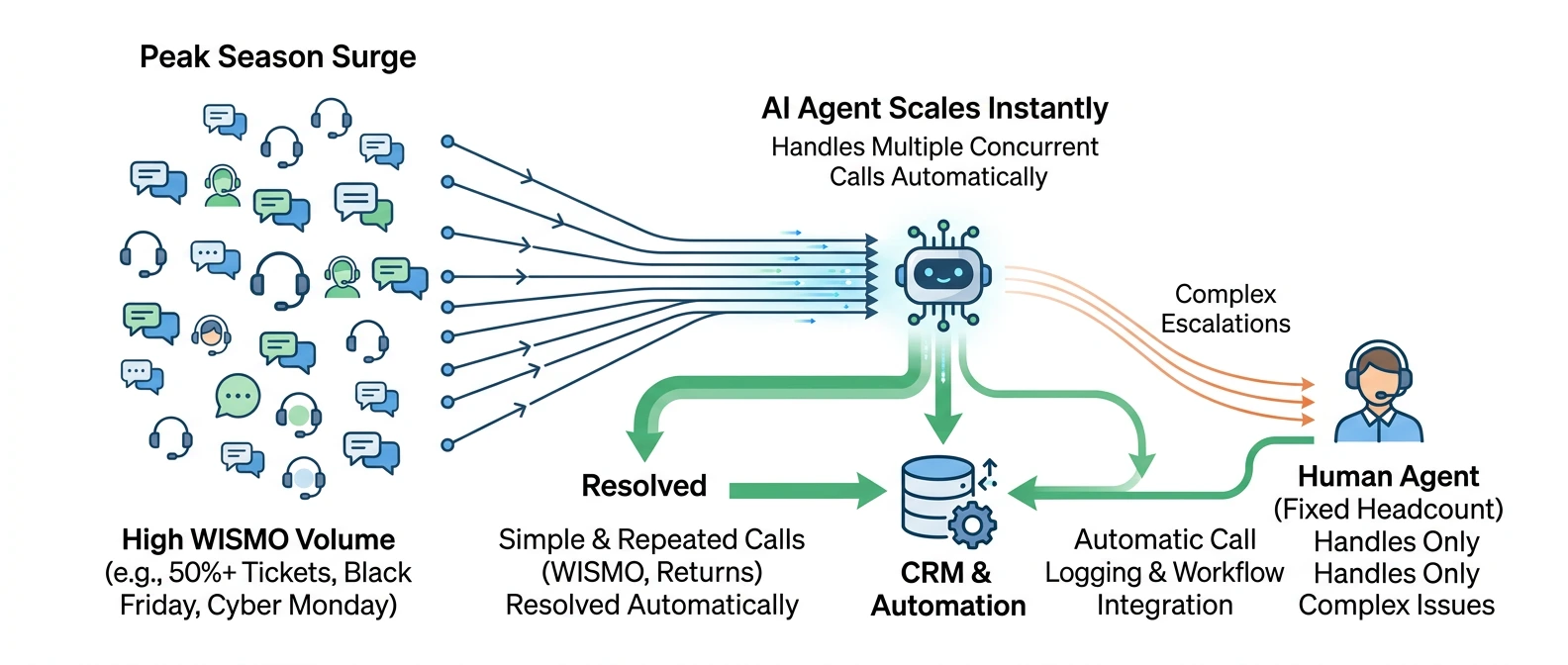
Holiday volume is where a support line breaks. Gorgias reports from its research on support costs that brands at 60% or more automation nearly tripled their ticket volume while human hours grew just 6%. The mechanism on the phone is the same as on email. The routine calls go to the agent, the exceptions go to people, and the people are not spending their day reading tracking numbers aloud.
Two limits to plan around. Aloware currently runs up to 40 concurrent AI calls across all accounts, inbound and outbound combined. Beyond that the agent waits and retries, so size a spike shaped like a marketing email against that number rather than against "unlimited". And an agent handling peak volume needs its knowledge base current before the season, because a stale return window read confidently is worse than a hold queue.
Proactive updates are a text job, not a voice job
The cheapest order-status call is the one that never happens, and the way to prevent it is a message, not a phone call. An outbound AloAi text agent can send the shipping confirmation, the out-for-delivery note and the delay notice. It follows up when there is no reply and answers the question that comes back. Reserve outbound voice for the calls where a conversation is the point, such as a two-question satisfaction check after a return. Our post on AI voice agents for outbound calls covers what those agents can and cannot do.
What it costs
AloAi Voice Agent minutes are billed by model tier: Basic from $0.10 per minute, Premium from $0.20, Ultra Premium at $0.50, on the +AI plans. Carrier minutes are billed separately, as with any call. AI Call Rescue runs on the Basic tier and asks an administrator to confirm the per-minute rate once before it is switched on. Our breakdown of what an AI voice agent costs walks through a month of minutes on each tier.
How to set it up in a week
- Pull your last 200 inbound calls and sort them by reason. If order status and returns are most of them, this is worth doing.
- Put the shipping policy, the return policy and the top 20 product questions into the agent's knowledge base as FAQ text, and import the policy pages from your site.
- Connect the order lookup as a custom function if your order system has an API. Test it with five real order numbers.
- Decide the handoffs: which calls transfer, which create a ticket, which get a callback. Write them into the instructions. Our guide to prompting a voice agent has the structure.
- Switch on AI Call Rescue first and spend a week with the overnight transcripts before you give the agent the daytime line.
Call your own main line tonight at 7:40 from a number nobody at the company has saved. Whatever happens to you is what happened to your last three evening callers. If you want to hear the agent take that call on your own numbers and policies, book an AI voice agent demo.
Frequently Asked Questions
What is a WISMO call in eCommerce?
WISMO stands for "where is my order". It is the order-status call or message a shopper sends after the shipping confirmation and before the package arrives, usually once the promised date has passed or the tracking page has stopped moving. On a phone line these calls cluster in the evening and on weekends: in Aloware's platform data for the year to August 31, 2026, 24.4% of inbound calls arrived outside 8 a.m. to 6 p.m. or on a weekend.
How do AI voice agents reduce WISMO calls?
Two ways. On the inbound side, the agent answers the call, asks for the order number, looks the order up through an API call to your order system, reads back the status and the expected date, and can text the tracking link during the call. On the outbound side, a text agent sends the shipping, out-for-delivery and delay updates before the shopper has to ask, which removes the call at the source.
Can an AI voice agent process returns and exchanges?
It can take the request end to end: confirm the order, read your return window and conditions, and capture the item and the reason. Then it does what you decided in advance: opens the return through your system's API, creates a HubSpot Service Hub ticket with the details filled in, or transfers to a person. Approving refunds and judging damaged-item or high-value cases stay with your team.
How does an AI voice agent handle Black Friday / peak season volume?
It takes the routine calls alongside your team instead of adding them to the hold queue, and the exceptions still reach people with the details already captured. Two limits matter for planning. Aloware currently runs up to 40 concurrent AI calls across all accounts, so size a spike against that number. And the agent's knowledge base has to carry the season's return window and shipping cutoffs before the season starts.
Does Aloware integrate with eCommerce CRMs and order management systems?
Aloware integrates natively with HubSpot, Salesforce, Pipedrive, Zoho and HighLevel, and the agent writes what it captures to the contact record in those systems. Order systems connect through custom functions: an API call the agent makes during the conversation to look up or update an order in any system that exposes an API. Call summaries can also fire a webhook to Zapier.
What percentage of eCommerce support can AI handle autonomously?
There is no published percentage we can stand behind, and the number depends on your call mix. The calls an agent can finish on its own are the ones with a clear answer in your systems: order status, policy questions, and return requests inside policy. The calls it should hand off need a judgment: damaged items, refunds outside policy, and escalations. Sort your last 200 calls by reason and you will have your own percentage in an afternoon.
Is Aloware's AI voice agent secure for customer order data?
The agent only sees the systems you connect it to, and what it captures lands on the contact record in your CRM under your existing user permissions. Transcripts run through AloAi Voice Analytics with PII redaction, every enrollment and conversation is written to an audit log, and safety guardrails are always on for voice agents. For security documentation, ask your Aloware contact.
.png)

Ruby Kootval is Head of Product Marketing at Aloware. She has 12 years in digital marketing, including 8 in B2B SaaS and 5 in telecom, and writes about AI voice agents, dialers, CRM integrations, and contact center operations.