


.webp)
TL;DR
A parallel dialer is software that dials several phone numbers at once from a single agent's seat and connects that agent to whoever answers first. It increases dials per hour. For most teams, that's where the good news ends: the abandoned calls it creates degrade your number reputation, carriers label your numbers "Spam Likely," and the connect rate the tool was supposed to improve collapses instead. We deliberately don't build one.
- What it is: one rep seat dials multiple lines at once and bridges the agent to the first live answer.
- The catch: when two or more people answer the same burst, the rep talks to one. The rest get dead air, then a drop. That's an abandoned call.
- The real cost: abandoned calls feed carrier reputation analytics that flag your numbers as spam, so a larger share of your dials never connect.
- The compliance line: the FCC caps abandoned calls at three percent of calls answered live by a person, over a 30-day period per campaign (47 CFR § 64.1200(a)(7)). Parallel dialing runs straight at that line.
- What our data shows: on a platform with no parallel or predictive mode, connect rate runs 16.7% in an account's first 30 days. After the first year it runs 20.4%. The median rep's dials per business day stayed between 19.0 and 26.9 across those same tenure buckets. That is 55.4 million outbound dials, with a connect counted only at 30 seconds or more of talk time.
- When it fits: burning a huge, disposable cold list where the numbers are throwaway. For any team that reuses its numbers, it's a trap.
Every parallel dialer pitch sells the same fantasy: more lines, more conversations, less idle time. The first two are not the same thing, and the way they come apart is quietly killing the connect rate you get paid on.
I'll say up front where this is going, because it's an unusual position. We make a dialer; we deliberately don't make a parallel one. That's a choice, not a feature we're apologizing for. On the outbound teams we work with, the pattern is almost always the same: the dial dashboard looks incredible for about three weeks, then the connect rate falls off a cliff and nobody can say why. The "why" is usually the tool that made the dashboard look good. You came here for a real answer to "what is a parallel dialer," so you'll get one: the upside the vendors are right about, then the part their pages leave out. For the wider picture, we keep an honest breakdown of sales dialers that pairs with this one.
What is a parallel dialer?
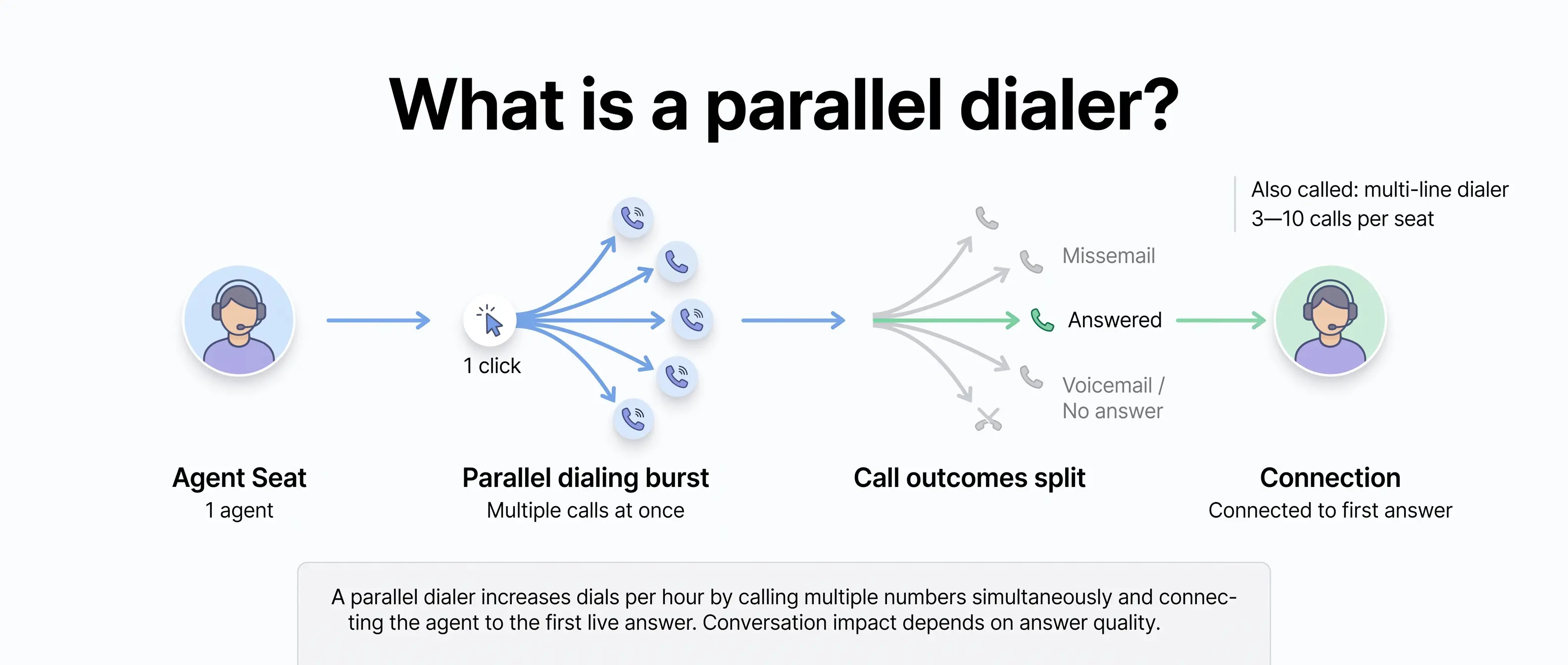
A parallel dialer is outbound calling software that dials multiple phone numbers simultaneously from one agent's seat and connects that agent to the first person who answers. It's also sold as a "multi-line dialer," and the line count is the whole product: three, five, sometimes ten per seat. The promise is arithmetic: keep five calls in the air at once and the rep stops waiting through ringing and voicemail and spends more of the hour talking.
Picture one burst. The rep clicks once; the system fires five calls at the same time. Four ring out to voicemail and one person says "hello," so the dialer bridges that live answer to the rep, drops the other four, and loads the next five. The vendors describe the rep-side experience accurately: less dead time and a dial count that jumps the moment you switch it on. Some advertise a leap from 10–15 minutes of talk time per hour up to 40 or 50; treat those as vendor marketing, not verified fact. But directionally it holds: more lines means more dials. The problem is what happens on the other end of the four calls the rep didn't take.
Key takeaway: A parallel dialer dials multiple numbers at once from one seat and connects the rep to whoever answers first. It reliably increases dials per hour. Whether it increases conversations is a separate, harder question.
Isn't more lines just more conversations?
This is the intuition every parallel dialer is built on: five lines, five times the pickups, five times the conversations. It feels like multiplication, and it breaks the moment two people answer at once. A rep can talk to one person at a time, so when two or five answers land on one seat at once, the rep takes one and the rest get silence, then a drop. That dropped call is an abandoned call, and past the first connect in a burst the extra lines stop multiplying conversations and start multiplying abandons. So the honest equation isn't "more lines = more conversations." It's more lines = more dials and more abandoned calls, which over time = fewer real conversations, because the abandons train carriers to send every one of your numbers to spam, which is the one thing that actually kills conversations.
Key takeaway: More lines reliably produce more dials and more abandoned calls, not more conversations, because the abandons degrade the number reputation that determines your connect rate.
How parallel dialing actually backfires
"It hurts your reputation" is easy to wave off, so let's walk the chain link by link.
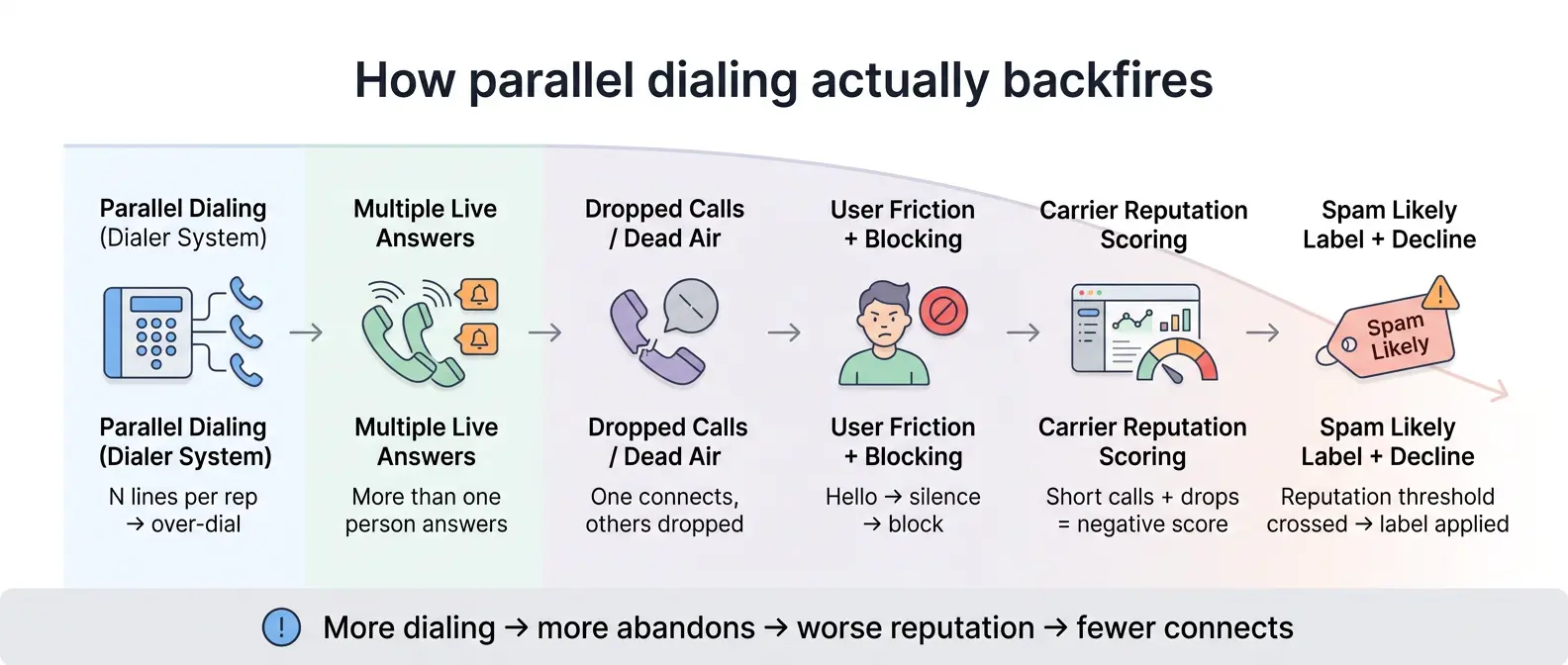
- The dialer puts more live answers on a seat than the rep can take. That's the design, not a bug. N lines per seat over-dials so the rep is never idle, and over-dial far enough and more than one person answers the same burst.
- The extra answers become dead air, then a drop. The rep is on the one call they took; everyone else who said "hello" hears nothing. The rep's dead air didn't vanish, it moved to the recipient who got dropped, and the vendor only describes the rep's side.
- Two systems start scoring you. Picture the person who got dropped: they say "hello," then "hello?", hear a click, and block the number, which is now dead to them and often to their whole household. Meanwhile carrier reputation analytics read high simultaneous volume plus a run of sub-two-second, no-audio drops as the signature of a robocaller, and the number's score falls. You're graded by an annoyed human and an unsentimental algorithm at once, and neither one heard your pitch.
- The score crosses a threshold and the number gets labeled "Spam Likely." Here's where most writing gets the telecom wrong: nothing "bans" parallel dialing, and there's no switch. The abandon pattern degrades the number's reputation until carrier analytics flag it. It's earned, not switched.
- Once labeled, the answered rate craters, first for that number, then, as you rotate volume, for the next number and the next.
- Net result: more dials, more abandons, worse reputation, fewer real conversations. The tool defeats the metric it was sold to improve, and you're paying to replace burned numbers on top of it.
Three questions every operator asks here. How fast? Nobody can hand you a clean "X abandons before you're flagged." The score is proprietary to each carrier, weighing volume, call duration, complaint rate, and how your number behaves against known-bad patterns. What's predictable is the shape: dials spike on day one while reputation decays on a lag, and that gap between instant upside and delayed cost is why the dashboard looks like a win for a few weeks before the connect rate gives out. Is a little parallelism safe? It's a dose, not a switch: two lines slides slower than ten, but fewer lines doesn't make the mechanism go away. The real question is "am I generating abandoned calls on numbers I need to keep," and if yes, the only safe number on those numbers is one. Can't I just rotate a big pool? Rotation spreads the damage; it doesn't avoid it. The same abandons get smeared across more numbers, and fresh numbers start with no trust to spend, so a brand-new line dialing hot out of the gate looks more suspicious, not less. You're paying to warm numbers you're systematically burning: a treadmill bought to outrun a problem you're still creating.
Two myths to kill here, because smart teams reach for both as escape hatches. The first: "I'll register branded calling, so my name shows and I'm protected even if I parallel dial." It doesn't work that way. Branded display and spam labeling are two separate carrier systems with different programs and triggers. Registering your name and logo improves recognition; it does not override a bad reputation. A branded number with a degraded reputation still gets flagged "Spam Likely." Branding does not buy permission to generate abandoned calls. (More in our pieces on how branded caller ID earns more pickups and why legitimate business calls land in spam.)
The second: "Answering-machine detection fixes the abandons, so the problem solves itself." AMD, sometimes sold as "AI voice detection," guesses human or voicemail before routing. It trims some wasted connects, but it doesn't remove the structural problem. It's probabilistic, so every wrong guess is either a dropped live person or a rep stuck on a voicemail. The detection step is also a delay: the recipient says "hello," the system spends a beat deciding, and that beat is dead air on the prospect's end, the exact thing the abandon rule measures. It can't repeal the arithmetic that two humans answering one seat means one gets dropped. And notice the tell: in the multi-line category, AMD is frequently sold as a separate paid add-on, billed per user on top of the dialer. That's a product charging you an extra layer to manage a problem the core product creates. A power dialer doesn't sell that upsell, because it doesn't generate the abandons.
Key takeaway: Abandoned calls degrade reputation, reputation triggers carrier spam labels, and spam labels collapse the answered rate across the whole pool. It's a dose, not a switch: fewer lines and rotation only slow the same decline. And neither escape hatch closes it: branded calling and spam labeling are separate carrier systems, and answering-machine detection only manages the symptom.
What happens to your numbers after you switch a parallel dialer on?
Switch a parallel dialer on and a number moves through the same sequence: abandoned calls, a falling carrier score, then a block. The abandoned calls come first. Every burst where two people answer leaves one of them hearing silence. A call not bridged to a live rep within two seconds of the greeting counts against the 3% cap in 47 CFR 64.1200(a)(7). Then carrier analytics score the pattern. High simultaneous volume from one number plus a run of short, no-audio drops is the signature those engines exist to catch. The score moves on a lag, so the dashboard looks fine for weeks while the number loses trust. Then the carrier stops delivering the call. A terminating carrier that blocks on analytics must return a response code to the origination point, and the rule names the code for IP networks: SIP 603+ (64.1200(k)(9)). That carrier must also keep a single point of contact on its public website for blocking-error complaints (64.1200(k)(8)). Aloware captures the code and stamps the call "Blocked by Carrier" in the call log and activity feed. Before that stamp existed, a blocked call looked like one more no-answer. The stamp tells you the block happened. It does not undo it. If that stamp is already showing in your call log, start with the order of operations in the alternative section below. Stop the over-dialing first, rest the worst-burned numbers, then let reputation management work the pool forward.
The FTC runs the same clock from the other side. The Telemarketing Sales Rule's safe harbor for abandoned calls (16 CFR 310.4(b)(4)) protects a seller only when all of its conditions are met. A buyer can measure three of them on any dialer:
- Abandon no more than 3% of calls answered by a person, measured over each 30-day period of the campaign.
- Let every call ring at least 15 seconds or four rings before dropping it.
- When no rep is free within two seconds of the greeting, play a recorded message that states the seller's name and phone number.
Ask a parallel-dialer vendor which of those three the product enforces for you and which one is left to the rep. Every extra line per seat moves the campaign closer to the 3% cap and triggers the recorded-message duty more often, because more simultaneous answers mean more abandons. The ring minimum is the question to put to the vendor: what happens to the lines still ringing when one of them answers?
Our own data shows what happens on a platform with no parallel mode. The window is 1 September 2025 to 31 August 2026, across 55.4 million outbound dials placed through Aloware. Connect rate ran 16.7% in an account's first 30 days and 20.4% after its first year. That is a 22% relative difference. A connect here means the call completed normally with at least 30 seconds of talk time. Over those same tenure buckets the median rep's output did not rise. It ran 19.0 to 26.9 outbound dials per business day, counted on rep-days with an assigned user, with the 75th-percentile rep at 70.5 to 83.1. Teams on Aloware, where no dialer mode places more than one call per rep at a time, connect more without dialing more. A parallel dialer sells the opposite trade: more dials now, and the connect rate is what moves later. Treat the tenure number as a pattern across teams. It is a cross-section of accounts grouped by tenure, and the one-year bucket is dominated by long-tenured, high-volume accounts.
The buyers who ask for parallel dialing by name are mostly agencies, call centers and outsourced sales floors working cold lists. On our sales calls the question is usually whether we have a parallel or predictive dialer. The answer is no. Several prospects who asked for parallel dialing accepted one-to-one dialing once the spam risk was explained. Buyers whose only requirement is maximum simultaneous dials go with a vendor built for that. A disposable-list floor is the one case where that trade holds up. The trade the others accept: fewer dials per rep per day for a number pool that keeps its reputation.
Parallel dialer vs. predictive dialer vs. power dialer
If you've been in sales long enough, a bell is ringing: isn't this just predictive dialing, the thing that got regulated decades ago? Good instinct. They're close cousins, not identical.
- A power dialer connects one call at a time, after the rep is ready. No over-dialing, so there's no structural way to generate an abandoned call.
- A predictive dialer uses an algorithm to dial ahead of rep availability across multiple lines and connects whoever answers. Here's the tell on the whole category: a predictive dialer's pacing setting is literally a target abandon rate. Operators tune how aggressively it over-dials right up against the regulatory ceiling. It's a machine built to abandon calls at the maximum the rule allows.
- A parallel dialer dials a fixed number of lines per seat at once and bridges the first answer. Different math from predictive, same failure mode: it routinely produces more answers than the seat can take.
Here's the part that should raise the hair on your neck. The FCC's abandoned-call rules exist because of exactly this behavior. In its own 2025 rulemaking, the FCC notes those rules were written "to ensure consumers do not answer calls only to get silence, or to be hung up on, largely as a result of the predictive dialers callers used at the time." Predictive dialing is what the rule was built to stop. Parallel dialing recreates the same experience (answer, silence, hang-up) under a newer name.
And here's the proof this is a position and not a cope: we don't build a predictive dialer either. If this were really "we just haven't shipped parallel yet," we'd have shipped the easier, older version, predictive, years ago. We didn't, on purpose. The line we won't cross isn't a feature; it's generating abandoned calls on numbers our customers need to keep.
DimensionPower dialerPredictive dialerParallel dialerLines per repOne at a timeMany (algorithm-driven)Fixed many (e.g., 3–10)Who it connectsThe one call the rep is ready forWhoever answers firstFirst answer in the burstStructural abandoned-call riskNone (no over-dialing)High (paced to a target abandon rate)High (over-dials by design)Effect on number reputationProtects itErodes itErodes itOptimizes forConnect rateDial volumeDial volumeBest fitTeams that reuse numbersDisposable-list call centersDisposable-list call centers
We go deeper on the trade-offs in our guide to auto, power, and predictive dialers. The short version: the two that over-dial share the same reputation problem; the one that doesn't is built around connect rate.
Key takeaway: Power dialer = one call at a time, no abandons. Predictive and parallel both over-dial and both generate abandoned calls, the exact behavior the FCC's rules were written to curb when predictive dialers first appeared.
Does parallel dialing violate the TCPA?
Careful here: this is operational reality, not legal advice. The FCC limits abandoned calls. Under 47 CFR § 64.1200(a)(7), a telemarketer may not "abandon more than three percent of all telemarketing calls that are answered live by a person, as measured over a 30-day period for a single calling campaign." And it defines the term precisely: a call "is 'abandoned' if it is not connected to a live sales representative within two (2) seconds of the called person's completed greeting." Two seconds after the prospect says "hello." That's the window.
Now hold that against what a parallel dialer does. When several people pick up the same burst, the rest aren't connected to a live representative within two seconds of their greeting. By the FCC's own definition, those are abandoned calls. A method whose entire design is "place more simultaneous calls than you can answer" is, structurally, an abandoned-call generator. It runs straight at the three percent line and raises TCPA exposure that lands on whoever owns the numbers and the quota, not the rep on the phones.
Two things make this more than a paperwork worry. The exposure isn't usually a regulator knocking; it's the TCPA plaintiff's bar, a cottage industry that lives on call records and statutory damages per call, and an abandoned-call pattern is a documented pattern. But the consequence that arrives first needs no regulator at all: carrier-side blocking and spam-labeling are automatic, private, and answerable to no comment period. The compliance line and the connect-rate line point the same direction, which tells you this isn't a regulatory technicality; it's how the phone network actually treats the behavior.
One more thing, for the reader who's seen the headlines. In late 2025 the FCC adopted a Further Notice of Proposed Rulemaking that seeks comment on eliminating these abandoned-call rules, reasoning that technology has moved on. Read it carefully: it's a proposal, open for comment, not an adopted rule, and as of this writing the three percent rule is in force. And as covered above, the rule was never the real reason to avoid this: the carriers and recipients punish the behavior either way. (Sources: the rule text at 47 CFR § 64.1200; the FCC's 2025 proposal.)
Key takeaway: The FCC caps abandoned telemarketing calls at three percent over a 30-day campaign, "abandoned" meaning not reaching a live rep within two seconds of the greeting. Parallel dialing structurally generates abandons and runs at that line. A 2025 proposal to drop the rule isn't adopted, and wouldn't change the connect-rate math if it were.
When does parallel dialing actually make sense?
Now the honest part, because a hatchet job isn't useful and I'd rather you trust the rest. There's one job parallel dialing is genuinely built for: burning through a huge, disposable, low-intent cold list, where the numbers are throwaway, you never reuse them, and your pool's long-term reputation isn't a cost you carry. There, raw dial volume is the point and reputation damage isn't a real downside. Spray, burn, move on. It's a legitimate tool for that motion, and I won't pretend otherwise.
The trouble is that almost no one reading this runs that motion. There's also a middle case: a blended team with some cold spray and some reusable numbers. The rule there is segmentation, not compromise: never parallel dial the numbers you reuse; if you must blast a junk list, do it on quarantined throwaway lines you'll never call from again. What parallel dialing is not built for is any team that reuses its numbers, cares about connect rate over weeks and months, calls a finite high-value list, or carries TCPA exposure it can't afford to expand. That's nearly every mid-market outbound team: 50-plus-employee shops in legal, insurance, solar, real estate, healthcare, financial services, and B2B SaaS. A personal-injury firm calling signed intake leads, a solar installer working a regional territory, an insurance agency calling renewals: these teams live and die on the reputation of a number pool they reuse every day. The numbers aren't throwaway. They're the asset.
Key takeaway: Parallel dialing fits one job: blasting a huge, disposable cold list where number reputation is a non-cost. For any team that reuses its numbers, calls a finite high-value list, or measures connect rate over time, it's the wrong tool.
The alternative: dial for connect rate, not dial count
So we made a choice. Aloware deliberately does not build a parallel dialer. We chose not to, because the behavior is self-defeating for any team that values its numbers, which is our entire customer base. The opposite engineering philosophy is the point: protect the number, and maximize the fraction of your dials that become real conversations, instead of maximizing raw dials at the number's expense. Dial smart, not loud.
That has a specific implementation, in two parts. The first is a Power Dialer: one quality call at a time, placed the moment the rep is ready, working through your CRM list. No over-dialing means no mechanism to manufacture an abandoned call, and nothing eroding your reputation from the dialing side. You trade the vanity spike in dials-per-hour for a clean number pool.
The second is the layer that decides whether those calls get answered at all: the Pickup Stack, three things that compound.
- NumberGuard: the number-reputation layer. It monitors how US carriers treat your outbound numbers via real-device testing and works upstream to prevent and remediate spam flags before they kill your connect rate, the direct antidote to the exact damage parallel dialing causes.
- Branded Calling: the carrier-verified display layer. Your business name (and, on enhanced tiers, logo and call reason) shows on the recipient's screen on supported US mobile carriers, turning an unknown number into a recognized one.
- Local Presence: the locality layer, matching your outbound area code to the prospect's. One caveat from experience: local presence done cheaply, on a shared pool of recycled numbers many companies dial from, inherits whatever reputation the last tenant burned. Run it on dedicated numbers you control. Locality only helps when the local number is also a clean one.
These are separate systems doing separate jobs: NumberGuard prevents the negative (the spam flag), Branded Calling and Local Presence supply the positive, and the attestation that signs your calls as legitimate happens upstream at the originating carrier, not in the dialer. You can read more on the NumberGuard product page.
Which raises the obvious have-it-both-ways question: couldn't I just run NumberGuard on top of a parallel dialer and clean up the mess? No, and the why is the whole logic of the position. Reputation management works by controlling the upstream behavior that triggers labeling, keeping your call patterns from looking like a robocaller's. Parallel dialing is that bad upstream behavior, so you'd be remediating with one hand while manufacturing damage faster with the other, and you don't get to remediate faster than a carrier's analytics observe. There is no "parallel dialing done safely." It's a different bet: spend your effort earning the pickup, not manufacturing dials.
Together, the two parts invert the parallel-dialer trade. A team running a Power Dialer on a clean, branded, local-presence pool places fewer calls and has more real conversations, because a larger fraction connect and it isn't constantly rotating flagged numbers. One honest caveat on the next number: it isn't a power-vs-parallel benchmark, it measures one leg of the stack (branded calling), but it shows the size of the lever parallel dialing throws away. A Twilio study across roughly 720,000 calls found branded calls were answered 62% of the time versus 20% for un-branded ones, more than tripling the pickup rate (Twilio, Feb 2024). Parallel dialing spends its energy multiplying dials; connect-rate-first spends it multiplying the share that actually get answered.
And if you're reading this from inside the hole, with numbers already flagged and connect rate already sliding, the order of operations matters. You can't un-flag a number on command; reputation recovers slowly, and only after the behavior that earned the flag stops. So fix the dialing behavior first (kill the over-dialing), rest or retire the worst-burned numbers instead of dialing them harder, and let reputation management work the pool forward from a clean baseline.
Book a 20-minute demo and we'll show the Power Dialer and the full Pickup Stack on your own outbound, on a live call.
Key takeaway: The alternative to parallel dialing isn't "dial slower." It's connect-rate-first: a Power Dialer (one quality call at a time) on a reputation-managed, branded, local-presence number pool, so a higher fraction of your dials become real conversations.
How to defend fewer dials to your manager
Here's the objection that keeps teams stuck: "If I go from five lines to one, my dials-per-day obviously drop. How do I defend that?" You don't. You change the scoreboard, because dials-per-day was always a vanity metric: easy to count, which is exactly why parallel dialing optimizes it. Nobody books a meeting because you dialed. Don't argue activity; argue outcome:
Here's the shape that takes (plug in your own numbers; these only show the gears). Parallel: 1,000 dials/day at a connect rate that started near 8% and slid to 4% as numbers got flagged, so 40 connects on a decaying line, on a pool you're paying to rotate. Power: 350 dials/day at a stable 11% on a clean pool, so about 38 connects on day one and still 38 next month while the parallel line keeps falling. A third of the dials, the same conversations today and more every week after, with no number-replacement bill.
Expect the rebuttal a good manager throws: "Connect rate is a vanity metric too if those conversations don't convert." Fair, so don't stop there. The terminal metric is meetings booked per rep, then pipeline per rep; connect rate matters because it's the input collapsing under parallel dialing while everything downstream rides on it. A conversion problem is a script-and-targeting problem you'd have at any dial volume, and spraying more abandoned calls fixes none of it. Loud loses to smart over any horizon longer than that first week, which is, not coincidentally, about when the parallel-dialer connect rate starts to fall.
Key takeaway: Don't defend dials-per-day; it's the vanity metric parallel dialing exists to inflate. Run the comparison on your own data and defend the chain that ends in revenue: connect rate, conversations per healthy number, pool flag rate, and meetings booked per rep. On every metric that pays, connect-rate-first wins over any horizon longer than a week.
Bottom line
Parallel dialing isn't a scam, and the vendors aren't lying about the dial count. It really does go up. They're just describing one side of the call. The side they leave out is the recipient who got dropped, the carrier analytics quietly scoring your numbers, and the spam label at the end of that road. For a team burning a disposable list, fine. For a team that reuses its numbers and gets paid on conversations, it wins the dashboard and loses the quarter.
The goal was never more dials. It was more conversations. Parallel dialing gets you the first and quietly costs you the second. Dial for the number that pays, and protect the numbers you dial from. Book a 20-minute demo and we'll show what connect-rate-first outbound looks like.

Frequently Asked Questions
What is a parallel dialer?
A parallel dialer is outbound calling software that dials several phone numbers at once from a single agent's seat and connects the agent to the first person who answers. It's also called a multi-line dialer. The benefit is more dials per hour and less rep idle time. The trade-off is that when more than one person answers the same burst, the rep can only take one — the others get dead air and a drop, which counts as an abandoned call. Those abandoned calls can degrade your number reputation over time and lead to "Spam Likely" labels, which is why it backfires for teams that reuse their numbers.
Is a parallel dialer the same as a predictive dialer?
No, but they're close cousins with the same failure mode. A predictive dialer uses an algorithm to dial ahead of rep availability across multiple lines and connects whoever answers. A parallel dialer dials a fixed number of lines per seat simultaneously and bridges the first answer. The mechanics differ, but both routinely produce more live answers than the seat can handle, so both generate abandoned calls. That abandoned-call behavior is exactly what the FCC's telemarketing rules were written to limit when predictive dialers first became common.
Does parallel dialing get your numbers marked "Spam Likely"?
It can, through a mechanism rather than a switch. When a parallel dialer produces more answers than the rep can take, the extra calls get dropped — short, no-audio, sub-two-second drops. A pattern of high simultaneous call volume plus those drops looks like robocaller behavior to carrier reputation analytics, which score each number on how it behaves. As the score falls, carriers flag the number "Spam Likely" or "Scam Likely." Once labeled, the number's answer rate collapses, and because high-volume teams rotate across a pool, the damage spreads from one number to the next.
Does parallel dialing violate the TCPA?
This is operational risk, not legal advice. The FCC's telemarketing rules (47 CFR § 64.1200(a)(7)) cap abandoned calls at three percent of calls answered live by a person, measured over a 30-day period per campaign, and define a call as "abandoned" if it isn't connected to a live representative within two seconds of the called person's greeting. Parallel dialing's core mechanism — dialing more lines than there are reps to answer — structurally generates abandoned calls, so it runs straight at that limit and raises TCPA exposure. The three percent rule is currently in force; a 2025 FCC proposal to eliminate it is open for comment but has not been adopted.
Does branded caller ID protect my numbers if I parallel dial?
No. Branded display and spam labeling are two separate carrier systems running in parallel. Branded calling registers your business name and logo to show on the recipient's screen, which improves recognition. Spam labeling is driven by a different system — carrier reputation analytics scoring how your number behaves. A branded number with a degraded reputation still gets flagged "Spam Likely." Branding does not override a bad reputation, and it does not buy permission to generate the abandoned calls that damage reputation in the first place. You need branding and number-reputation management as separate layers.
When does parallel dialing actually make sense?
There's one job it genuinely fits: burning through a huge, disposable, low-intent cold list where the numbers you call from are treated as throwaway and the long-term reputation of your pool isn't a cost you carry. For that motion, raw dial volume is the point and reputation damage isn't a real downside. For almost everyone else — teams that reuse their numbers, call a finite high-value list, measure connect rate over weeks, or carry TCPA exposure — it's a trap. That includes most mid-market outbound teams in legal, insurance, solar, real estate, healthcare, and B2B SaaS.
What's the difference between parallel dialing and power dialing?
A power dialer places one call at a time, after the rep is ready, working through a CRM list with no over-dialing — so there's no structural way to create an abandoned call. A parallel dialer places multiple calls per seat simultaneously and connects the first answer, which routinely produces more answers than the rep can take and generates abandoned calls. Power dialing is connect-rate-first: it protects number reputation and maximizes the share of dials that become conversations. Parallel dialing is dial-count-first: it maximizes raw dials at the expense of the number reputation that determines pickup rate.
Does Aloware have a parallel dialer?
No. Aloware deliberately does not offer parallel or multi-line dialing, because the abandoned calls it generates degrade number reputation and reduce connect rate — the opposite of what we optimize for. Aloware offers a Power Dialer (one quality call at a time) plus the Pickup Stack: NumberGuard for number reputation, Branded Calling for verified display, and Local Presence for area-code match. Together they maximize the fraction of your dials that become real conversations, instead of maximizing raw dial volume at the cost of your number pool. It's a positioning choice, not a missing feature.
Will my dials per day drop if I switch from parallel to power dialing?
Your raw dials per day will likely drop, and that's the wrong number to optimize. Dials per day is a vanity metric — it counts activity, not outcomes. The metrics that pay are connect rate, real conversations per healthy number, number-pool flag rate, and meetings booked per rep. A team placing fewer calls at a higher connect rate, on a clean pool it isn't constantly rebuilding, books more meetings and spends less doing it. The dial dashboard looks worse for a week; the pipeline looks better for the quarter.
What is the best dialer for a team that reuses its numbers?
For any team that reuses its numbers and gets paid on conversations rather than raw dials, a power dialer beats a parallel or predictive one. A power dialer places one call at a time with no over-dialing, so it never generates the abandoned calls that erode number reputation. Pair it with number-reputation management, branded calling, and local presence, and you protect the pool while improving the share of dials that connect. The goal is more real conversations per healthy number, not more dials — because the number pool is the asset, not a disposable.
Does answering-machine detection fix the abandoned-call problem in parallel dialing?
No. Answering-machine detection (AMD), sometimes sold as "AI voice detection," listens to a pickup and guesses human or voicemail before routing. It trims some wasted connects, but it doesn't remove the structural problem. AMD is probabilistic, so it mislabels humans as machines and machines as humans, and every wrong guess is either a dropped live person or a rep stuck on a voicemail. Its detection step also adds a beat of delay after the greeting — dead air the abandoned-call rule measures. Tellingly, multi-line dialers often sell AMD as a separate paid add-on, which is a sign the core product creates an abandon problem it then charges you to manage. A power dialer doesn't generate the abandons in the first place.
My numbers are already flagged as spam from parallel dialing. How do I recover?
You can't un-flag a number on command — carrier reputation recovers slowly, and only after the behavior that earned the flag stops. Start by fixing the dialing behavior: stop over-dialing, which means stop parallel or predictive dialing on numbers you need to keep. Rest or retire the worst-burned numbers rather than dialing them harder, which only deepens the hole. Then let number-reputation management work the pool forward from a clean baseline, paired with branded calling and local presence to rebuild answer rates. Buying fresh numbers and parallel dialing them immediately just restarts the cycle, because new numbers have no established trust and high-volume dialing out of the gate looks suspicious to carrier analytics.
.png)

Ruby Kootval is Head of Product Marketing at Aloware. She has 12 years in digital marketing, including 8 in B2B SaaS and 5 in telecom, and writes about AI voice agents, dialers, CRM integrations, and contact center operations.
.webp)
.webp)