

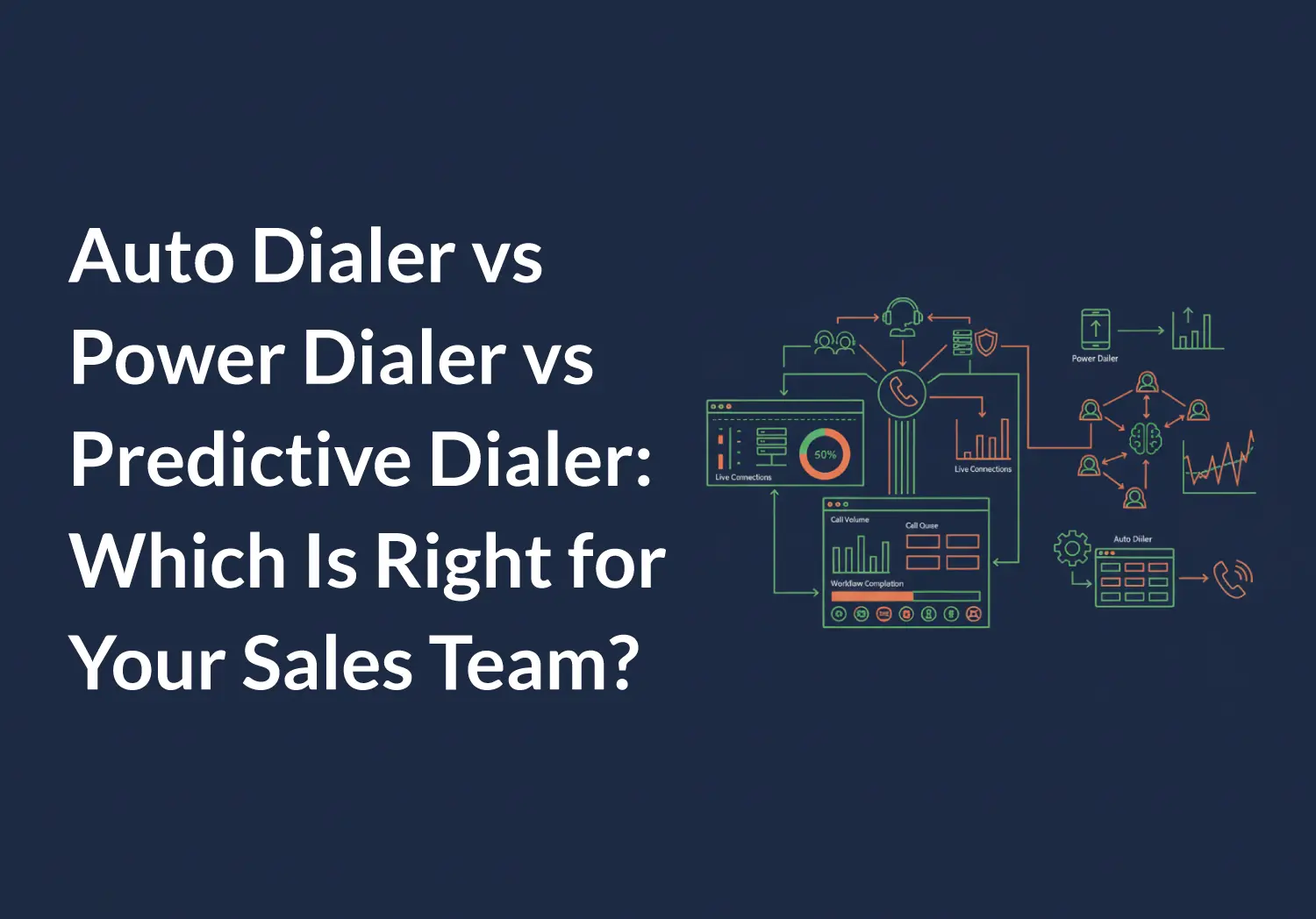
TL;DR
Pick a power dialer if you run B2B outbound. It calls one contact at a time with a live rep already on the line, so there are no abandoned calls, no dialing-mechanics exposure under the TCPA, and far less damage to your number reputation.
Power dialer = one call at a time, agent always ready before the call is placed. Best for most B2B sales teams.
Predictive dialer = several numbers dialed at once per agent, an algorithm guesses who will be free. Higher compliance risk, built for very high-volume consumer call centers.
Progressive dialer = a middle option that auto-advances pacing but still keeps one call per agent.
Auto dialer = an umbrella term covering all three. On its own it tells you nothing about compliance or call quality, which is exactly why vendors like using it.
What Is an Auto Dialer, Exactly?
"Auto dialer" is a catch-all for any system that dials numbers from a list automatically. It says nothing about how many lines are open at once, whether a human is standing by, or how much regulatory risk you are absorbing.
That ambiguity matters when you are comparing quotes. Two vendors can both say "auto dialer" and sell you fundamentally different risk profiles.
When someone says "auto dialer," they mean one of three things: a power dialer, a progressive dialer, or a predictive dialer. Before you compare prices, make the vendor name which one they actually sell. If you are still mapping the wider category, our breakdown of the best sales dialers covers how these engines show up across platforms.
Key takeaway: "Auto dialer" is a category, not a product. Ask which dialing mode is running, because that single answer determines your TCPA exposure.
How Does a Power Dialer Work?
A power dialer calls contacts from a list one at a time, dials the next number only after the previous call ends, and confirms a live agent is ready before any call is placed.
The workflow:
- Rep starts a power dialer session from their CRM contact list
- System dials the first contact
- No answer, so voicemail drops instantly and the next number dials automatically
- Someone answers, so the rep is connected immediately with full CRM context on screen
- Call ends, rep logs disposition, next number dials
The critical compliance advantage: because a live agent is always ready before the call goes out, there are zero abandoned calls. Nobody picks up to silence. That design is what keeps power dialers clear of the abandonment rules covered below.
Best for: B2B outbound teams, SDR and AE desks, account-based outreach, and any team making personalized calls at volume. Solar and home-services teams chasing same-day quote requests, insurance agencies working renewal lists, and real estate teams calling portal leads all sit squarely here.
Aloware's power dialer removes the dead time between calls rather than adding lines: the list auto-advances, voicemail drops without the rep waiting through the beep, and full CRM context loads on every connect. Deal stage, call history, last SMS, and open tasks appear on screen the moment someone answers, and every outcome logs to HubSpot or Salesforce automatically.
Key takeaway: One line per rep is not a limitation. It is the mechanism that removes abandoned calls from your risk surface entirely.
How Does a Predictive Dialer Work?
A predictive dialer calls multiple phone numbers simultaneously per agent, using an algorithm to predict when someone will finish their current call.
The workflow:
- System dials 3–5 numbers simultaneously per agent
- Algorithm predicts which call will connect first
- When a person answers, the system routes them to the next available agent
- Numbers that connect before an agent is free become abandoned calls
The compliance problem: when more people answer than the algorithm expected, someone picks up and hears silence or a hang-up. Federal rules cap that. Under 47 CFR 64.1200(a)(7), a telemarketer may not abandon more than three percent of telemarketing calls answered live by a person, measured over a 30-day period for a single calling campaign. The same rule bars disconnecting an unanswered telemarketing call before 15 seconds or four rings, and separately bars engaging two or more lines of a multi-line business at once. Statutory damages under 47 U.S.C. § 227(b)(3) run $500 per violation, up to $1,500 for willful or knowing violations. At scale, those numbers multiply fast.
The spam problem: predictive dialers generate bursts of short, disconnected calls, which is precisely the pattern carriers use to flag a number as "Spam Likely." Once that happens, pickup collapses. Hiya's State of the Call 2026 reports that 86% of unknown calls go unanswered, and a flagged number is about as unknown as a number gets. Teams on predictive dialers burn through phone numbers, rotate in fresh ones, and burn those too.
Wrong vs Right, in plain terms:
- ❌ The pitch: more lines per agent means more conversations per hour.
- ✅ The reality: more lines means more abandons, faster spam flagging, and fewer people willing to answer next week. The dial count goes up while the conversation count goes down.
Best for (legitimate use cases): very high-volume consumer operations such as collections or mass-market outreach, where a dedicated compliance function already exists. Not recommended for B2B outbound sales.
Key takeaway: A predictive dialer buys dials, not conversations. The connect-rate gain is borrowed against your number reputation, and the loan comes due.
How Does a Progressive Dialer Fit In?
A progressive dialer is the hybrid. It dials the next number automatically when a rep finishes a call, like a power dialer, but the rep never has to advance anything manually. The system owns the pacing.
It sits between the two: more automated than a power dialer, far more compliant than a predictive dialer. Some vendors use "progressive" and "power" interchangeably, so the question to ask is whether the rep retains any control over pacing.
Best for: teams that want maximum automation while staying TCPA-compliant. Support desks and inside-sales teams working warm inbound lists tend to land here.
Key takeaway: Progressive dialing still keeps one live agent per call. That is the line that matters, and it stays on the safe side of it.
Side-by-Side Comparison
What Does TCPA Compliance Actually Require in 2026?
The rules tightened through 2025 and 2026. Four provisions decide whether your dialing setup is defensible:
- Abandonment cap. No more than three percent of telemarketing calls answered live by a person, measured over a 30-day period for a single campaign (47 CFR 64.1200(a)(7)). Sustaining that across high-volume predictive deployments is genuinely hard.
- Ring-time floor. You may not disconnect an unanswered telemarketing call before 15 seconds or four rings (47 CFR 64.1200(a)(6)).
- Revocation. Replying with words like "stop," "quit," or "unsubscribe," using a key-press opt-out on a call, or using an opt-out number or website you designated all count as revoking consent outright. A voicemail or email creates a rebuttable presumption that consent was revoked. Any revocation made by reasonable means must be honored within no more than ten business days, and you may not designate an exclusive opt-out channel (47 CFR 64.1200(a)(10)–(11)).
- Damages. $500 per violation, up to $1,500 for willful or knowing violations (47 U.S.C. § 227(b)(3)).
Power dialers sidestep the first two entirely. An agent is connected before the call goes out, so there is nothing to abandon and nothing to disconnect early. The revocation and DNC obligations still apply to every team regardless of dialer, which is why DNC list management belongs in your stack no matter what you dial with.
One mechanical point worth getting right, because vendors routinely muddle it: STIR/SHAKEN caller ID authentication is not something a dialer performs. Under 47 CFR 64.6301, attestation is signed by the voice service provider that originates the call. Aloware originates calls onto a STIR/SHAKEN-attested trunk and its carrier partner signs at that layer. Any vendor claiming its dialer "signs" attestation does not understand its own plumbing.
Key takeaway: Compliance is decided by dialing mechanics, not by policy documents. One live agent per call removes two of the four exposures before you write a single rule.
Which Dialer Is Right for Your Team?
Choose a power dialer if:
- You run B2B outbound (SDRs, AEs, account-based motions)
- Conversation quality and personalization drive your win rate
- Your reps dial steadily through curated lists rather than blasting raw ones
- You need clean, compliant calling with no abandoned-call risk
- You run HubSpot, Salesforce, or another CRM you want natively connected
Choose a predictive dialer if:
- You run high-volume consumer outreach such as collections or mass-market campaigns
- You already have compliance infrastructure built specifically for abandonment-rate management
- Raw dial volume matters more to your economics than conversation quality
- You staff a large floor of agents dialing the same campaign concurrently
For most sales teams reading this: power dialer. The speed gain from predictive dialing is paid for with compliance exposure and spam flagging that compounds. A rep whose numbers got flagged is not making more connections than a rep dialing one at a time from a clean number. They are making fewer, and paying more for the privilege.
If you are still deciding how the dialer should sit against your CRM, our guide to CRM dialers covers the integration side of the choice.
Key takeaway: Choose on compliance posture and number reputation first. Dial volume is the easiest number to inflate and the least predictive of pipeline.
How Aloware's Power Dialer Compares
Aloware's power dialer is built for B2B outbound teams running on HubSpot, Salesforce, GoHighLevel, Pipedrive, or Zoho:
- One line per rep, auto-advanced: no manual dialing between calls and no multi-line exposure
- Full CRM context on every call: deal stage, history, last SMS, and open tasks load on screen when a call connects
- Automatic CRM logging: every call, disposition, recording, and AI summary syncs to the right contact and deal the moment you hang up
- Voicemail drop: a pre-recorded message drops instantly when nobody answers, and the rep is already dialing the next contact
- Automated follow-up: SMS and sequences trigger based on call disposition
- Progressive and preview dialing are available too, both configured through Sequences; progressive is enabled per account after vetting
One thing Aloware deliberately does not sell: a predictive or parallel dialer. That is a positioning choice, not a gap. Multi-line dialing is what produces the abandoned calls and spam flags described above, and we would rather protect your connect rate than inflate your dial count.
The Power Dialer is included in uPro + AI, from $60/user/month billed quarterly ($70 monthly). See full pricing.
Dialing volume is only half the equation. The other half is whether the phone gets picked up at all, which is what NumberGuard, Branded Calling, and Local Presence handle. Those three make up the Pickup Stack, and they are priced separately from the seat plan rather than bundled into it. Skip them and a clean number degrades over weeks of steady dialing until pickup collapses, which is why they are less an upsell than the maintenance layer under any serious outbound program.
Book a demo and we will walk your list, your CRM, and your current connect rate before you switch anything.
Frequently Asked Questions
What is the difference between a power dialer and an auto dialer?
"Auto dialer" is a broad term covering any system that dials automatically — including power dialers, predictive dialers, and progressive dialers. A power dialer specifically calls one contact at a time with a live agent always ready, which makes it TCPA-compliant by design. If someone says "auto dialer" without specifying the type, ask whether it's a 1:1 power dialer or a multi-line predictive dialer — the answer has significant compliance and quality implications.
Are predictive dialers legal?
Yes, but with strict limits. The FCC's TCPA regulations require businesses to keep their abandoned call rate below 3% per campaign. At high volumes, this is extremely difficult to maintain consistently. Violations carry fines of $500–$1,500 per call. For B2B outbound sales, the compliance risk of a predictive dialer typically outweighs the speed advantage.
What is a power dialer vs a predictive dialer?
A power dialer calls one number at a time with a live agent always ready — every answered call connects to a person immediately, no abandoned calls. A predictive dialer calls multiple numbers simultaneously and uses an algorithm to route the first live answer to an available agent. When more people answer than expected, calls get abandoned — triggering TCPA liability and spam flagging from carriers.
Which dialer is best for a B2B sales team?
A power dialer. B2B outbound sales requires conversation quality, CRM integration, and compliance — none of which predictive dialers optimize for. Power dialers let reps make 100–500+ calls per day while maintaining the personalized, informed conversations that B2B buyers expect.
Does a power dialer work with HubSpot and Salesforce?
Yes. Aloware's power dialer integrates natively with HubSpot, Salesforce, GoHighLevel, Pipedrive, and Zoho — importing contact lists directly, displaying full CRM context on every call, and auto-logging every outcome without manual data entry. Learn more: HubSpot Power Dialer Guide.
What is the best power dialer software in 2026?
Aloware ranked #1 in an independent 90-day test of 8 power dialer platforms (January 2026) across call quality, CRM integration, AI capabilities, and total cost of ownership. See the full comparison: Best Sales Dialers 2026.
.png)

Ruby Kootval is Head of Product Marketing at Aloware. She has 12 years in digital marketing, including 8 in B2B SaaS and 5 in telecom, and writes about AI voice agents, dialers, CRM integrations, and contact center operations.
.webp)