


TL;DR
A power dialer is outbound calling software that dials one contact at a time from a list and advances to the next record the moment the rep finishes, so a person is always on the line when someone answers. It is one type of auto dialer, not a synonym for the whole category: auto dialer is the umbrella term, and preview, progressive, predictive and power dialers all sit underneath it with different pacing.
- One live line per rep. The software never places more calls than it has reps free to take them, so nobody picks up to silence and the abandoned-call rate is structurally zero.
- The rep keeps control of the conversation. A power dialer removes the copying, pasting and manual logging between calls. It does not decide who gets called or how many phones ring at once.
- Pacing is a reputation decision as much as a speed one. Federal telemarketing rules cap abandoned calls at three percent of live answers over a 30-day campaign, and the same silent open that produces an abandoned call is the pattern carrier analytics score when they flag a number.
- Pricing is per seat, per month. Expect a per-user subscription rather than a per-dial fee, with the number-reputation layer priced separately from the dialer itself.
- It is the wrong tool for task-driven reps, for a short list of named enterprise accounts, for teams whose single hard requirement is maximum simultaneous dials, and for any list you would not want called twice.
Ask a sales manager what a power dialer is and you get a description of speed. Ask what they actually want out of one and you get a number: pickup rate, with a target attached and a note that it used to be higher.
The link between the two answers is pacing. How a dialer spaces its calls decides whether a human is on the line when someone picks up, and that decides how carriers score the number you call from. Get the pacing wrong and the pickup rate you are trying to fix is the thing you damage.
We pulled a year of outbound calling across our own platform to see what that looks like in practice. Those numbers are further down.
What is a power dialer?
A power dialer is software that calls one contact at a time from a loaded list, connects the rep the instant the call is answered, and moves to the next record automatically when the call ends. One rep, one live line, no overdialing.
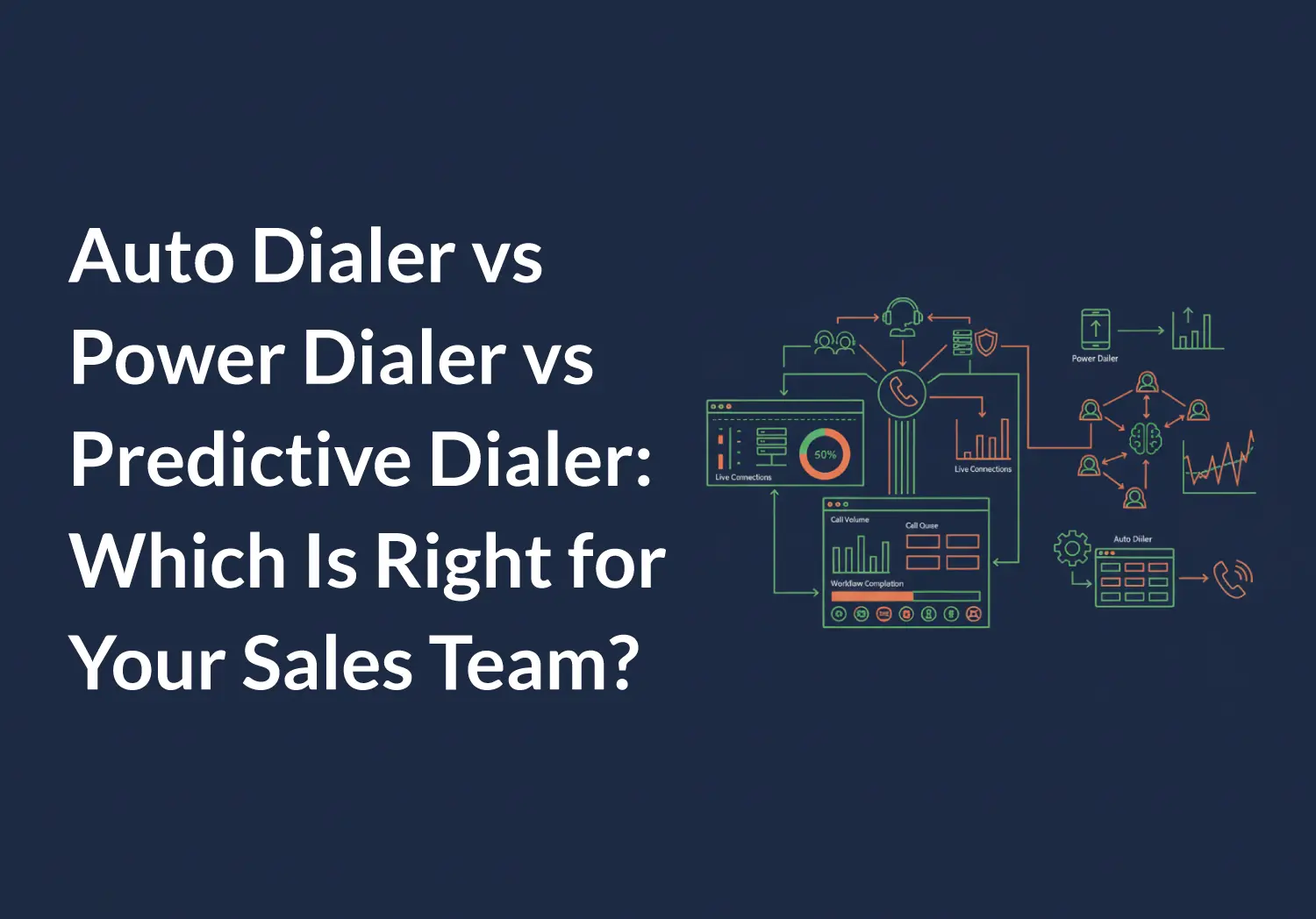
The umbrella term matters more than most buyers realize. Auto dialer covers any software that automates outbound dialing: preview, progressive, predictive and power dialers all qualify. A power dialer is the one-to-one member of that family. When a vendor calls their product an auto dialer, that word tells you nothing about pacing, and pacing is what you are actually buying. The side-by-side version of that argument is in how the dialer types compare on pacing, cost and risk.
Here is the practical difference, before and after, for a rep working an insurance renewal list:
- Before: open the CRM record, copy the number, paste it into a softphone, dial, wait, hang up, type a disposition, write a note, scroll to the next record. Admin around every single attempt, repeated a few hundred times a week.
- After: load the list, press start, talk. The record is on screen when the call connects, the disposition is one keystroke, and the next contact rings without the rep touching anything.
That is the whole product promise, and it is the shape of every power dialer that runs inside your CRM. It buys back the dead time between calls. It does not make the calls better, and it does not make anyone answer.
Which is why there is no dials-per-hour number on this page. Throughput is set by your list, your connect rate and how long your conversations run, so a vendor quoting a fixed rate is quoting their demo conditions, not your floor.
How does a power dialer work on a live call?
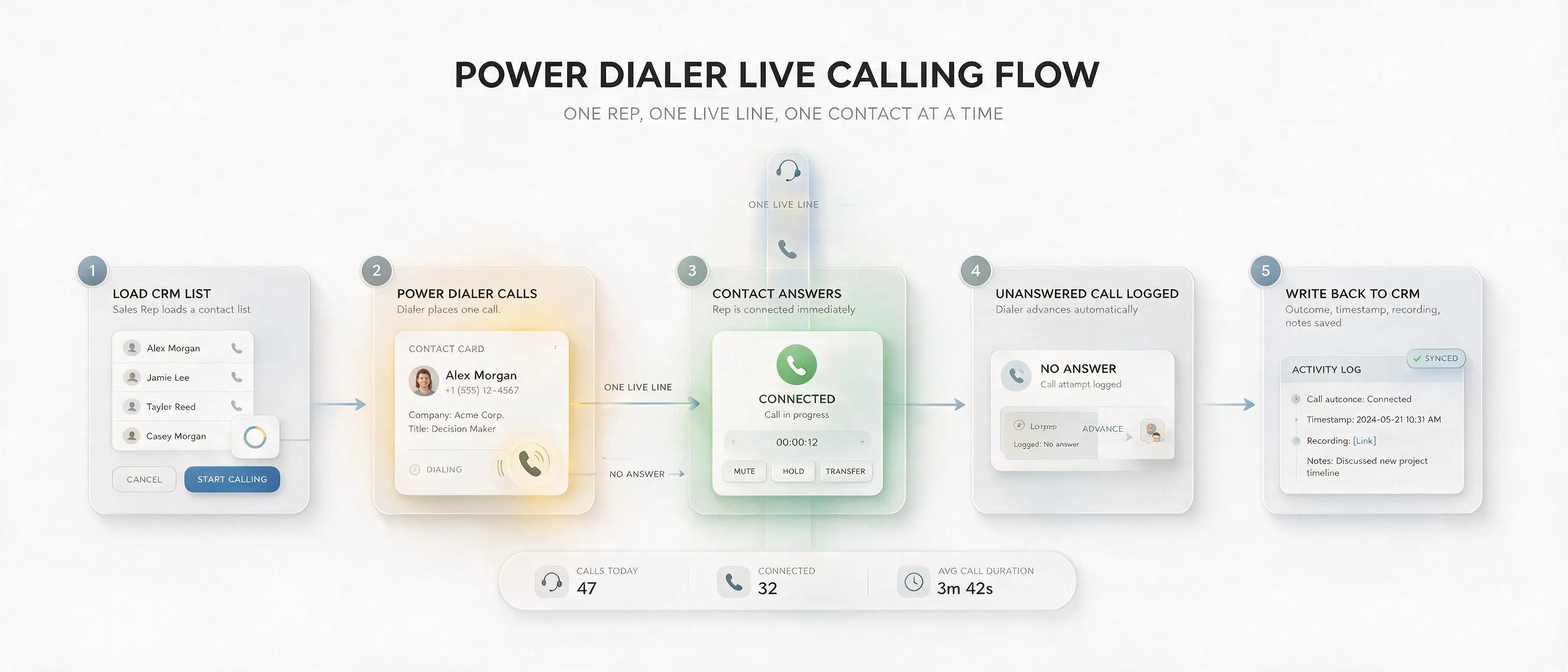
Five steps, each with a consequence worth understanding before you buy. The same loop sits under everything sold as outbound dialer software, whatever the pacing.
- The rep loads a list, typically a CRM view or a saved segment, and starts a session.
- The dialer places one call. The contact sees whatever the account is set to display: a line assigned to the rep, or an area-code match from a local-presence pool.
- If the call connects, the rep is already there. There is no transfer, no hold music and no gap.
- If it does not connect, the dialer logs the outcome, optionally drops a pre-recorded voicemail, and moves on.
- Every attempt writes itself back to the CRM with outcome, timestamp and recording, and the session advances.
Step three is where a power dialer parts company with every pacing model that dials ahead.
Why one line at a time keeps abandoned calls at zero
A predictive or parallel dialer places more calls than it has reps available, betting on the no-answer rate to even out. When the bet is wrong, someone picks up and hears nothing, and the law puts a hard number on how often that may happen. Under 47 CFR 64.1200(a)(7), a telemarketer may not "abandon more than three percent of all telemarketing calls that are answered live by a person, as measured over a 30-day period for a single calling campaign," and a call counts as abandoned when a live sales representative is not available within two seconds of the called person's completed greeting. The same rule requires a prerecorded identification and opt-out message when that happens, and a separate provision bars hanging up on an unanswered call before at least 15 seconds or four rings.
A power dialer never runs that risk, because it never places a call it cannot staff. Nothing is managed down to a threshold. The abandoned-call rate is zero by construction.
Compliance is only half of it. The silent open a consumer hears is the same signature the analytics engines behind Verizon, T-Mobile and AT&T score, the ones run by Hiya, First Orion and TNS. High volumes of short, silent-open calls from one number are the pattern that produces a spam label, and once a number carries that label the answer rate on every call from it collapses. The scoring attaches to the number, not to your company or your script.
That is expensive in an environment where getting answered is already the exception. Hiya's State of the Call 2026, built on a survey of more than 12,000 consumers across six countries, found that 86 percent of unknown calls go unanswered. Treat your outbound number like a credit score: it takes months to build, one bad quarter to wreck, and everything you do afterwards is priced off it.
Want the carrier side in full? Read how to lawfully increase pickup rates, which covers spoofing, number reputation and the local-presence and monitoring tools that protect it.

Power dialer vs auto dialer, predictive, parallel and preview: what actually differs?
Every mode below is an auto dialer. They differ on one axis: how many phones ring for every rep who is free to talk.
Aloware supports power, progressive and preview dialing, and deliberately does not build predictive or parallel dialing. We took that position on purpose. The throughput those modes add is paid for out of the number's reputation, which is the asset the rest of our product exists to protect. Teams whose single hard requirement is maximum simultaneous dials should buy from a vendor whose product is designed around it.
What does a connected outbound call actually look like?
Across a full year of outbound calling on our platform, from 1 September 2025 to 31 August 2026, half of connected outbound calls end inside 66 seconds, a quarter end inside 43 seconds, 18.5 percent run past five minutes, and the 90th percentile lasts about 10.7 minutes.
Methodology: a connected call is defined as a completed, resolved outbound call with at least 30 seconds of talk time. The 30-second floor is definitional, so the distribution describes real conversations rather than answered-and-hung-up calls. Test, demo, sandbox and internal Aloware accounts are excluded, and the figures are platform aggregates with no customer named.
Read that next to how much dialing actually happens. On the same platform the median rep places roughly 19 to 27 outbound dials on a business day, and the 75th-percentile rep places 70 to 83. The spread barely moves as teams get more tenured, which means experienced teams connect more without dialing more. (Dials with no assigned user are excluded, and the medians are interpolated in 10-dial bins.)
Put the two together and the case for one-line pacing stops being abstract. Most of the value in an outbound hour sits in a few conversations that run long, and the rest is a 43-second sort. A dialer's job is to get the rep to the next real conversation faster, not to maximize the count of phones ringing. Teams that chase the second number usually watch the first one shrink, because the numbers doing the ringing get labeled.
Key takeaway: half of connected outbound calls are over inside 66 seconds, so the metric that moves pipeline is conversations started per rep, not numbers rung per minute.
What does a power dialer cost?
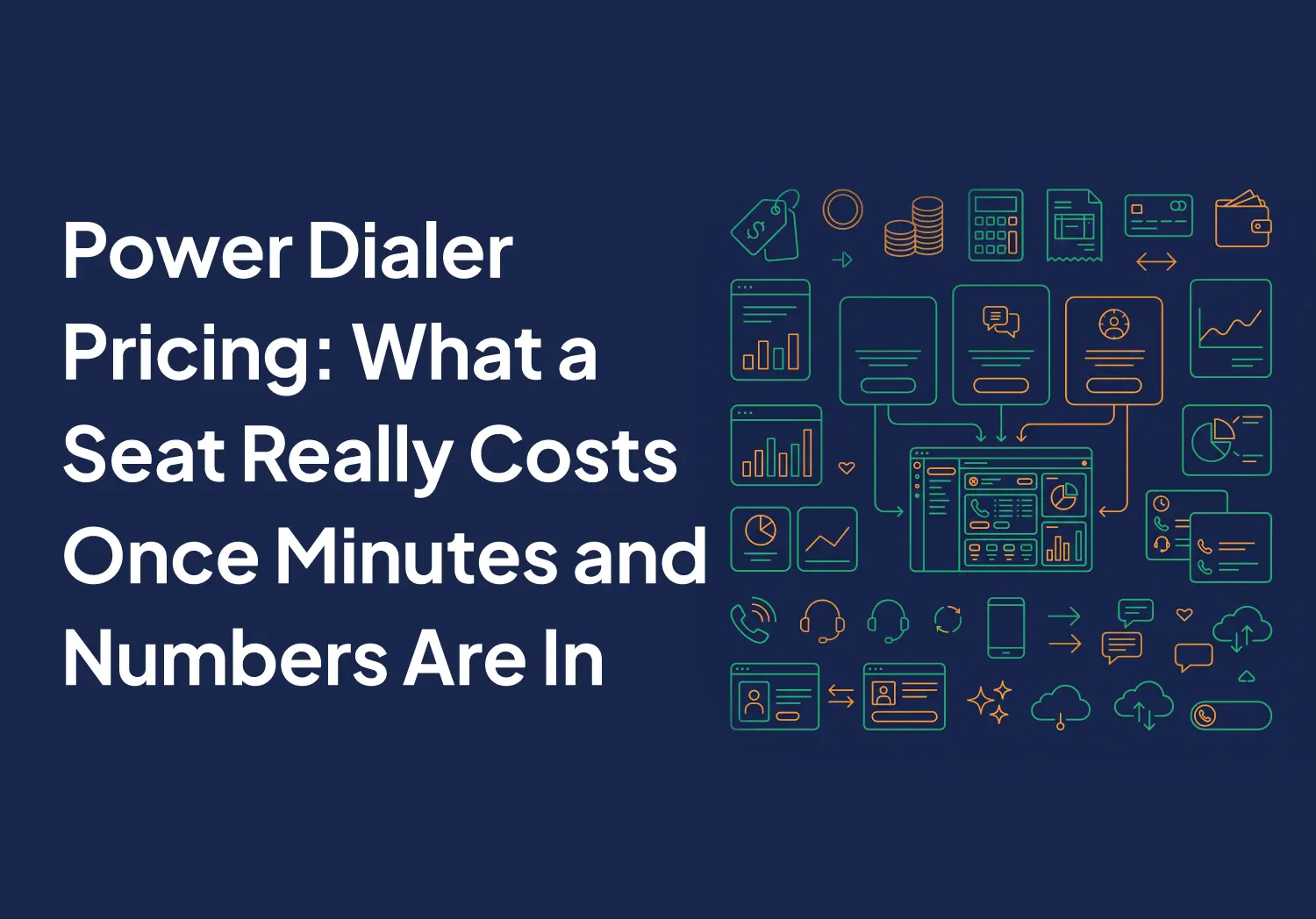
Power dialers are sold per seat, per month. You are buying a rep a license, not buying dials, and that distinction is worth confirming before you sign: a per-dial or per-minute meter behaves very differently on a heavy dialing day than a flat seat does.
Three questions decide the real number:
- Are the rep's calls metered? Rep-dialed calls bill as agent calls rather than automation. On Aloware's Core AI plans a rep live on the line dialing US and Canada numbers is unlimited with no per-minute charge, and power dialer sessions bill as agent calls for exactly that reason.
- Is the number-reputation layer in the seat price? Rarely, and it is not at Aloware either. NumberGuard, Branded Calling and Local Presence, the three pieces we call the Pickup Stack, are add-on services priced separately from any seat plan. The seat buys the dialing, CRM and AI layer; the answer-rate layer is bought on top. Budget it as infrastructure, not as an upsell you can defer.
- What does the plan floor look like? Seat minimums are standard in this category. Check yours before you price a pilot.
For our own numbers: Aloware's Power Dialer sits on the uPro + AI plan, from $60 per user per month on the quarterly plan and $70 month to month, with the current seat minimums shown on the plan page. If you want the shortlist with prices next to each other, we keep a comparison of power dialers built for sales teams current.
When is a power dialer the wrong tool?
Four situations, all of them common, where buying one will not fix what is broken.
1. Your reps work a task queue instead of a list. A HubSpot user raised this on the HubSpot Ideas board in August 2026: "I like the power dialler idea for speed and using the voicemail drop. However, our team work off of tasks and make calls as per their task. It seems somewhat counter intuitive to make a contact list to power dial which doesn't manage tasks?" They name the cost precisely: after the session, every task tied to those calls has to be updated by hand. A power dialer session runs off a list in a fixed order, so if every record in your reps' day carries a different next action, the session flattens the context that made the call worth making. Teams in this shape get more from click to dial inside the CRM record, which is a different product.
2. You sell to a small number of named accounts. A staffing agency working a candidate database needs throughput. An enterprise seller working a named target list needs research. When the account list is short and a single conversation can carry a quarter, a preview dialer or plain manual dialing wins, because the time a power dialer saves is time that account deserved anyway.
3. Maximum simultaneous dials is your only hard requirement. Some floors, high-volume lending shops in particular, have decided raw dial count is the metric and will accept abandoned calls and carrier scrutiny to get it. A power dialer does not satisfy that requirement and is not designed to. Buyers in that position go with a vendor built for it, which is the right outcome for both sides.
4. Your list or your consent posture is the actual problem. A dialer is a multiplier. Point one at a stale purchased list, or at contacts whose consent you cannot evidence, and you reach the wrong outcome faster and at greater volume. Home services and solar teams working aged lead lists hit this first, and it arrives as a spam label long before it arrives as a complaint. Fix the list, then buy the throughput.

What to check before you buy a power dialer
Six checks, in the order they affect revenue. Run them on a live call block with your own list, not on a scripted demo.
- Does the CRM record live inside the dialing session? If the rep has to alt-tab to see who they are talking to, the tool moved the admin instead of removing it. In Aloware's Power Dialer the CRM record sits inside the session, with timeline, properties and activity available while the call is live, and the same view is built for HubSpot, Salesforce and GoHighLevel.
- Does every dial log itself? Ask to see the CRM record ten seconds after the call ends. Outcome, timestamp, recording and notes should be there with no rep action, and each call should carry a tag naming the dialer that placed it. Without that tag no later report can separate dialer calls from manual ones.
- What happens to the number at volume? Ask the vendor directly how they monitor spam labeling and what remediation looks like. Aloware's answer is the Pickup Stack, priced as an add-on: NumberGuard for monitoring, Branded Calling for display, Local Presence for area-code matching. Customers report 30 percent more connections with Aloware, a customer-reported aggregate rather than a controlled study.
- Can you see a connect-rate report by rep and by team? Without a dialer-versus-manual comparison broken out by user, coaching turns into anecdote.
- Which pacing modes are available, and on which plan? Progressive and preview modes are commonly plan-gated or switched on per account after a review, and a demo that shows one does not guarantee you get all three. Ask which of the three you are actually buying.
- Does it survive your CRM? If your team runs on Salesforce or HubSpot, the integration is the product. See what Aloware writes back inside Salesforce and inside HubSpot.
The bottom line
A power dialer is a deliberate trade, and worth naming plainly: give up dial-ahead throughput, get an outbound motion where every answered call has a person behind it and your numbers stay answerable. For a B2B SaaS SDR floor, an insurance agency working renewals or a staffing team calling candidates, that trade is almost always right. For a shop whose only scoreboard is simultaneous dials, it is not. Decide which one you are before you shortlist anything, because every other dialer question is downstream of that one.
If you are running outbound inside HubSpot or Salesforce and want to see what one-line pacing does to your connect rate, book a demo and we will run the Power Dialer, AloAi Voice Agent and AloAi Voice Analytics against your CRM records while you watch.

Frequently Asked Questions
Is a power dialer the same thing as an auto dialer?
No. Auto dialer is the umbrella term for any software that automates outbound dialing, and it covers preview dialers, progressive dialers, predictive dialers and power dialers. A power dialer is the one-to-one member of that family: it places a single call at a time for a single rep and only when that rep is free. The distinction matters when you are shortlisting, because a vendor can accurately describe a predictive dialer as an auto dialer. Ask which pacing model sits underneath the label, since pacing is what determines your abandoned-call exposure and how your numbers are scored by carriers.
Does a power dialer cause dropped or abandoned calls?
No, because it never places a call it cannot staff. A power dialer dials one contact at a time for a rep who is already free, so a person is on the line the moment the contact answers. Abandoned calls are a property of pacing models that dial ahead of available reps. Federal telemarketing rules at 47 CFR 64.1200(a)(7) cap abandonment at three percent of live-answered calls measured over a 30-day period for a single campaign, and treat a call as abandoned when a live sales representative is not available within two seconds of the called person's completed greeting. With one line per rep, that rate is zero by construction rather than managed to a threshold.
How many calls does a rep actually make in a day?
It depends on your list, your connect rate and how long your conversations run, so treat any fixed number a vendor quotes with caution. Real distributions are wide. Across a year of outbound calling on the Aloware platform, from September 2025 to August 2026, the median rep placed roughly 19 to 27 outbound dials on a business day while the 75th-percentile rep placed 70 to 83, and that spread barely moved as teams got more tenured. Those are all rep-attributed outbound dials, manual and dialer-placed together, not a power dialer session rate: dials with no assigned user are excluded and the medians are interpolated in 10-dial bins. A power dialer removes the admin between attempts, so it raises the ceiling on what a rep can do in an hour. It does not set the number for you.
Is a power dialer legal under the TCPA?
The pacing model is not what creates most TCPA exposure. The abandoned-call rule at 47 CFR 64.1200(a)(7) is the provision aimed squarely at dial-ahead pacing, and a one-to-one power dialer does not trigger it because no call is placed without a rep on it. Your obligations around consent, do-not-call handling, calling windows and state-level rules are separate and they remain yours whichever tool you use. Written consent requirements, internal do-not-call list management and record keeping do not change because the dialing is automated. Treat this as background rather than legal advice and have counsel review your specific calling program.
Does a power dialer get your number marked as spam?
Not by itself, and that is one of the reasons teams choose it. The analytics engines the carriers rely on, run by vendors such as Hiya, First Orion and TNS, score patterns on a phone number: call volume, call duration, answer rate, complaint signals and the silent openings produced when a dialer places more calls than it can staff. One line per rep removes the silent-open pattern entirely. Volume from a single number can still cause a flag, which is why number reputation is managed separately from the dialer through monitoring, branded caller display and local-presence number pools. If your numbers are already labeled, changing pacing helps but it will not clear an existing label on its own.
What is the difference between a power dialer and a progressive dialer?
Both place one live call at a time, so neither creates abandoned calls. The difference is who starts the session and what happens on answer. A power dialer is rep-driven: the rep loads a list, presses start and works through it. A progressive dialer is campaign-driven: it sits as a step inside an automated sequence and places the call only when an agent in the selected ring group is available, often playing a short message and asking the contact to consent before connecting. Power dialing suits a rep working a call block. Progressive suits an automated cadence where the call is one step among texts and delays.
Do you need a CRM to use a power dialer?
You can run one from an uploaded list, but most of the value disappears without a CRM behind it. The point of a power dialer is removing the work around the call, and the largest part of that work is getting the outcome back into the system of record. Without a CRM connection, reps still retype dispositions and notes, managers lose the attribution trail, and follow-up sequences do not fire. If your team runs on HubSpot, Salesforce or GoHighLevel, the question to ask a vendor is not whether it integrates but whether the record is visible and editable inside the dialing session itself.
How much does a power dialer cost?
Power dialers are priced per user per month, as a seat rather than per dial. Aloware's Power Dialer sits on the uPro + AI plan, from $60 per user per month on the quarterly plan and $70 month to month, with current seat minimums shown on the pricing page. Two things to confirm with any vendor before you compare numbers: whether rep-dialed calls are metered, since on Aloware's Core AI plans a rep live on the line to US and Canada numbers is unlimited with no per-minute charge, and whether the number-reputation layer is included. At Aloware it is not: NumberGuard, Branded Calling and Local Presence are add-on services priced separately from any seat plan.
.png)

Ruby Kootval is Head of Product Marketing at Aloware. She has 12 years in digital marketing, including 8 in B2B SaaS and 5 in telecom, and writes about AI voice agents, dialers, CRM integrations, and contact center operations.
-.webp)
.webp)