

--What-It-Actually-Costs.webp)
TL;DR:
Aircall pricing in 2026. Aircall sells three main plans plus a new entry tier: Essentials from $30 and Professional from $50 per user per month on annual billing (both carry a 3-license minimum), a quote-only Custom tier at 25 licenses, and a new Starter AI Plan for a single user. The catch for a sales team is that the machinery lives one tier up: the Power Dialer requires Professional, so does Salesforce, and the AI voice and messaging agents are usage-priced on top of the seat. Aircall's own pricing page renders every dollar figure as "null," so the real numbers come from its blog. Aloware puts the dialer and AI analytics inside the seat: uPro is $60 per user per month billed quarterly, power dialer and transcription included.
Aircall is a HubSpot-friendly cloud business phone. But if you go to price it, you hit an odd wall: the Aircall pricing page shows plan names and feature lists, then renders every actual dollar amount as the placeholder word "null" until you pick a country and license count or talk to sales. The published numbers exist, they just live on Aircall's own blog and help center rather than the pricing page.
This is a pricing teardown for one specific buyer, a sales or support team that dials out, texts leads, and runs on a CRM. If that's you, the $30 Essentials sticker matters less than which tier turns on the dialer and what the AI agents cost per minute. Here's the real math, sourced to Aircall's own pages.
What does Aircall cost in 2026?
Aircall sells its phone system in three main per-seat tiers plus a new single-user entry plan, billed per user, per month, with an annual discount of up to 25 percent versus monthly. Because the pricing page renders dollar amounts client-side as "null," the seat figures below come from Aircall's own blog, not the pricing page.
| Aircall plan | Annual (per user/mo) | Seat minimum | What the seat includes |
|---|---|---|---|
| Essentials | $30 | 3 | Click-to-call, call recording, IVR, 250+ integrations, and API access. |
| Professional (the dialer tier) | $50 | 3 | Adds the Power Dialer, Salesforce CTI, AI Assist included, advanced analytics, and smart routing. |
| Custom | Quote only | 25 | Enterprise controls and custom commercial terms. |
| Starter AI Plan | Not published | 1 (no minimum) | New single-user entry plan. |
Seat figures from aircall.io/blog, fetched July 8, 2026 ("From $30/user/mo (Essentials)" and "$50/user/month annually" for Professional). Aircall's pricing page renders these amounts as "null" client-side, so treat the blog figures as the citable rate. The Starter AI Plan and Custom tier prices are not published.
Key takeaway: Aircall's advertised entry is $30 per user per month on Essentials, and $50 on Professional, both annual and both with a 3-license floor. The seat is real, but you cannot read the price off the pricing page, and the entry seat is not where the outbound machinery lives.
The real cost: what stacks on the seat
For an outbound or CRM-driven team, four things drive the real Aircall bill, and most of them sit above the Essentials seat.
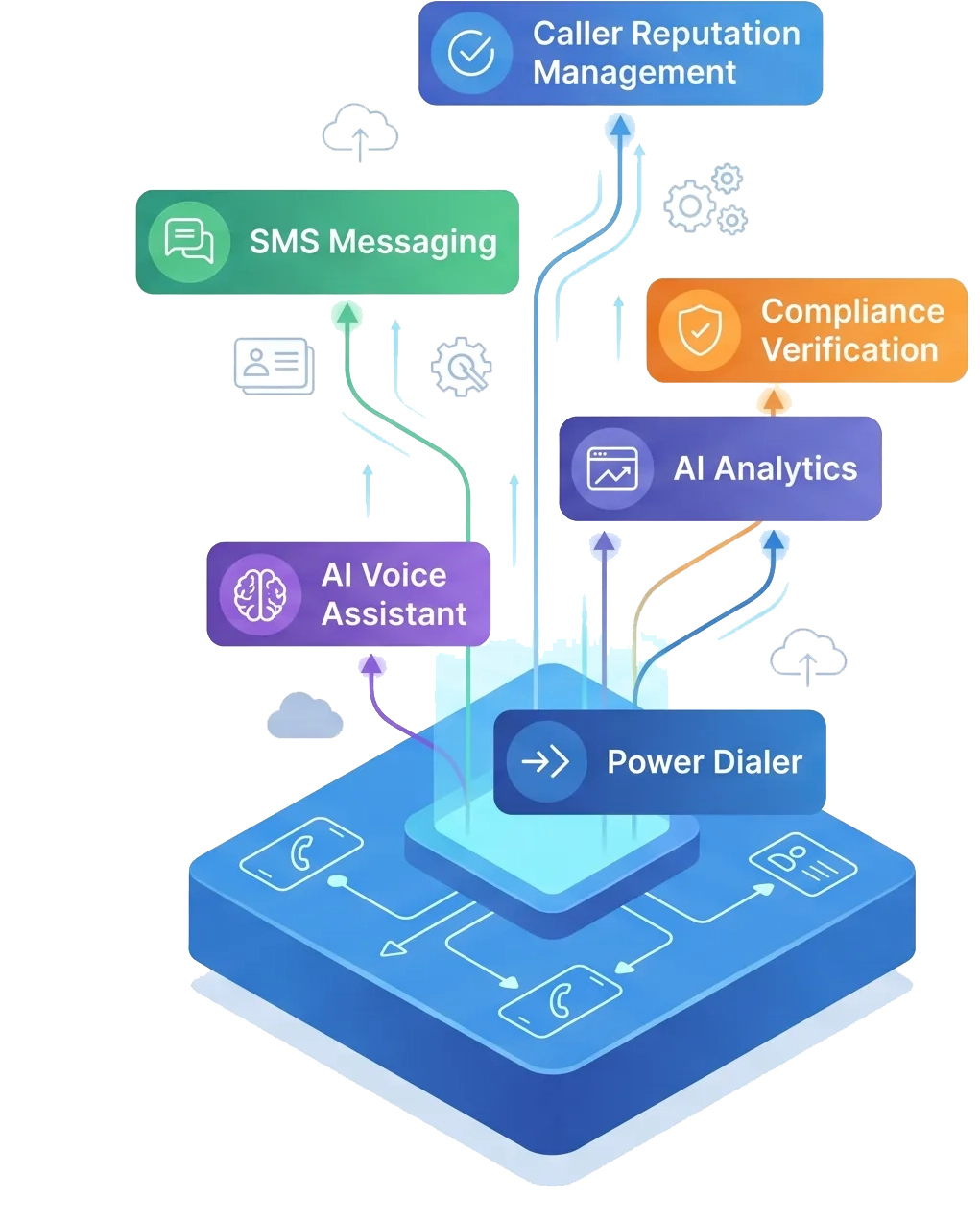
The dialer is a Professional feature. Aircall does have a sales dialer, and it is a genuine power dialer: it queues numbers and dials them one at a time. Aircall is deliberate that it is power-mode only, not predictive or parallel ("we believe that quality, personalized conversations are most important"). The catch is the gate: the Power Dialer requires the Professional plan at $50 per user per month annually. On Essentials you get click-to-call and logging, not list-based dialing. For a HubSpot team the upside is real, HubSpot Active Lists feed Aircall's dialer natively, but only once you are on the $50 seat.
The AI is partly bundled, partly metered. AI Assist, Aircall's live transcription and call summaries, is a $9 per-license add-on that is included free on Professional, so its cost depends on your tier. AI Assist Pro runs $49 per license per month. The agents are usage-priced: AI Voice Agents cost $0.49 per minute, dropping to $0.39 above 2,551 minutes, with prepaid bundles (500 minutes for $175, 2,500 for $725, 5,000 for $1,450), 50 free minutes per account per month, and a $0.015 per-attempt outbound origination fee that the bundles do not cover. AI Messaging Agents are priced per conversation, and Aircall does not publish that rate. So the AI layer is a mix of a bundled feature and a per-minute meter you size to your call volume.
Deliverability is your job, in Aircall's own words. This is the line a dialing team should read twice. Per Aircall's help center: "Aircall cannot remove spam labels from carrier or third-party databases." Its guidance is self-service only: register with the Free Caller Registry, change calling behavior, spread volume across numbers, and as a last resort request a new number with no guarantee (support.aircall.io, verified July 2026). There is no managed remediation service to buy. If your numbers get flagged "Spam Likely," you work the problem yourself.
Texting is self-serve compliance. Aircall supports SMS, but A2P 10DLC registration is a customer-driven, self-serve process that "usually takes up to 30 days," and unregistered outbound SMS is blocked. The fees are yours: roughly $4.50 to $46 in brand registration, $15 per vetting attempt, and $1.50 to $10 per month in campaign fees (support.aircall.io, verified July 2026). There is no managed-registration service described, so budget setup time as well as money.
Then there's the contract. Aircall's terms auto-renew for equal periods unless you give 30 days' written notice, allow price increases on 30 days' notice (45 days for annual plans), and refund unused prepaid fees only where termination is not for your breach (legal.aircall.io terms, verified July 2026).
Key takeaway: The real Aircall budget for an outbound team is the Professional seat at $50 for the dialer, plus AI Assist Pro or per-minute AI agents, plus your own spam remediation and self-serve 10DLC fees. The $30 Essentials line was never the number for a team that dials at volume.
Who Aircall is actually for
Aircall fits a team that wants a business phone with a CRM app and does not need volume dialing on the entry seat. Its HubSpot marketplace listing, "Aircall: AI-powered calling and SMS, built for HubSpot," holds a 4.3 out of 5 across roughly 316 ratings with 15,000-plus installs, and it delivers an embedded dialer, click-to-call, call and SMS logging to contacts and deals, workflow-triggered SMS, and power dialing from HubSpot lists (on Professional). For a smaller HubSpot team that lives in the inbox and dials in moderate volume, that polish is the draw.
It fits worse when your team is outbound-first and CRM-native from day one. The dialer, Salesforce, and advanced analytics are all gated to the $50 Professional tier, so the $30 seat is a phone, not a sales engine. The spam and deliverability work is self-service by Aircall's own admission, which is exactly the reliability an outbound floor cannot absorb. And you cannot price any of it off the pricing page, since the dollar amounts render as "null."
Key takeaway: Buy Aircall if you want a HubSpot-connected business phone and dial in moderate volume. If you are a US sales team that needs the dialer, real texting, and answer-rate tooling on every seat, price the Professional tier and the add-ons first, then compare.
Aircall vs Aloware for sales teams
Aloware is a purpose-built CRM-native contact center for SMB and mid-market sales and support teams. The difference from Aircall is where the outbound machinery lives: one tier up, or inside the seat.
| What a sales team needs | Aircall | Aloware |
|---|---|---|
| Published seat price | Essentials: $30/user/mo; Professional: $50/user/mo (annual, via blog; pricing page renders "null") | iPro $30, uPro $60, xPro $85/user/mo (quarterly), published up front |
| Outbound dialer | Power Dialer requires the Professional plan ($50/user/mo); power mode only | Power Dialer included in uPro and higher plans |
| Conversation intelligence and AI | AI Assist included on Professional; AI Assist Pro $49/user/mo; AI Voice Agents $0.39–$0.49/min plus $0.015 per attempt | AI Voice Analytics (transcription, summaries, sentiment) included by plan; AloAi Voice Agent from $0.10/min |
| SMS to leads | Two-way SMS with self-service A2P 10DLC registration; customer pays registration fees; unregistered outbound messaging is blocked | Unlimited 1:1 agent SMS to US & Canada on every plan; Managed A2P 10DLC ($500 one-time) |
| Agent call minutes | Outbound charges vary by region and are usage-based | Unlimited inbound and outbound agent minutes to US & Canada with no per-minute agent charges |
| CRM depth | Strong HubSpot integration (4.3/316); list-based Power Dialer requires Professional; Salesforce integration on Professional | HubSpot workflows and dynamic-list dialing (uPro); Salesforce (xPro); Pipedrive, Zoho, and GoHighLevel integrations |
| Answer-rate tooling | Self-service only; cannot remove spam labels from carrier or third-party databases | The Pickup Stack (NumberGuard, Branded Caller ID, Local Presence) available as a single add-on |
The structural contrast: Aircall sells you a $30 phone and puts the dialer, Salesforce, and advanced analytics on the $50 tier, then meters the AI on top. Aloware's power dialer and AI transcription, summaries, and sentiment are inside the uPro seat at $60 per user per month, with HubSpot workflows and unlimited agent calling and texting to the US and Canada already there. You're comparing a phone plus a tier climb to a platform that ships the dialing and the AI in one line.
Two places Aloware answers an Aircall gap directly:
- Deliverability as a system, not your homework. Aircall states plainly that it cannot remove spam labels and hands you a self-service checklist. Aloware bundles the answer-rate layer into one motion, the Pickup Stack: NumberGuard monitors your numbers for spam flags and manages remediation, Branded Caller ID registers your identity (xPro, requires a $2,000/mo RCPA), and Local Presence ($300/mo) dials from local numbers. It is still an add-on, but it is a managed system, not a checklist you run alone.
- The dialer on the seat, not the tier above. Aircall's list-based power dialing is real and HubSpot-fed, but it lives on the $50 Professional plan. Aloware's HubSpot integration runs dynamic-list dialing and workflow triggers on the uPro seat, with in-record texting and call logging, so there is no dialer tier to climb to.
Where Aircall wins, honestly: if you want a widely reviewed HubSpot phone and your team dials in moderate volume, Aircall's app breadth and UX are its selling points, and Aloware's unlimited calling and Pickup Stack are US and Canada-centric. Buy Aircall for the polish. Buy Aloware for an outbound engine that runs inside your CRM, and if you want the side-by-side you can read how the à-la-carte model compares across vendors.
Key takeaway: Aircall's $30 seat plus a $50 dialer tier, per-minute AI, and self-service deliverability adds up to a bundle you assemble and manage. Aloware's uPro puts the dialer and AI analytics in one $60 seat with managed compliance and answer-rate tooling on tap.

How to price Aloware in five minutes
You don't need a quote for Aloware, and no dollar figure renders as "null." The plans are published:
- iPro + AI, $30/user/mo (quarterly): core calling and texting, native HubSpot, Pipedrive, and Zoho, 1,000 AI Voice Analytics minutes. Best for speed-to-lead teams.
- uPro + AI, $60/user/mo (quarterly): adds the Power Dialer, HubSpot workflows and dynamic-list dialing, 5,000 AI Voice Analytics minutes, call coaching, and sequences. Best for outbound reps.
- xPro + AI, $85/user/mo (quarterly): adds Salesforce, unlimited voice analytics, AI agent monitoring, and Managed 10DLC compliance. Best for a full AI-driven contact center.
Add the Pickup Stack when you need answer rates to hold over time, and add AloAi Voice Agent (from $0.10/minute, $250/mo RCPA minimum) when you want AI to handle calls, priced per minute like Aircall's AI Voice Agents but starting well below Aircall's $0.49. Every number is published, not a sales call.
The bottom line: Aircall pricing in 2026 is a $30 phone with the outbound machinery a tier up and the AI on a meter, sold behind a pricing page that hides its own numbers. That's a fine buy for a HubSpot team that dials in moderate volume and wants polish. If you're a US sales team that dials at volume, texts leads, and needs answer rates to hold, add up the Professional tier, the AI minutes, and the deliverability work you'll own, then compare that to a platform that already includes the dialer and the AI in the seat. See Aloware's published pricing and book a demo to run your own numbers.
Frequently Asked Questions
How much does Aircall cost per month?
Aircall sells three main per-seat plans on annual billing: Essentials from $30 and Professional from $50 per user per month, plus a quote-only Custom tier at a 25-license minimum and a new single-user Starter AI Plan whose price is not published. Essentials and Professional both carry a 3-license minimum. Those seat prices don't include per-minute AI agents or, on Essentials, the power dialer. Figures come from Aircall's own blog, verified July 2026, because the pricing page renders dollar amounts as "null."
Why does Aircall's pricing page show "null" instead of a price?
As of July 2026, Aircall's pricing page renders its per-license dollar amounts client-side, and they display as the placeholder "null" until you select a country and license count or contact sales. The real figures ($30 Essentials, $50 Professional, both annual) are published on Aircall's own blog and help pages instead. Any third-party monthly figure you see elsewhere should be checked against those sources.
Is the dialer included in Aircall's price?
Only on Professional. Aircall's Power Dialer, which queues numbers and dials them one at a time, requires the Professional plan at $50 per user per month annually. On the Essentials plan you get click-to-call and logging, not list-based power dialing. Aircall's dialer is power-mode only by design, not predictive or parallel. For HubSpot teams, HubSpot Active Lists can feed the dialer natively once you're on Professional.
What are Aircall's hidden costs?
The costs buyers miss are the tier gate and the metered add-ons. The Power Dialer and Salesforce require Professional ($50/user). AI Assist Pro is $49/license/month, and AI Voice Agents are usage-priced at $0.49 per minute (dropping to $0.39 above 2,551 minutes) plus a $0.015 per-attempt outbound origination fee. A2P 10DLC registration carries customer-paid fees, and spam remediation is self-service, since Aircall states it cannot remove spam labels from carrier databases.
Does Aircall integrate with HubSpot?
Yes, and it's one of Aircall's strengths. Its HubSpot marketplace app holds about 4.3 out of 5 across roughly 316 ratings with 15,000-plus installs, and it provides an embedded dialer, click-to-call, call and SMS logging to contacts and deals, workflow-triggered SMS, and power dialing from HubSpot lists. The main caveat is the tier: list-based power dialing effectively requires the Professional plan, because the Power Dialer is Professional-gated.
How does Aircall pricing compare to Aloware?
Aircall's entry seat ($30 Essentials) matches Aloware's iPro, but Aircall gates the dialer, Salesforce, and advanced analytics to its $50 Professional tier and meters the AI on top. Aloware's uPro plan is $60 per user per month billed quarterly, with the Power Dialer and AI transcription, summaries, and sentiment already in the seat, plus HubSpot workflows and unlimited agent calling and texting to the US and Canada. For a US outbound team, it's a phone-plus-tier-climb versus one seat that ships the dialing and AI.
Does Aircall charge extra for AI features?
Partly. AI Assist (live transcription and summaries) is a $9 per-license add-on that is included free on the Professional plan, so its cost depends on your tier. AI Assist Pro is $49 per license per month. The AI Voice Agents are usage-priced at $0.49 per minute, falling to $0.39 above 2,551 minutes, with prepaid bundles and 50 free minutes a month, plus a $0.015 per-attempt outbound origination fee. AI Messaging Agent pricing is per conversation and not published.
Does Aircall help with spam labels and caller ID?
Not as a managed service. Aircall's help center states plainly that it "cannot remove spam labels from carrier or third-party databases," and its guidance is self-service: register with the Free Caller Registry, adjust calling behavior, spread volume across numbers, and as a last resort request a new number with no guarantee. There is no paid remediation product to buy, so if your numbers get flagged you work the problem yourself.
Is Aircall good for outbound sales teams?
Aircall can work for outbound, but you'll build up to it: the Power Dialer on the Professional tier, AI Assist Pro or per-minute AI agents for coaching and automation, and your own spam remediation and 10DLC registration for deliverability. Its dialer is power-mode only, not parallel or predictive. Teams that want the dialer, analytics, and answer-rate tooling included on every seat tend to shortlist a CRM-native contact center instead.
What's the cheapest way to use Aircall?
The Essentials plan from $30 per user per month on annual billing is the main entry point, with a 3-license minimum, and a new single-user Starter AI Plan removes that minimum but has no published price. Essentials includes click-to-call, recording, and integrations, but not the Power Dialer, Salesforce, or advanced analytics, which start at Professional ($50). The seat is affordable; it just doesn't include the outbound machinery a sales team uses to dial at volume.
.png)

Ruby Kootval is Head of Product Marketing at Aloware. She has 12 years in digital marketing, including 8 in B2B SaaS and 5 in telecom, and writes about AI voice agents, dialers, CRM integrations, and contact center operations.
--What-It-Actually-Costs.webp)