.jpeg)


TL;DR
Can you point an AI voice agent at a list of leads you bought and start dialing? Almost never, not legally. In February 2024 the FCC ruled that AI-generated voices count as an "artificial" voice under the TCPA, which means AI outbound calls need the same prior express consent (and, for sales and marketing, prior express written consent) that prerecorded robocalls do. A purchased or scraped list is exactly the kind of list that doesn't carry that consent and the legal burden of proving consent sits with you, the caller, not the vendor who sold you the list.
- AI voice = "artificial voice" under the TCPA. The FCC's Feb 8, 2024 Declaratory Ruling put AI-generated voice calls under the same consent rules as prerecorded robocalls.
- Telemarketing needs prior express written consent, clear, specific and given to your business by that person.
- Purchased lists don't carry valid consent. Consent can't be bought or transferred and you carry the burden of proof if you're sued ($500–$1,500 per call, up to a four-year lookback).
- The line is consent, not inbound vs. outbound. An AI voice agent can legally call anyone who gave you consent (opted-in leads, existing customers, people who asked for a callback). What breaks the law is the missing consent on a bought list, not the direction of the call.
Why AI voice calls raise the compliance bar
On February 8, 2024, the FCC issued a Declaratory Ruling confirming that calls made with AI-generated voices are "artificial" under the TCPA. That single word matters. The TCPA restricts calls that use an "artificial or prerecorded voice," and the FCC put current AI voice technology squarely in that bucket, including voice cloning and synthetic voices designed to sound human.
The practical effect: an AI voice agent placing outbound calls is treated like a prerecorded robocall, not like a human rep dialing manually. That means before the call you generally need to (1) have prior express consent from the person, prior express written consent if the call is telemarketing or advertising, (2) identify who's responsible for the call and (3) offer a way to opt out. (To be clear, the ruling didn't ban AI voice calls; it made them legal-but-restricted, the same as any other artificial-voice call.)
A human rep making a live, one-to-one manual call operates under different, generally lighter rules than an artificial-voice call, which is a big part of why "let the AI dial the cold list" and "let a rep dial the cold list" are not the same decision.
Key takeaway: the moment a synthetic voice makes the call, you're in robocall territory and robocall territory needs consent.
Why a purchased list is the wrong place to point an AI dialer
Even setting the AI question aside, purchased and scraped lists are a classic TCPA trap. Valid consent under the TCPA has to be:
- Given to you. Consent runs to the specific business the consumer agreed to hear from. A checkbox on some third-party lead-gen site is not consent to be called by your company.
- Clear and documented. For telemarketing it must be written, unambiguous and tied to a real disclosure, the kind of record you can produce years later.
- Yours to prove. If a recipient sues, the burden of proving consent is on the caller and it cannot be shifted onto the lead vendor or the comparison-shopping site that generated the "lead."
Purchased lists fail all three by default. That's why the guidance from telecom attorneys is blunt: consent can't be bought, rented, or inherited. And the stakes are real, statutory damages run $500 to $1,500 per call, class actions can reach back roughly four years and a bought list of unknown provenance is precisely the fact pattern plaintiffs' firms look for.
One nuance worth knowing if you've been reading headlines: the FCC's stricter "one-to-one consent" rule, which would have required separate consent for each individual seller, was vacated by the Eleventh Circuit in January 2025 just before it took effect. So the older, somewhat broader consent standard still governs. But that doesn't rescue purchased lists, the conservative, defensible posture is unchanged: get your own express consent from the person you're going to call and keep the proof.
Key takeaway: consent belongs to a relationship, not a spreadsheet. If you can't prove the person said yes to you, an AI voice agent shouldn't be calling them.
Where you can point an AI voice agent, because the consent is there
This is not a limit on the technology; it is a limit on who you have permission to call. Once consent exists, an AI voice agent is fully in bounds. The places it fits are simply the places where you already hold consent:
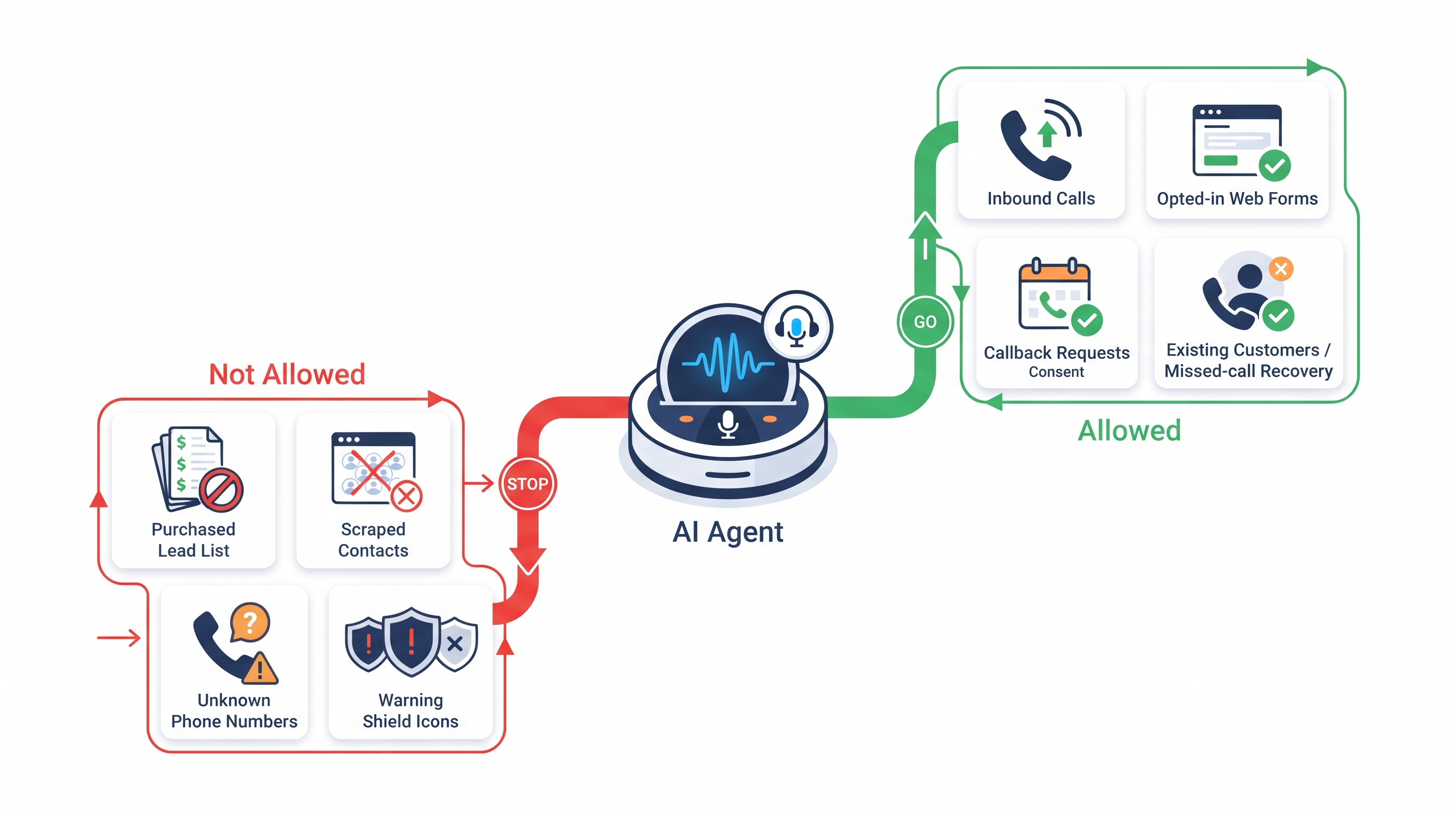
- Inbound calls. When a prospect calls you, they have initiated the contact, so consent is built in. An AI voice agent that answers, qualifies, books meetings and warm-transfers to a rep is fully compliant here.
- Opted-in leads. People who filled out your form, requested a callback, or texted you first, leads where you captured consent, with a record to back it up.
- Existing customers. Appointment reminders, renewals and service follow-ups to people who already have a relationship with your business.
- After-hours and missed-call recovery. Catching the calls your team can't answer, so a lead never hits voicemail, again, inbound, consent-clean and a direct revenue win.
For genuinely cold outreach, the compliant move is a human rep on a power dialer, one live, manual call at a time, paired with a clean, warmed number so the call actually connects. That's the opposite of pointing an autodialer or an AI at a bought list and it's deliberately how Aloware is built: AI answers the right calls, humans handle cold outreach and nothing dials ahead of consent.
Want to see an AI voice agent handle a real inbound lead in under 60 seconds? Book a 20-minute AloAi Voice Agent demo and we'll set it up around your actual workflow. (AI voice runs per-minute, transparently, from $0.10/min on the Basic model tier, $0.20/min on Premium, up to $0.50/min on Ultra Premium, so you only pay for the AI, not for the seat.)
Key takeaway: use AI voice where consent is inherent or documented, inbound and opted-in and keep humans on the cold list.
How Aloware enforces opt-out and DNC across every number
Consent is only half of compliance. The other half is honoring it the instant someone says no, everywhere, permanently, without a rep having to remember. In July 2026 Aloware shipped a rebuilt Do Not Contact and opt-out enforcement layer that does exactly that. Here's what it means for a team running outbound:
- Enforcement is at the contact level, not the phone-number level. If a contact has three numbers on file and any one of them replies STOP, all three are immediately blocked for SMS. Opt-out belongs to the person, not the single line that got the reply.
- DNC and SMS opt-out are separate, with clear rules. Marking a contact Do Not Contact (DNC) blocks every outbound call and text from any line, user, or agent. An SMS opt-out (a STOP reply) blocks texts only, the contact can still be called, because some people want calls but not texts and Aloware won't assume otherwise. Setting DNC automatically cascades to SMS opt-out; the reverse never happens.
- Opt-out survives deletion and re-import. Compliance flags live in a dedicated suppression table keyed to the phone number, separate from the contact record. It's never purged. Delete a contact and re-import them from a CSV or a CRM sync and their DNC/opt-out state is restored automatically, so a routine list refresh can't quietly resurrect a number that already opted out.
- Sequences and lines can't bypass it. Every outbound action, a call, a text, a sequence enrollment, checks the suppression table first. If a contact opts out mid-sequence, the sequence stops sending to all their numbers immediately.
- Removing a DNC is deliberate and logged. Un-DNC'ing a contact requires an admin, a signed account waiver and a mandatory written reason and every un-DNC is permanently recorded in the contact's compliance timeline with the actor, the reason and a timestamp. That audit trail is exactly what you want if you ever have to demonstrate you honored an opt-out.
- Your AI voice agent can flag DNC itself. Through in-conversation Actions, an AloAi Voice Agent can set a contact as DNC mid-call the moment they ask not to be contacted, no rep follow-up required.
- DNC/opt-out syncs one way into HubSpot. Aloware pushes compliance state to HubSpot and treats itself as the single source of truth; an edit made directly in HubSpot can't silently overwrite an opt-out Aloware is holding.
Key takeaway: an opt-out you honor on one number but miss on another is still a violation, Aloware closes that gap by enforcing at the contact level and keeping the record forever.
What Aloware does not do, and why we tell you
A compliance tool you can trust is one that's clear about its limits. So, plainly:
- Aloware does not scrub your list against the national or state Do Not Call registries. The suppression system above is your own per-account internal list, the numbers that opted out of your outreach or were flagged DNC in your account. Registry scrubbing against the federal DNC database is a separate compliance step you handle with a dedicated tool or your counsel's process.
- Aloware doesn't decide whether your consent is valid. The platform enforces the states you set and the opt-outs your contacts send. Whether a given lead's consent holds up is a legal judgment, yours and your attorney's.
- This article isn't legal advice. TCPA rules shift (the 2024 AI ruling and the 2025 consent-rule reversal are proof), interpretations vary by court and state laws add their own layers. Treat this as an informed starting point and confirm your program with qualified counsel.
Key takeaway: the vendors worth trusting on compliance are the ones who tell you where their tooling stops. Aloware handles enforcement and the audit trail; consent strategy and registry scrubbing stay with you.

A compliant AI-outbound checklist
If you want AI voice in your outbound motion without the exposure, here's the sequence we walk customers through:
- Start with inbound. Put your AI voice agent on inbound, missed-call recovery and after-hours coverage first. It's the safest, highest-ROI use and needs no cold-list gymnastics.
- Only dial consented leads with AI. Restrict AI outbound to opted-in leads and existing customers where you hold a documented record of consent to your business.
- Retire the bought list from AI entirely. If you must work a cold list, use a human rep on a power dialer, one live manual call at a time, not an AI agent or an autodialer.
- Capture and store consent at the source. Build the written opt-in into your forms and disclosures so consent is provable, brand-specific and dated.
- Let the system enforce opt-out. Turn on contact-level DNC and opt-out enforcement so one STOP blocks every number and keep the audit trail intact.
- Confirm with counsel. Have your compliance lead or attorney sign off on your consent language, your registry-scrubbing process and your state-law coverage.
Key takeaway: AI outbound done right is a narrowing exercise, fewer, cleaner, consented calls, not a way to blast a bigger list faster.
The bottom line
Can an AI voice agent call a purchased lead list? Technically the software could dial the numbers. Legally, you almost certainly shouldn't, AI voice calls carry robocall-grade consent requirements and a bought list is the definition of a list without consent. The teams that win with AI voice point it at inbound and consented outbound, keep humans on cold outreach and run on a platform that honors every opt-out automatically and keeps the receipts.
That last part is the difference between a compliance headache and a competitive edge. Aloware enforces Do Not Contact and opt-out at the contact level, restores compliance state through deletions and CRM syncs, logs every override and answers your inbound calls with AI, while being straight with you about what it doesn't do.
See AloAi Voice Agent in action
See how an AI voice agent handles your inbound and consented outbound, compliantly, inside your CRM. Book a 20-minute AloAi Voice Agent demo and we'll tailor it to your team's workflow and compliance needs.

Frequently Asked Questions
Can I legally point an AI voice agent at a purchased lead list?
Almost never. Since the FCC's February 2024 ruling, AI-generated voices are treated as "artificial" under the TCPA, so AI outbound calls need the same prior express consent as prerecorded robocalls — and prior express written consent for sales or marketing. A purchased list is the classic example of a list without that consent: consent has to be given to your specific business and can't be bought or transferred. If you're sued, the burden of proving consent is on you, not the vendor who sold the list. The compliant approach is to use AI voice for inbound and opted-in contacts, and keep a human rep on any cold outreach. This isn't legal advice — confirm your program with counsel.
Does the TCPA treat AI voice calls differently from a human rep dialing?
Yes. A human rep making a live, one-to-one manual call operates under lighter restrictions than a call using an "artificial or prerecorded voice." The FCC's February 8, 2024 Declaratory Ruling placed AI-generated voices in that artificial-voice category, so an AI voice agent placing outbound calls is treated like a robocall — it generally needs prior express consent (written, for telemarketing), caller identification, and an opt-out. That's why "let a rep dial the cold list" and "let the AI dial the cold list" are legally different decisions, even though the phone numbers are identical.
What counts as valid consent for an AI outbound call?
For telemarketing, valid consent is prior express written consent: a clear, unambiguous agreement, given by the person to your specific business, with the required disclosures, that you can produce as a record later. Consent tied to a third-party lead-gen form or a bought list generally doesn't count, because it wasn't given to you. Keep the consent brand-specific, dated, and documented at the source — your own forms and disclosures. Because interpretations and state laws vary, have counsel review your consent language.
Does Aloware scrub my list against the national Do Not Call registry?
No. Aloware's Do Not Contact and opt-out system is your own per-account internal suppression list — the numbers that opted out of your outreach or were flagged DNC inside your account. Scrubbing against the federal (or state) Do Not Call registry is a separate compliance step you handle with a dedicated tool or your counsel's process. Aloware enforces the compliance states you set and the opt-outs your contacts send, and keeps the audit trail — but it does not check numbers against the national registry.
What is the difference between DNC and SMS opt-out in Aloware?
Do Not Contact (DNC) is the stricter state: it blocks all outbound calls and texts to that contact, from any line, user, or AI agent. SMS opt-out is softer: it blocks texts only, so the contact can still be called. Setting DNC automatically cascades to SMS opt-out, but an SMS opt-out never cascades up to DNC — some people want calls but not texts, and Aloware won't assume otherwise. A STOP reply triggers SMS opt-out; a START reply clears it. Removing a DNC requires an admin, a signed waiver, and a written reason, and is permanently logged.
If someone replies STOP to one number, are their other numbers still callable?
Opt-out is enforced at the contact level, not the phone-number level. If any number on a contact replies STOP, every number on that contact is immediately blocked for SMS — even numbers that never received the STOP. For calls specifically, a STOP (SMS opt-out) blocks texts only, so calls may still be allowed unless the contact is also marked Do Not Contact, which blocks calls and texts everywhere. The contact record shows which number triggered the opt-out, the reason, and the timestamp.
Can I use an AI voice agent for inbound calls without consent headaches?
Inbound is the safest, highest-ROI use of an AI voice agent. When a prospect calls you, they've initiated the contact, so the compliance profile is very different from cold-dialing them. An inbound AI voice agent can greet callers, answer questions, qualify, book meetings, and warm-transfer to a live rep — plus catch after-hours and missed calls so a lead never hits voicemail. Aloware is built so AI answers the right calls and humans handle cold outreach. (Consult counsel for your specific situation; this isn't legal advice.)
What happens to a contact's opt-out status if I delete and re-import them?
Their opt-out and DNC flags are preserved. Aloware stores compliance state in a dedicated suppression table keyed to the phone number, separate from the contact record, and it's never purged. If you delete a contact and later re-import them — manually, by CSV, or through a CRM sync — the system checks that table by phone number and automatically restores their DNC and opt-out flags. So a routine list refresh or a HubSpot sync can't quietly resurrect a number that already opted out.
.png)

Brandi Rice is the VP of Revenue at Aloware, focused on the operational side of running a contact center: SDR onboarding, connection-rate diagnostics, A2P 10DLC and STIR/SHAKEN compliance, healthy calling behavior, and the KPIs that predict revenue. She writes for sales managers, RevOps leaders, and ops practitioners.

.png)