


TL;DR
Cold calling still works in 2026 — but only if you do it differently than 2019. The teams winning at outbound aren't calling more; they're calling smarter. Here's what the data shows:
- 78% of decision-makers have taken a meeting from a cold call
- 57% of C-level executives prefer phone over other channels
- The best time to call is 4–5 PM — 71% more effective than 11 AM–12 PM
- It takes 8 attempts to reach a decision-maker — 44% of reps stop after one
- Top performers hit 6–10%+ meeting booking rates vs. the 2–3% average
- Local presence dialing alone can double your pickup rate — 87% of Americans ignore unknown numbers
Does Cold Calling Still Work in 2026?
Yes — but the game has changed. The reps making President's Club aren't cold calling like it's 2015. They're not working harder, they're working with better data, better tools, and a sharper approach.
Over 50% of B2B leads still originate from cold outreach. The difference between a 2% meeting booking rate and a 10% rate comes down to the 15 things below.
Before the Call: Preparation That Pays Off
1. Build smarter lists, not bigger ones
The biggest cold calling mistake is calling the wrong people efficiently. Your call volume is irrelevant if your list is full of people who will never buy.
Build your ICP filter before you dial: company size, industry, tech stack, hiring signals, funding announcements. One relevant insight about the prospect before the call is far more effective than making dozens of blind dials. The goal is to call fewer, more relevant people — not more random ones.
In Aloware, you can import CRM contact lists filtered by any HubSpot or Salesforce field — deal stage, engagement score, lead score, last contacted date — so your power dialer session starts with the highest-probability leads at the top of the queue.
2. Call at the right time
Timing is one of the highest-leverage, zero-cost cold calling improvements you can make:
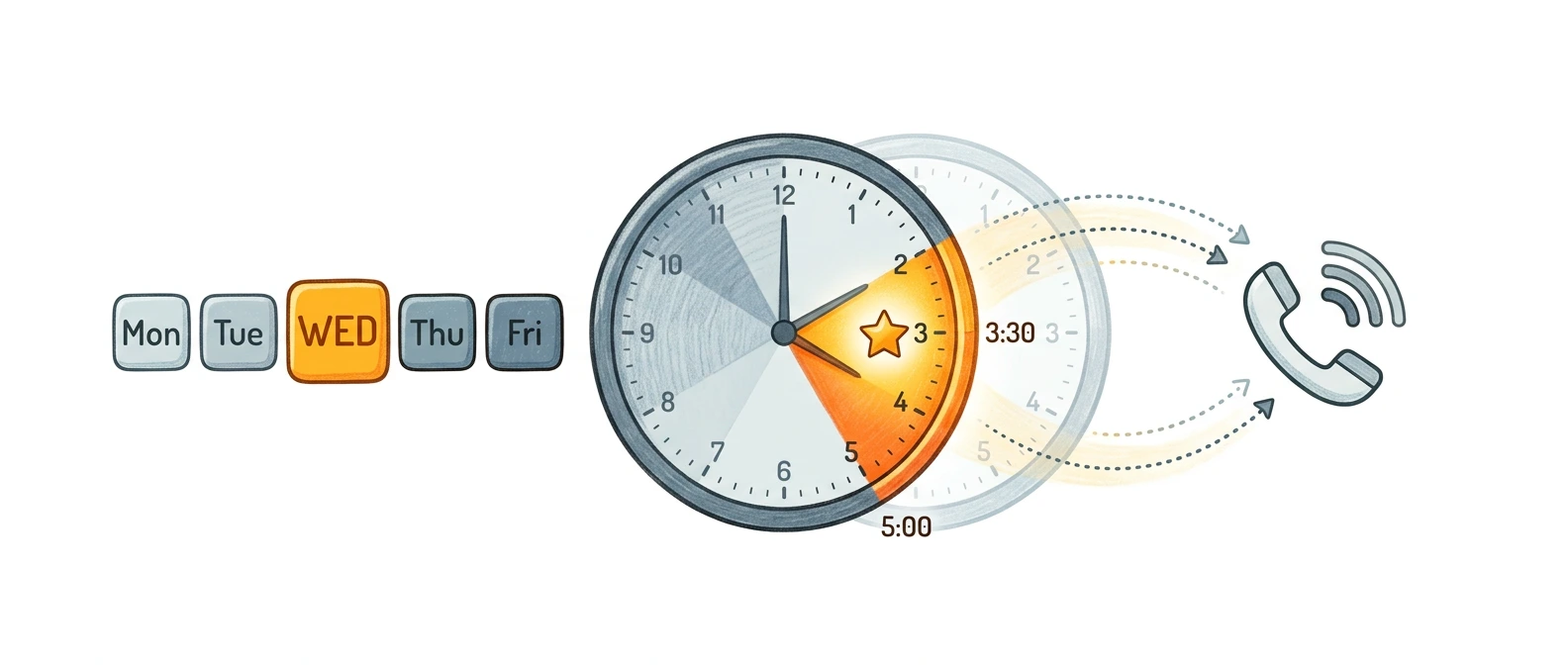
- Best window: 4–5 PM local time — 71% more effective than midday
- Best days: Tuesday and Wednesday consistently outperform Monday and Friday
- Worst time: 11 AM–12 PM — prospects are wrapping up morning work and heading to lunch
Always call in the prospect's time zone. A call at 4 PM EST hitting someone at 1 PM PST is a midday interruption, not an end-of-day catch. Aloware's power dialer automatically skips contacts outside their local business hours — no manual calculation, no wasted dials.
3. Do 5 minutes of research per account, not per contact
You don't need a 30-minute deep dive before every call. You need one relevant, specific observation. Check their LinkedIn for a recent post, their company news feed for a funding announcement, or their job postings for signals about where they're growing.
That single data point transforms your opening from "I'm calling about our product" to "I noticed you just expanded into a new market — how are you thinking about your sales team's outreach capacity?" The prospect hears that you did your homework. Most callers don't.
4. Protect your caller ID before your first dial
Here's a cold calling tip most guides skip: before you ever call a prospect, make sure your number isn't already flagged as spam by carriers.
81% of businesses report revenue loss from legitimate calls incorrectly flagged as spam. 87% of Americans refuse calls from unknown numbers. A rep making 80 dials a day with a flagged number might connect with 2–3 people instead of 8–10.
Aloware's NumberGuard monitors your caller ID reputation in real time and protects your numbers before they get flagged — not after. Combined with Local Presence (matching your area code to the prospect's location) and Branded Calling (showing your company name on their screen), Aloware gives you a three-layer pickup stack no single competitor matches.
During the Call: Techniques That Convert
5. Nail the first 10 seconds
You have 10 seconds before a prospect decides whether to stay on the line. Most cold callers waste them with pleasantries ("Hi, how are you doing today?") or immediate pitches ("I'm calling about our software platform that helps—").
Neither works. The opening that does:
- State your name and company clearly (no mumbling)
- Deliver one specific, relevant observation about their business
- Ask an open-ended question tied to that observation
Example: "Hi [Name], this is [Rep] from Aloware. I noticed [Company] just added 12 SDR roles in Q1 — I'm curious, are you seeing the pickup rate issue that a lot of teams with that volume run into?"
They either say yes (problem acknowledged, you're in) or no (you have 30 more seconds to pivot). Either way, you've started a conversation, not a pitch.
6. Aim for a 40/60 talk-to-listen ratio
The best cold callers let the prospect do 60% of the talking. That means asking a pain-focused question, pausing, and letting them answer fully before you respond.
When a prospect is talking, they're engaged. The moment you start a feature rundown, they start mentally composing their exit. Ask one question, listen completely, then connect what they said directly to how you can help.
7. Lead with problems, not products
Your prospect doesn't care about your features. They care about their problems. The reps who book the most meetings open with a problem statement, not a product pitch.
Bad: "Aloware is a power dialer with AI call summaries and CRM integration."
Good: "A lot of sales managers we talk to tell us their reps are spending 2–3 hours a day on CRM admin instead of actually selling. Is that something you're running into?"
The prospect who says yes has now told you their problem. You didn't pitch — you diagnosed. The conversation is entirely different from there.
8. Handle objections as information, not rejection
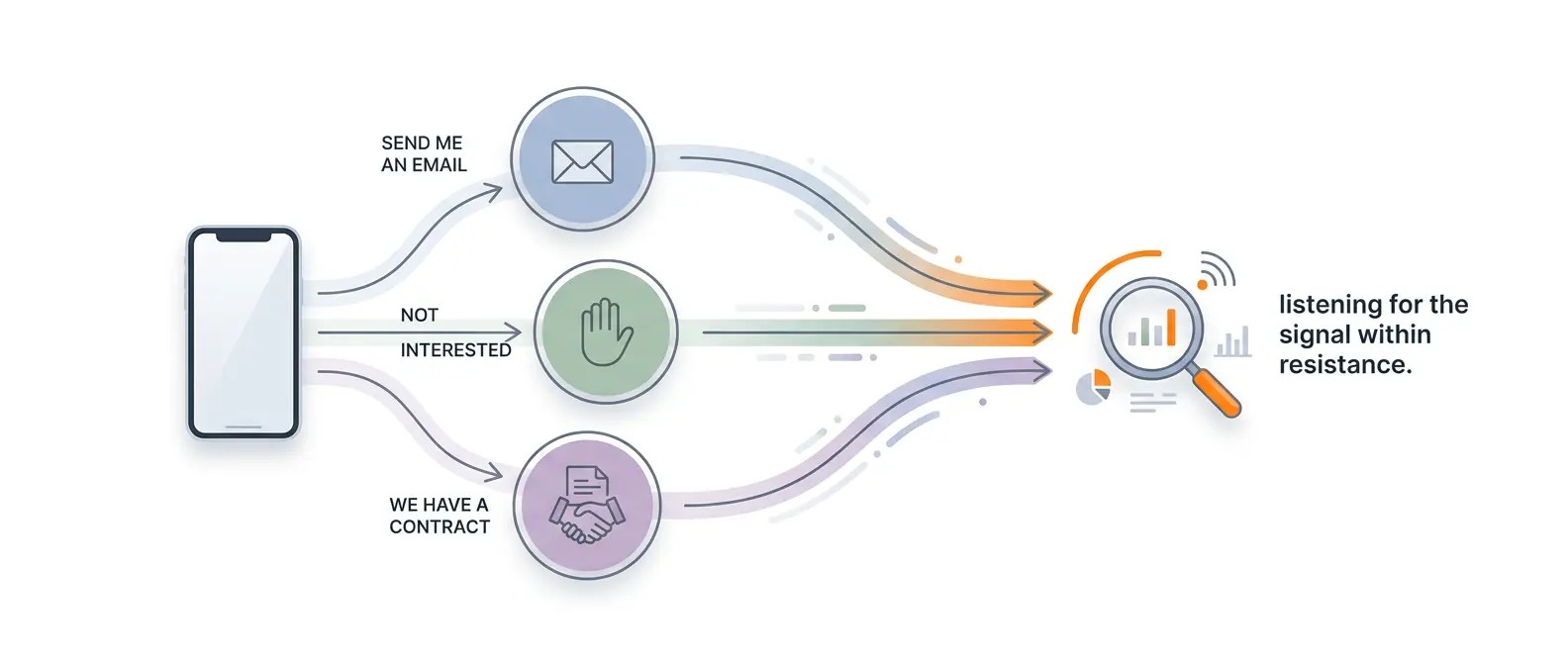
The most common cold call objections — "send me an email," "we're not interested," "we're locked into a contract" — aren't rejections. They're data points.
- "Send me an email" → "Of course. Before I let you go, can I ask what specifically you'd want that email to cover? That way I can make it worth your time." This turns a dismissal into a qualification question.
- "Not interested" → "That's fair. Can I ask what you're using currently for [problem]?" You either learn something useful or uncover a real objection you can address.
- "We have a contract" → "When does that renew? I'd love to stay on your radar for when that comes up."
Every objection is the prospect telling you something. Listen for the signal inside the resistance.
9. Never end a call without a next step
The close of a cold call matters as much as the open. Most reps trail off into vague promises — "I'll send some information over" — and the conversation disappears.
End every call with a specific next step, even a small one:
- A scheduled 15-minute follow-up call (specific date and time, confirmed before you hang up)
- Permission to send one specific piece of information with a defined follow-up date
- A referral to someone in their organization who owns the problem
Don't drift into the goodbye. End with a committed next step, and the call generates pipeline momentum instead of dying in an inbox.
After the Call: Follow-Up That Converts
10. Follow up with SMS immediately after a call
The window after a call — while you're still top of mind — is the highest-leverage follow-up moment. A text message sent within 60 seconds of hanging up has dramatically higher response rates than an email sent hours later.
Keep it short: "Hi [Name], great speaking with you. Here's the [resource/next step] I mentioned: [link]. Looking forward to [next step]. — [Rep name]"
Aloware lets you trigger an automatic SMS follow-up the moment a call ends based on the disposition you log — so the text fires while the rep is already dialing the next contact.
11. Persist through 8 touches, not 2
It takes 8 attempts to reach a decision-maker. 44% of reps give up after one attempt. That gap is where most pipeline leaks.
Build a multi-touch sequence: call → voicemail drop → SMS → email → LinkedIn → call again. Spread across 2–3 weeks. Multi-channel sequences generate 40% higher engagement than single-channel outreach.
Aloware's sequences automate this entire cadence — calls, voicemail drops, and SMS — triggered by CRM data, so no lead falls through the cracks because a rep forgot to follow up.
12. Use voicemail drops strategically
Most reps either skip leaving voicemails (the prospect never hears from them) or record the same message live 40 times a day (exhausting and inconsistent). Voicemail drop — pre-recording a message and dropping it instantly when a call goes unanswered — solves both.
A good voicemail is 20–30 seconds. State your name, company, and one specific reason for calling. End with a clear next step. Pre-record 2–3 versions for different segments so you're not repeating the identical script to every prospect in the same list.
Advanced: Using AI to Upgrade Your Cold Calling
13. Use AI to handle the calls your reps can't
Cold calling at scale has an unavoidable problem: your reps can only work certain hours. Leads that come in at 7 PM on a Friday go cold by Monday morning.
AI voice agents solve this. Aloware's AloAi Voice Agent can handle outbound qualification calls automatically — triggered by form submissions, CRM lead score thresholds, or deal stage changes — 24/7. When a prospect is ready to engage, the AI routes them to a human rep with a full transcript and call summary already logged.
For a deep dive on how this works: Can AI Agents Make Outbound Calls?
14. Review AI call summaries to improve faster
The traditional way to improve at cold calling: your manager listens to recordings and gives feedback. This works, but it's slow, inconsistent, and doesn't scale.
AI call summaries change this. Every call gets automatically transcribed, summarized, and scored — identifying talk/listen ratio, objections raised, questions asked, and next steps captured. Managers can review 20 calls in the time it used to take to review 2.
In Aloware, AI Conversation Insight surfaces patterns across your entire team: which objections are most common, which reps are dominating conversations (bad), which leads are showing buying signals. Coach from data, not gut feel.
15. Protect your numbers — don't let spam flags kill your pipeline
The last cold calling tip is the one most teams discover too late: your technique doesn't matter if your numbers are flagged as spam before you dial.
Carriers use AI to detect high-volume dialing patterns and flag numbers automatically. Once flagged, your calls show as "Spam Likely" or go straight to voicemail — and you won't know until your connection rates crater.
Aloware's NumberGuard monitors number reputation proactively, STIR/SHAKEN authenticates your caller ID with carriers, and Branded Calling shows your company name on the prospect's screen. The result: your calls get answered because prospects know who's calling, not screened because they don't.
The Cold Calling Stack for 2026
The tips above are the strategy. The tools that make them executable at scale:
Frequently Asked Questions
Does cold calling still work in 2026?
Yes. 78% of decision-makers have taken a meeting from a cold call and 57% of C-level executives prefer phone communication over other channels. Cold calling works when it's relevant, well-timed, and persistent — not when it's high-volume and random.
What is the best time to cold call?
4–5 PM in the prospect's local time zone is 71% more effective than calling at midday. Tuesday and Wednesday show the highest meeting booking rates. Always call in the prospect's time zone, not yours.
How many cold call attempts does it take to reach a prospect?
It takes an average of 8 attempts to reach a decision-maker. 44% of reps give up after one attempt — which means persistence alone puts you ahead of nearly half your competition.
What is a good cold call success rate?
The average cold call meeting booking rate is 2–3%. Top performers using better targeting, local presence dialing, and multi-touch sequences achieve 6–10%+.
Why are my cold calls showing as spam?
Carriers use AI to flag numbers showing high-volume dialing patterns. Once flagged, calls show as "Spam Likely" or go straight to voicemail. The fix is protecting your numbers proactively with reputation monitoring (Aloware's NumberGuard), STIR/SHAKEN caller ID authentication, and branded calling — not after the damage is done.
What is a power dialer and how does it help cold calling?
A power dialer automatically works through your CRM contact list one call at a time — eliminating manual dialing, dead time between calls, and repetitive voicemail recording. Aloware's power dialer lets reps make 500+ calls per day while keeping every call intentional and fully logged. See: What is a CRM Dialer?
.png)

Ruby Kootval is Head of Product Marketing at Aloware. She has 12 years in digital marketing, including 8 in B2B SaaS and 5 in telecom, and writes about AI voice agents, dialers, CRM integrations, and contact center operations.
.webp)


.webp)