


Last updated: August 5, 2026
TL;DR: CNAM and STIR/SHAKEN solve two different problems. CNAM is a carrier database record that shows your business name (up to 15 characters) on the recipient's caller ID, mostly on landlines. STIR/SHAKEN is the FCC-mandated framework in which your originating carrier cryptographically signs each call to prove the caller ID is not spoofed. Neither one puts your logo on a smartphone, and neither one removes a "Spam Likely" label. Those jobs belong to two other systems: Branded Caller ID and carrier spam-label remediation.
Key facts:
- CNAM is registered per number with your carrier (Twilio for Aloware customers), and display is best-effort, especially on mobile devices.
- STIR/SHAKEN attestation is signed by the originating service provider, never by your dialer or CRM.
- Attestation has three levels: A (full), B (partial), and C (gateway).
- Branded Caller ID is a separate carrier-delivered display: Standard shows your verified business name; Enhanced adds your logo and call reason on supported US mobile devices.
- Spam labeling runs on its own carrier reputation systems. A signed, branded call can still be flagged.
Most sales teams find out something is wrong with their caller ID from a prospect, not a dashboard. A lead mentions your call showed up as "Spam Likely." A customer says the callback came through as a bare 10-digit number. The ops lead who goes looking for a fix then lands in a pile of acronyms that all sound like they do the same thing.
They do not. Four separate systems decide what a recipient sees when your team calls: CNAM, STIR/SHAKEN, Branded Caller ID, and carrier spam labeling. Each one is controlled by a different party, and fixing one does nothing for the others.
We test this every week at Aloware. US team members place recurring carrier test calls from our own lines to their personal phones and log three results separately: whether the business name displayed, whether the logo displayed, and whether the call was flagged as spam. Those three columns do not move together, and that single observation explains most of the confusion this guide clears up.
What is CNAM?
CNAM (Caller ID Name) is a carrier database record that associates a display name of up to 15 characters with a phone number, so the recipient's caller ID can show a name instead of just digits. It is the oldest layer of caller identity in the US phone system.
For businesses, CNAM is the baseline: it is how your company name displays on landlines and on the subset of devices whose carriers perform CNAM lookups. A correct, consistent CNAM record keeps your identity tied to your numbers as you scale outbound calling for sales, support, and service.
The catch is coverage. CNAM display is best-effort. The recipient's carrier decides whether to query a CNAM database at all, and most US mobile carriers skip the lookup on ordinary calls. If you have ever registered a CNAM name and still watched your own cell show a bare number, that is why.
CNAM is a 15-character name record in carrier databases. Display is best-effort, decided by the recipient's carrier, and most mobile phones never show it.
How does CNAM work?
When your team places a call, the terminating carrier may run the calling number through a CNAM lookup and display whatever name is on file. If a match exists, the recipient sees the name. If the record is blank, they see only the phone number or an anonymous label.
Three operational details matter here:
- Registration is per number, not per account. Every outbound number your team uses needs its own CNAM record. For Aloware customers, registration happens with our carrier, Twilio.
- Records go stale. Rebrands, relocations, and legal-name changes all require updating the record with the carrier. An outdated name erodes trust as fast as no name.
- Even a correct record is not guaranteed to display. Some carriers pass it through, some substitute their own data, and many mobile networks never perform the lookup. This is a limitation of how VoIP calling works, not of any one provider.
If a number report shows a blank label, the fix is updating that specific number's CNAM directly with the carrier. Do it for every number in your rotation, not just the main line.
register CNAM for every outbound number and keep it current, but treat it as a baseline. It will not brand your calls on most mobile phones.
What is STIR/SHAKEN?
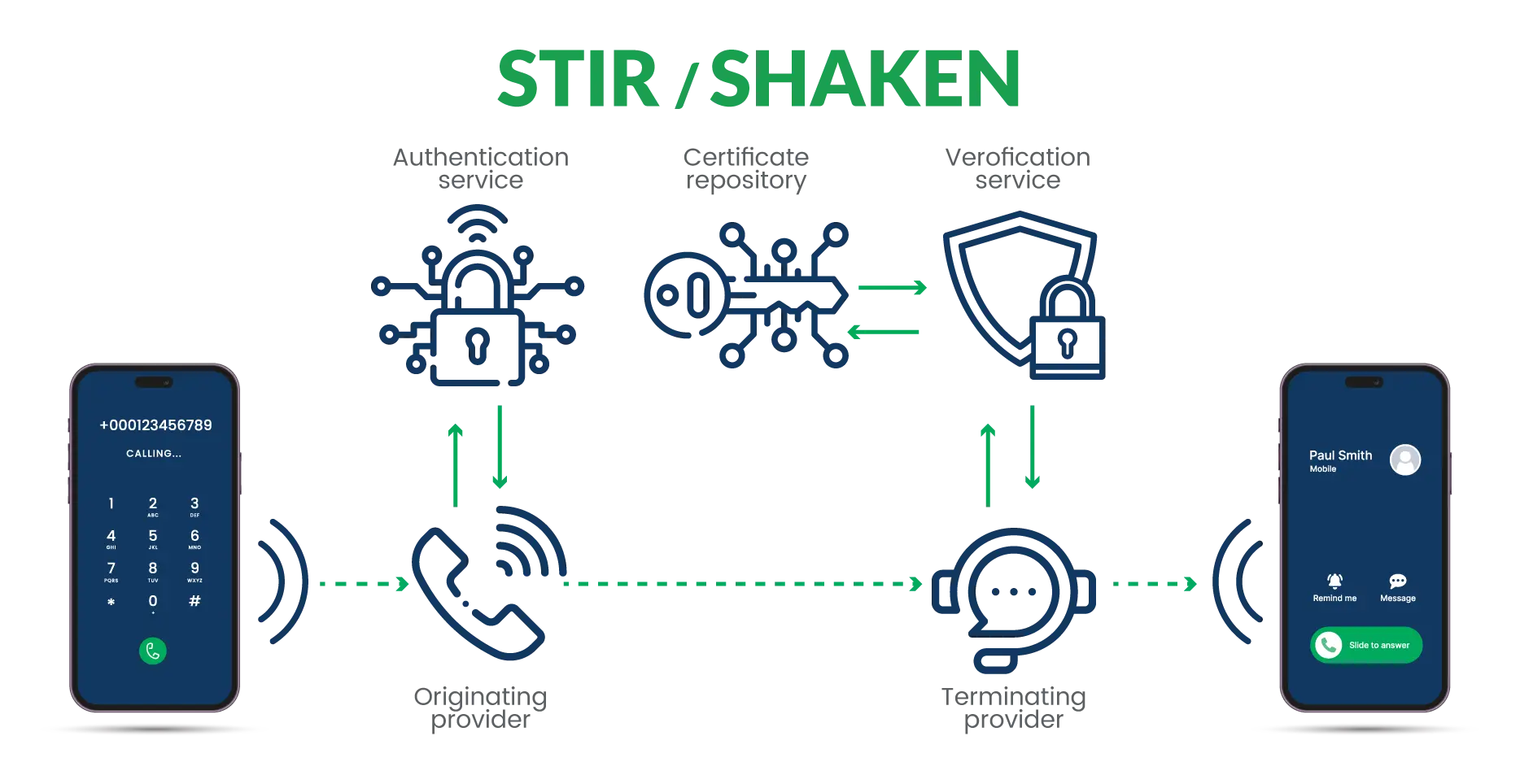
STIR/SHAKEN (Secure Telephone Identity Revisited / Signature-based Handling of Asserted Information Using toKENs) is the FCC-mandated caller ID authentication framework in which the originating carrier cryptographically signs each call to attest that the caller has the right to use the number being displayed. The FCC adopted the rules in 2020 and required voice providers to implement STIR/SHAKEN across the IP portions of their networks by June 30, 2021; in the FCC's own words it "digitally validates the handoff of phone calls passing through the complex web of networks, allowing the phone company of the consumer receiving the call to verify that a call is in fact from the number displayed on Caller ID" (FCC, Caller ID Authentication).
Where CNAM is about displaying a name, STIR/SHAKEN is about verifying legitimacy before the call ever reaches a device. It was built to fight caller ID spoofing (the FCC keeps a consumer guide on unwanted robocalls covering the same ground), the practice of forging caller ID information so a call appears to come from a trusted number when it actually comes from a scammer. STIR/SHAKEN authenticates that the call originator is who they claim to be. It does not catch every bad call, because spoofed traffic can still enter through networks that have not implemented attestation.
STIR/SHAKEN authenticates the calling number behind the scenes. It is about trust between carriers, not about what displays on the recipient's screen.
How does STIR/SHAKEN work?
Your dialer originates the call. Your carrier signs it. Keeping those two roles straight is the single most misunderstood part of this system.
When a call starts, the originating service provider (the carrier that puts the call onto the network, not the dialer, CRM, or any application layer) attests to the call and signs a cryptographic token called a PASSporT. That signature travels with the call, and the terminating carrier validates it on receipt to confirm nothing was tampered with along the way. Calls that fail validation can be flagged or blocked by downstream carriers.
The attestation itself is the originating carrier's confidence statement, and it comes in three levels:
Attestation levelWhat the originating carrier is sayingWhat it means for your callsA (Full)It knows the customer and has verified their right to use the calling numberThe strongest trust signal; branded display programs generally require itB (Partial)It knows the customer but cannot verify their right to the specific numberWeaker signal, common when numbers live outside the originating carrier's controlC (Gateway)It only knows where the call entered its network, typical of international gateway trafficThe weakest signal, treated with the most suspicion downstream
Note what the recipient sees: usually nothing. Some devices show a "Caller Verified" checkmark on attested calls, but STIR/SHAKEN never displays your business name. It is plumbing, not signage.
attestation is signed by the originating service provider. Your dialer originates the call; your carrier signs it. A-level attestation is the foundation everything else builds on.
What's the difference between CNAM and STIR/SHAKEN?
Both systems fight fraud and mistrust, but they differ in scope and mechanics:
- Purpose. CNAM displays a name associated with a number. STIR/SHAKEN verifies the call itself has not been spoofed.
- Technology. CNAM is a database lookup performed at the terminating end. STIR/SHAKEN is cryptographic signing performed at the originating end.
- What the recipient sees. CNAM produces a name on supported devices. STIR/SHAKEN is usually invisible, aside from an occasional verified checkmark.
- Business impact. CNAM affects recognition and pickup. STIR/SHAKEN affects whether carriers trust your traffic and complete your calls instead of flagging or blocking them in error.
CNAM is the name layer, STIR/SHAKEN is the trust layer. You need both, and neither one brands your calls on a smartphone.
Branded Caller ID vs CNAM: which one controls what your recipient sees?
Here is the disambiguation most teams researching CNAM actually need. When an ops lead says "I want our name and logo to show up when we call customers," the system that does that on modern smartphones is not CNAM. It is Branded Caller ID.
Branded Caller ID is a premium, carrier-delivered display for outbound calls. Instead of hoping the recipient's carrier looks up a database record, the mobile carrier pushes your verified business identity to the handset at ring time. Standard tier displays your verified business name. Enhanced tier displays your name, logo, and a call reason on supported US mobile devices. Registration is vetted: carriers verify your business identity before any branding goes live, which is exactly what makes the display trustworthy.
Four systems, one table:
| System | What it is | Who controls it | What the recipient sees | What it does NOT do |
|---|---|---|---|---|
| CNAM | A 15-character name record stored in carrier databases. | You register it per number through your carrier (Twilio for Aloware customers); the recipient's carrier decides whether to perform the lookup. | Your business name on landlines and some devices; otherwise only the phone number if no record is found. | Does not display your name on most mobile phones, verify a call, or remove spam labels. |
| Branded Caller ID | A premium, carrier-delivered branded display for outbound calls. | Registered through your provider, then vetted and delivered by participating mobile carriers. | Your verified business name (Standard) or business name, logo, and call reason (Enhanced) on supported U.S. mobile devices. | Does not remove a "Spam Likely" label and does not appear on landlines, inbound calls, or text messages. |
| STIR/SHAKEN | The FCC-mandated caller ID authentication framework. | The originating service provider signs the call; terminating carriers validate the attestation. | Usually nothing; some devices display a "Caller Verified" checkmark. | Does not display your business name and cannot stop spoofed calls entering through unattested networks. |
| Carrier spam labeling | Reputation scoring performed by carriers and their analytics partners. | Controlled by carriers and their analytics engines; businesses cannot manage it directly. | "Spam Likely" or "Scam Likely" displayed over your phone number. | Does not check whether you registered CNAM or Branded Caller ID. Even signed and branded calls can still be labeled. |
If you want the full setup path for branded display, our branded calling guide for sales teams walks through Standard vs Enhanced, carrier vetting, and rollout. For budgeting questions, see what branded caller ID costs.
CNAM and Branded Caller ID both put a name on a screen, but they are different systems. CNAM is a best-effort database record capped at 15 characters; Branded Caller ID is a carrier-verified display that can include your logo and call reason on supported US mobile devices.
Why do verified, branded calls still get labeled "Spam Likely"?
Because spam labeling is its own system, run by carriers and their analytics partners, and it does not consult your CNAM record, your attestation level, or your branding registration before it scores you.
Carrier reputation engines score each calling number on behavior: call volume and velocity, complaint reports, answer rates, call durations, and dialing patterns. When the score crosses a carrier's threshold, the label appears. That is why our weekly device tests log branding and spam flags in separate columns; a call can display a verified name and carry a label at the same time.
Getting a label off a number works in a specific order:
- Remediate the mislabel. Incorrect labels are corrected through carrier and analytics-partner channels, number by number. No vendor can simply switch a carrier's label off, so remediation runs through the carriers themselves.
- Fix the behavior that earned the label. Spread volume across a healthy number pool, clean your lists, and watch answer-rate and duration patterns. A remediated number that keeps the same behavior gets flagged again.
- Then layer on branding. Branding a number with poor reputation wastes the registration. Reputation first, recognition second.
This prevention-and-remediation lane is what NumberGuard covers for Aloware customers: real-device testing across major US carriers, monitoring for new labels, remediation filings for mislabeled numbers, and caller ID whitelisting to reduce repeat flags.
The effect is measurable on real outbound floors. A 73-agent sales team that turned on branded calling with no other change, same reps, same numbers, same lists, saw 26% more pickups and roughly 3,400 additional live conversations in under three months (full breakdown). Branding does not delete a spam label, but it changes what the recipient sees in the moment they decide whether to answer.
Key takeaway: branding and spam labeling run on separate carrier systems. A branded display improves recognition, but only reputation management and remediation deal with the label itself.
How does Aloware support CNAM, STIR/SHAKEN, and Branded Caller ID?
Aloware is AI-powered contact center software built for CRMs, and caller identity is treated as infrastructure that should work without your team becoming telecom experts. Here is how the four systems map to the platform:
- CNAM registration and upkeep. CNAM records are registered per number with our carrier, Twilio, and kept current as your business details change. Blank-label reports get fixed at the individual number level.
- STIR/SHAKEN attestation. Aloware originates calls onto a STIR/SHAKEN-attested trunk. Our carrier partner attests and signs the SHAKEN PASSporT at the originating service provider layer, with full A-level attestation when your outbound numbers are on our carrier and properly registered.
- Branded Caller ID. Available to order in-app, in Standard (verified name) and Enhanced (name, logo, and call reason) tiers on supported US mobile devices. See the Branded Calling product page for details.
- Number reputation. NumberGuard monitors how your numbers actually display on real devices and handles remediation when a number picks up a mislabel.
These four layers, plus local presence dialing, are the pickup-rate playbook in full. If you want the strategy view of why calls go unanswered and what to do about it, start with our pillar guide on how to lawfully increase pickup rates.
the platform handles registration, attestation, branding, and reputation as one stack, so identity problems get fixed at the layer that actually controls them.
The bottom line
CNAM shows a name where carriers still look it up. STIR/SHAKEN proves your calls are not spoofed. Branded Caller ID puts your verified name and logo on supported mobile devices. Spam labeling ignores all three and scores your behavior. Teams that know which system owns which outcome stop buying the wrong fix, and their answer rates show it.
Here is the one thing to do today: place a test call from your main outbound line to your own cell phone. Write down what name displayed, whether a spam label appeared, and whether your carrier shows the number as fully attested. That single call tells you which of the four systems needs attention first.
Want to see the Pickup Stack in your own outbound? Book a 20-minute demo and we'll show NumberGuard, Branded Calling, and Local Presence on a live call.

Frequently Asked Questions
What's the difference between CNAM and Branded Caller ID?
CNAM is a 15-character name record stored in carrier databases; the recipient's carrier decides whether to look it up, and most mobile phones never display it. Branded Caller ID is a premium, carrier-delivered display that shows your verified business name (Standard) or your name, logo, and call reason (Enhanced) on supported US mobile devices. They are registered separately, controlled by different parties, and only one reliably brands smartphone calls.
Does branded caller ID remove Spam Likely?
No. Branded display and spam labeling run on two separate carrier systems, so a call can show your verified name and still carry a spam label. Branding improves recognition; it does not repair number reputation. Removing a mislabel requires remediation through carrier channels, which is what a reputation service like Aloware's NumberGuard handles alongside real-device monitoring and caller ID whitelisting.
Who controls STIR/SHAKEN attestation?
The originating service provider. The carrier that puts the call onto the network attests to it and signs a cryptographic PASSporT, and terminating carriers validate that signature. Your dialer, CRM, or software vendor never signs attestation. Aloware originates calls on a STIR/SHAKEN-attested trunk, so its carrier partner signs at the originating provider layer, with full A-level attestation for properly registered numbers.
What does a blank CNAM record mean?
A blank CNAM record means recipients see only your 10-digit phone number with no name attached. It usually means no name was registered for that specific number, since CNAM is registered per number, not per account. The fix is updating the record directly with your carrier. Even then, display stays best-effort, because many mobile carriers skip CNAM lookups entirely.
Do I need both CNAM and STIR/SHAKEN?
Yes, because they are complementary rather than interchangeable. CNAM handles name display where carriers support it, and STIR/SHAKEN handles call authentication between carriers, which keeps legitimate calls from being flagged or blocked in error. High-volume outbound teams typically layer four things: CNAM records, attested calls, number reputation management, and Branded Caller ID for verified display on mobile devices.
What are the STIR/SHAKEN attestation levels A, B, and C?
Attestation is the originating carrier's confidence statement. A-level (full) means the carrier knows the customer and verified their right to use the number. B-level (partial) means it knows the customer but cannot verify the specific number. C-level (gateway) means it only knows where the call entered its network, which is typical of international gateway traffic. A-level earns the most downstream trust.
How do I fix a number that is already labeled Spam Likely?
Start with remediation: mislabels are corrected through carrier and analytics-partner channels, number by number. Then fix the behavior that earned the label, such as heavy volume on one number, poor list hygiene, or short-duration call patterns, or the label comes back. Aloware's NumberGuard runs real-device tests across major US carriers, files remediation for mislabeled numbers, and whitelists outbound caller IDs.
Does STIR/SHAKEN show my business name on caller ID?
No. STIR/SHAKEN works between carriers and is mostly invisible to recipients; at most, some devices show a Caller Verified checkmark on attested calls. It authenticates that your caller ID is not spoofed, but it never displays a name or logo. Name display comes from CNAM on supported devices or, far more reliably on mobile, from Branded Caller ID.
.png)

Ruby Kootval is Head of Product Marketing at Aloware. She has 12 years in digital marketing, including 8 in B2B SaaS and 5 in telecom, and writes about AI voice agents, dialers, CRM integrations, and contact center operations.


