


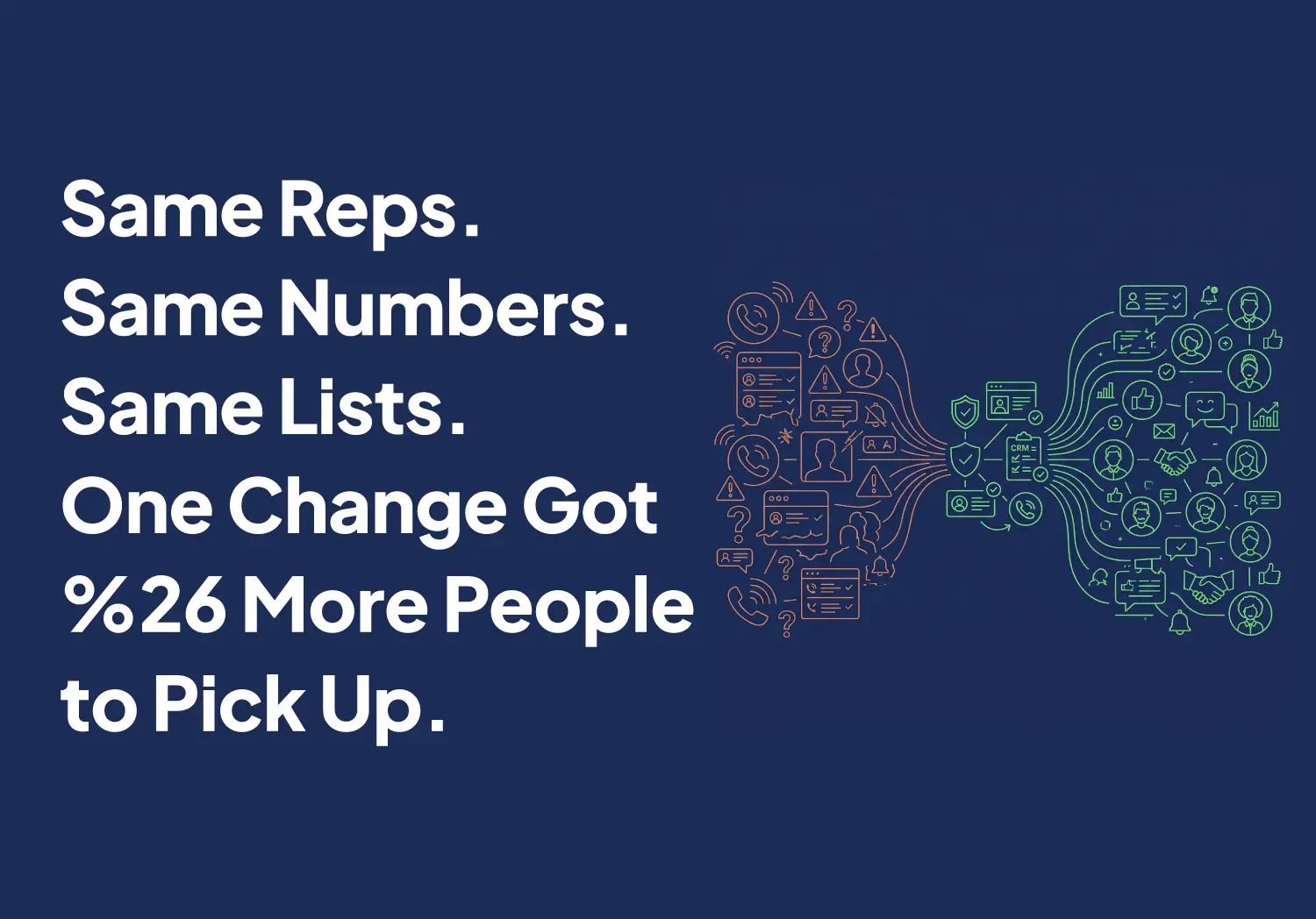
How Mastermind.com turned roughly 3,400 ignored calls into live conversations in under three months — by changing one thing on the screen.
TL;DR — The Results
Mastermind.com turned on branded calling across their sales team — putting their brand name on the prospect's screen before the phone is answered. Same reps, same numbers, same lead lists. Here's what changed:
The kicker: this is measured against the same agents' own unbranded calls, using true connection rate (real talk time, voicemails excluded) — so the branded line is the only variable that moved. No new reps. No new leads. No extra dials.
Picture two phones ringing.
The first one shows what almost every sales call shows: ten digits and a vague guess at a city. The person holding it does what 87% of Americans now do with unknown numbers — they let it ring out.
The second phone shows a name. A brand the person already recognizes, because they've read its blog, logged into its platform, maybe filled out one of its forms. They answer.
Here's the part that should stop you: those two calls were placed by the same rep, from the same desk, to the same kind of lead, on the same day. The only difference was what appeared on the screen before the phone was picked up.
That difference is worth 14.8 points of connection rate. For Mastermind.com, it added up to about 3,400 live conversations that simply would not have happened otherwise — in just under three months.
This is the story of how that number is real, why it's defensible, and what it says about the way phone outreach actually works in 2026.
Who Mastermind Is, and Why Their Phones Never Stop
Mastermind.com is built on a simple, ambitious idea: where everyday people turn life experience into impact and income. They don't sell to a narrow vertical. They reach people everywhere — through ads, through blogs, through a platform that thousands of people log into to start building something of their own.
That model produces an enormous top of funnel. People fill out forms. People browse. People log in and signal real intent. And then a sales team has to call all of them.
And call them they do. Mastermind runs roughly 73 agents. Last month, the team placed just under 19,000 outbound calls. In a single recent week, 8,000. On one ordinary day, more than 2,200 dials.
When you're calling at that volume, your connection rate isn't a vanity metric. It's the entire economics of the business. A point of pickup rate, multiplied across 19,000 calls a month, is the difference between a conversation and a voicemail tens of thousands of times over. At that scale, small percentages become headcount, pipeline, and revenue.
So Mastermind had every reason to care about a problem that quietly taxes every high-volume sales team in America: the calls that never get answered.
The Real Enemy Isn't Bad Reps. It's the Caller ID.
There are 2.56 billion robocalls placed in the US every month. To survive that flood, carriers deployed aggressive AI spam detection — and that detection cannot tell the difference between a scammer and a productive sales team dialing hard. It flags both.
The result is a tax nobody put on the invoice. 81% of businesses report losing revenue to legitimate calls wrongly labeled as spam. 87% of people refuse calls from numbers they don't recognize. A rep grinding through 80 dials a day might reach six or eight actual humans. Everything else is voicemail, rejection, or silence.
None of that is a reflection of how good your reps are or how warm your leads are. It's a reflection of one thing: what shows up on the screen before anyone decides whether to answer.
This is the exact problem Mastermind set out to solve — not by hiring more reps or buying more leads, but by fixing the screen.
The Pickup Stack: Four Layers Working Before the Rep Says a Word
Most teams treat "getting picked up" as luck. Aloware treats it as architecture.
Mastermind's setters — the highest-volume callers on the team — run on what we call the pickup stack: a set of layers that each attack a different reason a legitimate call gets ignored. By the time a setter clicks "call," four things are already working in their favor:
Local Presence. Mastermind's setters each carry nine U.S. lines from across the country, and the system auto-matches the outgoing area code to the lead's location. A familiar area code gets answered more often than a strange one. (Their leads outside the U.S. — Australia and the UK — run on dedicated international lines, since carrier branding works differently abroad.)
NumberGuard. This watches the reputation of every number in real time and protects it from getting flagged as spam before it happens — not after the damage is done. In a 19,000-call-a-month operation, a burned number is a silent leak. NumberGuard plugs it.
CNAM. For calls hitting AT&T's network, CNAM ensures the caller name displays correctly — an essential, often-overlooked layer for making sure the brand actually shows up where it should.
Branded Calling. The newest layer, and the catalyst for this story. Branded calling puts Mastermind's name and identity on the prospect's screen before they answer. It converts a cold, anonymous ring into a recognized brand touchpoint. For a company whose leads have often already read their content or logged into their platform, that recognition is everything.
No single layer is magic. The power is in the stack: carrier flagging, unknown-number anxiety, and lack of brand recognition all get addressed at once, automatically, before the conversation even starts. Branded calling was the layer that pushed the whole system over the top.
So what happened when Mastermind turned that top layer on?
The Number: +14.8 Points, and Why You Can Trust It
Mastermind switched on branded calling across 59 active numbers in late March. Then we let the data accumulate for about two and a half months — long enough that the result couldn't be a fluke.
Here's what the calls show:
- Branded calls connected 70.7% of the time.
- The same setters, calling unbranded, connected 55.9% of the time.
- That's a 14.8-point lift — a 26.5% relative increase in the rate at which a real human picks up.
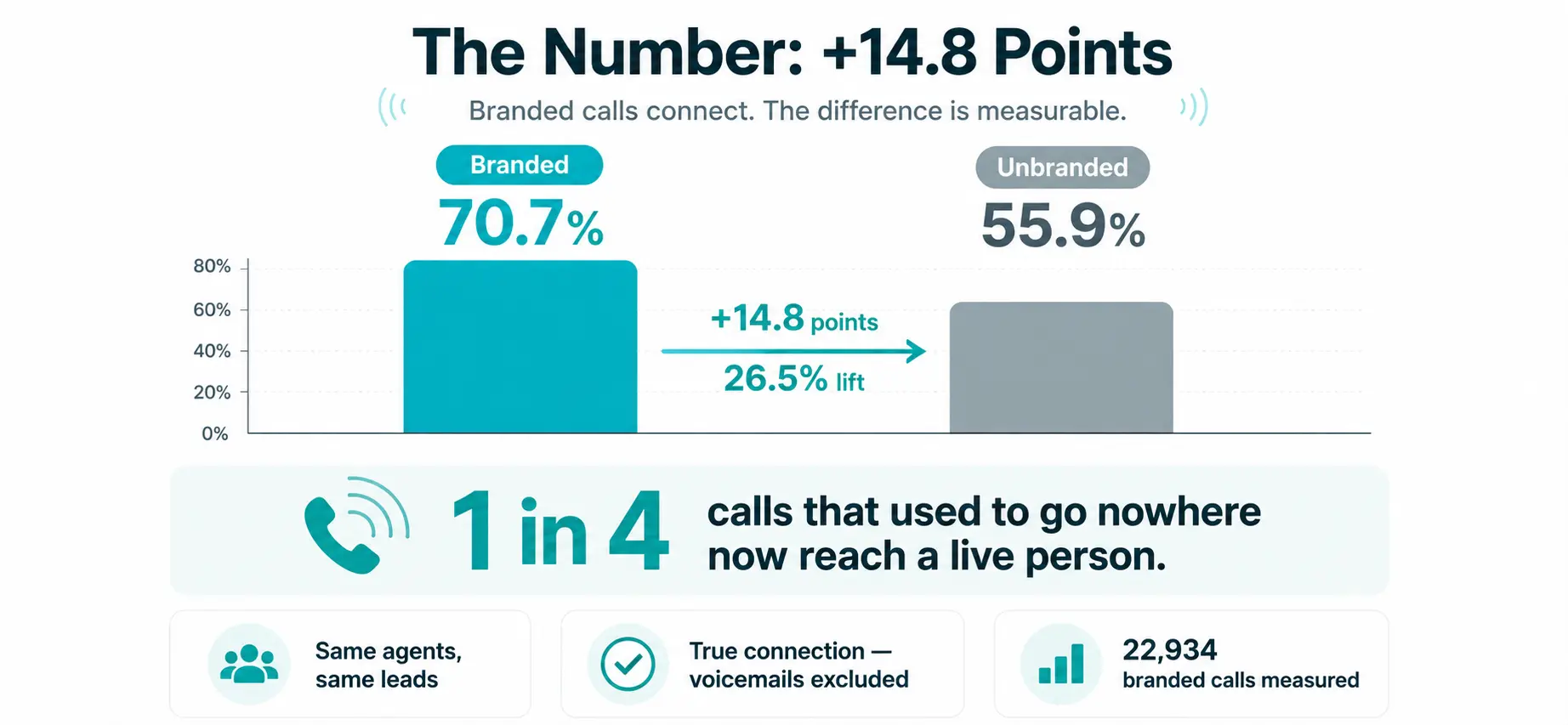
Read that last line again. More than one in four calls that used to go nowhere now reaches a live person. Not because the reps got better. Not because the leads got warmer. Because the brand showed up on the screen.
And this is where the result earns its credibility. This isn't a flattering before-and-after pulled from two different time periods or two different teams. It's the same agents, compared against their own unbranded calls. Same people, same dialing habits, same lead quality — the branded line is the only variable that moves. That design is what kills the obvious objection ("maybe those were just the better reps") before anyone can raise it.
It's also measured the honest way. These connection rates are based on true connection — a call that produced actual talk time, with voicemails stripped out. No inflating the number by counting rings that rolled to voicemail. When the methodology says "connected," it means a human was on the line.
Across the 22,934 branded calls in the measurement window, that 14.8-point lift produced roughly 3,400 additional live conversations that the same calls, placed unbranded, would never have reached.
What 3,400 Conversations Actually Means
Big percentages are easy to nod at and forget. So let's make this concrete.
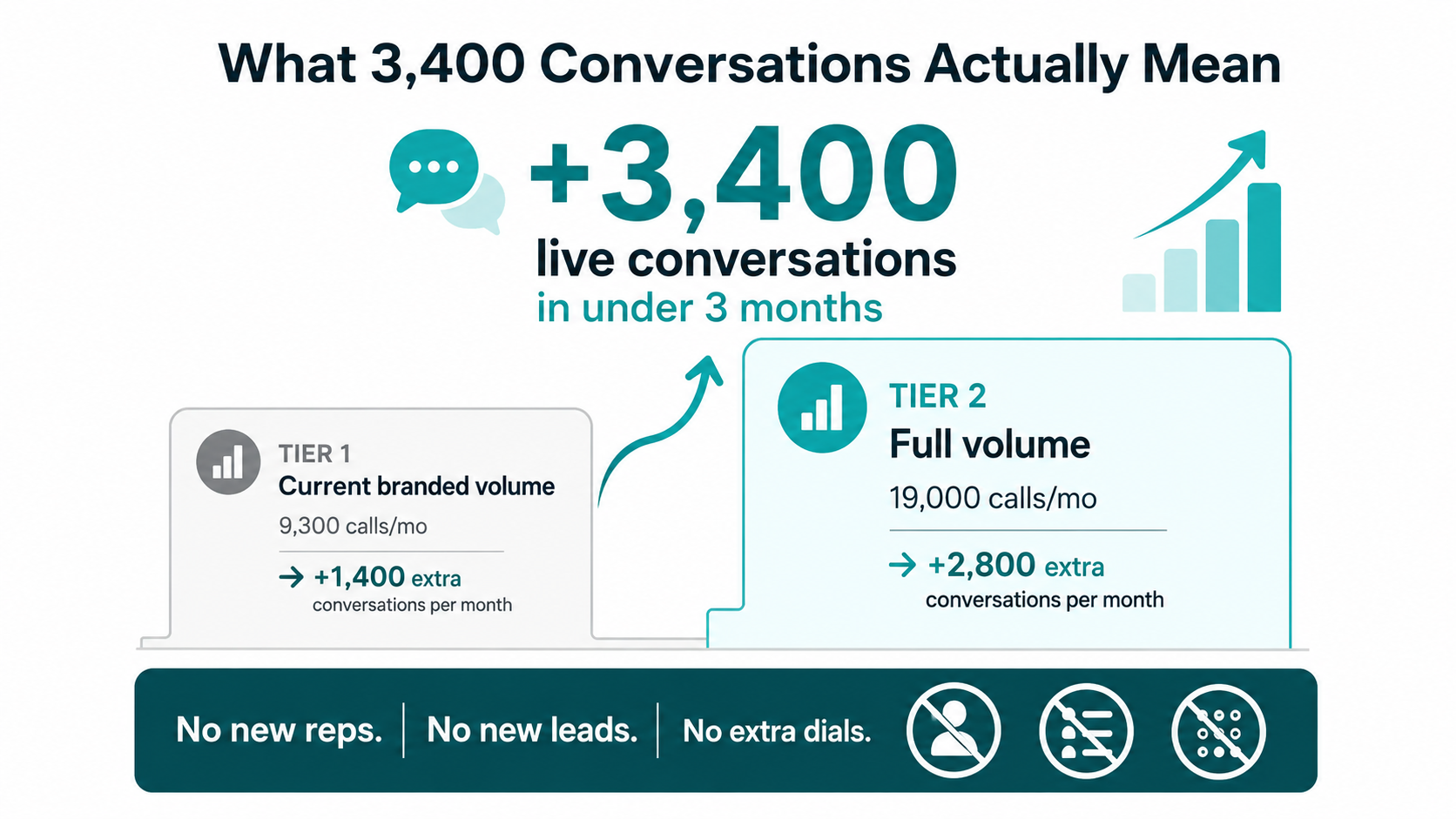
At Mastermind's current branded volume — about 9,300 branded calls a month — a 14.8-point lift is on the order of 1,400 extra human conversations every single month. Conversations that would otherwise have been dead air.
And that's before scaling. Mastermind places roughly 19,000 outbound calls a month in total. Extend branded calling across that full volume, and the same math points to around 2,800 additional connected conversations per month — the equivalent of adding meaningful selling capacity without adding a single rep, a single lead, or a single extra dial.
That's the real headline. Branded calling didn't make the team work harder. It made the work they were already doing land — converting calls they'd already paid to place into conversations they can actually close.
The Honest Footnote: Branding Amplifies, It Doesn't Replace
If this case study claimed every rep saw an identical jump, you should be skeptical — and you'd be right to be. They didn't. A couple of setters saw flat or even slightly negative movement.
That's not a flaw in the data. It's the truth about how calling works, and it's worth saying out loud: a branded line amplifies good calling behavior — it doesn't manufacture it.
Connection rate still depends on the fundamentals. When you call matters enormously: dialing at 7 or 8 in the morning gets you fewer pickups than calling at 11, no matter what's on the screen. Volume matters: a rep making 1,200 calls and a rep making 600 are not running the same play, and comparing their raw pickup rates without that context is misleading. Habits matter.
Branded calling stacks on top of all of that. For reps doing the fundamentals well — calling at the right times, working their lists with discipline — branding turns their good behavior into more answered calls. It's a multiplier on effort, not a substitute for it. Which is exactly why the cohort result is the one that matters: across the team, calling the way they actually call, the lift held at nearly 15 points.
The Takeaway
Mastermind didn't change their reps. They didn't change their leads. They didn't even change how many calls they made. They changed what their prospects saw before deciding whether to pick up — and got more than a quarter more of them to answer.
The lesson generalizes well beyond one company:
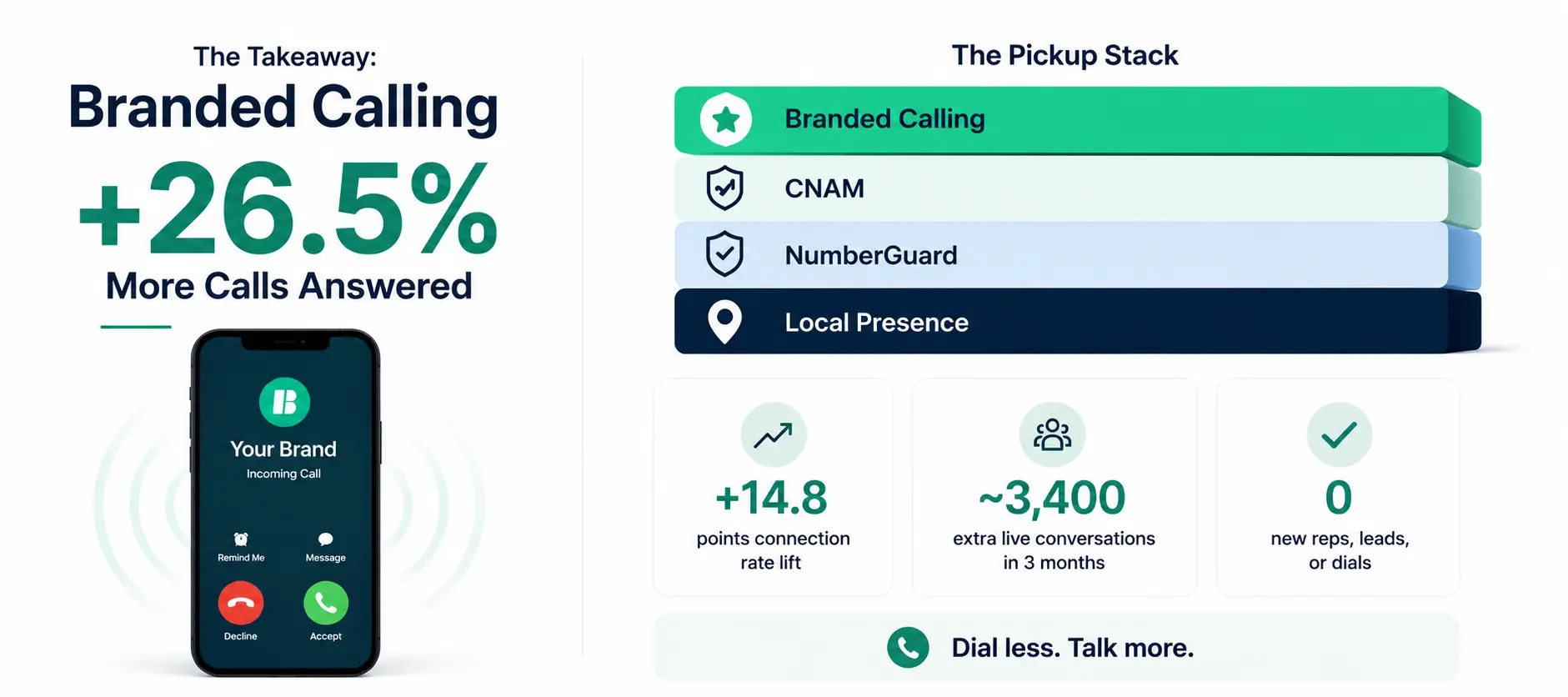
- Getting picked up is an engineering problem, not a luck problem. The pickup stack — local presence, NumberGuard, CNAM, and branded calling — attacks every reason a legitimate call gets ignored, automatically, before the rep speaks.
- Branded calling is the layer that tips it over. When prospects already know your brand, putting that brand on the screen converts recognition into pickups. For Mastermind: +14.8 points, a 26.5% relative lift, measured the rigorous way.
- The ROI is conversations you already paid for. ~3,400 extra live connections in under three months, with no new reps, no new leads, and no extra dials. That's not a feature working. That's a system working.
In a world where 87% of people ignore numbers they don't recognize, the most valuable thing you can do is be recognized the instant the phone rings.
Dial less. Talk more.
Want to see what the pickup stack would do for your team's connection rate? Talk to Aloware about branded calling, local presence, and NumberGuard — the layers that get your calls answered.
Methodology note
Connection rates reflect true connection rate (TC%) — completed calls with actual talk time, voicemail-drops excluded. Branded calls are outbound calls placed on numbers where branded caller ID was already active at the time of the call. The baseline is the same agents' calls on unbranded numbers, holding rep and lead quality constant so branded caller ID is the only variable. Cohort includes agents with 50 or more branded calls in the window. Figures drawn from Mastermind.com's account over the period beginning March 23, 2026 (59 active branded numbers; 22,934 branded calls measured). Mastermind.com is featured with permission.
.png)

Ruby Kootval is Head of Product Marketing at Aloware. She has 12 years in digital marketing, including 8 in B2B SaaS and 5 in telecom, and writes about AI voice agents, dialers, CRM integrations, and contact center operations.


