

TL;DR:
what a sales team's SMS platform actually needs
The best SMS marketing platform for a sales team is the one that lives on your CRM contact record and registers your numbers for A2P 10DLC, not the one at the top of a "best SMS platform" list. Almost every ranked list you find was written for retailers running promo blasts and cart-abandonment flows. A pipeline-driven sales team needs the opposite motion: one-to-one texts that pull from the deal record, log back to it, and get delivered because the sender is registered. Evaluate any vendor against five hard requirements and the choice makes itself.
- CRM-native two-way sync: every message personalizes from the contact record and logs back to the deal, not from a separate list tool.
- Managed A2P 10DLC registration: the platform handles Brand and Campaign registration, or carriers surcharge and filter your traffic.
- Conversational, not blast: two-way threads triggered by something the prospect did, optimized for replies instead of sends.
- An AI text agent that qualifies and hands off: reads the record, asks qualifying questions, follows up on no-reply, passes a warm lead to a human.
- Compliant opt-out on the record: a STOP reply auto-suppresses further texts, and consent is captured and logged.
- Skip the myth: the widely quoted "98% open rate" is not measurable, because texts have no read receipt. The defensible case is behavioral: 89% of US consumers now opt into business texts and 87% read one within 15 minutes.
The best SMS marketing platform for your sales team probably isn't on any "best SMS marketing platform" list. Those lists rank tools built for ecommerce: bulk promos, coupon drops, cart recovery. Buying one gives a sales team a fast way to broadcast to a list, which is not the same job as moving a deal forward.
We build and run CRM-native text agents for sales teams every day, and when a deployment underperforms the cause is almost always one of two things: the platform could not see the contact record, or the number was never A2P-registered. Both are boring. Both are fatal. Neither shows up in a feature-count comparison, which is why sales teams keep buying the wrong category.
Why do sales teams keep buying the wrong SMS platform?
Because the search results sell them the wrong category by omission. Type "sms marketing platforms" and the page fills with tools optimized for one metric: sends. That is the retail job. A store wants 40,000 people to know about a weekend sale, the message is identical for all of them, and success is how many clicked through to buy.
Sales is a different motion. You are moving one named person, on one deal, from interested to booked. The message that works references what that person just did (downloaded the pricing sheet, missed a call, asked about onboarding) and picks up the thread where it left off. That only happens if the texting tool can read the CRM record while it writes.

Watch the difference play out across three verticals:
- Real estate. ❌ A blast tool texts 2,000 old leads "New listings just dropped, reply YES."
✅ A CRM-native thread texts one buyer "Saw you favorited the Oak St listing, want a showing Thursday or Saturday?" One is noise. The other is a booked appointment. - Insurance. ❌ A promo blast pushes "Bundle and save 15% this month."
✅ A record-aware text says "Your auto policy renews April 12, want me to quote the home bundle before then?" The second one closes because it knows the renewal date. - Solar. ❌ A list tool sprays "Go solar and save."
✅ A conversational agent follows up on the exact quote a rep sent Tuesday, then answers the financing question that stalled the deal.
The old way blasts a list; the new way runs a conversation on the record. Same channel, opposite outcome. A blast tool fires at a list export. A sales texting platform sits on the contact record itself, so every message is personalized and every reply logs back to the deal. The closest thing to a pipeline machine is an AI text agent that works the contact record, because it reads the deal while it replies instead of firing from a static export.
Key takeaway: A sales team searching "sms marketing platforms" is being sold the retail category. Blast tools optimize for sends; sales needs a conversation that lives on the contact record. Pick the category first, then the tool.
Does SMS still work, or is the "98% open rate" a myth?
The channel works. The number everyone quotes to prove it does not. There is no dependable way to track SMS opens, because standard text messages do not send read receipts, so the open-rate figure the blast-tool listicles still parrot is not something anyone can actually measure (Omnisend, 2026). Any vendor still selling you on it is selling a myth, and a sales leader who repeats it in a board deck is one skeptical question away from looking careless.
The defensible case for texting is about behavior you can source. Consumers opted in, and they answer:
- 89% of US consumers have opted into business texts, up from 66% in 2021 (EZ Texting). Permission is no longer the barrier it was.
- 87% read a business text within 15 minutes (EZ Texting). Speed-to-reply is the whole reason SMS beats email on a time-sensitive sales follow-up.
- SMS campaign click-through runs 12.39% against email's 0.74% (Omnisend). Measure engagement, which is real, not opens, which are not.
Bad practice: quote an open rate you cannot defend. Good practice: quote opt-in and reply behavior you can. The first gets you challenged. The second gets you budget.
Key takeaway: SMS opens are not trackable, so drop the open-rate claim. The sourced case is that 89% of consumers opt in and 87% read within 15 minutes. Buy on behavior, not on a myth.
What does CRM-native texting actually require? The 5-requirement framework
Score every platform you demo against these five. A tool can be cheap, fast, and polished and still fail a sales team on any one of them. Each requirement below comes with the reason blast tools miss it, a named industry example, and a one-line test you can run live in the demo.
Requirement 1: It sits on the contact record (bidirectional CRM sync)
What it is: every text is composed from the CRM contact and deal, and every message (sent, received, opt-out) writes back to that record automatically. The CRM is the system of record, and the texting tool is a window into it, not a parallel database.
Why blast tools fail it: they keep their own contact list. You export a CSV, upload it, and blast. The replies live in the blast tool, not on the deal, so a SaaS account executive chasing a renewal never learns the prospect texted back "call me Friday," because that reply died in a separate inbox.
Named example: a mortgage lender's loan officer needs the rate-lock expiration on the same screen as the text thread. If the platform cannot read that field, the officer texts blind and the borrower drifts to whoever followed up on time.
How to test it: in the demo, send a text, then check whether it appears on the contact timeline and the deal with nobody clicking "sync." If it does not log automatically, it is a list tool wearing a CRM costume.
Requirement 2: A2P 10DLC registration is handled for you
What it is: before a US business can text reliably from a standard 10-digit number, it has to register a Brand and one or more Campaign use cases through The Campaign Registry. A2P 10DLC is a messaging framework, not a voice or caller-ID system, and the right platform manages the whole registration for you.
Why blast tools fail it: many push registration back onto you as a self-serve form and a wait for carrier approval, then leave you to interpret carrier rejections. Anyone sending application-to-person messages over a 10DLC number to US recipients must register, and unregistered senders get charged additional carrier fees and see their traffic filtered or blocked (Twilio). The failure is silent: your rep hits send, the dashboard says "delivered," and the message never lands.
Named example: a solar installer spins up a new number for a spring campaign, skips registration, and watches reply rates crater with no error message. The texts were filtered at the carrier. Nobody got told.
How to test it: ask the vendor, "Do you register my Brand and Campaign for me, or do I fill out the forms?" Then ask what happens to messages sent from an unregistered number. If the answer is vague, the deliverability risk is yours.
Requirement 3: It's conversational, not blast
What it is: two-way threads that start from a trigger (a form fill, a missed call, a stage change) and are built to earn a reply, not to maximize sends. The unit is a conversation, not a campaign.
Why blast tools fail it: their entire architecture optimizes the send. More recipients, higher throughput, bigger lists. That logic actively hurts a sales team, because blasting the same message to a list tanks reply rates, spikes opt-outs, and trains carriers to filter your number. You are not just wasting the send, you are degrading the numbers you need next week.
Named example: a law firm intake team that texts each new personal-injury lead within minutes of the form submission books consults. The same team blasting a monthly "we're here to help" to its whole list just harvests STOP replies.
How to test it: ask to see a thread that started from a CRM trigger with a human replying inside it. If the only demo is a campaign builder aimed at a list, it is a blast tool.
Requirement 4: An AI text agent that can qualify and hand off
What is an AI text agent: a goal-driven agent that reads the contact record, asks qualifying questions, answers from a knowledge base, follows up automatically when there is no reply, and hands a ready lead to a human cleanly, logging every step to the CRM.
Why blast tools fail it: autoresponders match keywords. "Reply 1 for a quote." That is not qualification, and it collapses the moment a prospect writes a real sentence. A genuine text agent holds a conversation toward a goal (qualify, route, book) instead of running a decision tree.
Named example: an insurance agency gets 300 inbound texts after a mailer. A keyword bot drops every lead that does not type the magic number. A real agent asks about coverage needs, answers the premium question, and books the people who are actually ready.
How to test it: text the demo agent an off-script question ("do you cover rental properties?") and watch whether it answers from knowledge and moves the conversation forward, or dead-ends.
Requirement 5: Compliant opt-out and consent, on the record
What it is: when a contact replies STOP, further texts to that contact are automatically suppressed, and the consent to text is captured and logged on the record. Compliance is a field on the contact, not a bolt-on.
Why blast tools fail it: some handle STOP inside their own list but never write the suppression back to your CRM, so a rep in the CRM texts a contact who already opted out. One caution: a text opt-out suppresses texts specifically. It is not a blanket cross-channel do-not-contact, and it is not registry scrubbing. Do not let a vendor imply STOP stops everything.
Named example: a home-services company running both calls and texts needs the STOP to kill texts and the record to show it, while calling consent stays governed separately. Conflating the two is how you end up non-compliant on one channel while thinking you are covered.
How to test it: reply STOP in the demo, then try to send that contact another text. If the platform lets you, or if the opt-out never appears on the CRM record, walk away.
Key takeaway: CRM-native sync, managed 10DLC, conversational design, a real AI text agent, and on-record opt-out are the five requirements that separate a pipeline SMS platform from a blast tool. Score every vendor against all five, not on feature count.
How CRM-native texting works inside Aloware (the AloAi Text Agent approach)
Those five requirements stay abstract until you see them implemented. Aloware's AloAi Text Agent is one implementation of the bar, built around the contact record instead of a list.
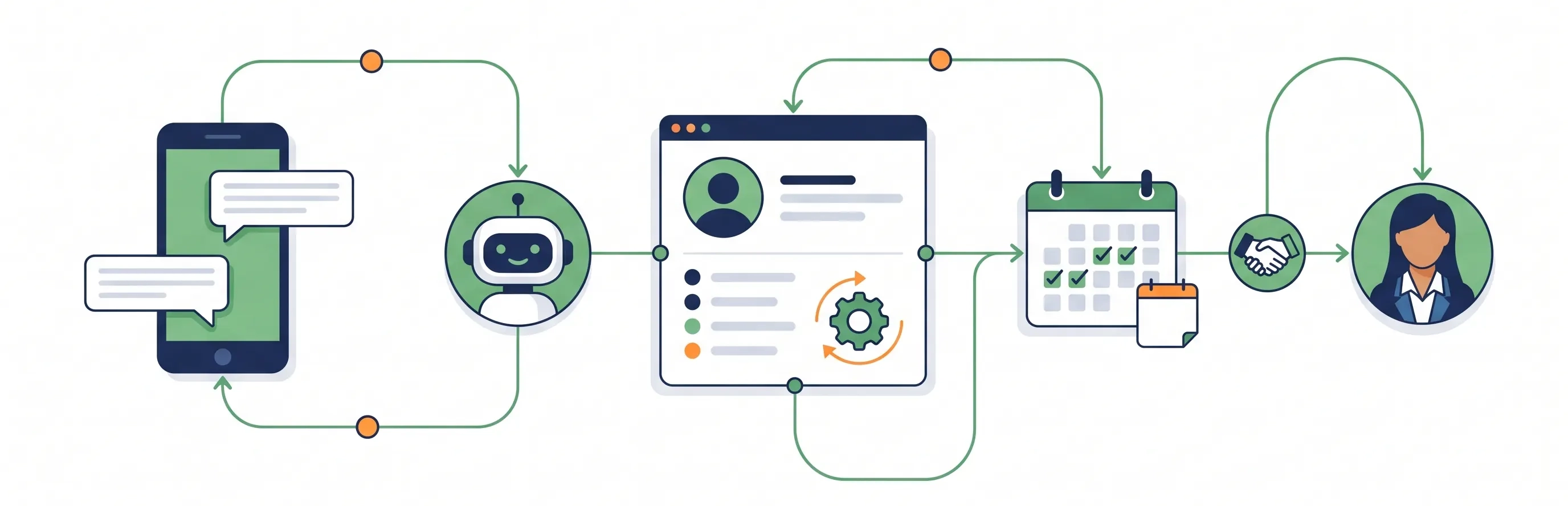
It reads and writes the CRM record. The agent's Update Contact Property action syncs to HubSpot, Salesforce, Pipedrive, Zoho, HighLevel, and Guesty where the integration allows, so a text updates the contact and the deal, and CRM events can trigger texts back. That is business texting built into your CRM, not a separate inbox to reconcile.
It qualifies and follows up on its own. The text agent holds goal-driven SMS conversations to engage, answer, qualify, route, and book. Its SMS Follow-Up action sends automatic follow-ups after an unanswered opener and cancels the instant the contact replies, so nobody gets double-texted after they respond.
It registers your numbers. Aloware is a registered CSP with The Campaign Registry and offers managed A2P 10DLC registration, handling the Brand and Campaign setup so your traffic is registered instead of filtered. Deliverability is not a side quest: carrier reputation decides whether you reach anyone, on text exactly as on voice.
It suppresses opt-outs on the record. Set Contact as DNC is a built-in action, so a STOP is honored and logged where your reps can see it. For teams that want a shared human view, a shared conversation inbox for the whole team keeps every thread in one place.
The honest cons. The AloAi Text Agent is SMS-only by design. If you want an agent that also answers the phone, that is a separate voice agent, not the same entity. Pricing is per outbound SMS segment (it varies by plan) plus carrier fees, so a high-volume texting motion has a usage line you should model, not a flat unlimited rate. And like any CRM-native tool, it assumes you actually run a CRM. If your team lives in spreadsheets, you have a prerequisite to fix first.
Want to see it in action? See how the AloAi Text Agent handles inbound SMS at scale.
Two notes for the roadmap-minded. For the tactics that make any of this land (timing, cadence, message length), our SMS marketing best practices covers the fundamentals. And if you are wondering what comes after plain text, read up on where business messaging is heading with RCS, then treat it as an enhancement, not a replacement, because adoption is still uneven.
Key takeaway: The AloAi Text Agent implements the five requirements. It reads and writes the CRM record, qualifies and auto-follows-up, ships with managed A2P 10DLC registration, and logs opt-outs on the record. It is SMS-only and usage-priced, and it assumes you run a CRM.
The SMS platform evaluation checklist (copy this into your demo calls)
Run every vendor through these ten questions live. If the answer to any of the first five is no, it is a blast tool, not a sales platform.
- Does a sent or received text log automatically to the CRM contact and deal, with no manual sync?
- Do you register my A2P 10DLC Brand and Campaign for me, or do I fill out the forms myself?
- What happens to messages sent from an unregistered number: delivered, surcharged, or filtered?
- Can a text thread start automatically from a CRM trigger like a form fill, missed call, or stage change?
- Will your AI agent answer an off-script question from a knowledge base and hand a hot lead to a human?
- When a contact replies STOP, is that opt-out suppressed and written back to the CRM record?
- Does the agent follow up on no-reply automatically and stop the instant the contact responds?
- Can CRM workflow events trigger a text, and can a text update a CRM field?
- What is the per-message or per-segment cost, separate from the seat, and what are the 10DLC passthrough fees?
- Can my whole team see the same conversation, or is each thread siloed to one rep?
Key takeaway: The demo is where blast tools get exposed. Ask these ten questions out loud and make the vendor answer requirements one through five with a yes before you talk price.
The bottom line
Pick on requirements, not on a ranked list. A sales team's SMS platform is CRM-native, registered, and conversational, or it is just a faster way to get filtered. The lists ranking "sms marketing platforms" were built for retailers optimizing sends. Your job is pipeline, and pipeline needs a text that lives on the deal record and actually gets delivered.
Score the five requirements, run the ten-question checklist in your next demo, and the right platform stops being a matter of opinion. It becomes the one that passed.
See it on your own CRM. Book a demo and watch CRM-native texting run against your pipeline.

Frequently Asked Questions
What is an SMS marketing platform for sales teams?
It is software that sends and receives texts tied to the CRM contact record, so every message is personalized from the deal and logged back to it, instead of firing promos from a separate list. For sales, the useful version is two-way and conversational, registers your numbers for A2P 10DLC, and can qualify or route a lead the moment they reply. If it cannot see your CRM, it is a broadcast tool, not a sales tool.
What's the difference between SMS marketing software and a sales texting platform?
Most SMS marketing software is built for retail: bulk promos, cart-abandonment recovery, coupon blasts. A sales texting platform is built around one-to-one conversations that live inside the CRM, start from something the prospect actually did, and turn into pipeline. Same channel, opposite motion. Buy the one that matches how your team actually sells.
Do I really need A2P 10DLC registration to text from a business number?
Yes. Any US business texting from a standard 10-digit number has to register a Brand and a Campaign through The Campaign Registry. Unregistered traffic gets surcharged and filtered or blocked by carriers, which means your messages quietly fail to deliver with no error to warn you. A platform that manages this for you is a hard requirement, not a nice-to-have.
Is the SMS open rate really as high as everyone claims?
The number you have seen quoted is not measurable. Text messages do not send read receipts, so there is no reliable way to track opens, and any vendor selling you on a specific open-rate percentage is selling a myth. The honest, sourced case is behavioral: 89% of US consumers opt into business texts and 87% read one within 15 minutes. Buy on that.
What should a sales team look for when evaluating an SMS platform?
Five things: bidirectional CRM sync so messages live on the contact record, managed A2P 10DLC registration, two-way conversational messaging instead of blasts, an AI text agent that can qualify and hand off, and compliant opt-out captured on the record. Score every vendor against all five in the demo, and make them answer yes before you discuss price.
Can an AI text agent qualify leads over SMS?
Yes. A CRM-native AI text agent reads the contact record, asks qualifying questions, answers from a knowledge base, follows up automatically if there is no reply, and hands off to a human when the lead is ready, logging the whole conversation to the CRM. That is different from a keyword autoresponder, which drops any prospect who writes a real sentence instead of typing the magic number.
Does SMS marketing integrate with HubSpot or Salesforce?
The right platform does more than log a message. It syncs bidirectionally, so a text updates the contact and deal and CRM events can trigger texts back. Depth varies a lot by tool. Test it directly: send a text in the demo and check whether it appears on the record automatically, and whether a workflow can both send and read texts.
How does opt-out work for business texting?
When a contact replies STOP, further texts to that contact are automatically suppressed, and the consent to text should be captured and logged on the record. One caution: a text opt-out suppresses texts specifically. It is not a blanket cross-channel do-not-contact, and it is not registry scrubbing. Make sure the suppression writes back to your CRM so a rep does not text someone who already opted out.
How much does a sales SMS platform cost?
It varies by seats, message volume, and usage. Separate from the platform fee, A2P 10DLC carries carrier and registry passthrough fees for Brand and Campaign registration. Before you compare vendors, make each one break out three numbers: the platform cost, the per-message or per-segment cost, and the 10DLC passthrough fees. A cheap seat with expensive messaging can cost more than the reverse.
Is blast SMS bad for a sales team?
For sales, yes. Blasting the same message to a list tanks reply rates, spikes opt-outs, and trains carriers to filter your number, which degrades the deliverability you need next week. Sales texting wins by being one-to-one and triggered by something the prospect actually did. Save the broadcast for a retailer's weekend sale.
What's the difference between SMS and RCS for business?
SMS is the universal fallback that works on every phone. RCS adds richer features like read receipts and branded senders where the carrier and device support it, with SMS as the fallback when they do not. Adoption is still uneven, so treat RCS as an enhancement to plan for, not a replacement to bet on today.
.png)

Ruby Kootval is Head of Product Marketing at Aloware. She has 12 years in digital marketing, including 8 in B2B SaaS and 5 in telecom, and writes about AI voice agents, dialers, CRM integrations, and contact center operations.