

TL;DR
Text message marketing works for sales teams because people actually read and answer texts. Between 90% and 98% of texts get opened, against roughly 29% for email, and 90% of them are read within three minutes. The average text gets a reply in about 90 seconds; the average email waits 90 minutes. Your prospects are already on their phones all day, and a text shows them exactly what you want in one glance, with no subject line to gamble on and no voicemail to ignore.
- Texts get seen and answered. 90–98% open rate vs ~29% for email; read within 3 minutes; replies in ~90 seconds vs ~90 minutes (Omnisend, 2025).
- A text carries its own context. One screen shows who you are, what you want, and what to do next. No opening, no scrolling, no hold music.
- For sales, texting only works two-way. Blast texting is a retail play; sales texting is a conversation that starts from something the prospect did.
- Consent and registration come first. Marketing texts need prior express written consent and A2P 10DLC registration; registered traffic is cheaper and actually gets delivered.
- Run it where your pipeline lives. Texts that log to the contact and deal record turn into pipeline; texts in a separate blast tool turn into noise.
Why does texting work in sales when calls and emails don't?
Run the math on a rep's Tuesday. Forty dials, most ring out. Thirty emails, most sit unread under a pile of other unread emails. Then one text: "Hi Sam, it's Dana from Acme. You asked about pricing for 25 seats, want me to send the breakdown or hop on a 10-minute call Thursday?" That message gets read in the elevator, and it gets answered.
The reason is not magic, and it is not the technology. People live on their phones. A text lands on the one screen your prospect checks dozens of times a day, and it gets read almost immediately: 90% of texts are read within three minutes, and the average reply comes back in about 90 seconds, versus roughly 90 minutes for email (Omnisend, 2025).
The second reason matters just as much: a text shows the prospect exactly what the rep wants at a glance. An email hides its ask behind a subject line and three paragraphs. A call demands the prospect stop what they are doing right now. A text is the whole ask, visible on the lock screen, answerable with one thumb, on the prospect's own schedule. That combination of instant visibility and zero pressure is why the reply rates embarrass every other channel.
Key takeaway: texting wins on two human facts, not features: people are always on their phones, and a text makes the ask visible in one glance.
Blast SMS vs two-way sales texting: which one are you actually doing?
Here is where most teams get it wrong. "Text message marketing" covers two very different motions, and only one of them belongs in a sales pipeline.
❌ The blast motion: "FLASH SALE! 20% off everything this weekend only. Shop now: [link]" pushed to 5,000 numbers at once. That is retail SMS. It optimizes for sends and clicks, it treats every recipient the same, and when a sales team copies it, three things happen: reply rates crater, opt-outs spike, and carriers start filtering the number.
✅ The sales motion: "Hi Marcus, it's Dana from Acme. Saw you downloaded the TCPA checklist, most teams get tripped up on consent records. Want the 5-minute version for your setup?" One person, one context, one clear next step. It optimizes for the reply and what happens after it.
Key takeaway: if your text could be sent to 5,000 people unchanged, it is a promotion, not a sales conversation. Sales texting starts from what the prospect just did.
How do sales teams actually use text messaging?
The teams getting results use texts at the moments where speed and context beat formality:
- Speed-to-lead (SaaS, solar, mortgage): a form fill gets a text within a minute: "Hi Priya, it's Alex from Acme. Got your demo request, does tomorrow at 2 or 4 work better?" The lead is still at their desk, still thinking about the problem, and the reply books the meeting before a competitor's email even lands.
- Appointment confirmations (real estate, home services): "Confirming Saturday 10am at 42 Elm St. Reply YES and I'll bring the comps for the neighborhood." No-show rates drop because confirming takes one thumb.
- Quote follow-ups (insurance): "Hi Rob, the bundled auto+home quote came back $212/mo, about $40 under your current. Want me to send the full breakdown?" The number is the hook, and it is visible without opening anything.
- No-show rescue (every industry): a missed demo triggers "Sorry we missed each other! Want to grab 15 minutes Thursday instead?" within minutes, while the calendar hole still exists.
Notice what every example has in common: the text references something real, asks one question, and makes replying the easiest possible action. Compare the version that fails: "Hi, just following up on my previous message. Let me know if you have any questions!" No context, no ask, no reason to reply. The channel is not the problem; the message is.

Key takeaway: the winning pattern is trigger, context, one question. If the text does not reference what the prospect did, it reads as spam even when it is not.
What does compliant sales texting require?
Texting's response rates exist because the channel is protected. Inboxes tolerate cold email; the TCPA does not tolerate cold texting. Three things are the entry ticket:
- Written consent before marketing texts. Marketing and promotional texts require prior express written consent, captured on your forms with clear disclosure. A bought list does not carry it, and the burden of proof sits with the sender.
- A2P 10DLC registration. US carriers require business texting from regular 10-digit numbers to be registered (brand + campaign). Registered traffic is both cheaper and deliverable: on AT&T, a registered SMS segment runs about $0.003 versus $0.01 unregistered, and unregistered traffic gets surcharged or blocked outright. Registration is not bureaucracy; it is why your texts arrive. (Details: A2P 10DLC registration.)
- Honor STOP immediately. Under the FCC's 2024 rules, revocation requests must be honored within at most ten business days (FCC 24-24); treat the real standard as "instantly," because every text after a STOP is both a legal exposure and a brand insult.
Key takeaway: consent, registration, and instant opt-out handling are what keep the channel's response rates worth having. Teams that skip them lose the number, then the channel.
How do you know it's working?
Skip vanity opens. Sales texting has four numbers that matter: reply rate (are people answering?), meetings booked from text threads (is it moving pipeline?), speed-to-lead (minutes from form fill to first touch), and opt-out rate (are you wearing out your welcome?). A healthy motion looks like double-digit reply rates on triggered texts and an opt-out rate near zero. If replies are low and opt-outs are climbing, you are blasting, not selling.
Key takeaway: measure replies and meetings, not sends. The channel is a conversation engine, so judge it like one.
What should a sales team look for in a texting tool?
The tool question is really a location question: sales texting belongs where your pipeline lives, not in a separate blast platform. Four criteria separate a sales texting stack from a marketing blaster:
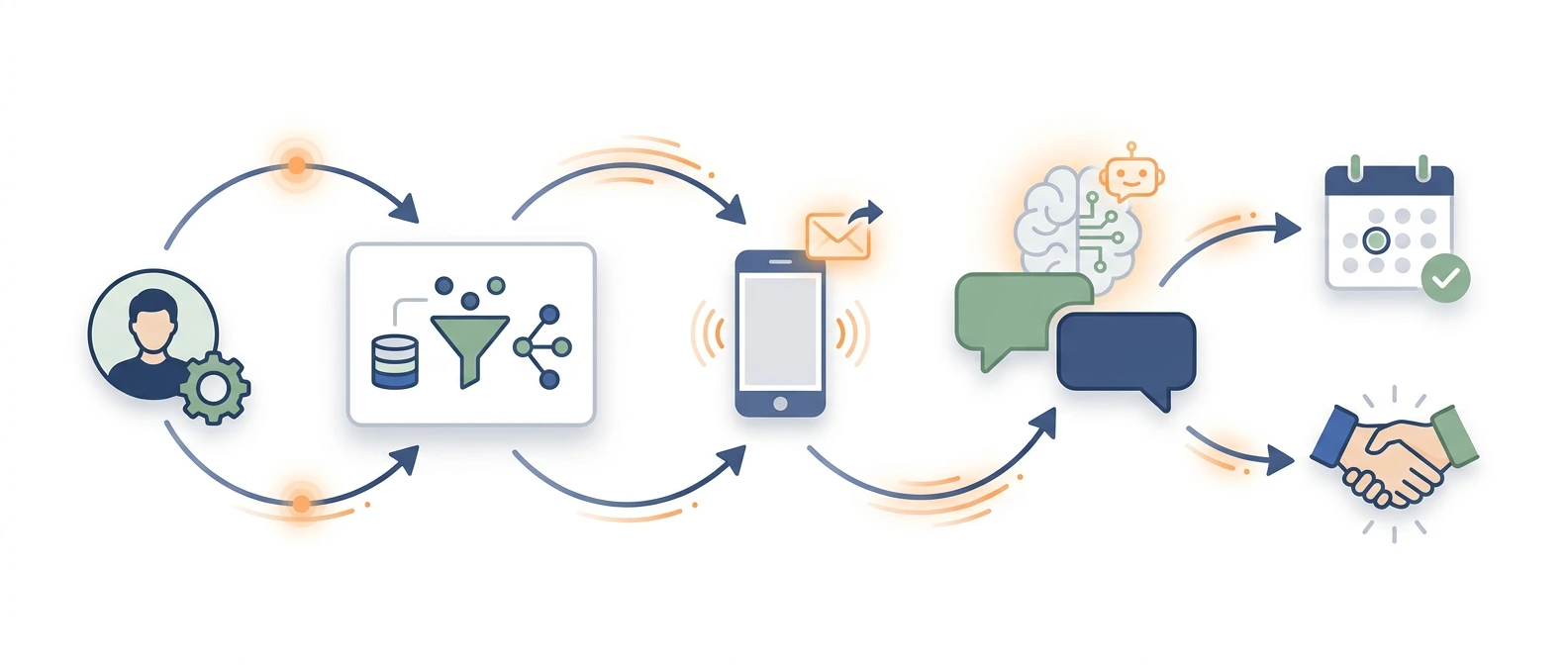
- Texts log themselves to the CRM. Every message lands on the contact and the deal, so the thread is visible to the whole team and attribution actually works.
- The CRM can trigger the text. Form fill, stage change, missed call: the workflow sends the first touch in seconds, from the rep who owns the deal.
- Calls and texts share one place. Reps switch between channels mid-deal; the history should not fragment across tools.
- Consent is enforced by the system. Opt-outs suppress automatically, so compliance does not depend on a rep's memory.
This is what Aloware is built for. Texting runs inside the CRM record: reps text from Talk2 within HubSpot contact and deal views, every message auto-logs as an SMS engagement, and HubSpot workflows can send a text across contacts, deals, companies, and tickets, including a Form-to-Text first touch for speed-to-lead. One-to-one texting to the US and Canada is unlimited on Core AI plans, and a STOP suppresses texts to that contact automatically. When volume outgrows your reps, an AI text agent can run the qualifying conversation two-way and hand the live ones to a rep. And when you want richer messages with branding and read receipts, RCS messaging is the next step up from SMS.
Key takeaway: pick the tool that puts texting inside the pipeline. Logged, triggered, consent-enforced texting compounds; disconnected blasting does not.
The bottom line
Text message marketing for a sales team is not a smaller version of email marketing. It works because of two stubbornly human facts: your prospects are on their phones all day, and a text puts your ask in front of them in one glance, answerable in one thumb. Earn the channel with real consent and registration, send texts that start from what the prospect actually did, and run it inside your CRM so every reply becomes pipeline. Do that, and the response rates that make texting famous become your team's numbers, not a statistic in someone's chart.
Want to see two-way, CRM-native texting on your own pipeline? Book a 20-minute demo and we'll show Form-to-Text, workflow texting, and the AI text agent inside your CRM.

Frequently Asked Questions
What is text message marketing for a sales team?
For a sales team, text message marketing is using SMS and MMS as a two-way, consent-based conversation channel to qualify leads, follow up, book meetings, and route prospects to the right rep, wired into the CRM so every message logs to the right contact and deal. It differs from broadcast SMS, which is one-way promotional sending built for coupons and alerts. The sales version is measured by replies, meetings, and deal movement rather than by open rate.
Is text message marketing legal, and do I need consent?
Yes, it is legal when you follow the rules. Marketing texts in the US require prior express written consent from the recipient, and you must honor opt-out requests. The FCC's 2024 order confirmed that replying STOP (or a similar word) is a valid way to revoke consent, and that senders must honor a revocation within a reasonable time not to exceed 10 business days, though the FCC encourages acting as soon as practicable. In practice that means a real opt-in (an active checkbox with rate and frequency disclosures and a link to your terms) and a platform that automatically stops texting a contact the moment they opt out, rather than waiting out the 10-day window.
What is A2P 10DLC and do I need it?
A2P 10DLC is the US carrier-mandated framework for sending application-to-person business texts from a standard 10-digit number. You register a Brand (your business identity) and a Campaign (your use case), then onboard your sending numbers to the approved campaign. You need it to text US mobile numbers at scale: unregistered or pending traffic is surcharged or blocked, while registered traffic delivers and costs less per message. Some platforms, including Aloware, offer a managed service that handles the whole registration for you.
What's the difference between SMS marketing and business text messaging?
SMS marketing usually refers to promotional broadcasts to an opted-in list, such as sales, drops, and alerts. Business text messaging is the broader practice of using texts for two-way communication across sales, support, and operations, including lead follow-up, appointment reminders, and conversations tied to a CRM record. A sales team benefits most from the business-texting model, where the reply drives the next action, rather than a one-way marketing blast.
Can text message marketing integrate with HubSpot?
Yes. With Aloware, texting runs inside HubSpot: you send and receive SMS and MMS from the contact and deal record through the Talk2 messenger, every message auto-logs as an activity on the right objects, and Send a Text is available as a HubSpot workflow action across contact, deal, company, and ticket workflows. That lets you text the instant a form is submitted or a deal changes stage, and it keeps the whole conversation attached to the record instead of stranded in a separate tool.
What happens when someone replies STOP to my texts?
A reply of STOP (or a similar opt-out word) revokes consent, and you must stop sending marketing texts to that contact. Federal rules require honoring the request within a reasonable time, not to exceed 10 business days, and a single confirmation text is allowed as long as it only confirms the opt-out. On Aloware, a STOP reply automatically suppresses further texts to that contact right away, well inside that window, so the opt-out is enforced by the system in real time rather than depending on a rep to remember. Note that stopping texts and stopping calls are handled separately; do-not-call handling covers calls.
How is an AI text agent different from a bulk SMS blast?
A bulk SMS blast sends one message to many people and does nothing with the replies. An AI text agent holds a two-way conversation with one contact at a time: it can qualify, answer questions from a knowledge base, book a meeting, update the CRM, and hand off to a human. Aloware's AloAi Text Agent works toward a goal you set and replies with the contact's CRM context in view, so it reads as a helpful conversation rather than a broadcast. It also sends paced follow-ups and cancels them automatically once the lead responds.
Should a sales team use a short code or a long code for texting?
Most sales teams use a registered 10-digit long code, because it supports true two-way conversations from a local business number and is quick to provision once A2P 10DLC registration is complete. Short codes support very high one-way throughput and are common for large-scale promotional broadcasts, but they take weeks to provision and are overkill for conversational sales texting. For qualifying leads and booking meetings, a registered long code is the practical choice.
How fast should a sales team text a new lead?
As close to instantly as you can. Speed-to-lead is one of the strongest predictors of connecting, and a text is the least intrusive way to reach someone in the first minute. The reliable way to hit that window is automation: trigger a text the moment a form is submitted (Form2Text) rather than relying on a rep to notice. An AI text agent can carry that first exchange, qualify the lead, and book time before a human is even available.
What can I text about, and what's forbidden?
Allowed use cases include notifications and alerts, customer care, verification, and marketing to opted-in contacts. Forbidden content includes SHAFT categories (sex, hate, alcohol, firearms, tobacco) plus other restricted categories such as high-risk lending, third-party lead generation, and certain regulated products. You also must avoid public URL shorteners in favor of a branded one. Your registered Campaign use case should match what you actually send, because carriers vet the content against it and can block traffic that drifts off the registered purpose.
.png)

Ruby Kootval is Head of Product Marketing at Aloware. She has 12 years in digital marketing, including 8 in B2B SaaS and 5 in telecom, and writes about AI voice agents, dialers, CRM integrations, and contact center operations.