


TL;DR
Lead generation in 2026 splits into three jobs: getting found where buyers now look, capturing intent without friction, and actually reaching the person who raised their hand. Most strategy lists cover the first two and stop at the form submission. The sixteen below cover all three, and the last five decide whether the first eleven produce revenue or just rows in a CRM.
- About four in ten U.S. adults say they use chatbots for information searching, per Pew Research Center's June 2026 report (survey of 5,119 U.S. adults, February 17 to 23, 2026). Discovery no longer begins and ends on a results page.
- Stretching first response from 5 to 30 minutes produces "a staggering 21-fold decrease in the odds of qualifying a prospect," per the 2007 InsideSales.com/MIT Lead Response Management study, which also found contact success drops more than tenfold across the first hour.
- 74% of consumers check a new text within five minutes and 23% within one minute, per SimpleTexting's January 2026 survey of 1,000 U.S. consumers.
- 86% of unknown calls go unanswered, per Hiya's State of the Call 2026 (12,000+ consumers across six countries). Reaching a lead by phone is a number-reputation problem before it is a script problem.
- A single missed call costs $12.15 on average, and $26,000+ a year for a business missing around six calls a day, per Ambs Call Center's 2025 report.
- The sixteen split three ways: strategies 1 to 6 create demand, 7 to 11 capture it, and 12 to 16 turn a lead record into a live conversation. Teams with existing traffic almost always have their constraint in the third group.
Most teams do not have a lead problem. They have a contact problem.
We read two of the top-five ranking guides for this query end to end. Between them they list twenty-six tactics, and not one of them addresses what happens after the form is submitted. That is a strange place for the genre to stop, because the gap between a lead existing and a human conversation happening is where almost all of the waste sits: the callback that goes out three hours late, the dial that lands from a number the carrier has quietly flagged, the inbound call at 7pm that rings into nothing. Sales leaders feel that gap in their pipeline every month, and no amount of new lead volume closes it.
So the sixteen strategies below are ordered the way the work actually runs. Six for creating demand, five for capturing it, five for converting a lead record into a live conversation. The third group is short, unglamorous, and the reason the other eleven pay off. It also runs through the phone, which means it runs through why legitimate business calls get flagged as spam whether you have thought about it or not.
Where do leads actually come from in 2026?
The discovery layer moved. Buyers still search, but a large share of them now ask a model first and click second, and the pages that get quoted inside those answers are not the pages that were built to rank in 2019. These six strategies are about being present where the question gets asked.

1. Write the answer, not the article
Answer engines extract. They lift a self-contained paragraph, a definition, a table row, or a number, and they attribute it. A page that buries its answer under six paragraphs of context gives them nothing to lift. Put the direct answer in the first two sentences under every heading, then explain. An insurance agency writing about coverage gaps should open with the coverage rule and the dollar threshold, not with a paragraph about how insurance is complicated.
- ❌ Bad: 900 words of framing before the answer appears.
- ✅ Good: the answer in sentence one, the reasoning underneath it.
Key takeaway: if a model cannot quote one paragraph of your page and have it stand alone, your page cannot be cited.
2. Own the comparison and alternative queries in your own category
Someone searching "X versus Y" or "alternatives to X" has already decided to buy something. They are picking. That is the highest-intent free traffic available to any company, and most teams never build the pages because writing about rivals feels uncomfortable. Build one page per real competitor, keep it factual, state what each tool is genuinely built for, and let the reader disqualify themselves. Factual beats flattering, and it also beats fiction, which is what a reader assumes when a comparison page has no honest limitations in it.
Key takeaway: comparison pages convert because the searcher is at the end of the decision, not the beginning.
3. Publish one number nobody else has
Original research does not require a research budget. It requires an operational log you already keep. A home services company dispatching hundreds of jobs a month knows the real median response time in its metro. A staffing firm knows the actual time-to-fill by role. A solar installer knows how many quotes convert at each system size. Publish the number with the method attached, including the sample size and the dates. A figure with a stated method gets cited; a figure without one gets ignored, and increasingly it gets stripped out by anyone checking sources.
Key takeaway: the smallest real dataset you own beats the largest survey you cannot verify.
4. Mine your own sales calls for the words buyers actually use
Transcription is cheap enough now that every recorded call is a keyword study you already paid for. We ran this on our own conversations: an analysis of 221 transcribed Aloware calls, roughly 107 of them genuine prospect and customer conversations, found the phrase "local presence" in about 32 and spam or scam-label phrasing in about 21. Neither of those is how a marketer would have phrased the problem. Both are how buyers phrase it, which makes them the headings worth writing. Pull the exact objections too. The objection a rep hears four times a week is a page that does not exist yet.
Key takeaway: your prospects have already written your keyword list out loud. Read the transcripts.
5. Answer in public, completely, without the link
Forums, subreddits, and industry communities rank well and get quoted heavily, and they are the one surface where a vendor can build credibility faster than a blog. The discipline is severe: answer the question fully, in the thread, with no link and no pitch. The link is what gets the post removed and the account flagged. The complete answer is what gets a reader to search your name afterward. Treat it like unpaid support work that happens to be public.
Key takeaway: the fully answered question is the ad. The link is what kills it.
6. Turn partner marketplaces into a discovery surface
If your product integrates with a CRM, that CRM's app marketplace is a listing in front of people who are already shopping your exact category with their wallet out. It costs a listing and some screenshots. The same logic applies to integration partners' own content: a joint teardown or a co-hosted session puts you in front of an audience that has already qualified itself on the platform question. Co-marketing with a partner costs coordination, not budget.
Key takeaway: the people browsing an app marketplace have higher intent than anyone who will ever read your blog.
How do you turn attention into a lead worth having?
Traffic without capture is a vanity metric, and capture without qualification is a queue of records nobody wants to call. These five are about the handoff between the two.
7. Cut the form to the fields a rep will actually use
Every field is a trade: more qualification, fewer submissions. The test is simple. Can a rep make the first call without this field? If yes, delete it. Phone number stays, because the fastest path to a conversation is a phone number. Company size, industry, and job title can be enriched after the fact. A four-field form that a rep can act on immediately outperforms a nine-field form that produces a better-looking record and half the volume.
Key takeaway: a form field is not free. It is paid for in submissions you never see.
8. Retarget intent, not traffic
Retargeting everyone who touched the site burns budget on people who read one article and left. Retarget three audiences only: visitors to the pricing page, visitors to a comparison page, and anyone who started a demo request and did not finish. Those three behaviors are declarations. A blog reader is not. The narrower audience costs less, converts higher, and stops the campaign from following disinterested people around the internet for ninety days.
Key takeaway: pricing-page and abandoned-form audiences are the only retargeting segments that reliably pay for themselves.
9. Run a live teardown instead of a webinar
A webinar is a slide deck with a registration wall. A teardown is you fixing a real, permissioned example from the audience, on camera, in front of everyone. The recording becomes an evergreen asset, the registration list is the lead list, and the fix itself is the thing attendees screenshot and send to a colleague. Law firms, real estate brokerages, and home services companies all respond to this format for the same reason: they get to watch someone with their exact problem get it solved.
Key takeaway: people register for a slide deck and show up for a repair.
10. Treat short-form video as a search surface
Video results now surface inside AI-generated answers and in standard results, which makes a 90-second clip a discovery asset rather than a social post. The format that works is narrow: one specific question as the title, the answer in the first ten seconds, the demonstration after. Repurpose the question straight from your FAQ page or from the objection list you pulled in strategy 4. One question per video. Playlists do the topical work.
Key takeaway: title the video as the question, answer it in ten seconds, and it becomes searchable inventory.
11. Reactivate the leads you already own
Closed-lost, churned, and demo no-shows are the cheapest pipeline in the building, and almost nobody works them systematically. Segment by the reason they said no, then reopen only the segments where that reason has changed: price, a missing capability you have since shipped, or bad timing that has now passed. Do not blanket-blast the list. A reactivation campaign is a dialing job more than a marketing job, which is why it lives or dies on the dialer driving the volume and on whether those numbers still connect.
Key takeaway: a segmented dormant list beats a cold list on every metric, and you already paid for it.
Why do generated leads never become conversations?
One of our own prospects arrived on a sales call having "initially thought the service would generate leads for her." She had the categories crossed, and the correction is the honest shape of this whole section: we are not a lead source. We are what happens to a lead after it exists, and that is the part these lists skip.
Here is the arithmetic that makes it matter. Say your cost per lead is $75 and 40 inbound leads a month ring out with nobody picking up. That is $3,000 of acquisition spend written off before a human is involved, every month, plus roughly $12.15 of direct cost per missed call on the Ambs figure above. No new channel fixes that. These five do.
12. Respond in minutes, and automate it so it survives a busy Tuesday
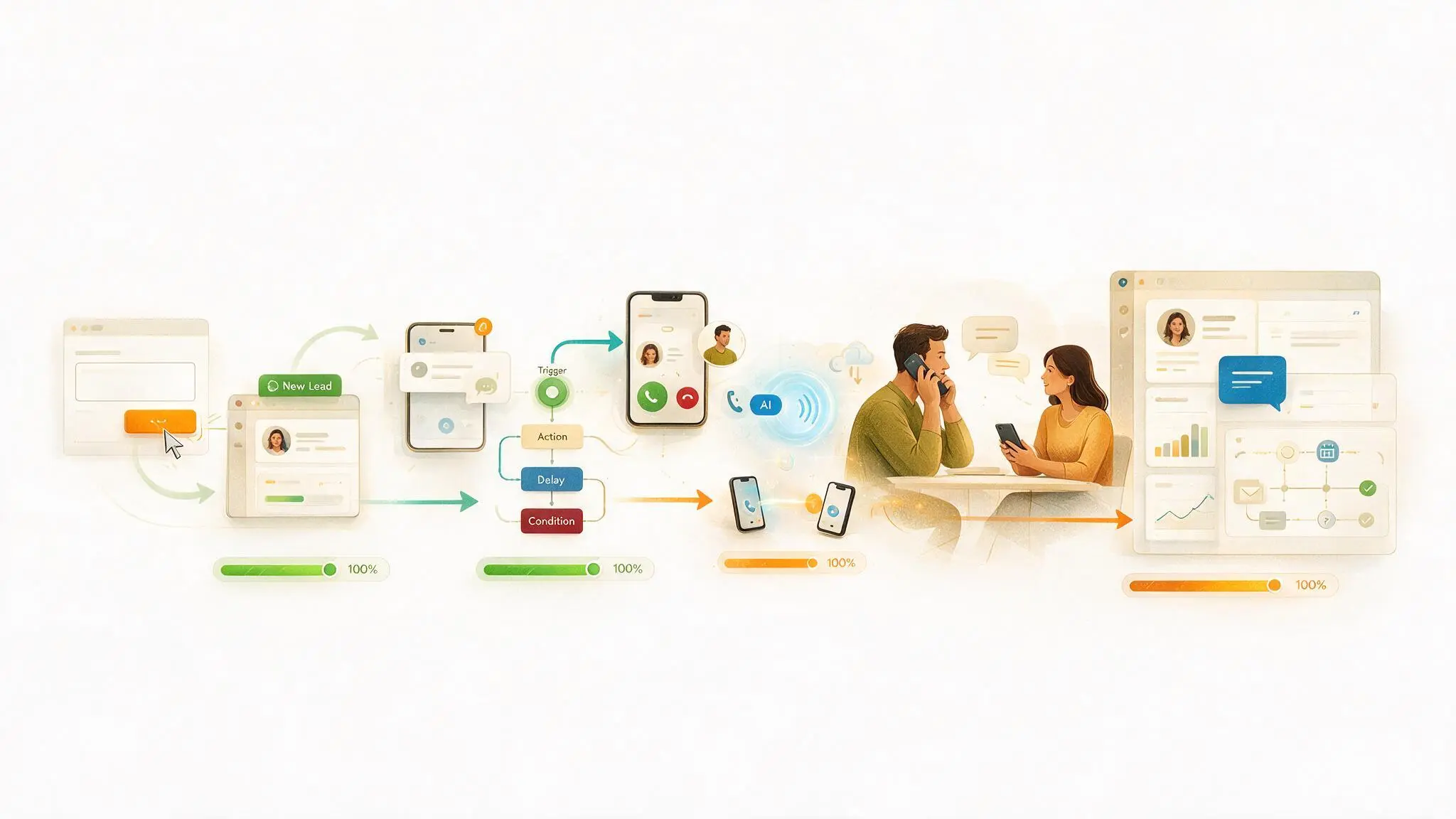
The 2007 InsideSales.com/MIT Lead Response Management study found that stretching first response from 5 to 30 minutes cuts the odds of qualifying a prospect 21-fold, and that contact success falls more than tenfold across the first hour. Every team knows this and almost none of them hit it, because five minutes is achievable on a quiet Tuesday and impossible on a busy one. The fix is not discipline. It is removing the human from the trigger: the form submission should route the submission straight into a rep's dialer rather than into an inbox. Aloware's Form2Call fires on the submission webhook and drops the lead into a rep's power dialer queue, either next in an active session or further down that rep's list. Treat speed-to-lead as an operating discipline with a number attached, not as an aspiration.
Key takeaway: if your five-minute response depends on someone noticing an email, you do not have a five-minute response.
13. Open with a text, then call
SimpleTexting's January 2026 survey of 1,000 U.S. consumers found 74% check a new text within five minutes and 23% within one minute. No call connects that reliably. So stop treating text and phone as alternatives. Send the acknowledgement text the second the form lands, naming the person and the thing they asked about, then dial ninety seconds later against a prospect who now knows who is calling. For inbound volume that outruns the team, an AI text agent working the first reply can hold the thread until a rep is free. Text agents and voice agents are separate things doing separate jobs; the text agent handles the thread, and it does not place the call.
Key takeaway: the text buys you the identity, and the identity is what gets the call answered.
14. Make sure the phone actually gets answered
Hiya's State of the Call 2026, surveying more than 12,000 consumers across six countries, found 86% of unknown calls go unanswered. That is the ceiling on every outbound strategy above it. Three things move it, and they work together: monitoring the reputation of your own outbound numbers so carrier flags get caught and remediated instead of accumulating, registering your business identity so your name displays before the answer, and matching your outbound area code to the prospect's. In one Twilio customer's ninety-day test across 720,000 calls, branded calls were answered 62% of the time against 20% for un-branded traffic.
Two cautions, because this is where vendors overclaim. Branded display and spam labeling are two separate carrier systems running in parallel: a branded number with a bad reputation still gets flagged, so display without reputation management is decoration. And at Aloware these three layers, NumberGuard, Branded Calling, and Local Presence, are add-on services priced separately from the seat plan rather than bundled into it. That is deliberate framing, not a hedge. A fresh number connects fine for a few weeks before reputation decays, so the answer-rate layer is what makes the results last, and it is bought on top of the platform.
Key takeaway: 86% of unknown calls go unanswered, which means number reputation is a lead generation strategy whether or not anyone files it under that heading.
15. Route by ownership, not by round robin
Round robin is the default because it is easy to configure, not because it converts. If a lead already has a relationship in the CRM, a prior demo, an open deal, a support history, that lead belongs to the person who owns it, and handing it to the next name in the rotation throws away the only advantage you had. Trigger routing off the CRM record rather than the form: existing contact goes to the owner, net-new goes to the rotation, and a match on company domain goes to whoever owns the account. This is a fifteen-minute configuration change that most teams never make because the round robin technically works.
Key takeaway: the CRM already knows who should take the call. Let it decide instead of the rotation.
16. Cover the hours you are closed
Inbound leads do not arrive during business hours; they arrive when the buyer has a free moment, which is often the evening. At $12.15 of direct cost per missed call on the Ambs figure, a business missing around six a day is looking at $26,000+ a year, and that is before the pipeline the call would have created. An AI voice agent sitting on the inbound line answers rather than routing to voicemail. Aloware's AI Call Rescue works at the account level: every missed inbound call from any line or ring group goes to a system-managed voice agent that greets the caller, captures intent and contact details, and writes a transcript note back to the record. It answers the phone. It is a voice agent, not a texting one, so it does not send a follow-up SMS on its own.
Key takeaway: an after-hours lead that reaches a voice and gets logged is a lead. One that reaches voicemail is a statistic.
Which of these 16 should you start with?
Not all sixteen at once, and not in order. Pick by the constraint you actually have.
- Inbound already outruns your callbacks. Start at 12, 14, and 16. You do not have a generation problem, you have a contact problem, and adding channels will make it worse.
- Your pickup rate sits under about one call in five. Start at 14 before anything else on this page. Every other strategy here feeds a phone nobody answers, so fixing number reputation multiplies the value of the other fifteen.
- You generate fewer than roughly ten inbound leads a week. Start at 1, 2, and 5. You need discovery surfaces before follow-up mechanics matter.
- You have more than a few thousand dormant CRM records. Start at 11, then 15. Fastest pipeline per hour of work available to you, and it needs correct routing to not get wasted.
- Your reps are busy but the pipeline is flat. Start at 4, then 2. The problem is usually that the pages you have answer questions nobody is asking in the words nobody uses.
Key takeaway: the right first strategy is the one that removes your current constraint, and for most teams with existing traffic that is a follow-up constraint, not a traffic one.
The bottom line
Lead generation stopped being a volume problem for most teams somewhere around the point that content became cheap to produce. The scarce thing now is reaching the person. The eleven strategies in the first two sections put a name and a number into your CRM; the five in the third decide whether that record ever turns into a voice on a phone. Run the first eleven without the last five and you will build a very well-attributed pile of leads that nobody talks to.
Pick the constraint. Fix that one. Then come back for the next fifteen.
See the follow-up layer running on your own leads.Book a 20-minute demo and we will show a form submission triggering an instant text and a rep dial, walk the number-reputation dashboard, and set up an inbound voice agent against a live line so you can watch what happens to a lead that arrives at 9pm.
Frequently Asked Questions
What is the most effective lead generation strategy in 2026?
There is no single best one, but the highest-return move for most teams with existing traffic is not a new channel at all. It is closing the gap between a lead arriving and a human contacting them. The 2007 InsideSales.com/MIT Lead Response Management study found that stretching first response from 5 to 30 minutes cuts the odds of qualifying a prospect 21-fold, and that contact success drops more than tenfold across the first hour. If you already generate leads that sit unworked for hours, fixing response speed and answer rate will beat adding a twelfth acquisition channel.
How fast should you respond to a new inbound lead?
Within five minutes, and the mechanism matters more than the target. The 2007 InsideSales.com/MIT Lead Response Management study found a 21-fold decrease in the odds of qualifying a prospect when response time stretched from 5 to 30 minutes, with contact success falling more than tenfold over the first hour. Five minutes is achievable on a quiet day and impossible on a busy one, so the reliable version removes the human from the trigger: the form submission should fire an automated text and place the lead directly into a rep's dialing queue rather than land in an inbox someone has to notice.
Should you call or text a new lead first?
Text first, then call, and treat them as one motion rather than alternatives. SimpleTexting's January 2026 survey of 1,000 U.S. consumers found 74% of people check a new text within five minutes and 23% within one minute, which is faster and more reliable than any call connects. Send an acknowledgement text the moment the form lands, naming the person and the thing they asked about, then dial roughly ninety seconds later. The prospect now recognizes who is calling, which is the single biggest thing you can do to get an unknown number answered.
Why do so many sales calls go unanswered?
Because the number is unknown, and often because carriers have flagged it. Hiya's State of the Call 2026, a survey of more than 12,000 consumers across six countries, found 86% of unknown calls go unanswered. Three things move that: monitoring the reputation of your own outbound numbers so carrier flags get caught and remediated, registering your business identity so your name displays before the answer, and matching your outbound area code to the prospect's. Note that branded display and spam labeling are separate carrier systems, so a branded number with a poor reputation still gets flagged.
Does an AI voice agent generate leads?
No, and the distinction matters when you are budgeting. An AI voice agent does not create demand or source contacts. It answers, qualifies, and captures the leads you already generated, particularly the inbound calls that arrive outside business hours or while everyone is on another line. Ambs Call Center's 2025 report puts the average direct cost of a single missed call at $12.15, and $26,000+ a year for a business missing around six a day. A voice agent addresses that loss. It does not replace a lead source.
How do you generate leads without a big marketing budget?
Use the assets you already own. Publish one operational number nobody else has, taken from a log you already keep, with the sample size and dates attached. Mine your recorded sales calls for the exact phrases buyers use and turn each recurring objection into a page. Answer questions completely in the communities where your buyers already ask, with no link in the post. List in the app marketplaces of every platform you integrate with. All four cost time rather than budget, and all four produce assets that compound instead of stopping when spend stops.
What is the difference between inbound and outbound lead generation?
Inbound means the prospect initiates contact, usually after finding you through search, an AI answer, a community thread, or a referral. Outbound means you initiate, through calls, texts, or email to a list you built or bought. The practical difference is where the friction sits. Inbound leads are warmer but perishable, so the constraint is response speed. Outbound leads are colder and unlimited in volume, so the constraint is whether your calls get answered at all. Most teams need both, and each fails for a completely different reason.
How do you get more leads from your existing CRM database?
Segment the dormant records by why they said no, then reopen only the segments where that reason has changed: price, a capability you have since shipped, or timing that has now passed. Closed-lost opportunities, churned accounts, and demo no-shows are the cheapest pipeline available because you already paid to acquire them. Do not blanket-message the whole list, which burns goodwill and number reputation at once. A reactivation campaign is mostly a dialing job, so it depends on your list segmentation and on whether those numbers still connect.
How do you measure whether a lead generation strategy is working?
Measure past the lead. Volume and cost per lead tell you whether a channel produces records, not whether it produces revenue, and a channel that looks cheap per lead often looks expensive per conversation. Track four things per channel: leads created, percentage contacted by a human, median time from lead creation to first contact, and opportunities created. The gap between the first and second numbers is usually the largest and most fixable loss in the funnel, and it is invisible if you only report on cost per lead.
.png)

Ruby Kootval is Head of Product Marketing at Aloware. She has 12 years in digital marketing, including 8 in B2B SaaS and 5 in telecom, and writes about AI voice agents, dialers, CRM integrations, and contact center operations.


.webp)