


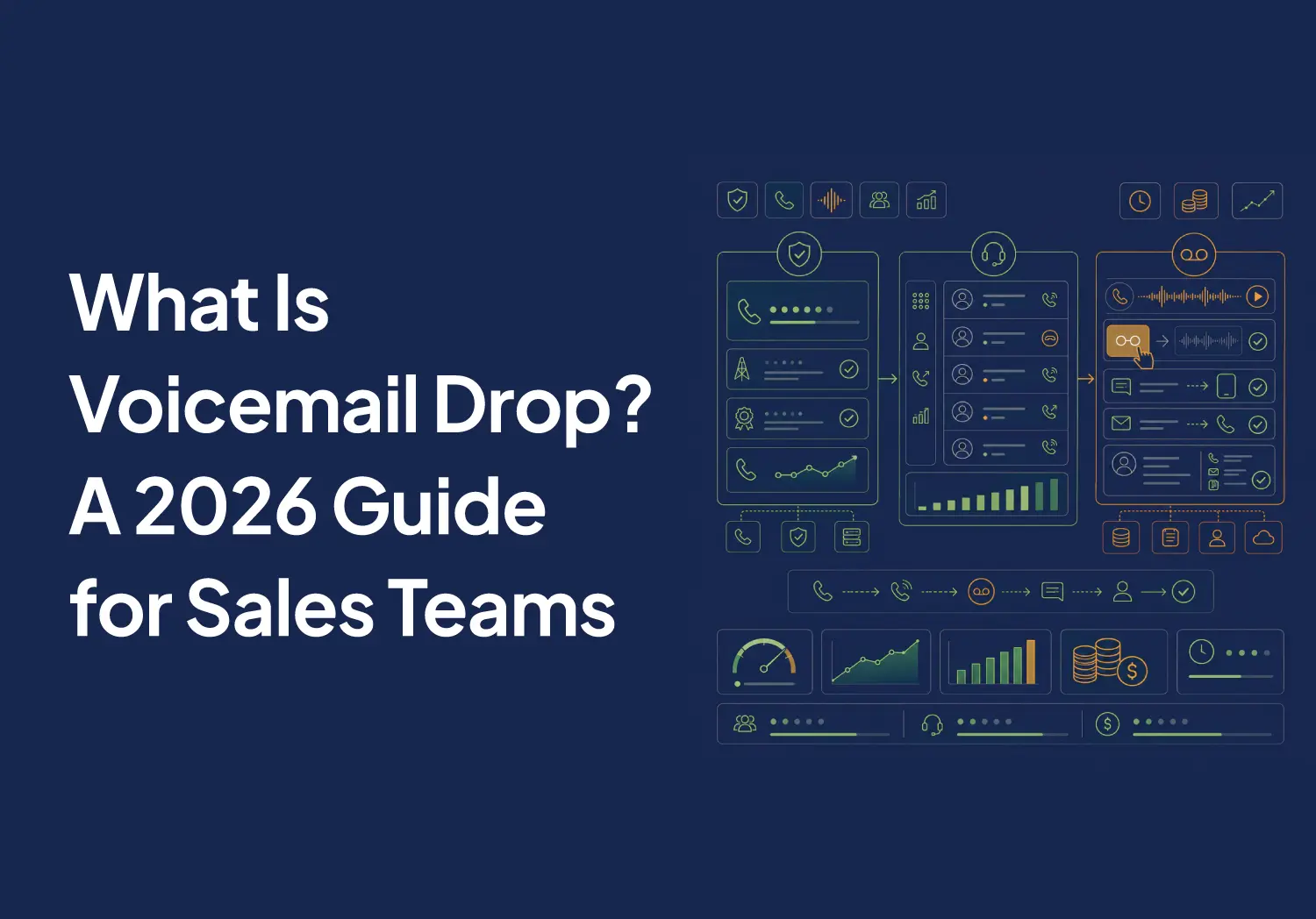
TL;DR: Voicemail drop lets a rep leave a pre-recorded voicemail in one click instead of speaking the same message on every no-answer, so they spend their time dialing instead of re-recording. It is a power-dialer feature, not a standalone tool, and it is not the same thing as ringless voicemail, which the FCC ruled is a "call" requiring consent under the TCPA. Voicemail drop only pays off when your calls actually connect, so number reputation comes first.
Key facts:
- Voicemail drop plays a saved recording into a live call's voicemail; the rep advances immediately to the next dial.
- Ringless voicemail is different: it injects a message direct-to-voicemail with no ring, and the FCC ruled in 2022 it requires prior express consent under the TCPA.
- TCPA statutory damages run $500 per violation, up to $1,500 for willful or knowing violations.
- Voicemail drop is a feature inside a power dialer, and a no-answer can trigger an automatic follow-up text.
- It captures no-answers; it does not create pickups. Fix number reputation and answer rate first.
If you run an outbound team, you've watched a rep leave the same voicemail 60 times in a day. Same words, same pace, by the fortieth one it comes out flat and rushed, and every one of those 30-second recordings is time not spent on the next dial.
That's the problem voicemail drop solves. I've watched reps claw back close to an hour a day just by not re-speaking the same message on every no-answer. But the feature gets sold as a magic callback machine, and it isn't one. Used wrong, it's a faster way to leave voicemails nobody returns. Used right, inside a system where your calls actually connect, it's one of the cleanest efficiency wins in outbound.
Here's what voicemail drop actually is, how it differs from the version of it that gets companies sued, and when it's worth turning on.
What is voicemail drop?
Voicemail drop is a calling feature that lets a sales rep leave a pre-recorded voicemail with a single click instead of speaking the message live on every call. When an outbound dial rings through to the recipient's voicemail, the rep selects a saved recording, the system plays it into the voicemail box, and the rep moves straight to the next contact without waiting for the beep-to-hang-up dance.
The mechanics matter for what comes next: the call is a normal outbound dial. The phone rang. It routed to voicemail the way any unanswered call does. The only thing automated is the rep not having to talk. That's why voicemail drop is sometimes called "voicemail drop on a connected call" — the rep is on a live session the whole time.
For a high-volume outbound team, the math is simple. A rep making 80 dials a day, where most go unanswered, is leaving dozens of voicemails. At 30 to 45 seconds of talking each, that's real time. Drop the message in a click and that time goes back into dialing. If you're building the dialing engine that voicemail drop sits inside, our guide to picking a power dialer that won't burn your numbers covers the parts that have to work before voicemail drop earns its keep.
Key takeaway: Voicemail drop is a one-click pre-recorded message left on a normally dialed call. It saves rep time per no-answer; it does not change how the call was placed.
Is voicemail drop the same as ringless voicemail?
No, and this is the distinction that keeps your team out of trouble. They sound interchangeable and they are not.
Voicemail drop happens on a live outbound call. The phone rings, the call routes to voicemail, the rep drops a recording. There was a ring. There was a connected dial.
Ringless voicemail (sometimes "direct-to-voicemail" or RVM) skips the ring entirely. It injects a message straight into the carrier's voicemail server, so the phone never rings and the message just appears. Vendors marketed this for years as a loophole: no ring, no "call," no rules.
Regulators closed that door. In 2022 the FCC issued a declaratory ruling finding that ringless voicemail qualifies as a "call" made with an artificial or prerecorded voice and falls under the TCPA's robocall rules requiring prior express consent. The petition that asked the FCC to exempt ringless voicemail argued it wasn't a "call" because it created a server session instead of ringing the phone. The FCC disagreed: from the consumer's side, a message arrived on their wireless number, so it's a call.
That ruling has teeth. Under the TCPA's private right of action (47 U.S.C. § 227), statutory damages run $500 per violation, and courts can treble that to $1,500 for willful or knowing violations. Multiply that by a list of thousands and ringless voicemail stops looking like a shortcut.
This is why the framing in most "voicemail drop" content is sloppy. Standard voicemail drop on a normally dialed call is a productivity feature. Ringless voicemail is a regulated robocall. Don't let a vendor blur the two when you're evaluating tools.
Key takeaway: Voicemail drop happens after a ring on a connected call. Ringless voicemail skips the ring and, per the FCC's 2022 ruling, is a "call" requiring consent under the TCPA — with $500 to $1,500 in damages per violation.
Why does voicemail drop only pay off when your calls connect first?
Here's the part the feature pages leave out. Voicemail drop multiplies your output per call. It does nothing to create the call in the first place.
If your outbound number is flagged "Spam Likely," your calls don't get answered, and a lot of them never reach a voicemail the prospect actually listens to. You can drop a perfect 18-second message into 200 voicemails a day, but if those numbers are burned, you're broadcasting into dead air faster. That's not efficiency. That's wasted volume at scale.
The order of operations is fixed:
- Get the call answered. Number reputation and answer rate first. This is the work that decides whether anything else matters.
- Dial fast. A power dialer moves your reps through the list without manual dialing dead time.
- Capture the no-answers. Voicemail drop turns the unavoidable unanswered calls into left messages without burning rep time.
Most teams do this backwards. They buy speed and automation, point a freshly registered number at a 5,000-row list, and watch the carrier flag it inside a week. The number's reputation craters, pickups collapse, and now the fancy voicemail drop is leaving messages on numbers that route everyone to spam. If you've ever wondered why your calls land in spam in the first place, that's the gap voicemail drop can't close on its own.
Aloware treats this as a stack. Number monitoring catches carrier flags before they tank your connect rate, branded calling registration and local presence improve the odds your call is answered, and the dialer plus voicemail drop run on top of numbers that are actually reachable. Branding and reputation are two separate carrier systems, so registering a brand display doesn't override a bad reputation; you manage both. Get that foundation right and voicemail drop is leaving messages on live, reachable contacts instead of spraying into the void.

Key takeaway: Voicemail drop captures no-answers; it can't create pickups. If your numbers are flagged, faster voicemail drops just waste rep effort faster. Reputation and answer rate come first.
How does voicemail drop work inside a power dialer?
Voicemail drop isn't a standalone app you bolt on. It's a control inside the dialer, and it's most useful in a power-dialing session.
A power dialer works through a CRM list one contact at a time, advancing automatically so reps aren't copying numbers and clicking dial. When a call routes to voicemail, here's what happens with drop turned on:
- The rep clicks once to drop a saved recording into the voicemail.
- The dialer advances to the next contact immediately — no waiting for the message to play out.
- The call and its disposition log automatically to the CRM record, so the no-answer-plus-voicemail is tracked, not lost.
Because Aloware's power dialer runs with the CRM record open inside the session, the rep can also fire the next channel without leaving the screen. That's where the real lift is: a no-answer disposition can trigger both the voicemail drop and an immediate follow-up text in the same sequence. The voicemail plants the context; the text gives the prospect a one-tap way to reply. We call that pairing the Double-Tap, and you can run it off our AI text agent so the SMS goes out automatically rather than rep-by-rep.
Key takeaway: Voicemail drop is a one-click control inside the power dialer. The dialer advances instantly, the call logs to the CRM, and a no-answer can auto-trigger a follow-up text in the same sequence.
How do you leave a voicemail drop that actually gets a callback?
The feature saves time. The message earns the callback. A great tool playing a bad recording 200 times a day is just an efficient way to get deleted.
The rule: under 20 seconds, and front-load the reason to call back.
❌ Bad drop: "Hi, this is Jordan from [Company], just wanted to touch base and see if you had a few minutes to connect. Give me a call back when you can." It says nothing. The prospect hears "sales call" in the first three words and deletes it.
✅ Good drop: "Hi [Name], it's Jordan at [Company] — I'm calling about the rate quote you requested Tuesday, I have it ready and it expires Friday. Text or call this number and I'll send it over." Specific reason, real stakes, one next step.
Record a few drops so the message always matches the list, instead of one vague all-purpose recording:
- Solar: reference the specific incentive or the install timeline window, not "checking in on your solar interest."
- Insurance: name the renewal date or the quote that's ready, which gives a time-bound reason to call back.
- Real estate: reference the inventory match — "a listing just came up that fits what you told me" beats a generic follow-up.
- Staffing and recruiting: name the role and why they fit, so the message reads as opportunity, not spam.
Then pair it with the text. The voicemail is the context; the SMS is the easy reply. Most callbacks in 2026 come back as a text, not a returned call, so give the prospect that lane.

Key takeaway: Front-load a specific reason to call back, keep it under 20 seconds, and record per-scenario drops so the message matches the list. Pair every drop with a follow-up text.
The voicemail drop checklist for outbound teams
Before you turn voicemail drop loose on a list, run these checks:
- Confirm it's drop, not ringless. You want voicemail drop on normally dialed calls. If a tool is pitching "no ring, direct to voicemail," that's RVM — route it through your compliance team first, because the FCC treats it as a consented robocall.
- Fix number reputation first. Monitor for carrier flags, register branded calling, and use local presence so the calls behind your drops actually get answered.
- Record per-scenario messages. Two to four drops mapped to your real lists beats one generic recording.
- Keep every drop under 20 seconds with the reason to call back in the first sentence.
- Pair drop with SMS. Trigger a follow-up text off the no-answer disposition so the prospect has a fast way to reply.
- Log it to the CRM. Every drop and disposition should write back automatically so you can see which messages and lists actually drive callbacks.
- Respect calling windows and do-not-call scrubbing. Voicemail drop doesn't change your consent or timing obligations — operational requirements stay the same.
Key takeaway: Verify it's drop and not ringless, fix reputation first, record per-scenario messages, pair with SMS, and log everything. Voicemail drop rewards the team that built the system around it.
The bottom line
Voicemail drop isn't a callback machine. It's a time machine for your reps — it hands back the minutes they were spending re-speaking the same message, so they spend them dialing instead. That's worth a lot. It's worth nothing if the calls behind it aren't connecting, or if a vendor talks you into the ringless version that lands you in TCPA exposure.
Treat voicemail drop as the last layer of a dialing system, not the first. Get your numbers answered, dial fast, and let drop turn the unavoidable no-answers into messages that earn a reply. That's the difference between leaving 200 voicemails and getting 200 callbacks ignored.
Want to see voicemail drop, the power dialer, and number reputation working together inside your CRM? Book a 20-minute demo — we'll show the Power Dialer, one-click VM Drop, and the automatic SMS follow-up running on a live HubSpot or Salesforce record.
Frequently Asked Questions
What is voicemail drop?
Voicemail drop is a calling feature that lets a sales rep leave a pre-recorded voicemail with one click instead of speaking the same message live every time. When an outbound call reaches the recipient's voicemail, the rep selects a saved recording, the system plays it into the voicemail, and the rep moves straight to the next call. It is built to save the 30 to 45 seconds reps otherwise spend re-recording the same message on every no-answer.
Is voicemail drop the same as ringless voicemail?
No. Voicemail drop happens on a live outbound call after the phone rings and routes to voicemail, so the rep is on a connected dial. Ringless voicemail injects a message straight into the voicemail server without ever ringing the phone. They are treated very differently under the law: in 2022 the FCC ruled that ringless voicemail is a 'call' that requires prior express consent under the TCPA. Standard voicemail drop on a normally dialed call does not carry that direct-to-voicemail legal exposure.
Is voicemail drop legal and TCPA compliant?
Voicemail drop on a normally dialed outbound call is a productivity feature, not a separate legal category, and is widely used by sales teams. The risk lives in ringless voicemail, which the FCC has ruled is a 'call' requiring prior express consent under the TCPA. TCPA violations carry statutory damages of $500 per violation, up to $1,500 for willful or knowing violations. Treat consent, do-not-call scrubbing, and calling-hour rules as operational requirements, and confirm your specific setup with your compliance team.
How does voicemail drop work inside a power dialer?
Inside a power dialer, the rep dials through a CRM list one contact at a time. When a call routes to voicemail, the rep clicks once to drop a pre-recorded message and the dialer advances to the next contact without waiting for the voicemail to finish. The call and disposition log automatically to the CRM record. In Aloware, voicemail drop is built into the Power Dialer, and a no-answer can trigger an immediate follow-up text in the same sequence.
Does voicemail drop actually get more callbacks?
Voicemail drop increases how many quality voicemails a rep can leave per hour, but the callback rate depends on the message and on whether the call connected at all. A generic 'just checking in' drop gets deleted. A specific drop that names a reason to call back, paired with a follow-up text, performs better. And none of it matters if the number is flagged 'Spam Likely' and the call never gets answered, so number reputation and answer rate come first.
What should a sales voicemail drop say?
Keep it under 20 seconds and front-load the reason to call back. State who you are, the specific reason you're calling (a quote, an application, an inventory match, a renewal date), and one clear next step. Skip 'I just wanted to touch base' openers, which signal a sales call and get deleted. Record two or three drops for different scenarios so the message always matches the list you're dialing, rather than one vague all-purpose recording.
Can you send a text after a voicemail drop?
Yes, and pairing the two is one of the highest-payoff moves in outbound. When a call hits voicemail, drop the pre-recorded message and trigger an SMS that references the same reason to call back. The voicemail plants context; the text gives the prospect a fast, low-friction way to reply. In Aloware, a no-answer disposition can fire both the voicemail drop and the follow-up text automatically inside a sequence, so reps don't manage it by hand.
Does voicemail drop work if my number is flagged as spam?
Not well. If your outbound number is labeled 'Spam Likely' or has poor carrier reputation, most calls won't be answered and many won't reach a real voicemail box that the prospect checks. Voicemail drop multiplies your output per call, but it can't fix a connection problem. Manage number reputation first with number monitoring, branded calling registration, and local presence, then layer voicemail drop on top so the messages you leave are reaching live, reachable contacts.
.png)

Ruby Kootval is Head of Product Marketing at Aloware. She has 12 years in digital marketing, including 8 in B2B SaaS and 5 in telecom, and writes about AI voice agents, dialers, CRM integrations, and contact center operations.
.webp)
-Alternatives-for-Sales-Teams-in-2026.webp)