

TL;DR:
For a CRM-first sales team in 2026, the best sales engagement platform is Aloware if your engagement motion runs on the phone and SMS and lives inside HubSpot or Salesforce, because it is a full contact center (power dialer, two-way texting, and AI voice and text agents) native to the CRM rather than a cadence tool bolted on top. Pick Salesloft or Outreach for enterprise email-cadence programs with heavy analytics, Apollo.io when you want prospecting data and sequences in one budget tool, HubSpot Sales Hub when you are standardized entirely on HubSpot, Groove by Clari for Salesforce-native enterprise engagement, and Reply.io or Mixmax for lighter, SMB-priced needs.
A sales engagement platform is supposed to make reps sell more and administrate less. Most of them do the opposite for CRM-first teams. You buy a cadence engine, then discover the calling is a bolt-on, the texting is an afterthought, and every call and reply has to be re-synced into the CRM your team actually runs on. The result: reps live in two tools, RevOps chases missing activity, and the "engagement" you paid for is really just email scheduling.
This guide ranks nine real platforms by the job they do best, so you can match the tool to how your team actually engages: by phone, by text, by email cadence, or all three. Every price here was pulled from the vendor's own page in July 2026, and every G2 rating is the real one with its review count.
Quick comparison: 8 sales engagement platforms in 2026
| Platform | Starting price | G2 rating (reviews) | Best for |
|---|---|---|---|
| Aloware | From $30/user/mo (iPro, billed quarterly) | 4.1 (822) | CRM-first teams that engage by phone and SMS. |
| Salesloft | Quote-only (custom) | 4.5 (4,260) | Enterprise email cadences with built-in conversation intelligence. |
| Outreach | Quote-only (custom) | 4.3 (3,500+) | Enterprise outbound at scale with deep analytics. |
| Apollo.io | Free; paid from $49/user/mo | 4.7 (9,400+) | SMBs and startups wanting data plus sequences in one tool. |
| HubSpot Sales Hub | Free; Professional $90/seat/mo | 4.4 (13,500+) | Teams standardized entirely on HubSpot. |
| Groove by Clari | Quote-only (custom) | 4.7 (4,700+) | Salesforce-native enterprise engagement. |
| Reply.io | From ~$59/user/mo | 4.6 (1,528) | AI-first multichannel sequencing. |
| Mixmax | From $49/user/mo | 4.6 (1,454) | Gmail-centric SMB outreach. |
Key takeaway: there is no single "best" sales engagement platform. There is a best one for your engagement motion. Phone-and-SMS teams and email-cadence teams should not buy the same tool.
How we chose
We built this list from the platforms that actually rank for "sales engagement platform" and the ones CRM-first sales teams evaluate most often, then scored each on four things that matter to an operator, not a spec sheet:
- CRM depth, not CRM logging. Does the platform write to real objects (contacts, deals, companies) inside HubSpot or Salesforce, or does it just drop an activity and call it an integration?
- Real engagement channels. Cadence email is table stakes. We weighted native calling, two-way SMS, and AI agents, because that is where connect rates and speed-to-lead are won.
- Honest pricing. Published price beats "contact sales," and the price that matters is the one after the add-ons your team will actually turn on.
- Fit by team size. A 12-rep team and a 300-rep team are not the same buyer. We scoped each pick to who it genuinely serves.
Ratings and review counts are pulled from each product's live G2 profile. Prices are the vendor's own published or quoted figures as of July 2026. Where a vendor does not publish pricing, we say so instead of guessing.
The 8 best sales engagement platforms for CRM-first teams
1. Aloware: best for CRM-first teams that engage by phone and SMS
Most tools on this list start with email and add a phone. Aloware starts with the phone system and the CRM, then layers AI on top. It is an AI-powered contact center built for HubSpot and Salesforce: power dialer, two-way SMS, IVR, sequences, and AI voice and text agents, all logging automatically to the right contact and deal. For a team whose engagement is a conversation, not a cadence email, that is the difference between selling and doing data entry.
- A power dialer that pulls straight from HubSpot dynamic lists and Salesforce, with dispositions and notes written back automatically.
- Two-way SMS and MMS, broadcasts, and a shared Team Inbox with native A2P 10DLC registration handled for you.
- The Pickup Stack: NumberGuard reputation monitoring, Branded Calling, and Local Presence working together so more calls get answered.
- AloAi Voice Agent for 24/7 inbound qualification and booking, and an AloAi Text Bot that qualifies leads by SMS.
- AI call transcription, summaries, and sentiment analysis included in the plan, not sold as a separate product.
- Native, entity-level HubSpot and Salesforce sync (see the best sales dialer for HubSpot): reps report saving 30 to 60 minutes a day on CRM admin.
The contrast is easy to feel.
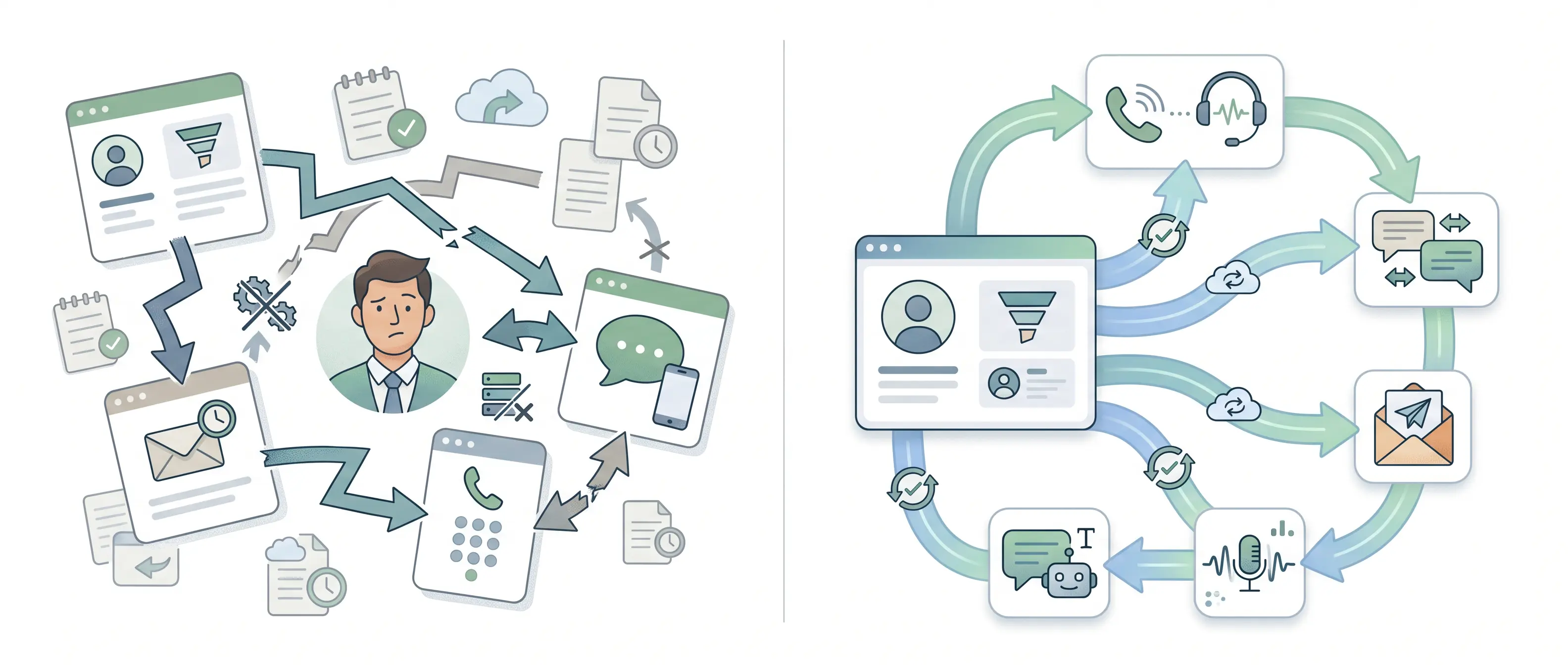
Old way: a rep finishes a call, then tabs into the CRM to log it, type notes, set a task, and fire a follow-up text from a second tool. Half the calls never get logged, and the follow-up goes out an hour late.
New way: the call, transcript, summary, disposition, and text land on the right deal automatically, and the next dial is already queued from the list. Same rep, same hour, twice the conversations.
What is missing: Aloware is a phone-and-SMS engagement platform, not a full email-sequencing suite. If your motion is primarily email cadences with light calling, a dedicated cadence tool will feel richer on the email side. Its power dialer is deliberately single-line: no parallel or predictive dialing, which is a compliance and deliverability stance against spam-flagging, not a missing feature. Brand awareness is lower than Aircall, and the admin UX has a short learning curve for self-service setup.
Who it is for: B2B and B2C sales teams that run real outbound and inbound phone and SMS volume inside HubSpot or Salesforce. Common switchers come from Aircall and JustCall when calling and CRM logging stop keeping up.
Pricing: Startup packages at $199/mo (3 users) and $399/mo (5 users). Core AI plans run from $30 to $40/user/mo (iPro), $60 to $70/user/mo (uPro, which adds the power dialer and HubSpot workflows), and $85 to $100/user/mo (xPro, which adds Salesforce and unlimited voice analytics). AloAi Voice Agent from 10¢/min. Agent calls and texts to the US and Canada are unlimited with no per-minute charge.
G2: 4.1 out of 5 across 822 reviews. A recurring theme: "the best HubSpot integration available," and reps citing time saved on logging. The honest counterweight in recent reviews is call-quality reports on weaker networks, which is worth testing on your own connection during a trial.
Key takeaway: if your engagement is a phone call and a text, buy the tool that is a contact center native to your CRM, not a cadence tool with a dialer stapled on.
2. Salesloft: best for enterprise cadences with built-in conversation intelligence
Salesloft is one of the two enterprise standards for multi-step cadence selling. Since the Clari merger in late 2025, it sits inside a broader revenue platform, and its Premier tier ships native conversation intelligence that is generally cleaner to deploy than bolting on a third-party recorder.

- Multi-step Cadences across email, calls, and social with strong A/B testing and analytics.
- Native conversation intelligence (Salesloft Conversations) on higher tiers.
- Deep Salesforce and HubSpot integrations built for large RevOps teams.
- Deal and forecast tooling through the Clari relationship.
What is missing: pricing is quote-only, so budgeting means a sales cycle before you see a number. It is enterprise-weight software: powerful, but heavier than an SMB team needs, and the calling and SMS are cadence steps rather than a full contact center.
Who it is for: mid-market and enterprise teams from roughly 30 to 150-plus reps that live in email cadences and want conversation intelligence out of the box.
Pricing: quote-only. Salesloft does not publish per-seat prices, so budgeting means a sales conversation. Expect mid-market and enterprise per-seat pricing that rises with volume and tier.
G2: 4.5 out of 5 across roughly 4,260 reviews, one of the highest-reviewed platforms in the category.
3. Outreach: best for enterprise outbound at scale
Outreach is the other enterprise standard, and the pick when reach and admin control at scale are the priority. Its analytics and governance are the deepest in the category, which is exactly what a large, process-driven SDR org wants.
- Sequences with the most granular admin controls and reporting in the category.
- Deal management, forecasting, and now AI agent capabilities layered on top.
- Strong Salesforce integration for complex enterprise workflows.
What is missing: pricing is quote-only and its model now blends seat access with consumption-based AI credits, so total cost is hard to predict. Implementation is a project, and the platform is overkill for a small team.
Who it is for: enterprise outbound teams above roughly 150 reps with a dedicated RevOps function and a Salesforce backbone.
Pricing: quote-only. Outreach packages access as Amplify tiers with AI-credit allotments; per-seat figures are not published. Expect enterprise-tier pricing.
G2: 4.3 out of 5 across 3,500-plus reviews.
4. Apollo.io: best for SMB and startups that want data plus sequences in one
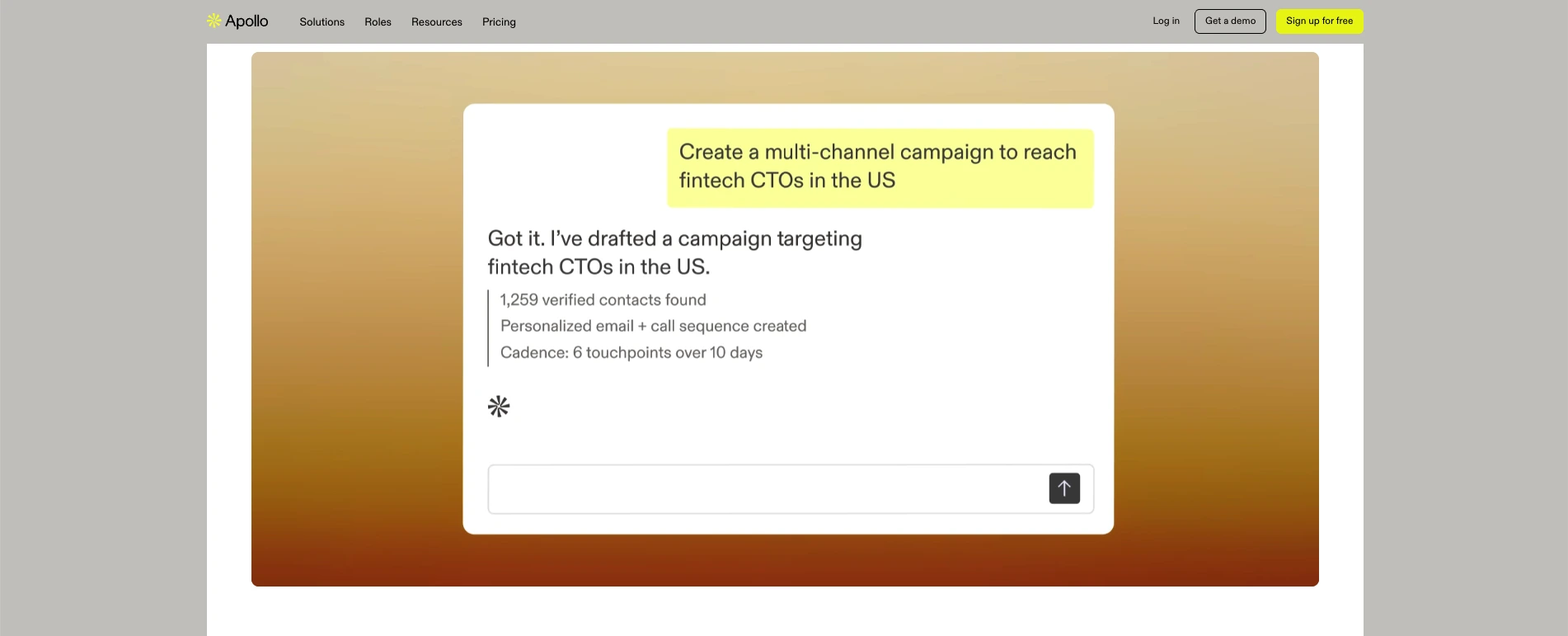
Apollo pairs a 275-million-plus contact database with email sequencing, a basic dialer, and CRM sync, all at a price a founder-led team can stomach. For early-stage outbound, having prospecting data and engagement in one login is a real advantage.
- Massive built-in B2B contact and company database with enrichment.
- Email sequences, a basic dialer, and LinkedIn steps in one tool.
- Two-way CRM sync with HubSpot and Salesforce.
- A free plan to start.
What is missing: the dialer and deliverability tooling are basic next to phone-first platforms, data accuracy varies by industry, and support can thin out as you scale. It is a data-and-email tool first, a calling tool second.
Who it is for: startups, SDR teams, and agencies under roughly 30 reps that need affordable data and sequencing more than heavy calling.
Pricing: Free plan; Basic $49/user/mo, Professional $79/user/mo, and Organization $119/user/mo billed annually (Organization requires 3 seats). Monthly billing runs higher.
G2: 4.7 out of 5 across 9,400-plus reviews, one of the highest-rated and most-reviewed tools here.
5. HubSpot Sales Hub: best for teams standardized entirely on HubSpot
If HubSpot is already your CRM and single source of truth, Sales Hub keeps engagement in the same place your data lives. Sequences, tasks, and a built-in dialer run natively against your records with zero sync tax.

- Native Sequences, task queues, and templates inside the CRM.
- A built-in calling tool and meeting scheduler.
- Reporting and automation that reuse your existing HubSpot properties.
- A free tier to start, scaling with your HubSpot footprint.
What is missing: the native dialer and SMS are light compared with a specialist contact center, and the engagement features that matter most are gated to Professional and above. Costs climb with seats, credits, and onboarding fees. Many HubSpot teams pair Sales Hub with a dedicated dialer for real outbound volume, which is exactly the gap a HubSpot dialer alternative fills.
Who it is for: teams already committed to HubSpot that want engagement in-platform and do moderate calling volume.
Pricing: Free plan; Starter from $7/seat/mo, Professional $90/seat/mo, and Enterprise $150/seat/mo billed annually. Professional and Enterprise carry one-time onboarding fees ($1,500 and $3,500).
G2: 4.4 out of 5 across 13,500-plus reviews, the largest review base in this comparison.
6. Groove by Clari: best for Salesforce-native enterprise engagement
Groove has been a Salesforce-native engagement layer since 2014 and is now part of Clari. Its signature strength is clean Salesforce sync: emails, calls, and meetings write to the right objects with minimal errors, which enterprise Salesforce shops value highly.
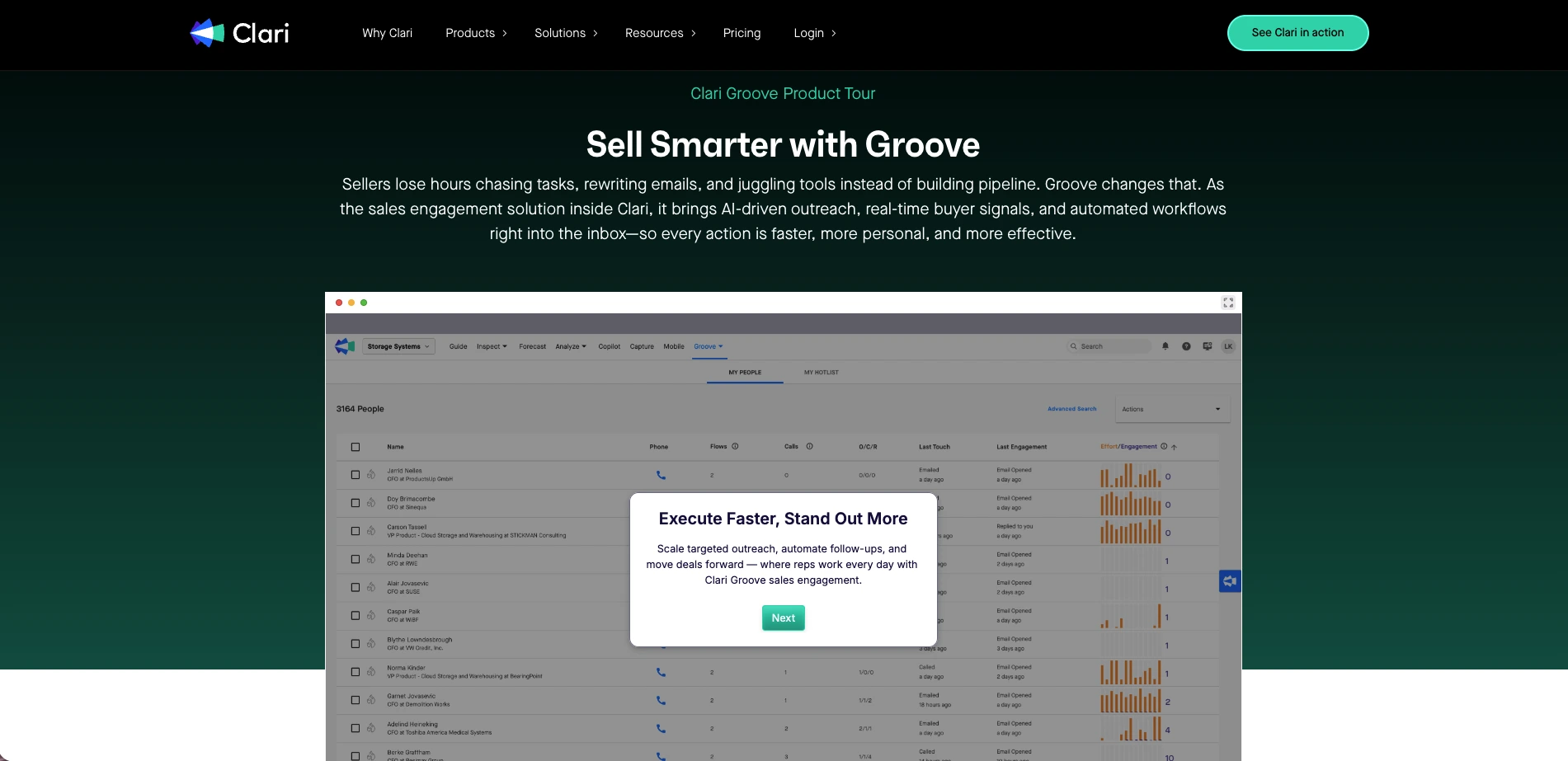
- Salesforce-native architecture with reliable, low-error sync.
- Flows (cadences), templates, and analytics built for Salesforce workflows.
- Revenue tooling through the Clari platform.
What is missing: it is Salesforce-first, so non-Salesforce and SMB teams are a poor fit. Pricing is quote-only, and the post-acquisition roadmap and packaging have shifted under Clari.
Who it is for: enterprise teams deeply invested in Salesforce that want a native engagement layer with dependable data hygiene.
Pricing: quote-only. Groove does not publish per-seat pricing.
G2: 4.7 out of 5 across roughly 4,700 reviews, and a long run at the top of enterprise satisfaction in the category.
7. Reply.io: best for AI-first multichannel sequencing
Reply.io leans hardest into AI-driven sequencing, with an AI SDR and multichannel steps across email, LinkedIn, calls, and SMS. For teams that want automation-heavy outbound and clean sequence building, it is fast and flexible.
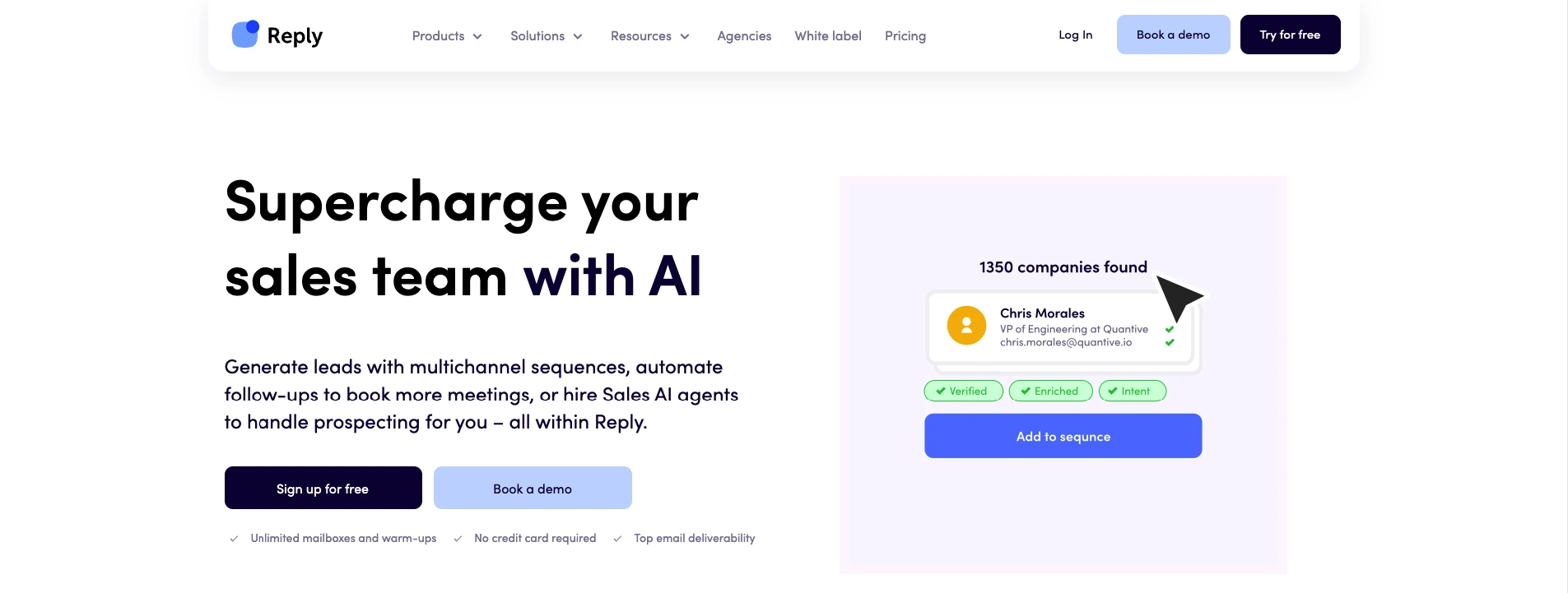
- AI-assisted sequence writing and an AI SDR agent (Jason).
- Multichannel steps: email, LinkedIn, calls, and SMS.
- Contact-based Email Volume plans that scale with active contacts.
What is missing: the base plan is email-first. True multichannel means adding LinkedIn automation and calling as paid extras, which pushes real per-seat cost well above the headline price. It is a sequencing engine, not a CRM-native contact center.
Who it is for: SDR and agency teams that want AI-led, automation-heavy sequencing and will budget for the add-ons.
Pricing: from around $59/user/mo billed annually on the Email Volume plan. True multichannel requires the higher plan plus LinkedIn and calling add-ons, which raise the effective per-seat price well above the base figure.
G2: 4.6 out of 5 across 1,528 reviews.
8. Mixmax: best for Gmail-centric SMB outreach
Mixmax is built inside Gmail, which makes it a natural fit for SMB teams that run everything through Google Workspace. Sequences, tracking, and scheduling live where reps already work, so adoption is easy.

- Gmail-native sequences, email tracking, and one-click scheduling.
- Templates, polls, and engagement rules inside the inbox.
- A dialer and Salesforce insights available as higher-tier add-ons.
What is missing: it is Gmail-centric, so value drops off outside Google Workspace, calling is an add-on rather than a core strength, and it is lighter for high-volume phone outbound.
Who it is for: SMB and startup teams running email-led outreach entirely in Gmail.
Pricing: individual copilots from $49/user/mo (Engagement Copilot, billed annually); the Mixmax Suite bundle is $89/user/mo. Team plans with the dialer add-on are custom.
G2: 4.6 out of 5 across 1,454 reviews.
Decision framework: which one should you buy?
- Your engagement is phone and SMS, inside HubSpot or Salesforce: Aloware. You want a contact center native to the CRM, not a cadence tool with a dialer.
- You are an enterprise team living in email cadences and want conversation intelligence: Salesloft.
- You are a large, process-driven outbound org on Salesforce: Outreach.
- You are a startup that needs prospecting data and sequences cheaply: Apollo.io.
- You are all-in on HubSpot and do moderate calling: HubSpot Sales Hub, often paired with a dedicated dialer.
- You are an enterprise Salesforce shop that prizes clean sync: Groove by Clari.
- You want AI-led, automation-heavy sequencing: Reply.io.
- You run email outreach entirely in Gmail: Mixmax.

Key takeaway: match the tool to your engagement motion and your CRM. A phone-and-SMS team that buys an email-cadence platform, or the reverse, will pay for features it never uses and miss the ones it needed.
See it on your own CRM.Book a demo and watch Aloware run the dialer, texting, and AI agents against your HubSpot or Salesforce pipeline.

Frequently Asked Questions
What is a sales engagement platform?
A sales engagement platform is software that helps reps run and track outreach across channels, then logs that activity to the CRM. It orchestrates multi-step outreach across calls, emails, texts, and social touches, automates the busywork around it, and gives managers visibility into what is working. The channels each platform does best vary widely, so the right choice depends on how your team actually engages.
What is the difference between a sales engagement platform and a CRM?
A CRM is the system of record: it stores contacts, deals, companies, and the history of every interaction. A sales engagement platform is the system of action: it drives the outreach and pushes the results back into the CRM. The best setups make the two feel like one, which is why CRM-native engagement tools save reps the most time.
Which sales engagement platform is best for a small business?
It depends on the motion. Phone-and-SMS teams that run on a CRM get the most from a CRM-native contact center with published, per-seat pricing. Email-led teams on a tight budget often start with a data-plus-sequences tool that has a free tier. The deciding factors are your primary channel, your CRM, and whether the price you see holds after add-ons.
How much does a sales engagement platform cost?
Prices range from free entry tiers to enterprise seats well over 150 dollars per user per month. Published per-seat pricing typically runs from the low 30s to around 100 dollars per user per month. Several enterprise platforms are quote-only, which means budgeting requires a sales conversation. Watch for add-ons: calling, SMS, data, and AI features are often priced on top of the base seat.
Do sales engagement platforms include a dialer?
Some do, many do not, and the depth varies enormously. Email-first platforms may offer a basic click-to-call, while phone-first platforms include a full power dialer with local presence, voicemail drop, and CRM write-back. If calling is central to your motion, evaluate the dialer as a primary feature, not a checkbox.
Do sales engagement platforms integrate with HubSpot and Salesforce?
Most claim to, but there is a real difference between logging an activity and writing to actual CRM objects. Deep integrations sync calls, texts, notes, dispositions, and sequence steps to the right contact and deal automatically, and can trigger and read CRM workflows and lists. Shallow ones drop a record and leave reps to reconcile the rest. Ask for a live demo against your own CRM before you buy.
Is a sales engagement platform TCPA and A2P 10DLC compliant?
Compliance depends on the vendor and how you use it. For business texting in the US, look for managed A2P 10DLC brand and campaign registration, opt-out handling, and suppression-list support. For calling, look for consent tracking and honest caller identity tooling. Compliance is a shared responsibility: the platform provides the controls, and your team is responsible for consent and outreach practices.
Can AI agents replace part of a sales engagement platform?
AI is moving from a bonus feature to the core engine in this category, drafting outreach, prioritizing accounts, and handling inbound qualification. AI voice and text agents can now answer, qualify, and book around the clock, which extends coverage without adding headcount. The strongest platforms build AI natively across the cycle rather than selling it as a separate add-on.
What is the best sales engagement platform for a CRM-first team in 2026?
For a team whose engagement is phone and SMS and whose data lives in HubSpot or Salesforce, the best fit is a CRM-native contact center that includes a power dialer, two-way texting, and AI agents in one platform with automatic logging. For email-cadence-heavy enterprise programs, a dedicated cadence platform with built-in conversation intelligence is the stronger fit. Match the tool to your primary channel and your CRM.
.png)

Ruby Kootval is Head of Product Marketing at Aloware. She has 12 years in digital marketing, including 8 in B2B SaaS and 5 in telecom, and writes about AI voice agents, dialers, CRM integrations, and contact center operations.
.webp)
-Alternatives-for-Sales-Teams-in-2026.webp)