

TL;DR:
AI voice agents are billed one of four ways — per minute of conversation, per seat, per resolved conversation, or by custom enterprise quote — so two "cheap" tools can be impossible to compare until you do the math. Aloware's AloAi Voice Agent uses the most forecastable model: per-minute, from $0.10/min, billed only on real talk time, on top of a plan where human calling is already unlimited.
Key facts:
- Per-minute AI voice rates generally land in the cents-per-minute range; Aloware's AloAi Voice Agent is $0.10/min (Basic), $0.20/min (Premium), or $0.50/min (Ultra Premium), set by the AI model you pick.
- On Aloware, outbound AI calls are billed only when a human answers. Unanswered calls and voicemails cost a $0.02 connection fee, not a per-minute charge.
- The AI voice agent is an add-on to a seat plan, not the seat price itself. You pay per-minute only for the AI; reps' US and Canada calling is already unlimited.
- Access runs on a credit pool that starts at $250/month . Your usage draws from it, and unused credits roll over.
- Watch for the four hidden costs: setup fees, per-resolution pricing that spikes at volume, annual lock-in, and per-minute billing on calls that hit voicemail.
Try to find out what an AI voice agent actually costs. Go ahead — open five vendor pages. You'll get five "Contact sales" buttons and roughly zero numbers.
When we priced out what it really takes to run an AloAi Voice Agent end to end — the seat, the credit pool, and the per-minute usage — the hard part wasn't the math. It was that almost nobody else will show you theirs. The category has turned pricing into a guessing game, and the guessing is the point.
Here's what's actually going on: there is no single "AI voice agent price." There are four different pricing models, and a sticker rate in one model tells you nothing about your bill in another. A $0.50-per-resolution tool and a $0.10-per-minute tool can't be compared on the rate alone — they're priced on different units entirely. So before you compare prices, you have to compare models. This guide does both, and shows you exactly how to forecast your own bill.
How much does an AI voice agent cost?
An AI voice agent costs either a rate per minute of conversation, a flat fee per seat, a flat fee per resolved conversation, or a custom enterprise quote — and which model a vendor uses matters more than the headline number. Most published per-minute rates land in the cents-per-minute range. Aloware's AloAi Voice Agent — covered in our complete guide to AI voice agents — is priced per minute from $0.10, and that rate is the same whether the agent is qualifying a lead, booking an appointment, or rescuing a missed call.
The reason "how much does an AI voice agent cost" has no clean answer is that the models measure different things. Per-minute scales with how long your calls run. Per-resolution scales with how many conversations close out. Per-seat scales with team size. Quote-based scales with whatever the sales rep decides you'll pay. Same product category, four different meters.
Key takeaway: There is no single AI voice agent price — there are four pricing models, and the model determines your bill far more than the sticker rate does.
What pricing models do AI voice agents use?
Four models cover almost the entire market. Here's how each one bills, what's predictable about it, and where it bites.
Pricing an AI voice agent by the resolution is like taking a taxi that charges by the destination instead of the meter — the per-trip number sounds fine until you realize you can't predict the fare for a month of trips. Per-minute is the meter. You can read it, and you can forecast it.
This is where the comparison usually breaks down. A buyer lines up a $0.40-per-resolution tool next to a $0.10-per-minute tool and "picks the cheaper one" — without noticing they just compared a per-trip fare to a per-mile rate. The only honest comparison is to run your expected volume through each model and look at the monthly total.
Key takeaway: Compare pricing models, not sticker rates. A per-resolution rate and a per-minute rate are different units — the only fair comparison is your real monthly volume run through each.
What does an AI voice agent cost to run on Aloware?
Aloware uses the per-minute model, and the whole bill comes from three parts. No "Contact sales" required.
Enabling the AI voice agent is free — you pay for what it actually says. And "actually says" is precise here, because the billing mechanics protect you from paying for dead air:
- Outbound calls: billed only when a human answers and the AI connects. An unanswered call or a voicemail isn't a per-minute charge — it's a flat $0.02 connection cost.
- Inbound calls: billed once the AI joins the conversation.
- Rounding: actual talk time, rounded up to the next minute, with a 60-second minimum. A 70-second call bills as two minutes; a 10-second call bills as one.
Now the part that trips up every pricing comparison. Some Aloware plans advertise "1,000 minutes" — and buyers assume that's 1,000 free AI voice agent minutes. It isn't. Those minutes belong to AI Voice Analytics (transcription, summaries, sentiment) — a separate product. The AI Voice Agent is billed per minute from $0.10 regardless of the analytics minutes in your plan. Anyone who tells you the voice agent is "included" in a bundle of minutes is conflating two different products.
The rate you choose comes down to the AI model. The Basic tier ($0.10/min) runs models like Claude 4.5 and GPT-4o and handles qualification, scheduling, and support workflows. Premium ($0.20/min) and Ultra Premium ($0.50/min) run real-time conversational models for the highest-stakes sales calls. Start on Basic — most teams never need to leave it.
Want the seat-plan side in detail? View Aloware pricing for iPro, uPro, and xPro plans.
Key takeaway: On Aloware, an AI voice agent's all-in cost is three readable parts — seat plan + a rolling credit pool from $250/mo + per-minute usage from $0.10/min — and you're never charged per minute for a call no human answered.
How do you estimate your monthly AI voice agent cost?
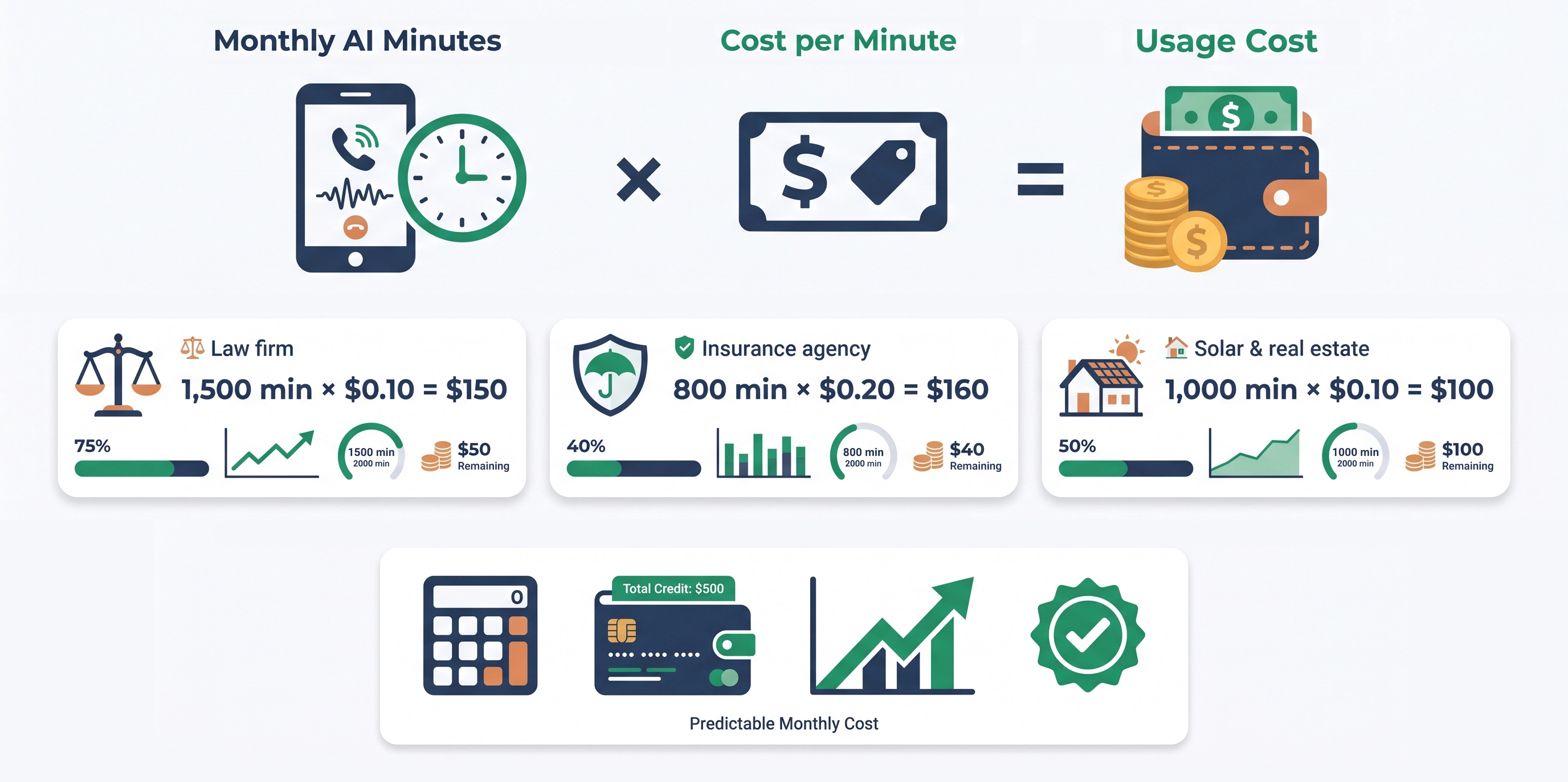
You don't need a quote. You need two numbers: your expected monthly AI conversation minutes and your model's per-minute rate. Multiply them. That's your usage cost, drawn from your credit pool — then add your seat plan for the all-in number.
Here's the math on three real scenarios:
- Legal intake (law firm): an after-hours intake line handles 1,500 minutes of AI conversation a month on the Basic model. That's 1,500 × $0.10 = $150 in usage — comfortably inside a $250 credit pool, with credit to spare that rolls over.
- Insurance agency (outbound qualification): an agent dials renewal leads and connects for 800 minutes of live conversation on Premium. That's 800 × $0.20 = $160 — and the dials that hit voicemail cost $0.02 each, not a minute of Premium time.
- Solar and real estate (speed-to-lead): an AI agent calls every web-form lead back instantly and runs 1,000 connected minutes a month on Basic. That's 1,000 × $0.10 = $100 in usage to make sure no lead waits for a callback.
Notice what didn't happen in any of those: a surprise. That's the entire advantage of a per-minute meter — you can run this calculation yourself, before you ever talk to sales. Try running it with a per-resolution rate and you'll find you can't, because you don't know how many conversations the vendor will count as "resolved."
The same forecastability is why an inbound-heavy team can lean on a tool like Aloware's AI voice agent for 24/7 coverage without a runaway bill — every minute is a known cost, and missed calls get answered instead of going to a competitor.
Key takeaway: Estimate your bill in one line — monthly AI minutes × per-minute rate = usage cost. A model you can forecast yourself is a model you can trust.
What hidden costs should you watch for before you sign?
The sticker rate is rarely the whole bill. Before you commit to any AI voice agent, get these five in writing:
- Setup and implementation fees. Some vendors charge a one-time onboarding fee that never appears next to the per-minute rate. Ask for the all-in first-month number, not the usage rate.
- Per-resolution surprises at volume. A per-resolved-conversation price looks cheap at 100 conversations and stops looking cheap at 10,000. Ask the vendor to forecast your bill at your real volume, not a sample.
- Annual lock-in. Quote-based and per-seat models often require an annual commitment. A per-minute add-on you can scale up or down month to month carries far less risk.
- Overage rates. If your plan includes a bucket of minutes, find out what the minute costs after the bucket — that's the number that hurts when a campaign spikes.
- Billing on voicemail. This is the quiet one. Some platforms bill per minute for outbound calls that hit voicemail. On a high-volume outbound list, that's real money for zero conversations. Aloware bills $0.02 for those, not a minute.
An AI voice agent that also dials outbound has one more variable that pricing pages skip: whether anyone answers. The cheapest per-minute rate in the world does nothing if your numbers are flagged and nobody picks up. That's a separate discipline — keeping your outbound numbers trusted is the job of the Pickup Stack, an add-on answer-rate layer that sits on top of the dialer. It's priced separately from the agent, but for outbound it's what turns paid-for minutes into actual conversations.
Key takeaway: The rate isn't the bill. Get setup fees, volume forecasts, lock-in terms, overage rates, and voicemail billing in writing before you sign.
How to choose a pricing model that won't surprise you
Match the model to how you actually run, and you'll never get a bill you didn't expect:
- Choose per-minute if your call volume is conversational and you want a bill you can forecast yourself — the safest default for most sales and support teams.
- Be careful with per-resolution if you're scaling fast; the per-unit price is friendly but the monthly total isn't, and you don't define "resolved."
- Consider per-seat only for a small, fixed team with steady volume, where flat budgeting matters more than usage efficiency.
- Push back on quote-only pricing — if a vendor won't show you a number without a sales call, you can't compare them to anyone, and that's by design.
And whatever model you pick, run your own volume through it before you sign. The vendor that lets you do that math without booking a call is telling you something about how they'll treat you as a customer.
Key takeaway: Pick the model that matches your volume, and never sign a price you can't reproduce yourself with a calculator.
The bottom line on AI voice agent pricing
AI voice agent pricing isn't confusing by accident — it's fragmented into four models so that sticker rates can't be compared, and gated behind "Contact sales" so you can't forecast at all. The fix is simple: stop comparing rates and start comparing models, then run your own minutes through the math. A transparent per-minute agent — billed only on real talk time, on top of a plan where human calling is already unlimited — is the one model you can budget for on a napkin. The price you can read is the price you can trust.
See AloAi Voice Agent answer a real lead in under 60 seconds. Book a 20-minute AloAi Voice Agent demo — we'll price it to your real call volume and your vertical, live.
Frequently Asked Questions
How much does an AI voice agent cost?
Most AI voice agents are billed one of four ways: per minute of conversation, per seat, per resolved conversation, or by custom enterprise quote. Published per-minute rates usually land in the cents-per-minute range. Aloware's AloAi Voice Agent is per-minute from $0.10/min on the Basic model tier, $0.20/min Premium, or $0.50/min Ultra Premium, billed on top of a seat plan.
How much does Aloware's AI voice agent cost per minute?
$0.10/min on the Basic model tier, $0.20/min Premium, and $0.50/min Ultra Premium. The rate is set by the AI model you choose. Calls are billed on actual AI talk time, rounded up to the next minute with a 60-second minimum. Most teams run on Basic.
Do you pay for an AI voice agent when no one answers?
On Aloware, outbound AI calls are billed only when a human answers and the AI connects. Unanswered calls and voicemails aren't billed per minute — they carry a flat $0.02 connection cost instead. Inbound calls are billed once the AI joins the conversation.
Is there a setup fee for an AI voice agent on Aloware?
Enabling AloAi Agents is free; you pay only for usage. Access runs on a recurring credit pool that starts at $250/month, and your per-minute usage draws from that pool. Unused credits roll over month to month, so you don't lose what you don't use.
What's the difference between per-minute and per-resolution AI voice agent pricing?
Per-minute bills the actual conversation time at a fixed rate, so cost tracks call length and is easy to forecast. Per-resolution bills a flat fee per "resolved" conversation — which looks simple per unit but is hard to forecast at volume and depends on how the vendor defines a resolution. Per-minute is the more predictable model for most teams.
Does an AI voice agent cost extra on top of a phone system plan?
Usually yes — the AI voice agent is an add-on to a seat plan. On Aloware the seat plan covers the dialer, CRM integration, and unlimited US/Canada human-agent calling; the AI voice agent is billed separately per minute. So you pay per-minute only for the AI, not for your reps' own calls.
How do I estimate my monthly AI voice agent cost?
Multiply your expected monthly AI conversation minutes by your model's per-minute rate. Example: 1,500 inbound minutes on the Basic model = 1,500 × $0.10 = $150 in usage, drawn from your credit pool. Add your seat plan and your monthly credit commitment for the all-in number. You can run this yourself before talking to sales.
Are the 1,000 minutes in some plans for the AI voice agent?
No. The 1,000 included minutes on iPro + AI are for AI Voice Analytics — transcription, summaries, and sentiment — which is a separate product from the AI Voice Agent. AI Voice Agent calls are billed per minute from $0.10 regardless of the analytics minutes included in your plan.
What hidden costs come with AI voice agents?
Watch for five: one-time setup or implementation fees, per-resolution pricing that spikes at volume, annual contract lock-in, overage rates above an included bucket of minutes, and per-minute billing on outbound calls that hit voicemail. Ask any vendor to forecast your bill at your real call volume before you sign.
Which AI voice agent pricing model is cheapest?
It depends on your volume and call length, not the sticker rate. Per-minute is the most forecastable and usually wins for predictable conversational volume. Per-resolution can look cheap at low volume but gets unpredictable as you scale. Per-seat suits a small fixed team. Run your own numbers at your expected volume rather than comparing rates across different models.
.png)

Ruby Kootval is Head of Product Marketing at Aloware. She has 12 years in digital marketing, including 8 in B2B SaaS and 5 in telecom, and writes about AI voice agents, dialers, CRM integrations, and contact center operations.
%20(1).webp)