


.webp)
TL;DR:
A Do Not Call list is a record of phone numbers that have opted out of telemarketing calls, and if your team makes the calls, you actually have to respect three of them: the FTC's federal National Do Not Call Registry, your own internal (company-specific) do-not-call list, and state lists. The National Registry is free and permanent for consumers, covers telemarketing sales calls only, and requires businesses to scrub their calling lists against it at least every 31 days. A violation can cost up to $53,088 per call. The place teams actually get burned isn't the federal scrub, it's an internal opt-out that one rep honors and another rep, or an automated sequence, ignores.
Key facts:
- The National Do Not Call Registry is run by the FTC; it tells registered telemarketers which numbers not to call and does not block calls.
- More than 253 million phone numbers are actively registered, with 4.2 million added in a single year.
- Businesses must synchronize their lists with the registry at least every 31 days.
- A Telemarketing Sales Rule violation carries a civil penalty of up to $53,088 per call.
- An established business relationship lets a company call a registered number for up to 18 months after a purchase, or 3 months after an inquiry, until the person opts out.
- Business-texting opt-outs (A2P 10DLC "reply STOP") are a separate consent regime, and both are separate from carrier spam-labeling.
A customer tells one of your reps to stop calling. Three weeks later a different rep dials the same number, or an automated sequence fires a text at 8 a.m. That is the moment a Do Not Call complaint gets filed, and it almost never starts with the federal registry.
Teams keep asking us the same question before they buy: can we legally call or text this list? The answer starts with understanding what the Do Not Call list actually is. Most people picture one government list you check once. For anyone who calls or texts prospects, that mental model is the trap. Honoring opt-outs cleanly is also part of how you keep your numbers healthy and lawfully increase pickup rates, so it is worth getting right.
What follows is the seller's-eye view: the three lists you have to respect, the exact scrub cadence and windows the FTC sets, where SMS opt-outs fit, and how to honor a "don't call me" once so it sticks across every channel.
What is a Do Not Call list?
A Do Not Call list is a record of phone numbers whose owners have opted out of receiving telemarketing calls. The best-known one is the FTC's National Do Not Call Registry, a free federal list that tells registered telemarketers which numbers they cannot dial for sales.
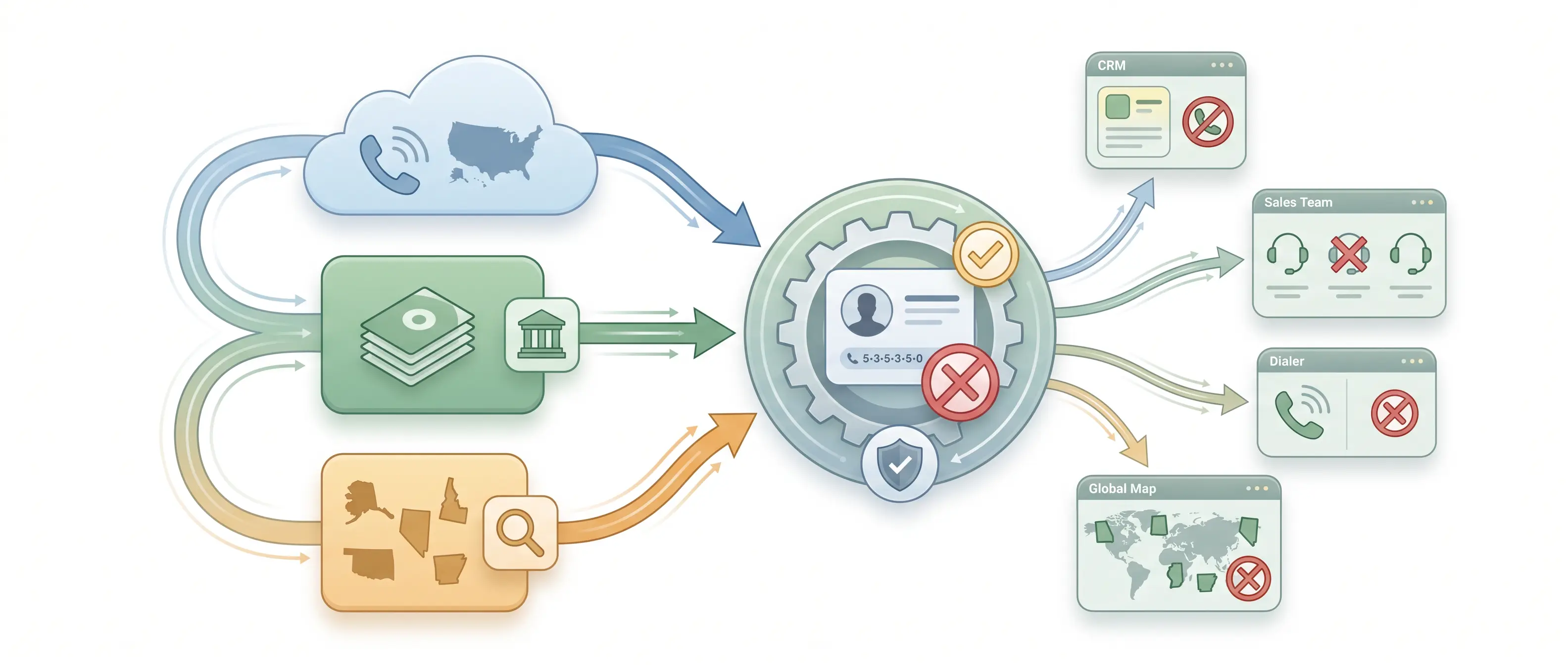
For a business that makes the calls, though, it is not one list. It is three. There is the federal registry, your own internal (company-specific) list of everyone who asked your business directly to stop, and state do-not-call lists. Respecting them is not a one-time scrub. It is an ongoing opt-out discipline: capture consent, scrub on cadence, and log every opt-out so it is honored across every call and every text.
Key takeaway: A Do Not Call list is a record of numbers that opted out of telemarketing. A business has to respect three of them at once: federal, internal, and state.
How does the National Do Not Call Registry work?
The National Do Not Call Registry is run by the FTC. It is a list that tells registered telemarketers which numbers not to call, and, as the FTC spells out, it does not block calls. Registration is free for consumers and permanent; it does not expire. After someone registers, it can take up to 31 days for sales calls to stop.
It also does not cover everything. Even for a registered number, these calls are still allowed as long as they carry no sales pitch:
- Political calls
- Charitable calls
- Debt-collection calls
- Purely informational calls (a flight delay, a delivery window)
- Survey calls
And the registry does nothing about scammers. Illegal robocallers ignore the list, so registering trims legitimate sales calls, not fraud. That distinction matters for your team: the registry is a rulebook for law-abiding callers, and your job is to be one of them.
Key takeaway: The registry tells registered telemarketers which numbers to skip. It does not block calls, does not cover no-sales-pitch calls like surveys or debt collection, and does not stop scammers.
The three Do Not Call lists your team has to respect
Here is where most "what is the Do Not Call list" explainers stop, and where the real exposure begins. A calling or texting team answers to three separate lists, not one.
Key takeaway: Three lists, one discipline. The federal registry is the famous one, but your internal company-specific list is where most complaints and penalties come from.
What does the DNC list require of a business that makes calls?
The obligations are concrete, and the FTC publishes them plainly. If your team calls prospects, this is the operational floor:
- Scrub at least every 31 days. You must synchronize your calling lists with an updated version of the registry at least every 31 days and delete registered numbers.
- Maintain a company-specific do-not-call list. Keep and honor your own internal opt-out list.
- Honor any opt-out, from anyone. A direct "don't call me" applies even to an existing customer you would otherwise be allowed to call.
- Keep records for the safe harbor. Documenting the process above is what earns the Telemarketing Sales Rule "safe harbor" that protects you from penalties for an inadvertent mistake.
The stakes are not theoretical. Under the FTC's rule, a violation carries a civil penalty of up to $53,088 per call. That is per violation, so a single bad list can compound fast. If you want the platform side of this, your team still runs the registry scrub on its own cadence, but compliance-ready outbound calling keeps the internal suppression list and the record-keeping inside the dialer instead of a spreadsheet, so an opt-out you log once stays honored on every later call.
Key takeaway: Scrub every 31 days, keep a company-specific list, honor every opt-out, and document it for the safe harbor. Each violating call can cost up to $53,088.
What is an "established business relationship" (and when can you still call)?
An established business relationship (EBR) is a limited exemption that lets a company call a registered number under specific conditions. It is not a loophole, and it does not survive an opt-out.
- Purchase, rental, lease, or payment: you can call for up to 18 months after the last transaction.
- Inquiry or application: you can call for 3 months after the person reached out.
- Written permission: a signed, written agreement to be called is its own exemption.
Make it concrete. An insurance agency can call a policyholder about a renewal well inside the 18-month window. A solar installer can follow up on a website inquiry for three months. A mortgage lender can call an applicant who submitted a form. In all three, the exemption evaporates the second the person says "stop calling me." A direct opt-out always overrides an EBR.
Key takeaway: An EBR lets you call a registered number for up to 18 months after a purchase or 3 months after an inquiry. A direct "don't call me" cancels it instantly.
Do Not Call and text messages: where SMS opt-outs fit
The Do Not Call idea extends to business texting, but through a different door. The National Do Not Call Registry governs telemarketing calls. Business SMS runs on its own consent regime under A2P 10DLC, the US carrier registration required to text American mobile numbers. There you must capture a clear opt-in and honor opt-out, typically a reply STOP that suppresses future messages, and register your A2P 10DLC campaign before you send.
Keep three systems straight, because they get conflated constantly:
- The National DNC Registry and your internal/state lists govern telemarketing calls.
- A2P 10DLC opt-out (reply STOP) is a separate consent regime for texts.
- Carrier spam-labeling and STIR/SHAKEN are a separate reputation and attestation system entirely. STIR/SHAKEN is signed at the originating carrier, not at your dialer, and being "on the Do Not Call list" is not the same thing as being "flagged as Spam Likely."
Best practice ties the first two together: treat a call opt-out and a text opt-out as one suppression list, so a prospect who says "stop" is quiet on both channels. That is easiest when your consent capture is native to the platform, which is exactly what AI SMS that captures consent at scale is built to do.
Key takeaway: The registry governs calls; A2P 10DLC "reply STOP" governs texts; carrier spam-labeling is a third, separate system. Honor call and text opt-outs as one list.
.webp)
How to keep your sales and support team DNC-compliant (a checklist)
This is educational, not legal advice, so confirm your specific setup with counsel. That said, the operational playbook is not complicated. Six moves cover most of the risk:
- Capture consent at the source. Record how and when a contact agreed to be called or texted, on the form, at the point of sale, in the CRM.
- Scrub on cadence. Sync against the National Registry at least every 31 days, and respect state lists.
- Log every opt-out once, in one place. The internal list only works if a single "stop" reaches every rep, dialer, and sequence.
- Sync DNC status across dialer and CRM. A suppressed contact in one system must be suppressed in all of them.
- Honor opt-outs across channels. A "stop calling me" should also stop the texts.
- Keep records. Documentation is what qualifies you for the safe harbor if an honest mistake ever happens.
The contrast is stark, before and after you centralize opt-outs:
- ❌ Wrong: a rep marks a contact "do not call" in a personal note. The queued sequence never sees it, and the CRM never syncs it, so a text goes out Tuesday and a second rep dials Thursday.
- ✅ Right: the rep flags the contact as DNC once, the flag writes to the CRM record, and every future call, text, and sequence reads that flag and skips the contact automatically.
For the full operational depth, from list hygiene to team training, our guide to DNC compliance for outbound sales teams is the companion to this piece.
Want to see how a "do not call me" gets honored automatically across your dialer and CRM? Book a 20-minute demo and we will show DNC flagging and cross-channel opt-outs on a live HubSpot record.
Key takeaway: Capture consent, scrub every 31 days, log every opt-out once, sync it across dialer and CRM, honor it across channels, and keep records. The whole game is making one "stop" stick everywhere.
The Aloware approach: honor every opt-out once, everywhere
The reason opt-outs leak is almost always plumbing: the "stop" is captured in one tool and never reaches the others. Aloware closes that gap by making the DNC flag native to the platform and syncing it into the CRM, so a request honored once by one rep holds for the whole team and every future call, text, and sequence.
- HubSpot DNC field sync: when a contact is set to Do Not Call in Aloware, the DNC status pushes automatically to the HubSpot contact record, so suppression lives on the record every rep already works from.
- AloAi Voice Agent "Set Contact as DNC": the voice agent can classify a contact as Do Not Call mid-call, the moment the person asks, without waiting for a rep to remember.
- IVA "Set to DNC + hang up": your inbound voice assistant can route a caller straight to a "set to DNC and hang up" action, turning an opt-out request into a logged suppression.
- Inbound SMS STOP capture: a "reply STOP" is captured as an opt-out that suppresses future messages.
- A2P 10DLC consent capture: opt-in and opt-out handling are built into the texting workflow, not bolted on after.

One honest limitation: native DNC tooling automates the plumbing and raises the odds you stay clean, but it does not itself guarantee legal compliance. Your team still sets the policy, defines the calling windows, and owns the records. The software makes honoring an opt-out automatic; it does not make the decision for you. If you want opt-outs handled in one place across channels, a unified inbox for calls and texts is where those requests land.
Key takeaway: Native, CRM-synced DNC handling makes one opt-out stick across every rep, call, text, and sequence. It automates the plumbing; your team still owns the policy.
The bottom line
The Do Not Call list isn't one government checkbox. It is three lists, the federal registry, your internal company-specific list, and state lists, plus a continuous opt-out discipline that runs across calls and texts. The mechanics are knowable: scrub every 31 days, mind the 18-month and 3-month EBR windows, and remember that a single violating call can cost up to $53,088.
The teams that stay clean are not the ones with the best intentions. They are the ones whose "do not call me" is captured once and honored automatically, everywhere, so no rep and no sequence ever re-dials a contact who already said stop.
Handling call and text opt-outs in one place, synced to your CRM? See how Aloware's AI Text Agent captures consent and honors STOP automatically.

Frequently Asked Questions
What is a Do Not Call list?
A Do Not Call list is a record of phone numbers that have opted out of telemarketing calls. The best known is the FTC's National Do Not Call Registry, a free federal list that tells registered telemarketers which numbers they can't call for sales. A business that makes calls has to respect more than one: the federal registry, its own internal company-specific list of everyone who asked it directly to stop, and state lists. It is less one government list and more an ongoing opt-out discipline.
What is the National Do Not Call Registry?
It is the FTC-run federal database of phone numbers whose owners asked not to receive telemarketing calls. Registration is free and permanent, and it does not expire. The Registry does not block calls; it tells law-abiding, registered telemarketers which numbers not to dial. It can take up to 31 days after someone registers for sales calls to stop, and it does nothing to stop scammers who ignore the law.
Does the Do Not Call Registry stop all calls?
No. The Registry only limits telemarketing and sales calls from companies that follow the rules. Political calls, charitable calls, debt-collection calls, purely informational calls, and survey calls are still allowed to a registered number as long as they carry no sales pitch. Illegal robocallers ignore the list entirely, so registering cuts legitimate sales calls, not fraud.
How often do businesses have to scrub against the Do Not Call list?
Telemarketers and sellers must synchronize their calling lists with an updated version of the National Registry at least every 31 days and drop any registered numbers. Meeting that cadence, plus maintaining a company-specific do-not-call list, training staff, and keeping records, is part of the Telemarketing Sales Rule safe harbor that protects a business from penalties for an honest mistake. Skip it and each violating call can carry a civil penalty of up to $53,088.
What is a company-specific (internal) Do Not Call list?
It is your own record of every person who told your business directly to stop calling or texting. The Telemarketing Sales Rule requires sellers and telemarketers to maintain it and honor those requests, even for existing customers and even for calls that would otherwise be allowed. In practice this internal list is where most complaints and penalties start: a customer asks one rep to stop, the request never reaches the rest of the team or the automated sequences, and someone calls again.
What is an established business relationship (EBR)?
An established business relationship is a limited exemption that lets a company call a registered number. If someone bought, rented, leased, or paid for something, the company may call for up to 18 months after that last transaction. If they only made an inquiry or submitted an application, the window is 3 months. The exemption disappears the moment the person asks that company not to call again, because a direct opt-out always wins.
Do Do Not Call rules apply to text messages?
Business texting runs on its own consent regime. To text US mobile numbers, a business registers under A2P 10DLC and must capture clear opt-in and honor opt-out, typically a reply STOP that suppresses future messages. So while the National Do Not Call Registry governs telemarketing calls, the same principle, get consent and honor the opt-out, applies to SMS through 10DLC. Treating call opt-outs and text opt-outs as one suppression list is the safest habit.
What is the penalty for calling a number on the Do Not Call list?
Under the FTC's Telemarketing Sales Rule, a violation can carry a civil penalty of up to $53,088 per call. That is per violation, so exposure adds up fast across a calling list. The rule does offer a safe harbor for honest mistakes if the business can show a routine compliance process: scrubbing every 31 days, keeping a company-specific do-not-call list, training staff, and documenting all of it.
How can a sales team stay compliant with Do Not Call rules?
Capture consent at the source, scrub against the National Registry at least every 31 days, respect state lists, maintain a company-specific do-not-call list, and log every opt-out in one place so it is honored across every rep, dialer, and automated sequence. Keep records to qualify for the safe harbor. The failure mode is almost never the federal scrub; it is an internal opt-out that one system honored and another ignored.
Is the National Do Not Call Registry still active in 2026?
Yes, and it is growing. As of the FTC's most recent Data Book, more than 253 million phone numbers were actively registered, with 4.2 million added in a single year, and the FTC continues to enforce the rules. For any team doing outbound, the registry is a live compliance obligation, not a historical footnote.
Does registering my business number remove it from the Do Not Call Registry?
The Registry is for the numbers you call, not the number you call from. Registering does not change your ability to make compliant calls; you still have to scrub the lists you dial against. If your outbound numbers are getting flagged as spam, that is a separate carrier-side reputation issue, not a Do Not Call matter. Being on the Do Not Call list and being labeled Spam Likely are two different systems.
.png)

Ruby Kootval is Head of Product Marketing at Aloware. She has 12 years in digital marketing, including 8 in B2B SaaS and 5 in telecom, and writes about AI voice agents, dialers, CRM integrations, and contact center operations.

.png)