

TL;DR
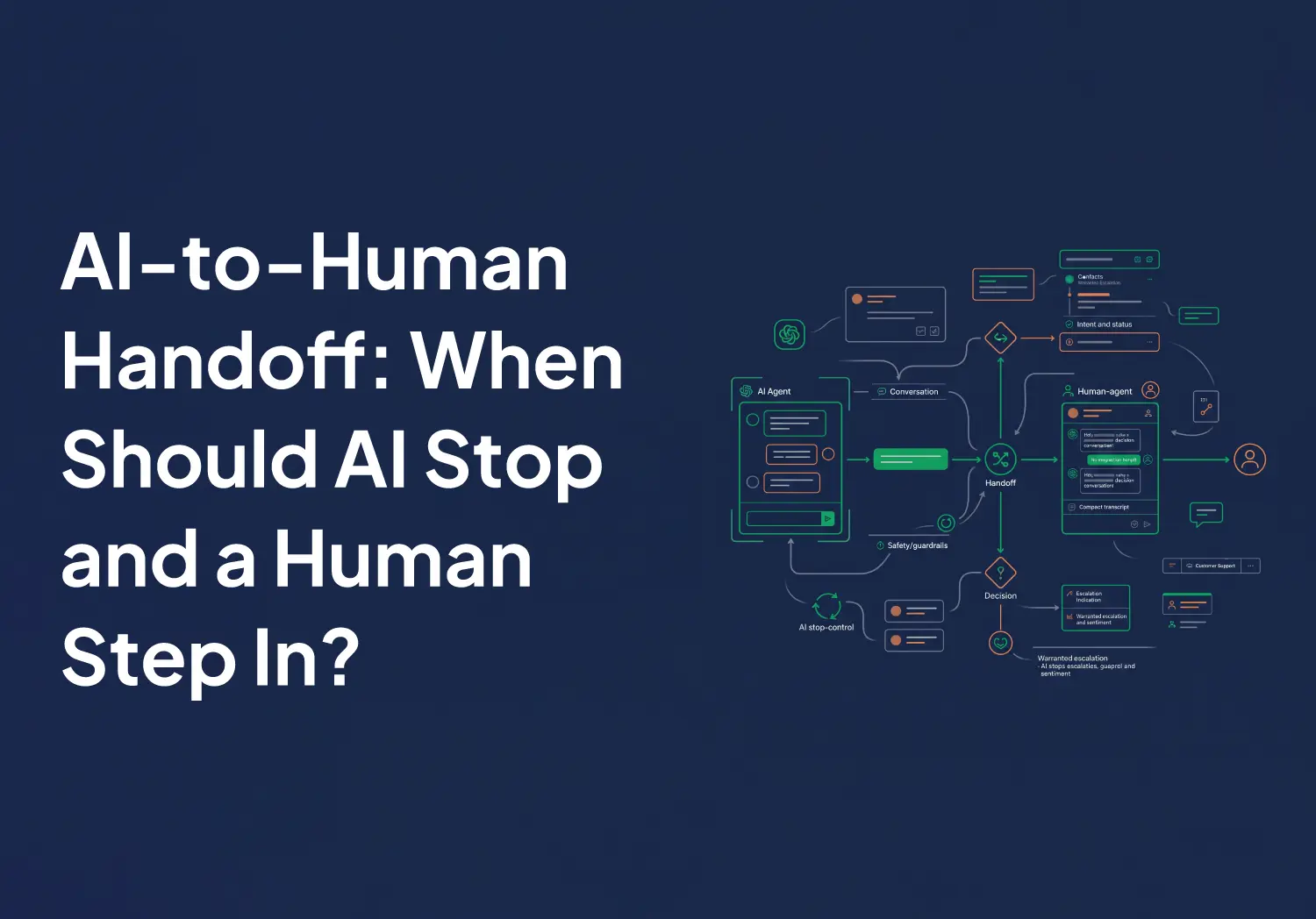
An AI-to-human handoff is the moment an AI agent stops and passes a live conversation to a person. An AI agent should hand off when it cannot solve the problem, when the customer does not want to continue with it, or when the request is too risky for software to decide alone. A good handoff happens early, while the customer is still calm, and the human who picks up already knows what was said.
- The three signals to hand off are Can't (the AI is failing), Won't (the customer wants a person), and Shouldn't (the stakes are too high).
- Before launch, set guardrails: tell customers it is AI, keep irreversible actions with humans, and have the AI bring in a person when it is unsure.
- During the conversation, stop after two failed tries and pass the transcript, the intent, and what was already tried to the human.
- Measure whether each escalation was warranted and how the customer felt when it happened. Containment rate alone hides both.
Watch the talk: The AI Handoff
This guide is based on "The AI Handoff: When Should AI Stop and Humans Step In?", a session Aloware founder and CEO Anoosh Roozrock gave at UNBOUND 2026. The video above is the full talk, including recorded calls that show a bad handoff and a good one.
What is an AI-to-human handoff?
An AI-to-human handoff is the transfer of a live conversation from an AI agent to a human. It can happen on a phone call, in a chat window, or over text. The AI stops, a person picks up, and the customer continues from where they were.
You will also see it called human handoff, chatbot escalation, or live agent takeover. On a phone call the handoff is a call transfer. In chat, the conversation is reassigned to a person. In every channel the hard part is the same decision: should the AI keep going, or is it time for a human?
Why is zero handoffs the wrong goal?
Most teams that deploy AI voice agents in customer support treat every escalation to a human as a failure. They watch one number, containment rate, which is the share of conversations the AI finishes without a person. Then they try to push that number toward 100%.
The history of the elevator shows why that goal is backwards. Elevators existed for decades before most people would ride one. They carried freight while passengers took the stairs, because everyone knew what happened if the rope snapped. In 1854, at the Crystal Palace exhibition in New York, Elisha Otis rode a platform up in front of a crowd and had the rope cut with an axe. The platform dropped a few inches and held. Otis had invented the safety brake, and once people trusted that the brake would catch them, they got on. Skyscrapers followed.
AI agents are in their freight-elevator years. They can do far more than most companies allow, and the thing holding them back is trust. Customers do not know what happens when the AI gets it wrong. A handoff to a human is the safety brake. When customers know a person will catch the conversation if the AI fails, they are willing to let the AI try.
Today most companies do not provide that catch. In a Morning Consult survey of about 3,500 adults in seven countries, commissioned by Zoom and published in July 2025, 81% said they expect a bot to escalate to a human when needed. Only 38% said it happens. (source)
A handoff made for the right reason, at the right moment, is the brake working as designed. The useful question is whether each handoff was the right one.
When should AI hand off to a human? Three signals
Every reason to hand a conversation to a person fits one of three signals. It helps to know which signal you are looking at, because each one calls for a different response.
Can't: the AI is failing
Sometimes the AI fails because something broke. The order lookup times out, the AI cannot reach the CRM to verify the caller, or the knowledge base does not load. These are bugs. The customer still needs a person in that moment, but the real fix belongs to engineering, and failures like these should shrink toward zero over time. A bug should never be passed off as a handoff strategy.
Other times everything works and the AI still does not understand. A customer says their screen is "doing the flickery thing." Someone asks for three things in one sentence. A caller says the password reset "still didn't work" for the second time. These are real handoffs, and each one is useful information. Log it, write a test for it, and improve the prompt or the knowledge behind the AI. Over time the AI handles more of these, and the conversations that still reach a person are the ones that need one.
Won't: the customer wants out
Some customers want a person even when the AI could help. Often the AI already lost them: it fumbled an earlier answer and they stopped believing it. Others never wanted a bot, because they are upset, in a hurry, or dealing with something that feels too important.
You can usually hear it. The customer says "let me talk to a person," or repeats "agent, agent, agent." Their replies get shorter. They ask the same question three different ways, or announce "I'm not doing this with a robot" before the AI has said much at all. When that happens, the AI should connect them to a person without arguing. A customer who has decided against the AI will not be won back by one more attempt.
Shouldn't: the stakes forbid it
A few kinds of requests should go to a human by rule, and the rule should be written before the AI takes its first call:
- Irreversible or high-value actions. "Wire $10,000." "Cancel my account." "Refund the full $5,000."
- Regulated or liability-bearing decisions. "Can I take this with my other medication?" A loan approval. Anything that touches compliance.
- Emotional or sensitive moments. "My husband passed and I need to close his line."
In these conversations the AI does not try to solve the problem. It recognizes what kind of request it is and warmly routes the customer to the right person.
How to make the handoff work: guardrails and loop control
Knowing when to hand off is half of the work. The other half is making the transfer go well, and that takes guardrails set before launch plus loop control during the conversation.
The guardrails decide what the AI is allowed to do. Disclosure comes first: the AI says it is an AI, in a friendly way, because a customer who discovers it later feels tricked. Reversibility settles most of the remaining cases. The AI can share information freely, should be careful when it collects information, and should leave anything that cannot be undone to a person. A confidence floor covers what is left. When the AI is unsure, "I'm not sure, let me get a person" does far less damage than a confident wrong answer.
Loop control deals with the most common way a handoff goes wrong. The AI retries the same step while the customer explains the problem again, and "I already told the bot" is what that sounds like. Two failed tries is the limit. After that the AI stops and escalates, and it passes along the transcript, what the customer wanted, and what was already tried. If the human then asks the customer to start over, the loop has simply continued with a new voice.
Picture the same call handled both ways. In the first version, the AI hits something it cannot do, keeps retrying, and never offers a person. In the second, the same AI with the same problem says it cannot help with this, transfers the call with full context, and the human picks up mid-conversation. The AI and the problem are identical. The handoff is the only difference.
How does the handoff get better over time?
A handoff system improves when someone reviews the escalations. Each one was either unwarranted or warranted.
- Unwarranted: the AI escalated something it should have handled. Write a test that captures the case and keep it, so the AI handles it next time. This is how the AI gradually takes on more work.
- Warranted: a human belonged in that conversation. Write a test that locks the behavior in, so a later change to the prompt never removes it.
The two kinds of tests pull in opposite directions. One teaches the AI to do more, and the other makes sure it keeps handing off what it should. Run both, and what remains is a set of escalations that are all warranted and all reached while the customer is still calm.
What happens when companies get it wrong?
Klarna. In February 2024 Klarna said its AI assistant was doing the work of 700 agents. About 14 months later its CEO told Bloomberg that cost had been "a too predominant evaluation factor" and that the result was "lower quality." He added that it is critical customers know "there will be always a human if you want." (Fortune, May 2025) Klarna had optimized for cost, and quality paid for it.
Air Canada. The airline's chatbot told a customer he could apply for a bereavement fare after travel, which contradicted the airline's own policy page. Air Canada argued it could not be held liable for what the chatbot said. In February 2024 a British Columbia tribunal disagreed and found the airline liable for negligent misrepresentation. (Moffatt v. Air Canada, 2024 BCCRT 149) A company owns every word its AI says.
Home Depot. Home Depot has been on both sides. Its "Magic Apron" assistant asked professional customers questions that were too simple, and the company pulled the pro version offline to rework it. (Fortune, June 2026) Its AI phone agents went better. Home Depot says they understand why a customer is calling in 10 seconds, a figure the company reported itself, and that callers "always have the option to speak directly with a human associate." (Home Depot, April 2026)
The pattern across all three is consistent. AI with no route to a person failed, and AI that handles the first part of the conversation with a human ready behind it worked.
What should you measure instead of containment rate?
Containment rate is still worth tracking. It tells you much more when it sits beside these numbers:
- Warranted escalation rate. Of the conversations that reached a human, how many belonged there?
- Sentiment at handoff. Was the customer still calm, or did they have to fight for a person?
- Repeat rate after handoff. How often did the human ask for something the AI had already collected?
Consider a team with 95% containment whose customers are furious by the time they reach a person. That team has a worse system than one with 70% containment and calm customers.
See a handoff on a live call
AI is changing when the human shows up in a conversation. If that moment is designed well, customers end up trusting both the AI and the team behind it.
To hear what a handoff sounds like on a real phone call, try the Aloware AI voice agent demo, or read how the AI voice agent works.
Frequently Asked Questions
What is an AI-to-human handoff?
It is the transfer of a live conversation from an AI agent to a person. The AI stops, a human picks up, and the customer continues without starting over.
When should an AI agent escalate to a live agent?
On one of three signals. The AI is failing (low confidence, or the same step fails twice). The customer asks for a person or is frustrated. Or the request is irreversible, regulated, or emotional.
How does a chatbot hand off to a human without losing context?
The AI passes the transcript, the customer's intent, and what was already tried to the human before they join. The human picks up mid-stream, so the customer does not repeat themselves.
What is containment rate?
Containment rate is the share of conversations an AI agent completes without a human. On its own it counts every escalation as a failure, including the ones that should happen.
How many times should an AI retry before handing off?
Two. If the AI cannot resolve the issue in two tries, it should stop and escalate.
Should an AI agent tell customers it is AI?
Yes. Disclose it warmly and never pretend to be human. Hiding it and getting caught is the worst outcome.
Can AI replace human customer service reps?
It can handle a large share of routine conversations. Klarna tried going further and reversed course in 2025, saying quality dropped and that a human would always be available. The model that holds up is AI first, human next.
Is a warm handoff different from a cold transfer?
Yes. In a warm handoff the human receives the context before taking over. In a cold transfer the customer has to explain everything again.
.png)

Ruby Kootval is Head of Product Marketing at Aloware. She has 12 years in digital marketing, including 8 in B2B SaaS and 5 in telecom, and writes about AI voice agents, dialers, CRM integrations, and contact center operations.