

TL;DR: Local presence dialing, which matches your outbound caller ID to the prospect's area code, lifts answer rates for some teams and quietly hurts others. It works best for local and regional B2C teams calling from clean, private numbers. It backfires in trust-sensitive industries, on shared number pools, and any time the number is already flagged. Area-code matching only changes the number on the screen. It does nothing to the carrier reputation that decides whether the call is labeled "Spam Likely." Use it as one layer of a system, not a switch you flip on its own.
- About 8 in 10 Americans don't answer calls from unknown numbers (Pew Research), which is why a familiar area code can help.
- But 92% of consumers now assume an unidentified call is fraud (Hiya, 2024), so in trust-sensitive verticals a local-but-unknown number can read as a spoofing attempt.
- A flagged number still shows "Spam Likely" no matter which local area code it wears. Reputation, not the area code, decides the connect.
- Use private, monitored numbers, never a shared pool, and pair area-code matching with number-reputation monitoring.
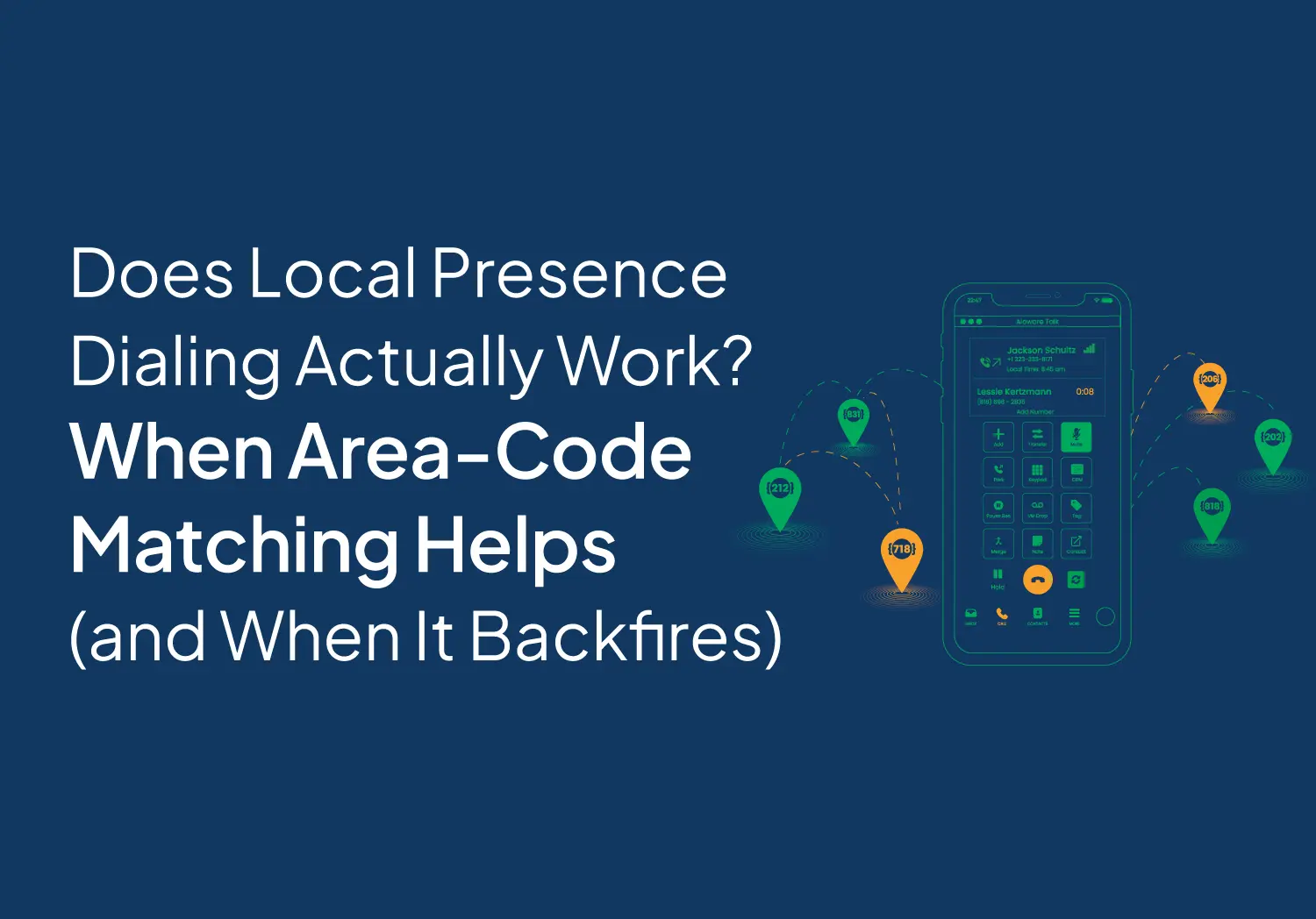
Does local presence dialing actually work?
Sometimes. The honest answer is that it depends on two things: who you're calling, and whether the numbers you're dialing from are clean. Local presence is a real effect, not a myth. When most people ignore unknown numbers, a number that shares the prospect's area code feels less foreign, and for some teams that nudge measurably lifts pickups. But "looks local" and "gets trusted" are not the same thing in 2026, and the feature that helps a home-services team can sink a wealth-management firm.
Key takeaway: Local presence can lift answer rates, but the lift is conditional on your vertical and the reputation of your numbers.
Where local presence works
The case for it is the psychology of the unanswered call. Roughly eight in ten Americans say they don't answer their cellphone when an unknown number calls. A matching area code signals "this might be someone local" instead of "telemarketer three time zones away." That effect is strongest where a local call is plausible:
- Local and regional B2C: home services, real estate, auto, insurance, local healthcare.
- Field and territory sales, where a rep genuinely covers that region.
- High-volume outbound to consumers who expect a callback after a form fill.
For these teams, area-code matching removes a specific objection, "why is an out-of-state number calling me," and that is a real if modest win. If you just want to set it up correctly, our guide on increasing call answer rates with local presence covers the mechanics.
Key takeaway: Local presence helps most where a local call is believable: local and regional B2C, territory sales, and expected callbacks.
Where local presence backfires
The same matched area code that reassures one prospect makes another reach for "Block this caller." Three situations turn the feature against you.
Trust-sensitive and regulated verticals
In finance, wealth management, healthcare, legal, and collections, contacts are coached to distrust unexpected calls, and a local number from a name they don't recognize fits the profile of a neighbor-spoofing scam, where fraudsters fake a nearby number to boost pickups. With 92% of consumers already assuming an unidentified call is fraud, a local-but-anonymous number can read as more suspicious, not less. A recognizable branded caller ID or a scheduled call often beats a local mask in these segments.
Shared number pools
Cheap local-presence offerings often put you on a shared pool, the same numbers other companies dial from. The reputation of your caller ID is then at the mercy of strangers. One aggressive dialer on a shared number can get it flagged, and your calls inherit a spam label you did nothing to earn. Private, dedicated numbers keep your reputation in your own hands.
Numbers that are already flagged
This is the one that matters most. Area-code matching changes which number displays. It does nothing to that number's carrier reputation score. The "Spam Likely" label is assigned by carrier analytics systems and partners like Hiya, First Orion, and TNS based on call patterns, complaints, and STIR/SHAKEN attestation, not on whether the area code matches. Put local presence on a burned number and the prospect sees a local area code with a "Spam Likely" warning attached. That is worse than an honest out-of-area number.
Key takeaway: Local presence backfires in trust-sensitive verticals, on shared pools, and on flagged numbers, where the label rides along with the local area code.
The real variable: number reputation
Local presence is a display feature. It controls the number on the screen. What controls whether the call connects is the reputation of the number underneath. That is why two teams running the identical feature get opposite results: one dials from clean, monitored numbers, the other from a burned shared pool. It is also why area-code matching cannot fix a spam problem on its own. If your calls are getting labeled, the fix lives at the reputation layer, monitoring how carriers score your numbers and remediating flags before they compound. Our "Scam Likely" playbook covers that layer. At Aloware these are layers of one system, the Pickup Stack: NumberGuard for reputation, Branded Calling for identity, and Local Presence for locality. Local presence supplies locality and assumes the reputation problem is already solved.
Key takeaway: Area-code matching controls the display; reputation controls the connect. Local presence only pays off on clean, monitored numbers.
Should your team use local presence?
Use this before you buy a single local number.
Key takeaway: A default yes for local and regional B2C on clean numbers, a "test it first" for regulated and enterprise B2B, and a no until you fix reputation if you're on shared or unmonitored numbers.
How to run local presence so it helps
If it fits, these are the rules that separate a real lift from a quiet backfire:
- Use private, dedicated numbers, never a shared pool.
- Pair it with reputation monitoring. Know the day a number gets flagged, not the week your connect rate craters.
- Mind the callback. A prospect who calls a local number back should reach you, not a dead line or a number you've already rotated away.
- Rotate responsibly. Carrier AI scores rapid, scattershot area-code switching as a robocaller pattern, so spread volume across a healthy pool and warm new numbers.
- Match the channel to the vertical. Where local presence is risky, lead with branded identity or a scheduled call instead.
Key takeaway: Private pools, reputation monitoring, clean callbacks, responsible rotation, and channel matched to vertical are what make local presence a genuine lift.
The bottom line
Local presence dialing is neither a miracle nor a gimmick. It is a locality layer that works when a local call is believable and your numbers are clean, and it backfires when it looks like spoofing, when you're on a shared pool, or when the number is already burned. The teams that win with it fixed number reputation first and added area-code matching as the finishing touch. Before you turn it on, answer the question underneath it: are the numbers I'm dialing from actually trusted?
See whether local presence will help your numbers
Book a 20-minute demo and we'll look at your real outbound numbers: their reputation, how they display, and whether area-code matching will lift your pickups or just mask a reputation problem.
Frequently Asked Questions
Does local presence dialing actually increase answer rates?
Often, but not universally. Because roughly 8 in 10 Americans don't answer calls from unknown numbers, a familiar local area code can lift pickup rates, especially for local and regional B2C teams. The lift only holds when the number behind that area code has a clean carrier reputation. On a flagged number, or in trust-sensitive industries where a local-but-unknown number reads as a scam, local presence can do nothing or even hurt.
When does local presence dialing backfire?
In three situations. First, trust-sensitive and regulated verticals like finance, healthcare, legal, and collections, where buyers are trained to distrust a local number from an unknown caller as neighbor-spoofing. Second, shared number pools, where other teams' calling behavior damages the reputation of the numbers you dial from. Third, any time the number is already flagged, because area-code matching changes what displays, not the reputation score that triggers a spam label.
Is local presence dialing the same as caller ID spoofing?
No. Legitimate local presence uses phone numbers your provider owns or leases on your behalf, and a prospect can call them back and reach you. Spoofing displays a number you don't control and can't receive calls on, which is illegal for deceptive purposes under the Truth in Caller ID Act. The catch is that to a wary recipient, a local number from an unfamiliar business can look like spoofing, which is why number reputation and callback handling matter so much.
Does local presence stop my calls from being marked 'Spam Likely'?
No. The "Spam Likely" label comes from carrier reputation systems and analytics partners like Hiya scoring a number on call patterns, complaints, and STIR/SHAKEN attestation. Matching the area code changes which number is shown. It does not change that number's score. A flagged local number still displays "Spam Likely." To prevent the label you need number-reputation monitoring and remediation, which is a different layer from area-code matching.
Should regulated industries like finance or healthcare use local presence?
Test it carefully before committing. In regulated, high-trust verticals, contacts are often coached to treat unexpected local calls as fraud, so a recognizable branded caller ID or a scheduled, expected call can outperform an anonymous local number. Run a small A/B test against branded or national numbers on your own list before rolling local presence out across the team.
Is a shared or private local presence number pool better?
Private, dedicated numbers, almost always. On a shared pool, the reputation of the numbers you dial from is affected by every other team using them, and one bad actor's behavior can get your calls flagged through no fault of your own. Dedicated numbers you own and monitor keep your reputation in your control.
What actually makes local presence dialing work?
Three things have to be true at once: a clean number reputation so the call isn't already flagged, a private monitored pool so you don't inherit other teams' problems, and sane callback handling so a prospect who calls back reaches you rather than a dead or rotated number. That is why local presence works best as one layer of a system, reputation plus identity plus locality, rather than a switch you flip on its own.
Does local presence work with high-volume dialing?
It can, but high volume is what burns number reputation fastest, so local presence at scale only holds up when it's paired with active reputation monitoring and responsible number rotation. Spreading dials across a healthy, monitored pool and warming new numbers protects the area-code advantage. Hammering a small set of numbers erases it within weeks.
.png)

Ruby Kootval is Head of Product Marketing at Aloware. She has 12 years in digital marketing, including 8 in B2B SaaS and 5 in telecom, and writes about AI voice agents, dialers, CRM integrations, and contact center operations.