


TL;DR:
A missed inbound call doesn't just lose a lead. It burns the ad spend that bought the lead. You already paid to get that person to call; if no one answers fast, a competitor closes them and your budget is gone twice. The fix isn't a bigger budget. It's answering instantly, across call and text, the second a lead comes in.
You approved the ad budget. The campaigns are live, the landing pages convert, and leads drop into the CRM all day. Then a rep is mid-call. A new lead rings out to voicemail. Forty-five minutes later someone calls back, and the prospect already booked a demo with whoever picked up.
You didn't lose one lead. You lost the money that bought it. Most teams obsess over cost-per-lead and never look at what happens in the ninety seconds after the lead lands. That ninety seconds is where the budget goes.
What does a missed call actually cost you?
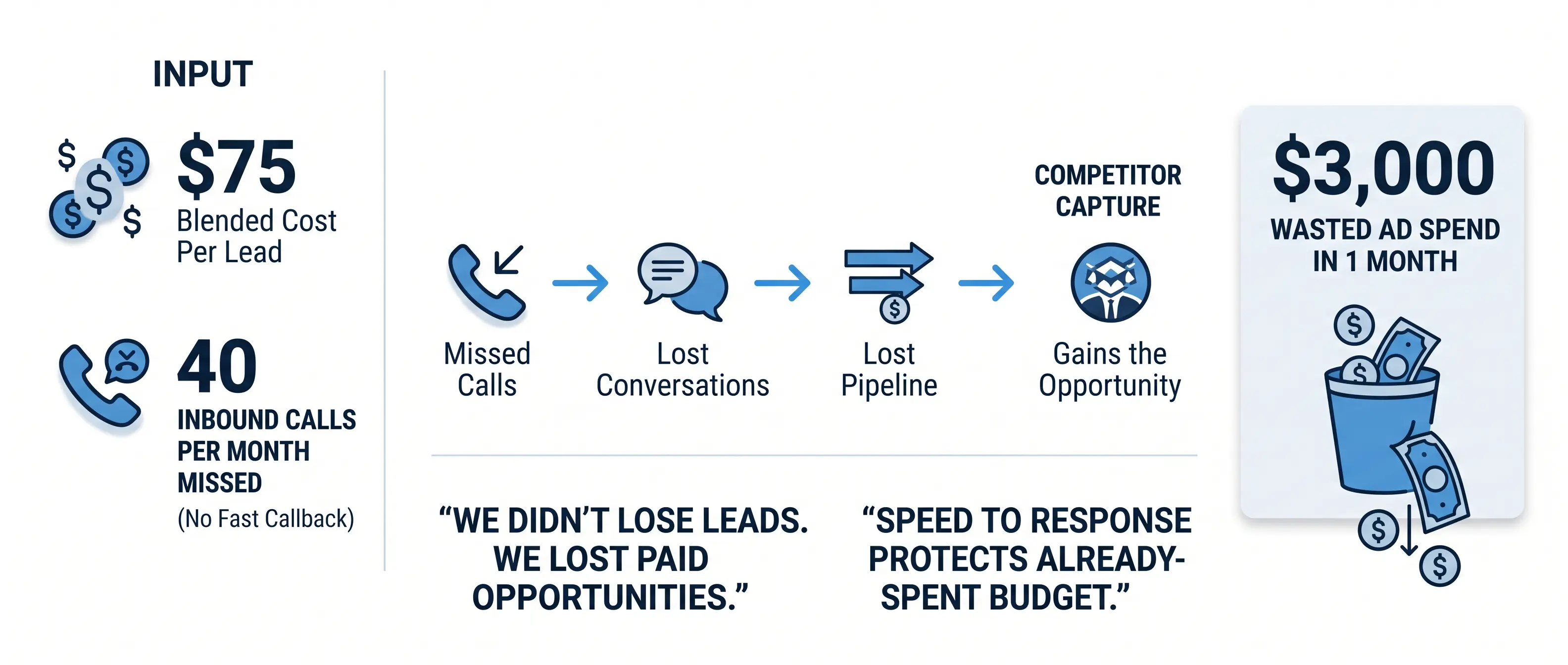
Do the math on a single month. Say your blended cost per lead is $75, and 40 inbound calls a month ring out without a fast call back. That's $3,000 in ad spend written off, before you count the pipeline those 40 conversations would have become. You didn't lose 40 leads. You set $3,000 on fire and handed the prospects to whoever answered first.
That's why "we need more leads" is usually the wrong call. Converting more of the leads you already pay for beats buying leads you can't answer. The cheapest pipeline you will ever build is the lead you already bought and actually reached in time. Instant lead response turns spend you've already committed into conversations instead of write-offs.
Key takeaway: a missed call writes off the ad spend that generated the lead. Answering fast protects budget you've already committed.
Why does speed matter more than anything else in lead response?
Lead intent has a short half-life. The second someone submits a form or dials your number, they're at their desk, the problem is top of mind, and they want to talk. Wait an hour and that's gone. They've moved on, gotten busy, or found another option. The teams that win aren't smarter than you. They're faster. The first company to respond gets the conversation, and usually the deal.
Speed is the most valuable minute in your whole follow-up sequence. Spend it.
Key takeaway: lead intent decays within minutes. The first minute matters more than every follow-up after it.
Why does your team keep missing calls, and it isn't laziness?
Reps miss calls because they're working. They're on another live call, between meetings, or three leads landed in the same ten minutes with one person to work them. After hours, no one is there at all. For a mid-market team running real volume, "answer every inbound lead within minutes, all day" is not a discipline you can coach into people. It's a coverage problem. And coverage problems need a system, not a pep talk.
The teams that win speed-to-lead don't ask reps to become faster humans. They put automation in front of the rep, so the lead gets a call, a text, or an AI conversation while the rep is still finishing the call they're on.
Key takeaway: missed calls are a coverage gap, not a motivation gap. The fix is automation in front of the rep, not pressure on the rep.
How do you stop missed calls from leaking your ad budget?
The goal is simple: no inbound lead waits, ever, no matter who's free. Aloware runs three motions in parallel the second a lead comes in, so the response never depends on a rep being available:
- Form2Call dials the lead the instant the form is submitted and connects an available rep. No queue. No "I'll get to it after this call."
- Form2Text fires an SMS if the call isn't picked up, so the lead hears from you in seconds instead of an hour.
- The AI Missed Call Handler texts back on any missed call, and AloAi Voice Agent can answer, qualify, and book the meeting 24/7 when every rep is busy or off the clock.
All of it runs inside the CRM, so every touch logs to the right contact and deal automatically. No rep admin. No lead lost in a spreadsheet. The lead you paid for gets answered in seconds, and your spend becomes a conversation instead of a callback nobody makes.
Key takeaway: instant response can't depend on a rep being free. Parallel call, text, and AI coverage means no paid lead goes unanswered.
Speed only works if your calls actually get answered
Here's the catch most speed-to-lead advice skips. Answering in thirty seconds does nothing if your call shows up as "Spam Likely" and the prospect declines it. Pickup rate is the other half of this. Flagged or unbranded numbers lose the connection no matter how fast you dial.
So speed and pickup are one system, not two projects. Getting answered is the prerequisite for speed to matter. It's worth understanding why legitimate sales calls get flagged as spam and fixing it before you tune response time. For the text side of that first touch, an AI SMS agent that qualifies leads in the thread keeps things moving while a rep frees up.
Key takeaway: speed and pickup rate are one system. A fast call that gets declined as spam still loses the lead.
Start measuring the gap
You know your cost per lead to the dollar. Here's the number you probably don't track: your average response time to an inbound lead, and how many ring out unanswered. Pull both. Multiply the unanswered calls by your cost per lead. That figure is the ad spend you're writing off at the moment of the missed call, and it's usually the cheapest pipeline you can recover, without buying a single new lead.
Book a 20-minute demo and we'll show Form2Call, Form2Text, and the AI Missed Call Handler running in parallel on a live inbound lead, so you can see exactly where the budget stops leaking.

Frequently Asked Questions
What does it mean to miss a sales lead?
A missed lead is any inbound inquiry that does not get a fast response. It is lost not because it was bad, but because no one reached it before intent faded or a competitor responded first. Missed leads write off the marketing spend that generated them.
How fast should you respond to an inbound lead?
As close to immediately as possible. Lead intent is highest at the moment of submission and decays quickly over the following minutes, so the practical standard is a response within the first few minutes, ideally seconds, rather than the hours most teams actually take. Automating the first touch is the only reliable way to hit that window consistently.
Why do missed calls cost more than the lead itself?
Because you have already paid to generate the lead through ad spend. When the call rings out, you lose both the lead and the budget that acquired it, and the prospect often converts with whichever competitor answered first. The true cost is the cost per lead plus the lost pipeline, not just one missed conversation.
What is speed to lead?
Speed to lead is how quickly your team responds to a new inbound lead. It is one of the highest-leverage levers in sales because the first company to respond captures a disproportionate share of deals. Strong speed-to-lead programs use automation to respond instantly across call and text rather than relying on a rep being available.
How does Aloware help with speed to lead?
Aloware responds to inbound leads the moment they arrive using three parallel motions: Form2Call dials the lead on form submission, Form2Text sends an instant SMS if the call is not answered, and the AI Missed Call Handler plus AloAi Voice Agent cover any missed call 24/7. Everything logs to the CRM automatically, so no lead waits on a rep being free.
Does fast response matter if my calls get marked as spam?
No, speed only helps if the call gets answered. If your outbound numbers are flagged as Spam Likely or show as unknown, prospects decline them no matter how fast you dial. Effective programs pair instant response with a clean, branded, monitored calling reputation so the fast call also connects.
.png)

Ruby Kootval is Head of Product Marketing at Aloware. She has 12 years in digital marketing, including 8 in B2B SaaS and 5 in telecom, and writes about AI voice agents, dialers, CRM integrations, and contact center operations.


.webp)