

TL;DR: Quick Answer
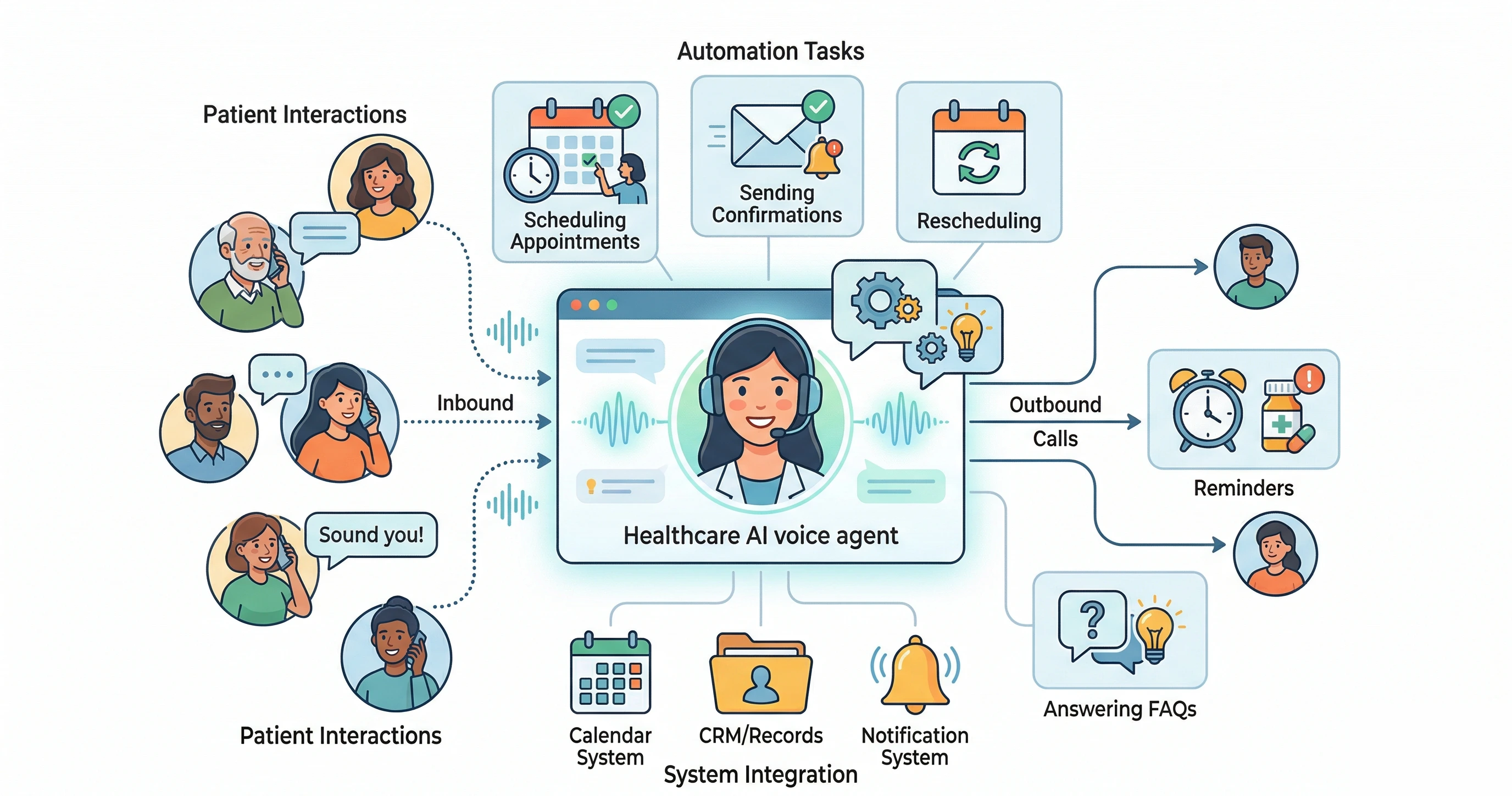
An AI voice agent in healthcare is software that autonomously handles inbound and outbound patient calls, scheduling appointments, sending reminders, managing cancellations, answering common questions, and routing complex calls to staff, without a human on the line. They work 24/7, eliminate hold times, and integrate with your scheduling and CRM systems in real time.
Key facts:
- Healthcare no-shows cost US providers$150 billion annually, and AI reminders cut no-show rates by 25–40%
- The AI voice agents in healthcare market is growing at37.8% CAGR, from $468M in 2024 to $3.2B by 2030 (Grand View Research)
- Primary care practices using AI receptionists report40–60% fewer missed appointments
- AI voice calls cost10–15% of live agent calls with comparable or better completion rates
- 43% of physicians experience burnout, and administrative call burden is a leading cause (AMA, 2024)
- The WHO projects ashortfall of 10 million healthcare workers by 2030, so AI handles volume while staff focus on care
Your front desk phone rings 200 times a day. Most of those calls are about appointments, directions, hours, or prescription refills. None of them need a trained staff member. Meanwhile that same staff member is managing check-ins, handling insurance questions, and trying not to fall behind on a queue that never ends.
AI voice agents in healthcare exist to solve exactly this problem. They answer the phone, handle the routine, and pass the complex calls to the humans who need to handle them.
This breakdown covers how AI voice agents work in healthcare, the use cases with the clearest ROI, how they connect to your systems, and how to deploy one without disrupting your operations. If you're also evaluating AI voice agents for other industries, see our complete guide to AI voice agents for SMBs for a broader comparison.
What Is an AI Voice Agent in Healthcare?
An AI voice agent in healthcare is a conversational software system that can make and receive phone calls, understand natural speech, and take real actions, booking appointments, sending confirmations, rescheduling cancellations, and answering FAQs, without a human on the line.
Unlike the old IVR phone trees ("press 1 for appointments, press 2 for billing"), modern AI voice agents hold a real, two-way conversation. They listen, respond contextually, handle follow-up questions, and adapt to what the caller says in natural language, not a rigid menu. For a deeper look at how this compares to legacy IVR systems, read our IVA vs. IVR breakdown.
When a patient calls to reschedule, the AI checks availability, offers alternatives, books the new slot, sends a confirmation, and logs everything to your scheduling system. No hold music. No staff interruption. No missed call at 7pm.
Key takeaway: An AI voice agent in healthcare is not a phone tree. It's a conversational system that handles real patient calls end-to-end, scheduling, reminders, and routing, 24/7.
Why Healthcare Needs AI Voice Agents Now
The numbers make the case better than any argument:
- Healthcare no-shows cost US providers $150 billion every year, with each missed appointment averaging $200 in lost revenue (Curogram, 2024)
- Patient no-show rates range from 5.5% to 50% across practice types, with a global average of 23.5%
- 43% of physicians reported burnout symptoms in 2024, with administrative workload, including phone management, a leading cause (AMA)
- The WHO projects a global shortfall of 10 million healthcare workers by 2030
- Front-desk staff in a typical medical practice spend 2–4 hours per day on scheduling calls alone
- 58% of providers still don't charge no-show fees, so the revenue loss is mostly absorbed silently
The structural pressure is only increasing. Healthcare organizations are being asked to serve more patients with fewer people. AI voice agents don't replace clinical staff. They absorb the administrative call volume so clinical staff can focus on care.
Key takeaway: The case for AI voice agents in healthcare is structural, not just operational. Staffing shortages, no-show revenue loss, and burnout are all worsening, and AI addresses all three at once.
Core Use Cases: Where AI Voice Agents Deliver in Healthcare
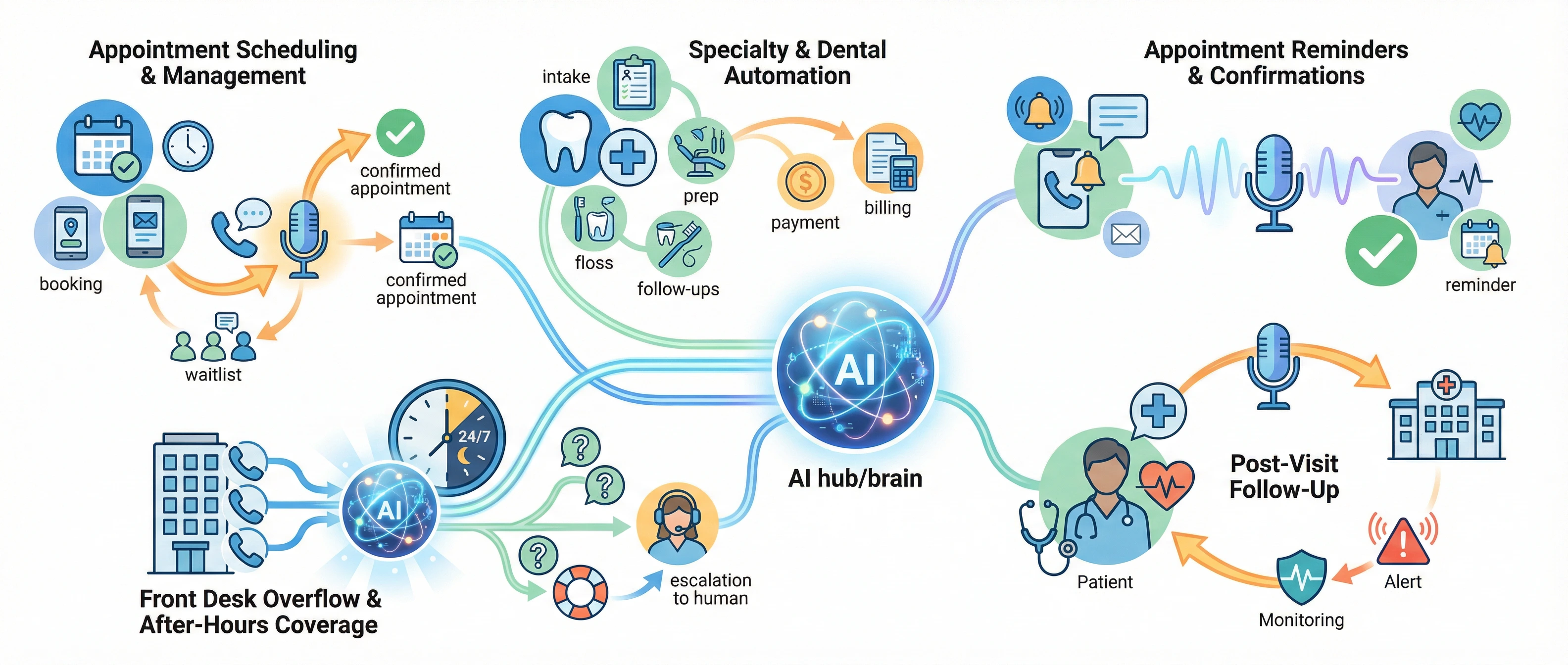
1. Appointment Scheduling and Management (24/7)
This is the highest-volume, clearest-ROI use case. AI voice agents handle:
- Inbound scheduling: patients call, the AI checks availability, books the appointment, and sends a confirmation
- Rescheduling and cancellations: patients cancel, the AI offers alternatives and fills the slot
- After-hours booking: the AI captures appointment requests at 9pm that would otherwise wait until morning, or be lost entirely
- Waitlist management: when a slot opens, the AI calls waitlisted patients automatically
Real-world result: a multi-location hospital reduced no-shows by 25% in six months after deploying AI voice reminders and confirmations. A family practice in the Midwest replaced manual reminder calls and saw 40% less staff time spent on scheduling with improved patient satisfaction scores.
The same principle applies beyond healthcare. Our guide on how AI voice agents help improve customer support with limited resources covers how this scales across any high-volume call environment.
2. Appointment Reminders and Confirmation Calls
Automated outbound reminder calls, timed at the right intervals (48 hours before, 24 hours before), dramatically reduce no-shows. The AI:
- Calls patients with natural, conversational reminders
- Handles real-time responses, so if the patient says they can't make it, the AI reschedules on the spot
- Updates your scheduling system instantly with the outcome
- Sends follow-up confirmation via SMS if needed
Memorial Hospital at Gulfport achieved nearly $804,000 in additional revenue in seven months after cutting no-shows by 28% with automated appointment reminder calls, a run rate of more than $1 million annually (Health Catalyst).
3. Front Desk Call Overflow, After-Hours Coverage, and Missed-Call Recovery
Most medical practices miss calls, especially outside business hours. Patients who can't reach you don't wait. They call a competitor. That is a patient-access problem as much as a staffing one. AI voice agents solve it with:
- 24/7 inbound call answering: no call goes unanswered, even at 11pm
- FAQ handling: hours, directions, parking, insurance accepted, how to get referrals
- Prescription refill routing: the AI captures the request and routes it to the right staff member
- Urgent call escalation: the agent detects urgency signals and transfers to an on-call human immediately
Missed-call recovery is the piece most practices overlook. When a call comes in while every line is busy, the AI answers the overflow instead of sending the patient to voicemail, and when a call still slips through, it captures the callback request or returns the call automatically. The patient never has to redial, and never ends up booking with the practice across town. Your front desk stops leaking patients it never knew it lost. Our post on how to stop missing phone calls covers the true cost of missed calls across business types.
One practice eliminated two full-time admin roles, saving $87K annually, while extending service hours with AI coverage (Callin.io case study).
4. Post-Visit Follow-Up Calls
Patient care doesn't end when the appointment does, but manual follow-up calls rarely happen consistently. AI voice agents conduct structured outbound follow-ups:
- Checking how the patient is feeling post-procedure
- Reminding them to take prescribed medications
- Asking standardized questions for chronic disease monitoring
- Flagging concerning responses for clinical review
Hospital systems using AI for discharge follow-up achieved a 28% reduction in readmission rates for high-risk patients through consistent monitoring and early intervention.
5. Specialty and Dental Practice Automation
The AI dental receptionist use case is particularly strong. Dental practices typically have high call volumes relative to staff size, with most calls falling into predictable categories:
- New patient intake and scheduling
- Treatment plan reminders and pre-procedure prep calls
- Post-procedure check-in calls
- Payment and billing reminders
Dental and specialty practices using AI receptionists report 35% increases in procedure preparation compliance, resulting in fewer cancellations and better clinical outcomes.
Key takeaway: The five core use cases, scheduling, reminders, front desk overflow, post-visit follow-up, and specialty automation, each have documented ROI and can be deployed independently or together.
How AI Voice Agents Integrate with Healthcare Systems
A common concern is integration complexity. The reality: modern AI voice agents are built to connect with the systems healthcare organizations already use.
Scheduling systems: AI agents connect directly to your scheduling platform to check availability, book slots, and update records in real time. No double-entry, no sync delays.
CRM integration: Aloware's AI voice agent integrates natively with Salesforce and HubSpot. Every patient call is logged automatically, with recording, transcript, AI-generated summary, and call outcome, directly on the contact record. Your team has full context on every interaction without touching the phone.
Call routing and escalation: when the AI encounters a complex question, an urgent situation, or a patient requesting a human, it transfers the call immediately, with the full conversation context passed along so the staff member doesn't start from zero.
Outbound campaign integration: AI agents pull contact lists directly from your CRM and execute outbound campaigns, reminder calls, follow-up sequences, and re-engagement campaigns, automatically, based on rules you define.
Key takeaway: Integration is not a barrier. AI voice agents connect to your scheduling system and CRM, log every interaction automatically, and hand off to humans cleanly when needed.
See how Aloware's CRM integration works in detail: Aloware Salesforce Integration Guide
Using HubSpot? Read: Everything You Can Do with Aloware's HubSpot Integration
The ROI Case: What Healthcare Organizations Actually See
Here is the financial math that makes AI voice agents compelling for healthcare administrators:
What to Require From an AI Voice Platform in Healthcare
Healthcare organizations handle sensitive patient data, so the security bar for any AI voice platform is high. Treat these as requirements, not nice-to-haves, when you evaluate vendors.
What to look for in an AI voice platform:
- SOC 2 controls: validate that the platform meets audited security standards for data handling, availability, and confidentiality
- Data encryption: call recordings and transcripts should be encrypted both in transit and at rest
- Access controls: role-based access so only authorized staff can review call data
- Audit trails: every call logged with a complete, tamper-proof record
- Clear data retention policies: know exactly how long call data is stored and who can access it
Put these questions to any vendor before you sign. A platform that cannot answer them in writing is not ready for patient data. For teams managing outbound calling campaigns alongside inbound coverage, review our TCPA compliance checklist, because the same consent and DNC requirements apply to healthcare outreach.
Key takeaway: Make SOC 2 controls, encryption, role-based access, and audit trails hard requirements when you evaluate any AI voice platform for healthcare.
AI Voice Agent vs. Traditional Front Desk vs. IVR
For more on why AI agents are a significant leap beyond IVR technology, see our dedicated IVA vs. IVR comparison and the complete guide to moving from IVR to conversational AI.
Key takeaway: AI voice agents outperform IVR on every dimension and match or exceed human front desk capabilities for routine calls, at 10–15% of the cost.
How to Deploy an AI Voice Agent in Your Healthcare Organization
Deployment is faster than most practices expect. Here is the practical path:
Step 1: Start with one high-volume workflow. Don't try to automate everything at once. Pick the highest-volume, most predictable workflow. Appointment reminders or after-hours answering are the easiest starting points with the clearest ROI.
Step 2: Connect your scheduling system and CRM. Aloware integrates natively with Salesforce and HubSpot. Your AI agent needs access to your scheduling data to check availability, book slots, and log outcomes. Setup typically takes less than a week.
Step 3: Build your conversation flow. Define what the AI should handle, what it should route to a human, and what escalation triggers look like (urgency language, frustrated callers, clinical questions). Aloware's no-code interface allows this without writing code. See our guide on how to prompt your AI voice agent for best practices on building effective conversation flows.
Step 4: Set compliance parameters. Define calling hours for outbound campaigns, configure DNC list management, and set up call recording consent handling aligned with your state requirements.
Step 5: Go live and monitor. Launch with real-time dashboards. Review AI call summaries and transcripts regularly in the first weeks to refine conversation flows. Most practices have their first workflow fully optimized within 30 days.
Step-by-step setup guide: How to Set Up Aloware's Native Salesforce Integration
Key takeaway: Start with one workflow, connect your CRM, define your escalation rules, and go live. Most healthcare organizations are fully operational within a week.
Key Takeaways
- AI voice agents in healthcare handle appointment scheduling, reminders, front desk overflow, post-visit follow-up, and specialty automation, 24/7 and at scale
- The ROI is measurable: 25–40% fewer no-shows, 60–75% less staff time on routine calls, and 85–90% lower cost per call versus live agents
- The market is growing at37.8% CAGR, so healthcare organizations not piloting AI today are falling behind the adoption curve
- Integration is straightforward. Aloware connects natively to Salesforce, HubSpot, and your scheduling system, logging every call automatically
- Security matters: require SOC 2 controls, encrypted call data, audit trails, and role-based access from any platform you evaluate
- Start small, scale fast. Deploy one workflow first, measure results, then expand across your practice
See How Aloware's AI Voice Agent Works for Healthcare
Aloware's AI voice agent handles patient calls, automates scheduling, and logs every interaction to your CRM automatically, 24/7.
Book a demo → and see it handle a real patient call scenario in under 20 minutes.
Frequently Asked Questions
What is an AI voice agent in healthcare?
An AI voice agent in healthcare is a conversational software system that autonomously handles patient phone calls — scheduling appointments, sending reminders, answering common questions, and routing complex calls to staff — without a human on the line. It works 24/7 and integrates with your scheduling and CRM systems in real time.
Can AI voice agents book and reschedule medical appointments?
Yes. AI voice agents connect directly to your scheduling system, check real-time availability, book appointments, handle rescheduling requests, and send confirmation messages — all within the same phone call, without staff involvement.
How much do AI voice agents reduce no-shows in healthcare?
Primary care practices using AI voice reminders report 25–40% reductions in no-show rates. A multi-location hospital reduced no-shows by 28% in six months, translating to over $1 million in recovered annual revenue for one site.
Are AI voice agents secure enough for healthcare organizations?
Yes, when the platform holds appropriate certifications. Look for SOC 2 certification as the baseline standard for enterprise data security. Aloware is SOC 2 certified — call data is encrypted in transit and at rest, with full audit trail support and role-based access controls.
Do AI voice agents replace healthcare front desk staff?
No. AI voice agents handle high-volume, routine calls — scheduling, reminders, FAQs — so front desk staff can focus on complex or sensitive patient interactions that genuinely require a human. Most practices use AI to extend capacity without reducing headcount, especially for after-hours coverage.
How does an AI voice agent handle urgent or sensitive calls?
AI voice agents are configured with escalation triggers — specific language patterns, urgency signals, or patient requests — that immediately transfer the call to a live staff member, with full conversation context passed along so the human doesn't start from zero.
How long does it take to deploy an AI voice agent in a healthcare practice?
Most practices are live within a week. Starting with a single workflow (appointment reminders or after-hours answering) makes deployment fastest. Aloware's native CRM integrations and no-code conversation builder significantly reduce setup time.
What is the cost of an AI voice agent compared to a human receptionist?
AI voice agents handle calls at approximately $0.80–1.50 per call, compared to $8–15 per call for a live agent. For a practice handling 150+ calls per day, this represents significant savings — plus the AI never takes a day off or misses an after-hours call.
.png)

Ruby Kootval is Head of Product Marketing at Aloware. She has 12 years in digital marketing, including 8 in B2B SaaS and 5 in telecom, and writes about AI voice agents, dialers, CRM integrations, and contact center operations.

%20(1).webp)