

TL;DR:
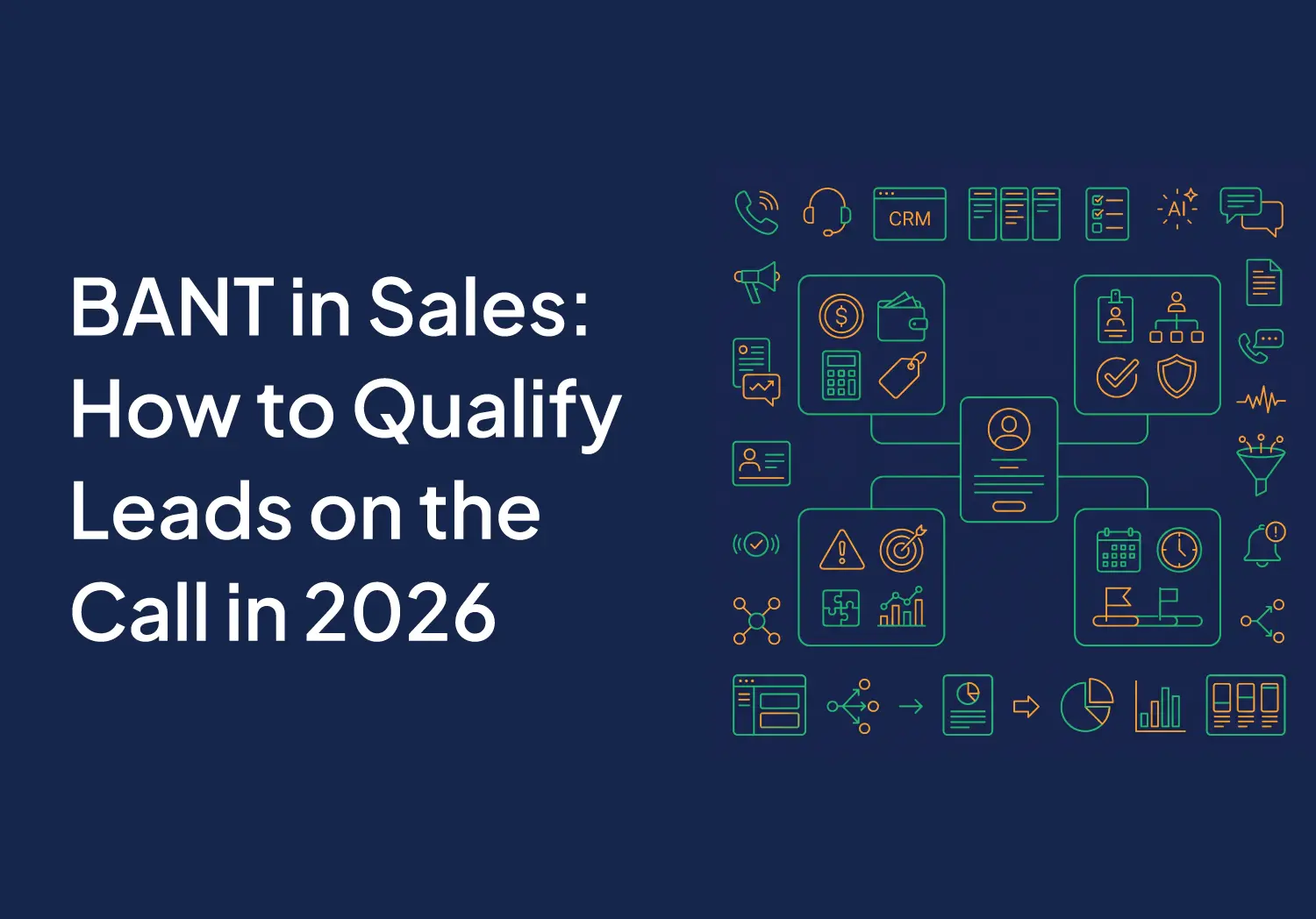
BANT is a four-part sales qualification framework that scores a prospect on Budget, Authority, Need, and Timeline, and it is designed to be answered inside a single discovery call. It works well on fast, transactional deals and breaks down on complex purchases where no single person holds the decision.
- B is Budget: can they fund this, and does their expectation match your price.
- A is Authority: can the person on the phone decide, and if not, who else has to agree.
- N is Need: is there a real, expensive problem your product removes.
- T is Timeline: when does a decision actually get made, tied to a dated event.
- Authority is where BANT fails most often. Gong, analyzing more than 9,000 opportunities, found deals with no decision-maker involved were 80% less likely to close, rising to 233% less likely on enterprise cycles.
- Qualify on the call, not afterward. Reps who reconstruct BANT from memory hours later produce fiction, and the CRM inherits it.
- Not every call earns a BANT. A rep making 50 to 60 dials a day will genuinely qualify a fraction of them.
Your pipeline says 40 qualified opportunities. Your close rate says otherwise. The gap usually traces back to a qualification step where four boxes got checked because the rep needed them checked, not because the prospect said anything that filled them.
What is BANT in sales?
BANT is a lead qualification framework that evaluates a prospect against four criteria before a seller commits time to the deal: Budget, Authority, Need, and Timeline. HubSpot defines it as "a method for qualifying prospects at the start of the sales cycle. It lets salespeople determine whether a prospect is a good fit."
The framework is widely attributed to IBM, which built it to triage a large sales force against far more inbound interest than it could work. The problem it solved is the one every outbound team still has: finite selling hours, an unsorted list, and no way to tell the serious from the curious before spending a week on them.
A prospect who satisfies all four is worth a proposal. A prospect who satisfies two is worth a follow-up task, not a forecast line.
Key takeaway: BANT is a triage tool that decides where a rep spends the next hour, not a scoring rubric to be filled in after the fact.
What does each letter actually require?
Budget. Whether the prospect can fund the purchase, and whether their expectation is anywhere near your price. Budget does not require an approved line item. On most SMB deals it does not exist yet, and the useful version of the question is what the problem currently costs them.
Gong's research points at when to raise it: win rates run 10% higher when pricing comes up on the first call. Sellers who defer price to "the next conversation" are protecting themselves, not the deal.
Authority. Whether the person on the call can decide, and who else has to say yes. This is the criterion that quietly destroys forecasts, covered in its own section below.
Need. Whether there is a real problem your product removes, expensive enough that solving it beats doing nothing. Doing nothing is the competitor that wins most deals.
Timeline. When a decision actually gets made. A timeline anchored to a dated event is real. A timeline anchored to a feeling is not.
Key takeaway: every BANT answer should contain a number, a name, or a date. An answer with none of those is a rep's opinion wearing a prospect's words.
How do you ask BANT questions without interrogating someone?
The complaint about BANT is fair when it becomes a form read aloud. Mailchimp names the failure directly, warning that BANT turns "off-putting" when reduced to "rehearsed and formulaic questions," and that the framework is "quite seller-centric" because the criteria measure whether the prospect is right for you rather than the reverse.
The fix is sequence. Earn the answer before asking for it.
❌ Bad opening: "Do you have budget allocated for this?" in the first two minutes. The prospect has no reason to tell you, and the true answer is usually no.
✅ Good opening: establish the cost of the problem first, then let budget answer itself. "How many inbound calls go to voicemail on a typical Monday?" followed by "What happens to those leads?" gets you Need and Budget in two questions, and the prospect did the arithmetic themselves.
Gong's call analysis puts the sweet spot for questions on a call at 11 to 14. Below that you are pitching. Above it you are deposing.
Industry versions of the same move:
- Insurance agency: "How many quote requests came in last week, and how many got a call back inside an hour?" Need and Timeline arrive together.
- Solar and home services: "What does a booked appointment cost you right now, all in?" Budget, in their numbers rather than yours.
- Real estate brokerage: "Who signs off on tools the whole team uses, you or the broker?" Authority, asked without the word authority.
- Legal intake: "What is a signed case worth on average?" Need, priced.
Key takeaway: ask for the cost of the problem before asking for the budget. Prospects will not hand you a number they have not yet justified to themselves.
Where BANT breaks: the Authority problem
Authority assumes one person decides. On most deals worth having, that stopped being true.
Gong's analysis of more than 9,000 opportunities found that deals where a decision-maker was not involved were 80% less likely to close. On enterprise deals with a sales cycle longer than 90 days and valued at over $100,000, deals were 233% less likely to close without one.
Read that as an instruction rather than a statistic. A rep who confirms "yes, I'm the decision maker" and stops has satisfied the letter of BANT while collecting the exact condition that predicts the loss. The person answering your call is frequently a researcher with real influence and no signature.
❌ The question that fails: "Are you the decision maker?" Nobody answers no.
✅ The question that works: "Walk me through how a purchase like this gets approved at your company." You get the process, the other names, and the sequence, and you have not challenged anyone's status.
When a deal has multiple stakeholders, BANT stops being sufficient on its own. MEDDIC, which covers Metrics, Economic buyer, Decision criteria, Decision process, Identify pain, and Champion, exists because complex deals need the decision process mapped rather than a yes-or-no on authority. Use BANT to decide whether the deal is worth working. Use a heavier framework once it is.
Key takeaway: replace "are you the decision maker" with "how does a purchase like this get approved here." The first question protects the rep's comfort; the second protects the forecast.
When should you not use BANT?
BANT fits fast, transactional deals with a short cycle and a clear category. It fits poorly where the buying committee is large, the budget gets created rather than found, or the product is new enough that the prospect cannot yet describe the need.
It also does not belong on every call. A HubSpot sales practitioner describes making 50 to 60 calls a day and BANT-qualifying only 10 to 15 of them, noting that "not every call qualifies for BANT" and that credibility has to be earned through insight and pain discovery first.
That ratio is the honest benchmark. If a team's CRM shows BANT complete on every dial, the field is being filled to satisfy a manager rather than to describe a buyer.
Key takeaway: BANT is for transactional deals and it applies to a minority of dials. Full BANT on every record is a data-integrity problem, not a productive team.
Capturing BANT while the call is still happening
The framework fails operationally long before it fails strategically. A rep finishes a call, dials the next one, and writes notes four hours later from memory. What lands in the CRM is a reconstruction, and the forecast is built on it.
Bad practice: notes from memory. Good practice: answers captured live. The old approach asks a rep to recall four answers across thirty conversations and hope the CRM fields match what the prospect actually said.
The new way: capture the four answers as call artifacts, so qualification is evidence rather than recollection.
Aloware's platform handles this layer directly. Its published feature set includes Call qualifying, described as evaluating and categorizing incoming calls against customizable predefined criteria to identify high-quality leads, and Contact disposition for labeling the outcome of each interaction. Call transcription stores transcripts in the CRM, and AloAi call summarization condenses conversations into key points and posts them to the CRM as call notes. The effect is that what the prospect actually said is attached to the record while it is still accurate, instead of being reconstructed from a rep's memory at the end of a dialing day.
Volume matters too. A dialer that removes the dead time between calls is what makes a 50-dial day possible in the first place, and bidirectional CRM sync is what keeps the qualification data where the forecast reads it.
Honest limits: no transcript decides whether a prospect is qualified. It removes the excuse for guessing. The judgment stays with the rep, and a team without an agreed definition of "qualified" will produce inconsistent BANT records no matter what tooling sits underneath.
Key takeaway: qualification quality is a data-capture problem before it is a framework problem. Answers recorded during the call are evidence; answers typed at 6pm are estimates.
The bottom line
BANT survived because four questions are the fastest way to decide whether a deal deserves an hour. It gets a bad reputation when it is used as a checklist to close out rather than a conversation to run.
Ask for the cost of the problem before the budget. Ask how purchases get approved instead of who the decision maker is. Anchor timeline to a dated event. Accept that most dials will not qualify, and record the ones that do while the prospect is still talking.
Related reading: what outbound sales actually involves, the outbound playbook for high-volume teams, cold calling techniques that lift pickup rates, QA-ing sales calls with voice analytics, and how conversation intelligence tools compare.
Book a 15-minute walkthrough to see qualification captured on the call instead of typed in afterward.
Frequently Asked Questions
What does BANT stand for in sales?
BANT stands for Budget, Authority, Need, and Timeline. It is a lead qualification framework that scores a prospect on four criteria before a seller commits serious time to the deal: whether they can fund the purchase, whether the person you are speaking with can decide, whether a real problem exists that your product removes, and when a decision actually gets made. HubSpot describes it as a method for qualifying prospects at the start of the sales cycle to determine whether a prospect is a good fit. It is designed to be answered inside a single discovery call.
Is BANT still relevant in 2026?
Yes for fast, transactional deals with a short cycle and a clear category, where four questions are the quickest way to decide whether a deal deserves an hour. It is weaker where the buying committee is large, where budget gets created rather than found, or where the product is new enough that the prospect cannot yet describe the need. The criticism it attracts is mostly about execution: Mailchimp notes the framework becomes off-putting when it is reduced to rehearsed and formulaic questions, and that it is quite seller-centric because the criteria measure whether the prospect suits you.
What are good BANT qualifying questions?
The best ones never use the framework's own vocabulary. Instead of asking about budget, ask what the problem costs today: "How many inbound calls go to voicemail on a typical Monday, and what happens to those leads?" Instead of asking who the decision maker is, ask "Walk me through how a purchase like this gets approved at your company." For timeline, look for a dated event such as a contract renewal rather than a vague quarter. A useful test: every answer should contain a number, a name, or a date. Answers with none of those are opinion, not qualification.
What is the difference between BANT and MEDDIC?
BANT covers Budget, Authority, Need, and Timeline, and is built for speed on transactional deals. MEDDIC covers Metrics, Economic buyer, Decision criteria, Decision process, Identify pain, and Champion, and is built for complex deals with many stakeholders. The key structural difference is that BANT asks a yes-or-no question about authority, while MEDDIC maps the entire decision process and requires an internal champion. Most teams use both: BANT to decide whether a deal is worth working at all, then a heavier framework once the deal qualifies and multiple stakeholders appear.
Should you use BANT on every sales call?
No, and expecting it on every call is a data-integrity problem. A HubSpot sales practitioner describes making 50 to 60 calls a day and BANT-qualifying only 10 to 15 of them, noting that not every call qualifies for BANT and that credibility has to be earned through insight and pain discovery first. If your CRM shows BANT complete on every dial, the fields are being filled to satisfy a manager rather than to describe a buyer, and your forecast is built on that. Treat partial qualification as a legitimate outcome, not a failure.
Why does BANT fail on enterprise deals?
Because the Authority criterion assumes one person decides, and on large purchases that stopped being true. Gong's analysis of more than 9,000 opportunities found deals where a decision-maker was not involved were 80% less likely to close, and on deals with a sales cycle longer than 90 days valued at over $100,000, they were 233% less likely to close. A rep who hears "yes, I'm the decision maker" and stops has satisfied the letter of the framework while collecting the exact condition that predicts the loss. Map the approval process instead of accepting a single confirmation.
How do you ask about budget without killing the call?
Establish the cost of the problem before asking for the budget. Asking "do you have budget allocated for this?" in the first two minutes gives the prospect no reason to answer, and the true answer is usually no because most SMB deals have no approved line item yet. Ask what the current situation costs instead, in their numbers: missed calls per month, cost per booked appointment, value of a signed case. The prospect does the arithmetic themselves. On timing, Gong's research found win rates run 10% higher when pricing is discussed on the first call, so do not defer it indefinitely.
What should replace BANT for complex deals?
Nothing has to replace it outright. Use BANT as the triage layer that decides whether a deal is worth an hour, then layer a framework that maps the decision process once multiple stakeholders are involved. MEDDIC is the common choice because it forces you to identify the economic buyer, the decision criteria, the decision process, and an internal champion rather than settling for a yes on authority. The practical rule: BANT answers "should I work this deal?" and a heavier framework answers "how does this deal actually get signed?"
How do you record BANT answers in a CRM?
Capture them during the call rather than reconstructing them later. The common failure is a rep finishing a call, dialing the next, and typing notes hours afterward from memory, which produces an estimate that the forecast then treats as fact. Contact records should carry the actual numbers and dates the prospect said out loud. Aloware supports this with call qualifying, which evaluates and categorizes incoming calls against customizable predefined criteria, contact disposition for labeling each interaction's outcome, call transcription stored in the CRM, and AloAi call summarization that posts key points to the CRM as call notes.
.png)

Ruby Kootval is Head of Product Marketing at Aloware. She has 12 years in digital marketing, including 8 in B2B SaaS and 5 in telecom, and writes about AI voice agents, dialers, CRM integrations, and contact center operations.