


TL;DR
Cold calling is not dead. The anonymous cold call is. Answer rates for unknown numbers collapsed because the carrier network and the handset now decide whether your call rings at all, before any human forms an opinion about your pitch. Fix the identity of the number and the channel works again.
- 86% of unknown calls go unanswered, per Hiya's State of the Call 2026, a survey of more than 12,000 consumers across six countries.
- In a Twilio study of roughly 720,000 calls over 90 days (published 2024), branded calls were answered 62% of the time against 20% for un-branded calls from the same traffic.
- Since March 25, 2026, US carriers must return a standardized SIP 603+ code when analytics block a call, so "nobody answered" and "the network refused it" are now two different, diagnosable events.
- Branded display and spam labeling are separate carrier systems. A branded number with a damaged reputation still gets flagged.
- Dialing more numbers does not repair an answer rate. It usually accelerates the damage.
Last updated: August 2, 2026
Your reps are not worse at the phone than they were three years ago. The network in front of them changed.
The industry keeps arguing this the wrong way. One camp says buyers stopped picking up and the phone is finished. The other says the phone works fine and you need better scripts. Both are debating human behavior. What actually changed sits underneath the conversation, at the carrier layer, and it never asks the buyer's opinion.
Is cold calling dead?
No. Cold calling is not dead as a channel, but the version of it most teams still run has stopped functioning: dialing from an unregistered, unmanaged number and hoping volume carries the day.
The distinction matters because the two problems have opposite fixes. If buyers had abandoned the phone, move budget to email and social. If the calls are screened before they ring, moving budget is an expensive way to avoid a solvable problem.
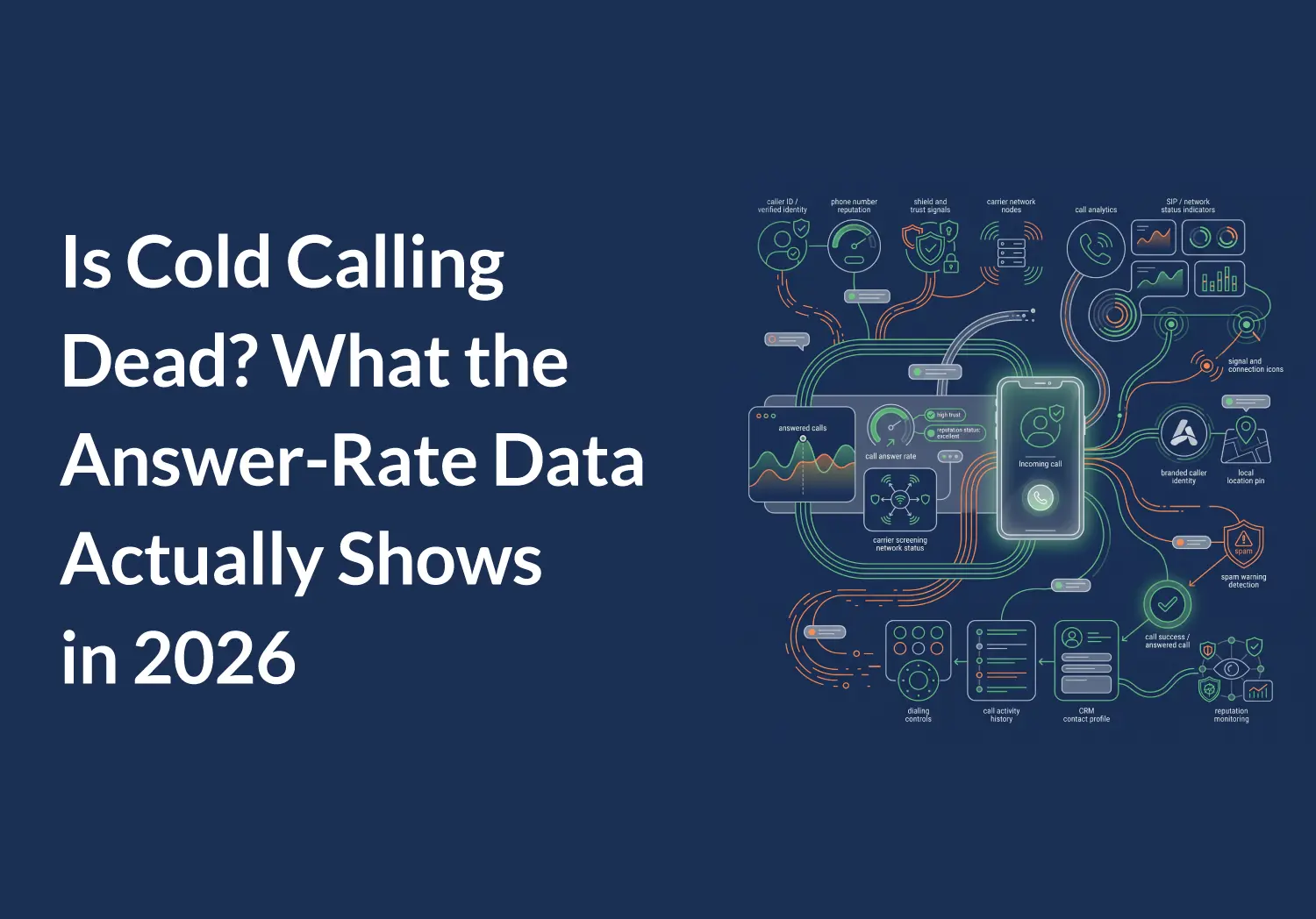
The evidence points hard at the second explanation. Consumers did not stop answering phones. They stopped answering unknown numbers, and they now have three layers of help doing it: carrier analytics that block suspicious traffic outright, reputation systems that stamp "Spam Likely" on the screen, and operating-system features that silence unrecognized callers without ringing at all. We break down how that screening machinery actually works in why your calls land in the spam folder.
Key takeaway: cold calling did not die. Anonymous outbound died, and it died at the network layer rather than in the buyer's preferences.
What actually happened to answer rates
Start with the number that frames everything else. Hiya's State of the Call 2026, built on responses from more than 12,000 consumers across six countries, puts it plainly: 86% of unknown calls go unanswered. That is not a sales statistic. It is a description of default consumer behavior toward any number the handset cannot identify.
The pressure behind it is documented too. The FTC's January 2026 biennial report on the National Do Not Call Registry records more than 258 million numbers on the registry at the end of fiscal 2025 and more than 2.6 million Do Not Call complaints that year, with consumers reporting most came from robocalls rather than live telemarketing. Consumers are not annoyed at salespeople. They are drowning in automated calls and have armed themselves accordingly.
Legitimate outbound teams absorb the collateral damage. A solar installer calling homeowners who requested a quote, an insurance agency working a renewal, a staffing firm calling yesterday's applicant: all three look identical to a robocall from the carrier's side, because the carrier scores the number's behavior and never reads the intent behind it.
Key takeaway: the 86% figure is a screening outcome, not a preference. The buyer never had to decide anything.
Why does your number get screened before it rings?
Three separate systems sit between your dialer and the person you are calling. Most teams treat them as one thing, which is why their fixes do not work.
Number reputation. Carrier analytics engines score every outbound number continuously: call volume, the ratio of very short calls, how often recipients reject or report it, how suddenly volume ramped. A number that starts hot on a cold list builds a bad score fast. Once it crosses a threshold the carrier attaches a "Spam Likely" label, and the label follows the number, not the campaign.
Analytics-based blocking. Worse than a label is a call that never arrives. Carriers block traffic their analytics flag, and until recently that block came back as an ambiguous jumble of SIP codes that looked, from the caller's side, like a normal failed call. That changed on March 25, 2026, when the FCC's unified standard took effect. Per Twilio's breakdown of the rule, SIP 603+ is now "the single, uniform way to indicate that a call was blocked by analytics on IP-based networks," replacing the old 603, 607 and 608 patchwork, and it carries standardized information that lets a caller seek redress when a legitimate call is blocked.
That one change turns a guess into a diagnosis:
- ❌ The old read: "Our connect rate is down. The list must be bad."
- ✅ The 2026 read: "Pull the SIP codes. If a real share of our dials came back 603+, the list is fine and the carrier is refusing our number."
Aloware surfaces this directly. When a carrier returns one of those codes on an outbound call, it appears in the Call Log and Activity Feed with a Blocked by Carrier disposition rather than dissolving into the unanswered pile. Detection, not prevention, and that is the point: you cannot fix a problem you cannot see.
Caller identity. This is the layer people get wrong most often, so it is worth stating flatly. Branded display and spam labeling are two separate carrier systems running in parallel. Registering a branded caller ID puts your business name on the screen. It does not remove a spam label, and it does not override a damaged reputation. A branded number with a bad score still gets flagged. Anyone who has run an enterprise outbound program has watched this happen.
The same discipline applies one layer down, to STIR/SHAKEN. Attestation is signed by the originating voice service provider, not by your dialer, your CRM or your sales engagement tool. The regulation is explicit: under 47 CFR 64.6301, the originating provider must "authenticate caller identification information for all SIP calls it originates and that it will exchange with another voice service provider." Any vendor claiming their software signs your attestation is describing something that does not exist. The handset adds one more layer on top of all three, which we took apart in our teardown of iOS 26 call screening.
Key takeaway: reputation, blocking and identity are three systems, not one. Fixing the wrong one is why so many teams buy a solution and see nothing change.
What does the branded-versus-unbranded data actually show?
This is the part that settles the argument, and the part every "is cold calling dead" article leaves out.
Twilio ran a 90-day experiment across roughly 720,000 calls for a healthcare customer, published in 2024, splitting the traffic: about 57,000 calls carried branded display and about 663,000 did not. The branded calls were answered 62% of the time. The un-branded calls from the same organization, to the same kind of contact list, in the same period, were answered 20% of the time.
Same company. Same list. Same reps. Three times the answer rate, from identity alone.
Note the denominators, because most vendors hide them. One customer, one vertical, one quarter, and the branded cohort was a small slice of the total. Directional, not a universal law. It is still a real experiment with a stated sample and method, which is more than the phone-is-dead argument has ever produced.
Key takeaway: identity, not persuasion, is the biggest single lever on a cold-call answer rate that anyone has published a real denominator for.
What still kills a cold call in 2026 that has nothing to do with your script
Teams facing a low answer rate reach for volume. It is the intuitive move and the wrong one, because the behavior that produces volume is what carrier analytics use to identify a spam operation.
Parallel and predictive dialers dial ahead of agent capacity. When more people answer than there are reps to take them, the system produces dead air and abandoned calls, precisely the signatures carriers score against. The dialer optimizes for dials per hour while degrading the asset that decides whether any of those dials connect next month. Predictive dialing also carries abandoned-call exposure under the TCPA rules governing telemarketing.
Aloware does not offer parallel or predictive dialing, and that is a position rather than a gap. Our Power Dialer runs one line at a time and advances automatically once the rep is ready. Fewer dials per hour, and a number whose reputation is still intact next quarter.
- ❌ The volume reflex: answer rate drops, so triple the dial count on the same numbers. Reputation degrades faster, the label arrives sooner, and the connect rate ends lower than it started.
- ✅ The identity fix: hold the dial pace, register the identity, monitor the reputation, and let the same number stay answerable.
If you are choosing tooling right now, the trade-offs are laid out in our guide to picking a dialer that won't burn your numbers.
Key takeaway: more dials on a damaged number is not a growth strategy. It is the mechanism of the damage.
How do you make cold calls that get answered?
Treat your phone numbers like a credit score. The score is built slowly by behavior, it is checked automatically by strangers, and once it drops, everything you try to do with it costs more.
Three layers do the work, and at Aloware they are the Pickup Stack:
- NumberGuard: monitors your outbound numbers against US carrier databases and their analytics providers, places real test calls over live mobile networks to see how each number actually displays on a handset, and works with carriers to remove spam mislabeling. It prevents the flag rather than arguing with it afterward.
- Branded Calling: registers your verified business identity so supported US mobile carriers display your name (and on the enhanced tier, your logo and call reason) when the phone rings. Outbound calls only, US carriers only.
- Local Presence: matches your outbound area code to the recipient's, so a familiar prefix appears instead of an out-of-state unknown.
One correction on pricing, because teams assume this wrong constantly. The Pickup Stack is not included in a seat plan. Aloware seats start at $30 per user per month on iPro + AI billed quarterly for calling, texting and the AI layer, and the Power Dialer sits on uPro + AI at $60 per user per month billed quarterly. NumberGuard, Branded Calling and Local Presence are add-on services priced separately from all of it, and they are not optional if you want results that last: a fresh number connects fine for a few weeks, then reputation decays and pickup collapses. The seat price buys the calling. Keeping the calls answered is bought on top.
Underneath all of it, calls originate onto a STIR/SHAKEN-attested trunk, with the carrier signing attestation at the originating provider layer. That is the foundation for compliant calling on an attested trunk, and branded registration does not work properly without it.
Follow-up then matters as much as the dial. Coordinating voice with text on the same identified number, and letting AI voice and text agents catch the callbacks a rep cannot take live, is what turns a repaired answer rate into booked meetings.
Key takeaway: the fix is a stack, not a feature. Reputation prevents the negative, branding and locality supply the positive, and pacing keeps you from undoing both.
The seven-point answer-rate audit
Run this on your own outbound this week. It takes an afternoon.
- Pull your SIP response codes. Count outbound calls that returned 603, 607, 608 or 603+ in the last 30 days, then compare that count to the same window last quarter. A rising block count means carriers are refusing you rather than ignoring you, and no list or script change will move it.
- Check how your numbers display. Call a real handset on each major US carrier and look at the screen. Do not trust a dashboard for this.
- Look at your short-call ratio. Track the share of calls under ten seconds, week over week. A ratio that climbs while your dial count climbs is the pattern analytics engines score hardest.
- Check your ramp. A number that went from zero to hundreds of dials a day in a week looks like a spam operation regardless of what you sell.
- Separate your two registrations. Confirm branded display registration and number-reputation management are both in place. Having one is not having both.
- Audit your dialer's pacing. If it dials ahead of agent capacity, measure your abandoned-call rate before you do anything else.
- Register with the Free Caller Registry. It covers the three major US wireless carriers and is the first remediation step when a number is already flagged.
For the tactical layer on top of this, our playbook on how to double your call pickup rates covers the rep-side moves that compound once the number itself is healthy.
Key takeaway: you can diagnose all seven of these yourself, this week, without buying anything.
The bottom line
The question is badly posed. "Is cold calling dead" invites a referendum on whether people like phones, and that referendum was never the constraint. Real estate agents, insurance producers, solar sales teams and recruiters all still close business over the phone, with people who took the call from a number they recognized.
What died is the assumption that a phone number is a neutral pipe. It is an identity with a score attached, and in 2026 that score is checked by three separate systems before a human hears a ring. Teams that manage the identity keep the channel. Teams that keep dialing harder on a burned number will keep producing evidence that cold calling is dead, and they will be right about their own numbers.
Cold calling is not dead. Calling from nowhere, as nobody, is dead.
Want to see the Pickup Stack running on your own outbound? Book a 20-minute demo and we will show NumberGuard, Branded Calling and Local Presence on a live call, against your real numbers.
Frequently Asked Questions
Is cold calling dead in 2026?
No. Cold calling still works, but the anonymous version of it does not. Hiya's State of the Call 2026, a survey of more than 12,000 consumers across six countries, found that 86% of unknown calls go unanswered. That figure describes how people treat numbers their handset cannot identify, not how they feel about sales calls. When a call carries a recognizable identity the picture changes sharply: in a Twilio study across roughly 720,000 calls over 90 days, branded calls were answered 62% of the time against 20% for un-branded calls from the same traffic. The channel is intact. Calling from an unregistered, unmonitored number is what stopped working.
Why do my cold calls show up as Spam Likely?
Carrier analytics engines score your phone number on how it behaves, not on what you say. The signals that push a number toward a spam label are call volume, a rising share of very short calls, how often recipients reject or report the number, and how sharply your dialing volume ramped up. A number that goes from nothing to hundreds of dials a day in a week looks like a spam operation regardless of what you sell. Once the score crosses a carrier's threshold, the label attaches to the number itself and follows it across campaigns. Fixing the script does nothing, because the script was never scored.
Does branded caller ID stop my calls from being marked as spam?
No. Branded display and spam labeling are two separate carrier systems running in parallel, and they do not override each other. Registering branded caller ID puts your verified business name, and on enhanced tiers your logo and call reason, on the recipient's screen. It does not remove an existing spam label and it does not repair a damaged number reputation. A branded number with a poor reputation still gets flagged. The full fix requires both pieces of work: branded registration for recognition, and continuous number-reputation management to keep the flag from being applied in the first place.
What is SIP code 603+?
SIP 603+ is the FCC's unified response code indicating that a call was blocked by carrier analytics on an IP-based network. It replaces the older mix of 603, 607 and 608, which previously all meant slightly different things and were applied inconsistently. Its use became required across the US industry on March 25, 2026. The practical value for outbound teams is diagnostic: a 603+ tells you the network refused your call rather than that the person ignored it, which are two different problems with two different fixes. The standardized response also carries information that lets a caller pursue redress when a legitimate call is blocked.
Who signs STIR/SHAKEN attestation, the dialer or the carrier?
The originating voice service provider signs it, not your dialer, CRM or sales engagement tool. The regulation is explicit. Under 47 CFR 64.6301, the originating provider must authenticate caller identification information for all SIP calls it originates and exchanges with another voice service provider. Terminating carriers then validate that signature when the call arrives. Any vendor claiming their software signs your attestation is describing something that does not exist at the application layer. What a platform can legitimately do is originate your calls onto a properly attested trunk and make sure your numbers are registered so full attestation is achievable.
What is a good cold call answer rate?
There is no single benchmark, because the number depends almost entirely on whether your calls carry an identity. The most useful published comparison is Twilio's 90-day test across roughly 720,000 calls, where branded calls answered at 62% and un-branded calls from the same organization answered at 20%. Treat that as directional rather than a universal law: it is one customer, one vertical, one quarter, and the branded group was a small share of total traffic. The practical takeaway is to benchmark against your own numbers before and after fixing identity, rather than against an industry average that hides whether the numbers were identified.
How do I tell whether my calls are being blocked or just ignored?
Look at the SIP response codes on your outbound calls. An ignored call and a blocked call both end without a conversation, but they return different codes and require completely different fixes. Since March 25, 2026, analytics-based blocks in the US return SIP 603+, and older systems may still return 603, 607 or 608. If a meaningful share of your dials come back with those codes, the carrier is refusing your traffic and your contact list is not the problem. Aloware surfaces this directly by labeling those calls Blocked by Carrier in the Call Log and Activity Feed instead of leaving them in the unanswered pile.
Will calling more numbers fix a low answer rate?
No, and it usually makes things worse. The behavior that generates high dial volume is the same behavior carrier analytics use to identify a spam operation: sudden volume ramps, a high share of very short calls, and abandoned calls. Dialers that dial ahead of agent capacity are the sharpest version of this problem, because when more people answer than there are reps available the system produces dead air and abandoned calls, which are the exact signatures carriers score against. Predictive dialing also carries abandoned-call exposure under TCPA telemarketing rules. Holding your pace and repairing the number's identity moves the answer rate; adding dials accelerates the decline.
How long does it take to fix a phone number that has been flagged?
It varies by carrier and by how badly the number's reputation has degraded, so treat any specific timeline you see quoted with suspicion. The first practical step is registering the number with the Free Caller Registry, which is free and reaches the three major US wireless carriers. Beyond that, remediation means correcting the underlying behavior that caused the flag and working with the carriers and their analytics providers to clear the mislabeling. Reputation management services handle that remediation continuously rather than as a one-time cleanup, which matters because a number that is cleared once will be flagged again if the calling pattern that caused it is unchanged.
Is cold calling still worth it compared to email and LinkedIn?
It depends on what you are trying to do, and they are not substitutes for each other. A live phone conversation still produces qualification and objection handling in one interaction, which asynchronous channels cannot match on speed. Where the phone genuinely loses is reach into people who will never take an unknown call, and no amount of identity work changes that for everyone. The realistic framing is that the phone remains the fastest path to a real conversation once your number is identified, and works best coordinated with text follow-up on the same number rather than treated as a standalone channel competing with email.
.png)

Ruby Kootval is Head of Product Marketing at Aloware. She has 12 years in digital marketing, including 8 in B2B SaaS and 5 in telecom, and writes about AI voice agents, dialers, CRM integrations, and contact center operations.
.webp)
.webp)
