

.webp)
TL;DR:
The highest-performing cold call opener in Gong's analysis of 90,380 cold calls is "How have you been?", which books meetings at a 10.01% success rate against a 1.5% baseline. The worst is "Did I catch you at a bad time?" at 0.9%. Scripts work when they earn the next 30 seconds, not when they pitch. Use the openers, pitch frame, objection handlers, and voicemail below, then adapt the language to your industry.
- Best opener: "How have you been?" (10.01% success, 6.6x baseline).
- Worst opener: "Did I catch you at a bad time?" (0.9%, 40% less likely to book).
- State your reason for calling: "The reason for my call is..." lifts success 2.1x.
- Call Tuesday, 10 to 11 AM, per Cognism's 2025 data. 93% of conversations happen by the third attempt, so dial three times before you rewrite the script.
- A script does not create consent. Check your suppression list before the dial, not after the complaint.
What the data says before you write a word
Most cold calling scripts are written from the seller's imagination. The ones that work are written from the recording. Gong analyzed 90,380 cold calls and found the opening line alone moves booking rates by an order of magnitude:
| Opening line | Success rate | vs baseline |
|---|---|---|
| "How have you been?" | 10.01% | 6.6× |
| "How are you?" | 5.2% | 3.4× |
| Baseline (all cold calls) | 1.5% | 1× |
| "Did I catch you at a bad time?" | 0.9% | 40% less likely to book |
The mechanism is not politeness. "Did I catch you at a bad time?" hands the prospect a scripted exit and they take it. "How have you been?" implies a prior relationship, which buys you two seconds of confusion, and two seconds is all you need to earn the next thirty.
Two more numbers should shape your script. Cognism's 2025 data puts the average cold call at 93 seconds and the average success rate at 2.3%. Your script is not competing for a ten-minute discovery conversation. It is competing for 93 seconds.
Key takeaway: the opener is the highest-leverage sentence you will write. A 0.9% opener and a 10.01% opener take the same effort to say.
The opener script
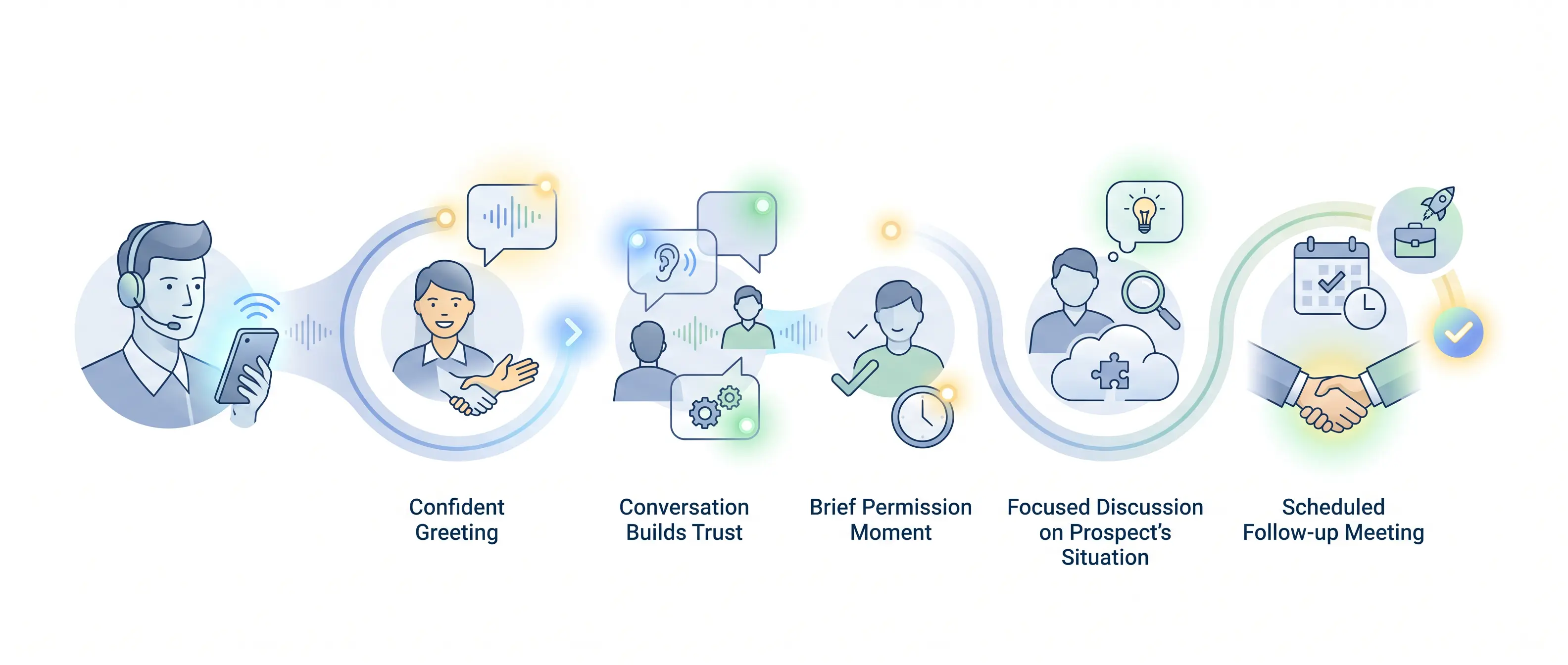
Here is the difference between a script that reads like a telemarketer and one that reads like a person.
Bad opener:
"Hi, is this Susan? Hi Susan, my name is Alex Rivera and I'm calling from Meridian Solar. Did I catch you at a bad time? Great. So the reason I'm calling is we're a leading provider of residential solar solutions and I wanted to see if you'd be interested in learning about how we can help you save on your energy bills..."
That script fails three ways: it asks permission to be rejected, it announces a category ("leading provider"), and it never says why this person is being called.
Good opener:
"Hey Susan, it's Alex over at Meridian. How have you been?"
[Let them answer. Do not fill the pause.]
"So the reason for my call is that you pulled a permit on Oakview last month, and we just finished two installs on that street. Can I take 30 seconds and you tell me if it's worth more?"
That version uses the 6.6x opener, states the reason for the call explicitly (a 2.1x lift on its own), anchors on a specific, checkable fact, and asks for 30 seconds rather than a meeting. Ask small, get the conversation, earn the meeting.
Key takeaway: name the reason for your call in the first ten seconds. "The reason for my call is..." lifts success 2.1x, and it costs you nothing.
The 30-second pitch frame
Once they grant the 30 seconds, the structure that survives contact is: observation, consequence, question. Never observation, feature, feature, feature.
- Observation: something true and specific about them. "You have nine agents on the roster and one main line."
- Consequence: the cost of that, in their language. "Which usually means after-hours leads ring out and go to whoever calls back first."
- Question: hand it back. "How are you handling the ones that come in after six?"
Then stop talking. The rep who talks through the answer loses the call. On a 93-second average, every sentence you add is a sentence they do not get to say.
Key takeaway: observation, consequence, question. Three beats, then silence. The pitch is what you say after they tell you what is broken.
Industry variants that actually change the words
A generic script is a script nobody believes. The observation line is what changes by industry.
Insurance: "The reason for my call is your renewal book hits in October, and most agencies your size start the retention calls in August and run out of hours by week two. How are you splitting renewals against new business right now?"
Real estate: "The reason for my call is you have four listings that went stale past 60 days on market. Most teams stop calling those leads at day 30. What happens to yours?"
Home services and HVAC: "The reason for my call is it hit 98 degrees Tuesday and your phones almost certainly rang more than you could answer. What happened to the calls you missed?"
Financial services: "The reason for my call is your advisors are chasing the same leads your website generated last quarter, and speed to first contact usually decides who wins them. How fast are you dialing a new inquiry?"
Recruitment: "The reason for my call is you have six roles open on your careers page that have been live since May. How many of those candidates are you reaching on the first call?"
Key takeaway: the observation line is the script. If you can send the same sentence to two prospects without editing it, delete it.

Objection handlers
Objections in the first 20 seconds are reflexes, not positions. Handle them as reflexes.
"I'm not interested."
❌ Wrong: "I understand, but if you could just give me two minutes to explain the value..."
✅ Right: "That's fair, you have no idea who I am yet. The reason I called was the Oakview permit specifically. If that's not a thing for you, I'll leave you alone. Is it not a thing?"
"Send me an email."
❌ Wrong: "Sure! What's the best address?"
✅ Right: "Happy to. So I don't send you something useless, are you trying to fix the after-hours calls, or is it more the follow-up on the old leads?"
"We already use someone."
❌ Wrong: "Oh, who are you with? We're actually much better than them."
✅ Right: "Good, I'd be worried if you didn't. Most people I talk to who have that in place still lose the after-hours calls. Is that clean for you, or is it a known gap?"
"How much is it?"
❌ Wrong: "It depends on a lot of factors, let's set up a call with our team."
✅ Right: "It starts at $40 a seat on monthly billing and goes up to $100 depending on the AI you turn on. Whether it's worth it depends on what a missed call costs you. What's a booked job worth?"
Answer the price question. Dodging it is the single fastest way to signal that you are running a play instead of having a conversation.
Key takeaway: never argue with a reflex. Agree, then ask one question that makes them tell you whether the problem is real.
The voicemail script
Most dials end in voicemail, so the voicemail is not an afterthought, it is most of your output. Keep it under 20 seconds and give exactly one reason to call back.
"Susan, Alex at Meridian, 555-0142. Calling about the Oakview permit, we finished two installs on that street and I think you're leaving money on it. If that's worth 30 seconds, call me back at 555-0142. If not, ignore me and I won't chase you."
Say the number twice, at the start and the end, because that is when they are holding the phone. Never leave the pitch in the voicemail. The voicemail sells the callback, not the product. There is more on this in our guide to voicemail scripts that get callbacks.
Key takeaway: the voicemail sells the callback, not the product. One reason, your number twice, under 20 seconds.
When to run the script
The best script dialed at the wrong hour is a voicemail. Cognism's 2025 data:
- Best day: Tuesday.
- Best window: 10 to 11 AM, then 2 to 3 PM.
- Avoid: 7 to 9 AM, the noon lunch hour, and the 5 PM commute.
- Persistence: 93% of conversations happen by the third attempt, and a callback reaches the prospect 26.85% of the time.
The third attempt matters more than the script rewrite. RAIN Group's Top Performance in Sales Prospecting study, built on 488 buyers representing $4.2 billion in purchases across 25 industries and 489 sellers, found Top Performers drive 2.7x more conversions and 1.8x more quality outcomes than the rest. The gap is not a magic phrase. It is targeting and follow-through.
Key takeaway: Tuesday at 10 AM with the third attempt beats Monday at 8 AM with a better script.
Before you dial: the part scripts cannot fix
A script is copy. It is not permission. Before a campaign goes out, confirm the list is one you are allowed to call, and confirm anyone who has asked you to stop is actually suppressed.
Be precise about how suppression works, because the two channels are not the same. In Aloware, a contact replying STOP suppresses further texts to that contact. It does not by itself stop calls. Calls stop through the internal do-not-call and suppression list, which is what you add a contact to when they ask you not to call again. Aloware does not scrub lists against the national or state DNC registries through a partner, so if your program requires registry scrubbing, that happens upstream of the dialer and stays your responsibility.
Key takeaway: STOP suppresses texts. The internal do-not-call list stops calls. Registry scrubbing is on you.
Why good scripts still fail
You can run the 10.01% opener and still get nothing, because the opener only matters if the call connects and the prospect trusts the number on the screen. Two things break that:
- Nobody picks up.If your number is flagged "Spam Likely," your script never gets read aloud. That is a carrier reputation problem, not a copy problem, and it is fixed with number monitoring and remediation. NumberGuard handles the flag side, and Branded Caller ID puts your business name on the screen so the contact knows who is calling before they answer.
- Reps do not make enough calls to find out. At a 2.3% average success rate, script quality is invisible until volume is high enough to measure. Manual dialing between CRM tabs does not get you there. Aloware's Power Dialer dials one contact at a time with the full contact history on screen and drops a voicemail instantly when nobody answers, so the rep says the script and moves on instead of typing.
Track it honestly once it is running. Our breakdown of the cold calling metrics that matter covers which numbers tell you the script is working, and 15 cold calling tips that actually work covers the delivery habits around the words. Plans and what each one includes are on Aloware pricing.
Key takeaway: a script problem and a pickup problem look identical on a dashboard. Check whether the phone is ringing before you rewrite the words.
Bottom line
Cold calling scripts do not fail because the words are wrong. They fail because the rep asks permission to be rejected in the first four seconds, never says why they called, and gives up on attempt one. Fix those three and you are running the 10.01% opener instead of the 0.9% one, on a list you are allowed to call, from a number that does not display as spam. The script is the cheapest part of that stack to fix, so fix it first, then go fix the rest.
Frequently Asked Questions
What is the best cold calling opener?
"How have you been?" books meetings at a 10.01% success rate against a 1.5% baseline, according to Gong's analysis of 90,380 cold calls. That is 6.6x baseline and the strongest opener in that dataset. It works because it implies a prior relationship, which buys you a couple of seconds of curiosity instead of an instant brush-off. Follow it immediately with "the reason for my call is," which lifts success another 2.1x on its own.
Should I ask "Did I catch you at a bad time?"
No. It is the worst-performing opener measured in Gong's dataset, at a 0.9% success rate against a 1.5% baseline, making you 40% less likely to book a meeting. The problem is structural rather than tonal: the question hands the prospect a scripted exit, and they take it. Openers that assume the call is welcome outperform openers that apologize for it.
How long should a cold call be?
The average cold call runs 93 seconds, per Cognism's 2025 data, up from 83 seconds previously. Write your script for 93 seconds, not for a ten-minute discovery conversation. Successful calls do run longer, but length is the result of a good call rather than the cause of one. Aim to earn the next 30 seconds, repeatedly, rather than to deliver a complete pitch.
What is a good cold calling success rate?
Cognism's 2025 data puts the average cold call success rate at 2.3%. Gong's baseline across 90,380 calls was 1.5%. Both are the rate at which a cold call turns into a booked meeting. If you are converting above 5%, you are doing genuinely well. Because the numbers are this small, you cannot judge a script on 20 dials. You need volume before the data means anything.
How many times should I call a prospect?
At least three. Cognism's 2025 data shows 93% of conversations occur by the third attempt, and it takes roughly three cold calls on average to connect. A callback attempt reaches the prospect 26.85% of the time. Stopping after one dial throws away most of your list, and it is a far more common failure than a weak script.
What is the best day and time to cold call?
Tuesday, between 10 and 11 AM, followed by 2 to 3 PM, according to Cognism's 2025 data. Avoid 7 to 9 AM, the noon lunch hour, and the 5 PM commute. Timing is the cheapest variable to fix in a cold calling program: the same script dialed in the wrong window is just a voicemail.
Should I read a cold calling script word for word?
Read the opener and the reason-for-call line word for word, because those are the parts that have actually been measured. Improvise everything after the prospect starts talking. A script is a structure for the first 20 seconds, not a teleprompter for the full 93. Reps who read the whole thing sound like they are reading the whole thing, and prospects hang up on that.
How do I handle "send me an email"?
Agree, then qualify. "Happy to. So I don't send you something useless, are you trying to fix the after-hours calls, or is it more the follow-up on the old leads?" You win either way: if they answer, you have qualified them and the email you send is actually relevant. If they don't, you have learned the objection was a brush-off and you have not wasted a follow-up on it. Arguing with the request is what fails.
Do cold calling scripts work if my number shows as spam?
No. If your number is flagged "Spam Likely," the script is never heard, because the call is not answered. That is a carrier reputation problem rather than a copy problem, and rewriting the opener will not touch it. Fix it with number monitoring and spam-flag remediation, and use branded caller ID so your business name displays before the contact decides whether to pick up.
Does a cold calling script make my calls compliant?
No. A script is copy, not consent. Before a campaign runs, confirm the list is one you are permitted to call and that anyone who asked you to stop is actually suppressed. Be precise about how suppression works: in Aloware, a contact replying STOP suppresses further texts to that contact, and it does not by itself stop calls. Calls stop through the internal do-not-call and suppression list. Aloware does not scrub lists against the national or state DNC registries through a partner, so registry scrubbing happens upstream of the dialer and remains your responsibility.
.png)

Ruby Kootval is Head of Product Marketing at Aloware. She has 12 years in digital marketing, including 8 in B2B SaaS and 5 in telecom, and writes about AI voice agents, dialers, CRM integrations, and contact center operations.