

.webp)
TL;DR
For a sales team dialing out of a CRM, the best cold calling software in 2026 is Aloware: a single-line Power Dialer embedded in HubSpot, Salesforce, Pipedrive, Zoho, or GoHighLevel, on the uPro + AI plan from $60 per user per month on the quarterly plan ($70 month to month; Salesforce needs xPro + AI, from $85 on the quarterly plan), with the Pickup Stack (number reputation, branded calling, local presence) as a separately priced add-on. The rest of the field splits by job. PhoneBurner sells standalone per-seat power dialing; Orum and Nooks sell maximum-volume parallel dial blocks; Aircall sells a mixed inbound/outbound cloud phone; Bland AI and Retell AI sell per-minute AI callers. Per-seat and per-minute tools price on incompatible units, so convert both to cost per conversation at your real volume before comparing anything.
Key facts:
- 19.93% of 55,373,863 outbound dials on Aloware connected (completed with at least 30 seconds of talk time, September 2025 to August 2026). Teams in their first 30 days on the platform connected 16.73% of dials; teams past their first year connected 20.44%.
- 86% of unknown calls go unanswered, per Hiya's State of the Call 2026 survey of 12,000+ consumers across six countries.
- 82% of Americans have ignored an important call or text out of scam fear, up from 59% in 2024, per Truecaller's 2026 survey of 1,614 U.S. adults.
- A signed call is still a labelable call: STIR/SHAKEN signing, carrier spam analytics, and branded display are three separate systems making three separate decisions.
- Aloware: the Power Dialer comes on uPro + AI at $60 per user per month on the quarterly plan ($70 month to month). AloAi Voice Agent calls start at $0.10/minute. The Pickup Stack is a separately priced add-on.
We first checked every tool on this list against its live public pricing on July 20, 2026, re-read every vendor's pricing page on October 12, 2026, and ranked the field for one job: getting a cold call answered by a stranger. The winner is not the fastest dialer.
That stops being surprising once you follow a dial after it leaves your software. Your rep clicks call. Your platform connects it. Then a system your software does not own decides whether the phone in someone's hand says your company name, says nothing, or says "Scam Likely." Everything you bought the dialer for happens before that moment. Everything that determines revenue happens after it.
How we evaluated
Criteria, in the order they affect revenue:
- Effect on answer rate. Does the tool do anything about number reputation, or does it only place calls faster?
- CRM depth. Does every call, disposition, and recording land on the record without a rep touching anything?
- Compliance posture. Consent handling, suppression of contacts who opt out, and dialing behavior that does not train carrier models against you.
- Total cost at real volume, including the fees that sit outside the headline rate.
- AI overflow. What happens to the calls your reps cannot get to.
What this ranking is built on: every price below was pulled from the vendor's public pricing page on July 20, 2026, and the criteria were scored from each vendor's published documentation plus our own operating experience running CRM-embedded outbound. What we did not evaluate: international calling quality outside the US and Canada, and contact center workforce management. Neither is what a high-volume outbound sales team buys this software for.
Quick comparison
| Tool | Pricing (re-read Oct 12, 2026) | Built for | Key constraint |
|---|---|---|---|
| Aloware | $60/user/mo (uPro + AI with the Power Dialer, quarterly plan; $70 month to month) | High-volume outbound inside a CRM | Pickup Stack priced separately |
| PhoneBurner | $140/user/mo billed annually ($165 monthly) | Standalone per-seat power dialing | Dialer sits beside the CRM, not inside it |
| Orum | No published price (request pricing; priced by package and number of users) | Power and parallel dialing for SDR teams | Quote-based buying |
| Nooks | No published pricing (custom quote) | Parallel dialing inside a new sales workspace | Quote-based buying, platform migration |
| Aircall | $30–$50/license/mo billed annually (3-license minimum) | Mixed inbound/outbound cloud phone | Power Dialer gated to the $50 Professional tier |
| Bland AI | $0.14/min at $0 platform fee; $0.12/min + $299/mo; Enterprise custom | Per-minute AI calling | Assumes AI places the calls |
| Retell AI | $0.07–$0.31/min, usage-based | Usage-based AI voice agents | AI layer only, no human dialer |
Notice the units. A per-seat tool and a per-minute tool cannot be ranked against each other on price until you convert both to cost per conversation at your actual volume. Most lists in this category never do that conversion, which is how a per-minute headline rate beats a $60 seat on a comparison chart while losing badly in production.
1. Aloware: the pick for teams that dial from a CRM
Best for: outbound sales teams running high daily dial volume out of HubSpot, Salesforce, Pipedrive, Zoho, or GoHighLevel.
Pricing: the Power Dialer comes on uPro + AI at $60 per user per month on the quarterly plan ($70 month to month). xPro + AI, from $85 on the quarterly plan ($100 month to month), adds the Salesforce integration. iPro + AI ($30 on the quarterly plan) covers calling and texting without the Power Dialer. AloAi Voice Agent calls are priced per minute starting at $0.10, rising by model tier to $0.50 for Ultra Premium.
Free trial: yes.

Why Aloware is the pick
Aloware is the only tool in this list that treats the answer rate as a product surface instead of someone else's problem.
The Power Dialer calls a list one contact at a time, with the rep live on the line when the prospect picks up. No connect delay, no dead air, no abandoned calls. Every call logs itself to the CRM record, including disposition and recording, so a rep making a hundred dials a day never copies a phone number or switches a tab. That sounds like a convenience feature. It is a compliance feature: silent, unlogged calls are how consent records go missing.
The Pickup Stack is where the ranking is earned. It is three components, and it is an add-on priced separately from your seats:
- NumberGuard monitors your numbers on real devices across AT&T, T-Mobile, and Verizon, catches spam and scam mislabeling, and negotiates remediation with the carriers. Remediation runs 1 to 3 business days on AT&T and T-Mobile, 3 to 5 on Verizon. It covers US numbers, and it is priced per number tier.
- Branded Calling displays your verified business name at ring time on T-Mobile and Verizon, with AT&T listed as coming. It is priced per call.
- Local Presence matches your outbound number to the prospect's area code.
Be clear-eyed about what this costs and what it buys. The Pickup Stack is not bundled into a plan, and anyone who tells you reputation management is free is selling you the version that does not work. It is also not optional in practice. Outbound runs fine without it for a few weeks, then reputation decays, labels land, and pickup collapses. You are already paying for that decay. You are just paying for it in unanswered dials instead of on an invoice.
AloAi Voice Agent catches what the team cannot. Inbound calls get answered instead of ringing out, every conversation is transcribed, and entities sync back to the CRM. On a cold calling team the highest-value use is the callback: a prospect returns your dial at 7pm and reaches a conversation instead of voicemail.
What it looks like in the field
An insurance agency running renewal outbound was dialing from a small pool of numbers and watching connect rates slide week over week. The dialer was not broken. The numbers were burned, and burned numbers do not recover on their own. NumberGuard surfaced the labels, remediation cleared them, and Branded Calling put the agency name on the screen at ring time. Same reps, same list, same script. Different outcome, because the calls were arriving as a business instead of as an unknown number.
The same pattern shows up in real estate, where speed to lead collides with number reputation, and in solar, where high dial volume against purchased lists burns numbers fastest.
Pros and cons
Pros: deepest CRM integration in the category, Power Dialer and Pickup Stack and AI voice agent in one operations layer, per-seat pricing that does not scale with call minutes, every call logged automatically.
Cons: advanced workflow customization has a learning curve. Aloware runs a free onboarding webinar, and most of the curve is front-loaded into the first week of setup.
Choose Aloware if your reps dial from a CRM every day and your answer rate is trending the wrong way.
Want to see the Pickup Stack in your own outbound? Book a 20-minute demo and we'll show NumberGuard, Branded Calling, and Local Presence on a live call.
Where each other tool fits
PhoneBurner. A per-seat power dialer listed at $140/user/month billed annually ($165 monthly), built around dialing throughput and voicemail drop for teams that want the dialer as its own standalone tool beside the CRM. That shape suits teams without a CRM-first workflow; once reps live inside CRM records all day, the separate-seat model pushes call logging and consent history onto a sync instead of the record itself.

Orum. A dialer for SDR teams running maximum-volume call blitzes, with power and parallel dialing in the same plan. It publishes no price: pricing goes by package and number of users through a pricing request, and AI coaching is sold as an add-on. For number health its pricing page lists Number Temperature (hot and cold numbers) and up to 10 caller IDs a month, which manages the wear that parallel dialing creates. What that pattern costs you is priced out in the next section.
Nooks. A quote-priced sales workspace whose dialer runs parallel calling with AI answer detection, built for teams consolidating calling, sequencing, and coaching into one new platform. Buying it is a platform migration with contact-sales pricing, a fit for teams re-platforming the whole outbound motion rather than adding a calling layer to the CRM they already run.

Aircall. A cloud phone system at $30 to $50 per license/month billed annually with a 3-license minimum, built for mixed inbound/outbound teams that want IVR, queues, and shared numbers in one phone layer. The outbound sales tooling arrives at the $50 Professional tier, where the Power Dialer and voicemail drop live, and number-reputation management is not the product's center of gravity.

Bland AI. A per-minute AI calling platform at $0.14/minute with no platform fee on its Start tier, $0.12/minute plus a $299 monthly platform fee on Build, and quote-based Enterprise pricing, with no separate token or model charges. The cost model assumes AI is placing the calls, which fits automated outreach programs rather than teams whose reps do the selling.

Retell AI. A usage-based AI voice agent platform at a published $0.07 to $0.31 per minute depending on model and configuration, pay-as-you-go from zero. It is scoped to the AI calling layer alone, for teams building an automated calling function rather than equipping a human one.
Two adjacent categories sit deliberately outside this list: general UCaaS suites (Dialpad, RingCentral) that carry outbound sales calling as one feature among many, and developer voice platforms (Vapi) or enterprise-contract AI systems (Synthflow) that assume you are assembling a stack, not shortlisting a tool.
Why one call at a time beats dialing four
Parallel and predictive dialers call several numbers at once and connect a rep after someone says hello. That design creates a signature.
❌ The old way: the prospect answers and hears one to three seconds of silence while the system finds a rep. They know exactly what that silence means, and they hang up. Worse, the carrier's analytics engine recognizes the same silence-gap pattern and starts scoring the number as a robocaller. When the rep count runs short, the call gets abandoned entirely, which is both a bad experience and TCPA exposure.
✅ The new way: one live call at a time, rep already on the line, zero dead air. Nothing to detect, nothing to abandon, nothing training the carrier model against your number.
Aloware does not offer a parallel dialer, and that is deliberate. Parallel dialing buys dial volume by spending number reputation, which is the one asset that determines whether tomorrow's dials connect. Any tool selling you four simultaneous lines is selling you next quarter's answer rate.
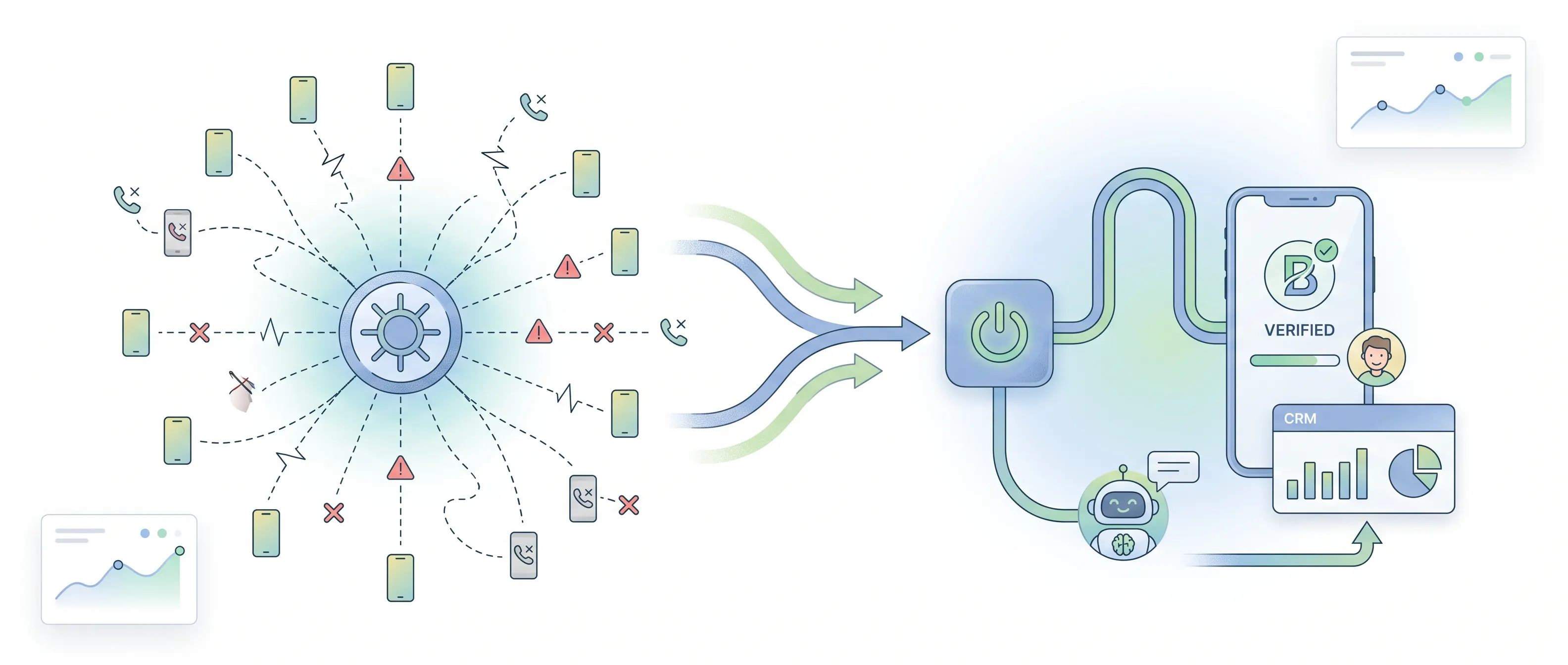
Key takeaway: Treat your phone numbers like a credit score. Parallel dialing spends the score to buy volume, and the bill always arrives.
Why cold calling software is really a pickup problem
Every buying guide in this category ranks tools by dials per hour. That metric made sense when the constraint was rep effort. The constraint moved.
Hiya's State of the Call 2026 found that 86% of unknown calls go unanswered. Truecaller's 2026 survey of 1,614 U.S. adults found 82% have ignored an important call or text out of fear it was a scam, a jump from 59% in 2024. Your prospects are not screening you personally. They are screening a category, and your unbranded 10-digit number is in it. Numbers flagged as spam, and the pickup drop that follows, are among the most repeated pains buyers bring to our own sales calls.
Does connect rate rise without more dials?
Our own dial logs give a measured answer. Across 55,373,863 outbound dials placed on Aloware between September 2025 and August 2026, 19.93% connected, which the study counts as a completed call with at least 30 seconds of talk time. Teams in their first 30 days on the platform connected 16.73% of their dials. Teams past their first year connected 20.44%.
Dial volume per rep did not climb over the same stretch. The median rep business day carried 26.9 outbound dials in a team's first 30 days and 19.0 after its first year, and the 75th-percentile rep day sat between 70.5 and 83.1 dials in every tenure bucket.
Two limits apply. This is a cross-section of every account dialing in that year, not one set of teams followed over time, and the rep-day counts leave out system-placed dials with no rep attached. Within those limits, connect rate rose with time on the platform and dials per rep did not rise. The study cannot tell you what adding dials does to one rep's conversations; it shows higher connect rates arriving without higher dial counts per rep. Speed is the cheapest variable to buy and the least important one to fix.

Key takeaway: Dial rate is a rep-effort metric. Answer rate is a revenue metric. Buy for the second one.
Signed is not the same as trusted
Vendors blur three separate systems. Keep them apart.
STIR/SHAKEN signing happens at your originating service provider, not in your dialer. It attests that the caller has the right to use the number. TNS's 2026 Robocall Investigation Report found 85% of traffic between Tier-1 carriers was signed in 2025, while traffic between smaller carriers was signed only 17.5% of the time. Signing is uneven, and it is not a trust score.
Carrier analytics labeling is a different system entirely. Hiya's own documentation is blunt about it: registration "doesn't mean you'll never be marked as spam," because spam analytics "varies by carrier and generally uses data modeling and AI to detect calls that look suspicious." Dial 300 numbers an hour from a fresh line and you look suspicious, because you are behaving identically to the thing the model was trained to catch.
Branded display is a third system that shows your business name at ring time. Branded display does not remove a spam label. A call can be signed, branded, and still labeled, because three independent systems are making three independent decisions.
Key takeaway: Signed ≠ trusted ≠ answered. Any vendor who collapses those three into one checkbox is selling you a checkbox.
How to choose cold calling software for your team
- If your answer rate is falling, do not buy a faster dialer. Buy number reputation management first. Start with why your calls get flagged in the first place.
- If your reps live in a CRM, the dialer must be native to it. A separate seat next to the CRM means manual logging, and manual logging means missing consent records.
- If you are on Salesforce, evaluate against the Salesforce dialer field specifically, because CTI depth varies more than the marketing suggests.
- If you are comparing dialers generally, our sales dialer comparison covers the category by dialer type.
- If you want AI to place the calls, price it per minute and run the conversion honestly. At 4,000 minutes a month, a $0.12/min tier with a $299 platform fee is $779, and a $0.14/min tier with no platform fee is $560 (both rates as one AI calling vendor published them on October 12, 2026). Compare that to seats at the same conversation count, not to a headline rate.
- If your problem is missed inbound, an outbound dialer is the wrong purchase. Look at number reputation and AI call answering instead.
How to evaluate any tool on a live demo
Do not buy from a feature table, including this one. Run the same 30-minute test on every tool you shortlist:
- Load a real list from your CRM, not the vendor's sample data, and run a live call block.
- Watch the moment of connect. Is the rep already live when the prospect says hello, or is there a beat of dead air? That beat is your abandonment-and-spam signature.
- Hang up and open the CRM record. The call, disposition, and recording should already be there. If the rep has to click save, multiply that click by every dial your team makes in a quarter.
- Leave a voicemail and send the follow-up text without leaving the workflow.
- Ask the number-reputation questions: who monitors your numbers on real devices, who negotiates label remediation with the carriers, and what happens the week a number gets flagged. Vague answers here predict your answer rate in month three.
- Run the per-minute math if AI is placing calls: minutes × rate + platform fee at your real volume, against seat pricing for the same conversation count.
Key takeaway: a demo proves the workflow. Only the reputation questions prove the answer rate.
Bottom line
Cold calling is not dying. Lazy cold calling is. The tools that win in 2026 are not the ones that help a rep dial more numbers into a network that has already decided not to trust them. They are the ones that make the phone ring as a business.
Buy the answer rate. The dials are the easy part.
Aloware is the pick because it is the only option here that owns the whole path from CRM record to answered call. Book a 20-minute demo and we'll run your numbers through NumberGuard live.

Pricing and product availability were first verified against each vendor's public pricing page on July 20, 2026, re-read on October 12, 2026, and are subject to change. Aloware publishes this comparison as the maker of one of the tools reviewed; every competing product's description is drawn from its own public documentation.
Frequently Asked Questions
What is the best cold calling software in 2026?
For a sales team dialing out of a CRM, Aloware. The evaluation turns on answer rate rather than dial speed: Aloware embeds a single-line Power Dialer in HubSpot, Salesforce, Pipedrive, Zoho, or GoHighLevel, logs every call and disposition automatically, and pairs it with the Pickup Stack, the separately priced number-reputation layer (NumberGuard, Branded Calling, Local Presence) that determines whether calls ring as a business or as an unknown number. With 86% of unknown calls going unanswered per Hiya's State of the Call 2026, dial volume is no longer the constraint. Answer rate is. The Power Dialer comes on uPro + AI, from $60 per user per month on the quarterly plan ($70 month to month); Salesforce needs xPro + AI, from $85 on the quarterly plan.
How much does cold calling software cost?
It depends which of two categories you are buying, because they price on incompatible units. Per-seat human dialers list from $60 per user per month (Aloware uPro + AI with the Power Dialer, on the quarterly plan) up to $140 to $165/user/month at the premium end of standalone power dialers, with cloud phone systems in the $30 to $50 per license range on annual billing. Per-minute AI callers list from $0.07 to $0.31 per minute usage-based, and some platforms add a monthly platform fee, such as $299 on a higher-volume tier. Convert both models to cost per conversation at your real volume before comparing. Prices re-read on public pricing pages on October 12, 2026.
Why are my cold calls being marked as spam?
Because a carrier analytics system scored your number as suspicious based on how it behaves. This system is separate from STIR/SHAKEN signing, which is a common point of confusion. Signing happens at your originating service provider and attests that you have the right to use the number. It is not a trust score and does not prevent a spam label. As Hiya's own documentation states, registration "doesn't mean you'll never be marked as spam," because spam analytics varies by carrier and uses data modeling to detect calls that look suspicious. High dial volume from a fresh number, short call durations, and low answer rates all look like the pattern those models were trained to catch.
Does STIR/SHAKEN stop my calls from being labeled as spam?
No. STIR/SHAKEN and spam labeling are two independent systems. STIR/SHAKEN signing happens at the originating service provider and attests that the caller is authorized to use the number. Spam labeling is a separate carrier analytics layer that scores calling behavior. A call can be fully signed and still get labeled. Signing is also uneven across the network: TNS's 2026 Robocall Investigation Report found 85% of traffic between Tier-1 carriers was signed in 2025, while traffic between smaller carriers was signed only 17.5% of the time. Branded display is a third separate system. Signed, trusted, and answered are three different things.
Is a power dialer better than a parallel or predictive dialer?
For cold calling, yes. Parallel and predictive dialers call several numbers simultaneously and connect a rep after someone answers, which creates a one to three second silence gap at the start of the call. Prospects recognize that silence and hang up. Carrier analytics engines recognize the same signature and score the number as a robocaller. When no rep is free, the call is abandoned entirely, which is both a poor experience and TCPA exposure. A power dialer calls one contact at a time with the rep already live, so there is no dead air and nothing training carrier models against your number. Aloware does not offer a parallel dialer, and that is a deliberate product decision.
What is the Pickup Stack?
The Pickup Stack is Aloware's term for the three components that determine whether your outbound calls get answered: NumberGuard, which monitors your numbers on real devices across AT&T, T-Mobile, and Verizon and negotiates remediation when they are mislabeled; Branded Calling, which displays your verified business name at ring time on T-Mobile and Verizon, with AT&T listed as coming; and Local Presence, which matches your outbound number to the prospect's area code. The Pickup Stack is an add-on priced separately from your seats. It is not bundled into a plan. Outbound works without it for a few weeks, then number reputation decays, labels land, and pickup rates collapse.
Can AI voice agents replace cold calling reps?
Not for the selling itself, but they close specific gaps well. The highest-value use on an outbound team is coverage: answering the callback that comes in at 7pm, handling overflow when every rep is on a call, and making sure inbound never rings out. AloAi Voice Agent transcribes every conversation and syncs entities back to the CRM, so a call handled by AI still produces a usable record. Pricing starts at $0.10 per minute and rises by model tier to $0.50 for Ultra Premium. Note that AI Voice Agent minutes are separate from AI Voice Analytics, which is the transcription and conversation intelligence included with plan limits.
How many dials per day should a cold calling rep make?
On Aloware, the median rep business day carried 19.0 to 26.9 outbound dials and the 75th-percentile rep day 70.5 to 83.1, depending on how long the team had been on the platform (September 2025 to August 2026, system-placed dials excluded). Those counts did not rise as teams matured, while connect rate did: 16.73% of dials connected in a team's first 30 days and 20.44% after its first year, across 55,373,863 outbound dials in a cross-section of all accounts. Dial count is a rep-effort metric. Instead of setting a dial quota, fix the answer rate first through number reputation management and branded display, then set activity targets based on conversations rather than attempts. If your dial count is climbing while your connect rate falls, you are accelerating toward burned numbers.
Does cold calling software integrate with HubSpot and Salesforce?
Integration depth varies far more than the marketing suggests, and the difference matters. Aloware integrates natively with HubSpot, Salesforce, Pipedrive, Zoho, and GoHighLevel, with Salesforce available on the xPro plan. Every Power Dialer call, disposition, and recording logs to the CRM record automatically, which is a compliance feature as much as a convenience one: silent, unlogged calls are how consent records go missing. Standalone dialers that sit next to your CRM rather than inside it push logging back onto reps. When evaluating, test whether a call places from the CRM record itself and whether the outcome writes back without anyone clicking save.
What should I look for when choosing cold calling software?
Rank these criteria in the order they affect revenue. First, effect on answer rate: does the tool manage number reputation, or does it only place calls faster? Second, CRM depth: does every call log itself to the record without rep effort? Third, compliance posture: consent handling, suppression of contacts who opt out, and dialing behavior that does not train carrier models against you. Fourth, total cost at your real volume, including fees outside the headline rate. Fifth, AI overflow for the calls your reps cannot reach. Most buyers invert this list and start with dial speed, which is the cheapest variable to buy and the least important one to fix.
Is cold calling still effective in 2026?
Yes, but lazy cold calling is not. The network changed underneath the tactic. Hiya's State of the Call 2026 found 86% of unknown calls go unanswered, and Truecaller's 2026 survey found 82% of Americans have ignored an important call or text out of fear it was a scam, up from 59% in 2024. Prospects are not screening you personally, they are screening a category that your unbranded 10-digit number belongs to. Teams that manage number reputation, display a verified business name at ring time, and dial one contact at a time still connect. Teams that buy a faster dialer and point it at a burned number do not.
Does Aloware offer a free trial for its cold calling software?
Yes. Aloware offers a free trial, and a 20-minute demo is the faster way to evaluate whether it fixes your specific problem, because the answer-rate question depends on the current state of your numbers. On a demo, the team can run your existing numbers through NumberGuard and show whether they are carrying spam or scam labels right now. That diagnostic is usually more informative than a trial, since a trial on already-burned numbers measures the damage rather than the platform. The Power Dialer comes on uPro + AI, from $60 per user per month on the quarterly plan ($70 month to month), with the Pickup Stack priced separately as an add-on.
.png)

Ruby Kootval is Head of Product Marketing at Aloware. She has 12 years in digital marketing, including 8 in B2B SaaS and 5 in telecom, and writes about AI voice agents, dialers, CRM integrations, and contact center operations.
.webp)