

TL;DR
There's no single power dialer that universally improves connection rates the most — published benchmarks vary widely, use different definitions, and come almost entirely from vendors themselves. What the data does show is that the lift comes from features, not the brand name:
- Local presence dialing — matching outbound caller ID to the prospect's area code
- Spam-risk mitigation and caller ID reputation monitoring — protecting numbers before they get flagged
- Branded calling — showing your business name and logo before the prospect answers
- Live-human detection — connecting reps only when a person, not voicemail, picks up
- Better timing and lead data — calling at the right time with clean, consented lists
The strongest options in our evaluation, by use case:
- Aloware — best fit if your priority is CRM-native calling with the full pickup-rate stack (local presence, branded calling, real-time number reputation monitoring) in one platform
- Kixie — best fit if your primary problem is spam labeling and low answer rates; makes the largest published lift claim we found (up to 500%, per kixie.com)
- Orum — best fit for high-volume SDR teams focused on live conversation throughput; transparent benchmark of ~18% median connect-rate increase and ~5.3% platform-wide connect rate in 2023 (orum.com)
- PhoneBurner — best fit if rep productivity and simple power dialing matter more than aggressive pickup-rate tooling
These are self-reported numbers using different methodologies. Your actual results will depend on list quality, mobile vs. landline mix, call times, and which features you actually enable.
Why connection rates have dropped
The industry average for outbound B2B calls sits at 4–6%, roughly half of where it was five years ago. Three factors explain most of the decline:
- Carrier spam labeling. AT&T, Verizon, T-Mobile, and others use AI-driven analytics to flag numbers showing outbound sales call patterns. Once flagged, calls show as "Spam Likely" on the recipient's screen.
- Prospect behavior. Hiya's 2024 State of the Call report found that 87% of Americans don't answer calls from numbers they don't recognize.
- Caller ID trust gaps. Even verified STIR/SHAKEN calls show only a digit string if the receiving carrier doesn't support rich caller ID.
A faster dialer alone doesn't fix any of this.
Features that actually move the needle
How leading platforms compare on pickup-rate tooling
Last updated April 2026. Features and plans change frequently — verify current availability with each vendor before purchasing.
What the pickup stack actually does
NumberGuard monitors every outbound number in Aloware's pool across all major US carriers. When a number starts showing early signs of spam labeling, it's automatically rotated out of active use before it impacts the team's connect rates. This is preventive — most dialers react after numbers are already burned.
Branded Calling displays the Aloware customer's business name and verified logo on the prospect's screen before they decide to answer. Research from TNS and Hiya shows branded calls are picked up at 4x the rate of unbranded calls (25% vs. 6%) and stay on the line 4.6x longer (370 seconds vs. 80 seconds).
Local Presence matches the outbound caller ID to the prospect's area code automatically. Familiar area codes get answered more — not because of novelty, but because prospects recognize the region. Aloware rotates local presence numbers through NumberGuard to prevent reputation decay.
STIR/SHAKEN Level A attestation means the call is verified at the carrier level — the "verified caller" checkmark some phones display.
AI Missed Call Handler automatically sends a contextual SMS when a prospect misses a branded call. Hiya data shows 15% of prospects who miss a branded call return it, turning a missed dial into a follow-up conversation.
Together, these layers compound. A customer switching from a basic 1:1 dialer to Aloware's full pickup stack typically sees answer rates go from single digits to 15–25%, combined with a higher "Human Connect Rate" (answers plus callbacks) of 50%+.
Platform summaries
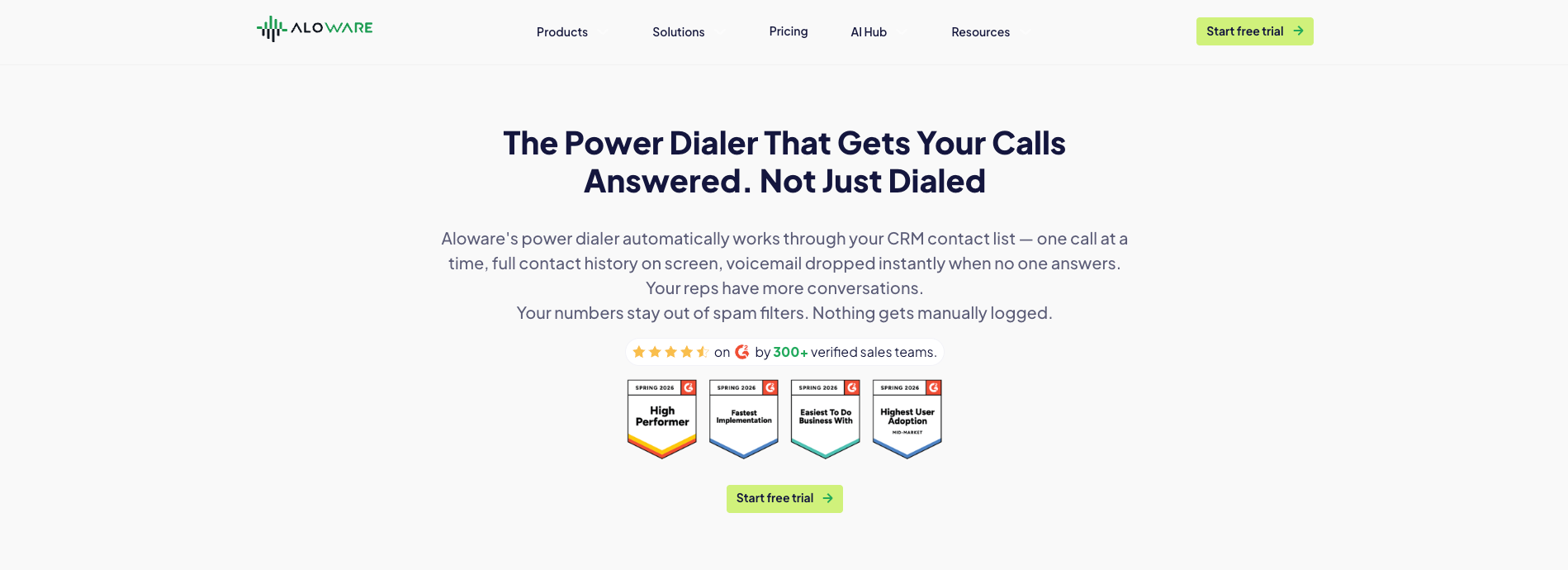
Aloware — Built for teams that want the full pickup-rate stack inside a CRM-native platform. NumberGuard monitors every outbound number in real time and rotates flagged numbers before they're burned. Branded calling shows your business name and logo pre-answer. Local presence and AI Missed Call Handler round out the stack. Best for SMB and mid-market teams running HubSpot, Salesforce, or Zoho who want fewer tools to manage. See the power dialer
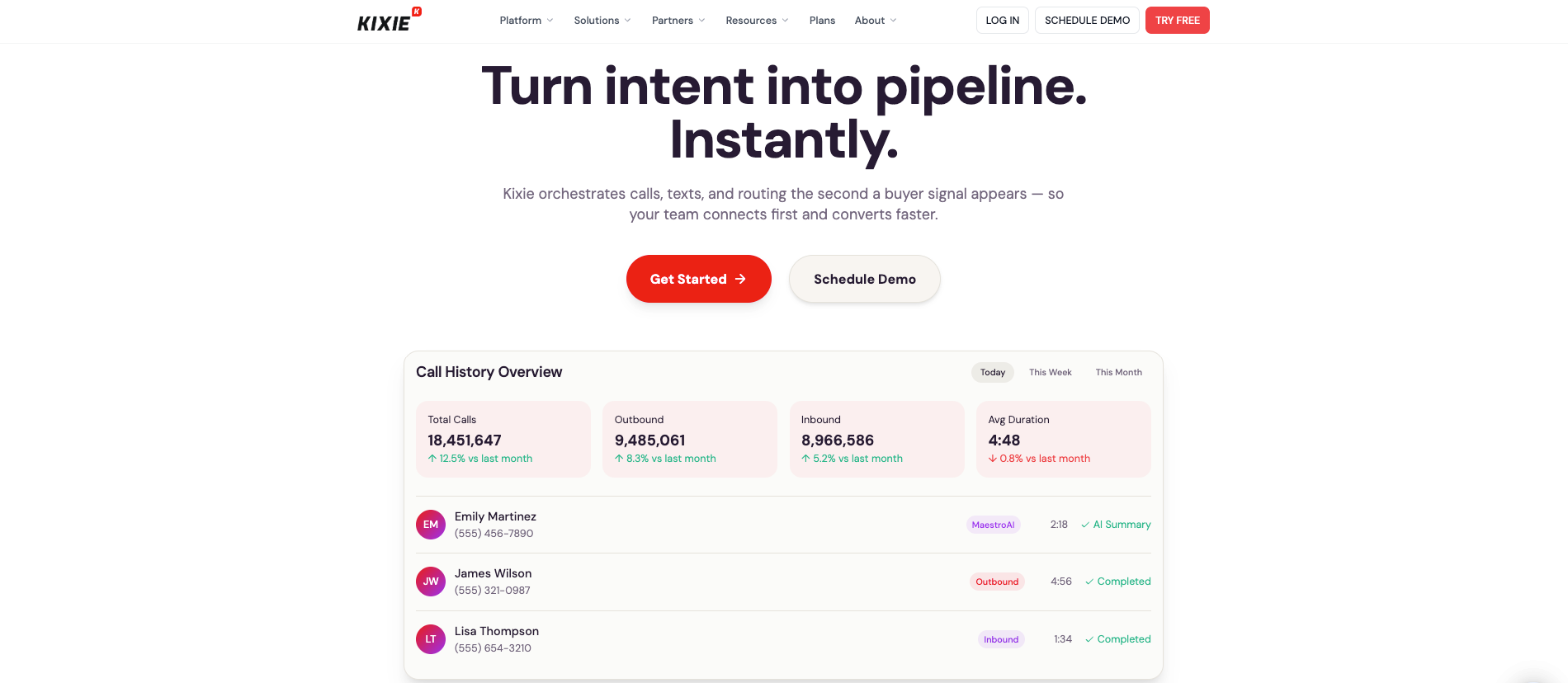
Kixie — Makes the largest published pickup-rate lift claim among dialers we reviewed (up to 500%, per kixie.com). Strong on local presence and spam-detection tooling. Offers automated multi-channel follow-up and CRM integrations with HubSpot, Salesforce, and Pipedrive. Best for teams whose primary problem is low answer rates due to caller ID and spam labeling. CRM integration depth varies by plan — confirm before buying.
Orum — A parallel dialer built specifically for high-volume SDR teams, with AI-powered live-transfer detection that connects reps only when a human picks up. Transparent about its platform-wide connect rate (~5.3% in 2023, with top performers doing significantly better). Lower emphasis on branded calling; stronger emphasis on maximizing live conversations per rep per hour. Best for enterprise SDR teams running large outbound sequences.
PhoneBurner — A reliable 1:1 power dialer with a clean rep experience, built-in voicemail drop, and solid productivity features. Clear pricing, no contracts. Does not emphasize aggressive pickup-rate tooling. Best when simplicity, rep speed, and predictable costs matter more than connection-rate optimization.

JustCall — Cloud phone system with a power dialer, number reputation alerts, and strong CRM integrations across HubSpot, Salesforce, Zoho, and others. STIR/SHAKEN supported. Branded calling is currently unavailable — verify with vendor for roadmap updates. Good fit for teams that need broad CRM coverage and solid outbound tooling without a heavy pickup-rate stack.
Dialpad — AI-native communications platform with built-in transcription, coaching, and call analytics. Offers a power dialer with local presence and basic reputation monitoring. Branded calling is limited — verify current plan availability. Better known for its AI productivity layer (real-time coaching, post-call summaries) than for connection-rate tooling specifically. Good fit for teams that prioritize conversation intelligence over raw pickup-rate optimization.
Nooks — A parallel dialing platform focused on SDR team productivity and live-call volume, similar in category to Orum. Emphasizes collaborative features (team dialing rooms, AI call research). Currently limited on branded calling and proactive reputation monitoring — verify with vendor. Best for teams prioritizing high-volume prospecting over a full pickup-rate stack.
RingCentral — A broad UCaaS and CCaaS platform with an outbound dialer, STIR/SHAKEN support, and basic reputation monitoring. Local presence and branded calling are available as add-ons depending on the plan — verify current availability with the vendor. Better known as a full communications suite (video, messaging, phone) than as a purpose-built sales dialer. Best for larger organizations that want a single platform covering internal and external communications, and where outbound dialing is one of many use cases rather than the core workflow.
When the problem isn't your dialer
Even the best pickup-rate tooling won't help if:
- Your list is stale. Calling the same unengaged contacts repeatedly burns numbers and signals spam behavior to carriers. Running lists through a phone number validator before importing reduces dead-end dials.
- You're calling at the wrong time. Most outbound research points to 10–11 am and 2–4 pm local time as the highest-pickup windows.
- You're over-dialing individual contacts. More than 2 calls per day or 6–8 per week increases the chance of carrier flagging.
- You're calling non-consented mobile numbers. TCPA complaints are used as spam signals by carriers. Aloware's compliant calling tools can help flag and filter non-consented contacts before they're dialed.
Related reading
Frequently Asked Questions
What is a good call connection rate for outbound sales in 2026?
A reasonable benchmark for cold B2B outbound is 10–15%. Teams using branded calling and local presence report rates closer to 20–25% in some contexts. Anything consistently under 5% usually points to burned numbers, stale lists, or missing pickup-rate features.
Does local presence dialing still work?
Yes, though less so on its own than a few years ago. Carriers now scrutinize accounts dialing many different area codes from a single account. Local presence works best when combined with real-time number reputation monitoring — so numbers rotate before they're flagged.
What is branded calling?
Branded calling displays your verified business name and logo on the recipient's screen before they decide to pick up. Research from Hiya and TNS shows branded calls are answered at roughly 4x the rate of unbranded calls, and average talk time increases significantly.
How do I tell if my outbound numbers are flagged as spam?
Call one of your outbound numbers from a personal mobile on a different carrier. If it shows "Spam Likely," it's flagged. For continuous monitoring across your full number pool, tools like FreeCallerRegistry, Hiya Connect, and Aloware's NumberGuard scan all major US carriers automatically.
Will a power dialer alone improve connection rates?
No — a power dialer improves dial efficiency, not pickup rates. To move the needle on connection rates, you need reputation monitoring, branded calling, and local presence on top of the dialer. Without those layers, a faster dialer just burns numbers faster.
.png)

Ruby Kootval is Head of Product Marketing at Aloware. She has 12 years in digital marketing, including 8 in B2B SaaS and 5 in telecom, and writes about AI voice agents, dialers, CRM integrations, and contact center operations.
.webp)
.webp)