

TL;DR: what an AI dialer is, and what the word "AI" is doing in it
An AI dialer is outbound calling software that bundles two separate things under one name: an AI layer that listens to the call and writes it up, and a dialing mode that decides how the numbers get dialed. The AI layer transcribes, summarizes, pushes structured fields into your CRM, coaches the rep, and in some products speaks on the call itself. The dialing mode is not AI at all. Most vendor pages fuse the two, so "AI dialer" frequently means a multi-line dialer with a transcription feature attached to it.
- The AI layer does four jobs: transcription and call summaries, writing structured fields back into the CRM, coaching, and handing part of a conversation to a voice agent.
- The dialing mode is preview, power (one line at a time), progressive, predictive, or parallel. Only the last two dial more numbers than there are humans ready to talk.
- Predictive and parallel dialing carry a legal ceiling, not just a quality cost. US telemarketers may abandon no more than 3% of live-answered calls, and a call counts as abandoned if a live rep is not on it within two seconds of the greeting.
- An AI voice that places or takes the call is an "artificial voice" under the TCPA, so it needs the called party's prior express consent. That is a consent question, not a feature question.
- Evaluate any AI dialer on three things: what the AI writes back into your CRM, what the dialing mode does to the person who picks up, and who owns the number reputation that decides whether anyone picks up at all.
Two products can both call themselves AI dialers and share almost no machinery. One transcribes every call, tags the objection, and drops the summary on the CRM record while a rep works a single line. The other opens five lines per rep, drops whoever answers second, and calls the transcript that arrives afterward "AI."
Both are sold to the same person: a sales manager in insurance, home services, or B2B software watching connect rates slide. The pitch decks look identical. Number reputation, CRM data quality, and compliance exposure all sit on the dialing mode, and none of them improve because the transcript got better.
What is an AI dialer?
An AI dialer is outbound calling software that applies machine learning to the calling workflow: converting speech to text, generating summaries, classifying what happened, extracting structured data into a CRM, surfacing coaching signals, and in some products conducting part of the conversation with a synthetic voice. The term describes the software layer wrapped around the call. It says nothing, on its own, about how the call was placed.
That second half is where the category gets muddy. Dialing automation is decades older than any of this: a dialer that advances through a list, pops the CRM record, and logs the disposition involves no model at all. When a vendor markets an "AI dialer," ask which half of the product the word is attached to. If the answer is the dialing pattern, the AI is doing marketing work, not calling work. Our roundup of the eight sales dialers teams actually shortlist maps the field on that split.
Wrong test: dials per hour. Right test: conversations that reach the CRM correctly. A team that doubles dials and halves data quality has not bought a better dialer. It has bought a faster way to produce records nobody trusts.
What does the AI in an AI dialer actually do?
Four things, and they are worth separating because vendors price and gate them differently.
1. Transcription and summaries. The call is converted to text after it ends, then summarized. AloAi Voice Analytics does this across recorded calls and voicemails, adding sentiment scoring for the agent and the contact separately, speaker separation, keyword highlighting, and call categorization. Every transcription product has a talk-time floor below which it will not run, and that floor decides how much of your actual call volume gets analyzed.
2. Structured fields written back into the CRM. This is the job that separates a note-taking add-on from a system of record. Automated Entity Mapping writes entities the model extracted from the transcript into mapped CRM properties instead of leaving them in a paragraph. Read the fine print on this one in any product: at Aloware, property-level mapping is specific to the HubSpot integration, while the other supported CRMs receive summaries as notes. A capability that exists somewhere in a product line is not a capability that exists for your CRM.
3. Coaching. Sentiment trends, talk-time ratios, keyword frequency, and objection categories, aggregated per rep so a manager acts on a pattern instead of spot-listening to recordings. The quietest of the four, and usually the one that survives contact with a real team: it needs no consent posture and breaks nothing.
4. A voice agent that speaks. Distinct from all of the above. AloAi Voice Agent holds the conversation itself, detects voicemail on outbound calls and either hangs up or leaves a message, and transfers to a named user, ring group, or line when the conversation needs a person. It is priced per AI talk-minute, from $0.10 a minute depending on the model tier, rather than per seat.
The consent line here is not a vendor's to interpret. In a February 2024 declaratory ruling, the FCC confirmed that the TCPA's restrictions on an "artificial or prerecorded voice" cover current AI technologies that generate human voices, so calls using them "require the prior express consent of the called party." Buyers arrive with a preference too: in a SurveyMonkey study of 2,017 US adults fielded in December 2025, 89% said companies should always offer the option to speak with a human. Any voice agent you buy needs a working transfer path, not a maze.
Is an AI dialer just a parallel dialer with AI on top?
Often, yes. The dialing mode is the part of the product that actually changes what happens on the other end of the line, so it deserves naming precisely.
The ceiling is written into federal rule, not into a best-practice blog. Under 47 CFR 64.1200(a)(7), a telemarketer may not "abandon more than three percent of all telemarketing calls that are answered live by a person, as measured over a 30-day period for a single calling campaign," and the same section defines the term: a call is abandoned "if it is not connected to a live sales representative within two (2) seconds of the called person's completed greeting." Two seconds. That is the entire budget a multi-line pacing algorithm has to work with.
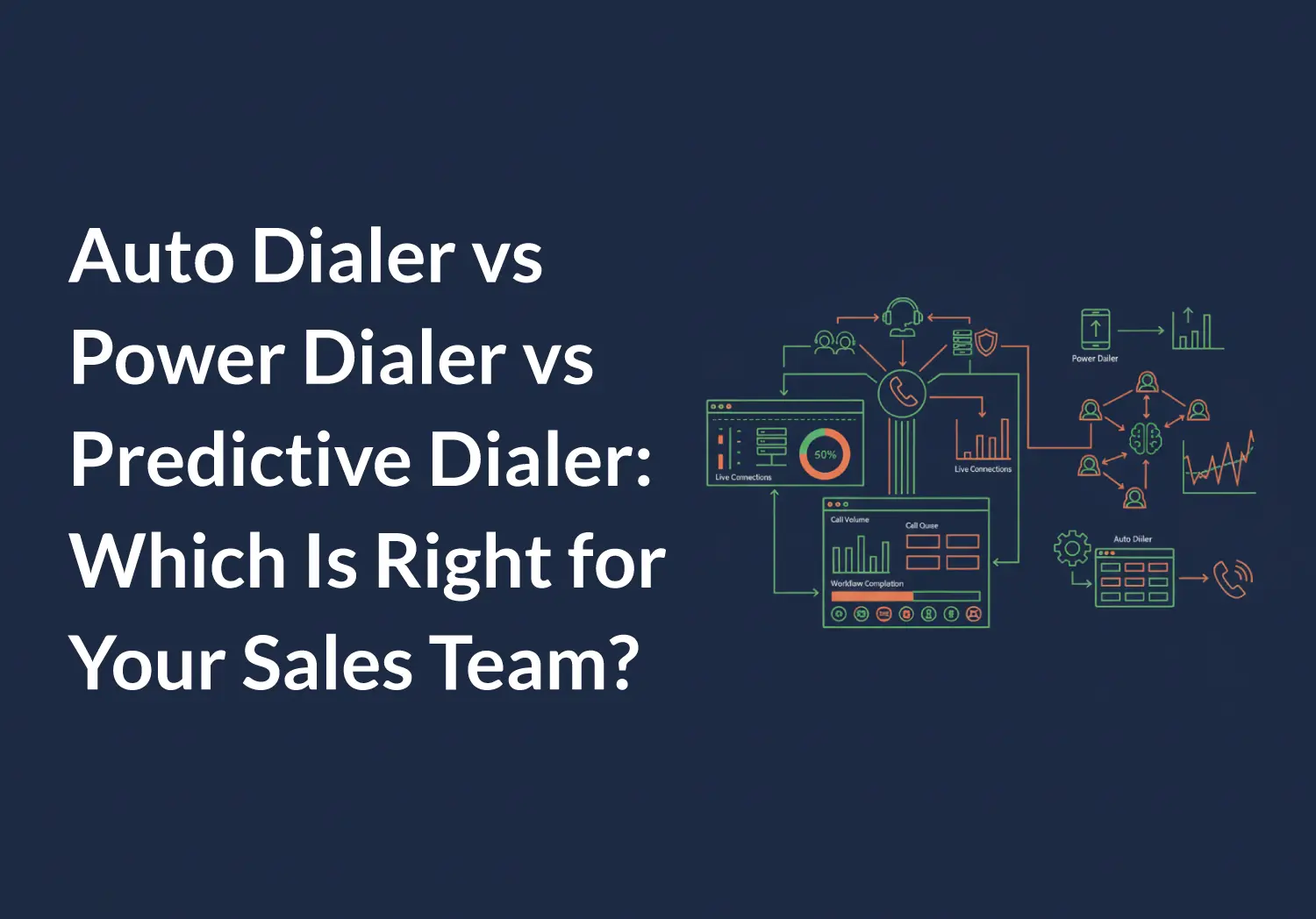
This is why Aloware does not build a predictive or a parallel dialer, and does not intend to. The Power Dialer runs one line at a time with the CRM record open inside the dialing session; progressive and preview modes exist for teams that want them, built on sequences. The dial-ahead patterns are absent on purpose. Abandoned calls train carriers to treat the number as a robocaller, dead air trains the person who answered to hang up on you next time, and the cap turns a throughput setting into a compliance obligation somebody on your team now owns. Each mode is pulled apart in our guide to auto, power, and predictive dialers.
The field splits the same way. Nooks, Orum, and Salesfinity are built around the maximum-dials-per-hour motion, with several simultaneous lines and answer detection as the core mechanism. Trellus is scoped to a real-time coaching overlay on calls placed elsewhere. PhoneBurner operates a power-dialing workspace of its own. Dialpad is positioned as a general business phone system with AI features across mixed inbound and outbound use. Naming the mode each one is built on tells you more about what you are buying than the word "AI" on any of their homepages.
Does dialing more numbers actually connect you with more people?
Aloware platform data says the two move independently. Across 55.4 million outbound dials from a sample of 1,229 accounts, the median rep places roughly 19 to 27 outbound dials on a business day, and the 75th-percentile rep places 70 to 83. The spread barely moves with tenure. Teams that have been on the platform for a year are not dialing appreciably more than teams in their first month.
Connect rate is what moves. Outbound connect rate climbs from 16.7% in an account's first 30 days to 20.4% after the first year, a 22% relative lift. Nothing in that number is a dial-volume story.
Key takeaway: teams get better at outbound by connecting more often, not by dialing more often. A product that only raises your dial count is optimizing the number that already refuses to move.
Methodology and caveats. Aloware platform data, 1 September 2025 to 31 August 2026, aggregates only, with test, demo, Aloware-internal, and sandbox accounts excluded. A connected call is defined as disposition 4, resolution 1, with at least 30 seconds of talk time. On the dial-volume figures: auto-dialer traffic with no assigned user is excluded and medians are interpolated in 10-dial bins. On the connect-rate figures: this is a cross-section across account tenure, not a single cohort tracked over time, and long-tenured accounts dominate the 365-day-plus bucket.
Why does the same list connect better from one dialer than another?
An outbound operator put the question publicly on X: "Cold calling update: Seeing 4% higher pick-up rate when calling from the native HubSpot dialer instead of Salesfinity. Can't exactly pinpoint why - anyone have experience with this?" (posted November 2024).
The mechanism is almost never the dialer's brand. Treat a phone number like a credit score: two variables move a pickup rate, how that number has behaved recently and whether the call carries authenticated caller ID. A multi-line dialer rotating a pool of numbers through high-volume campaigns generates more abandoned and short-duration calls per number than a single-line dialer working the same list, and carrier analytics score numbers on exactly that behavior.
Authentication is a separate system with a separate owner. Under 47 CFR 64.6301, the duty to "authenticate caller identification information for all SIP calls it originates" falls on the originating voice service provider. Your dialer application does not sign attestation, and no vendor can sell you STIR/SHAKEN as a software feature. Hold a dialer vendor to what it does control: which carrier it originates on, how it rotates numbers, and whether it monitors and remediates numbers that get flagged. The full mechanics are in our breakdown of why calls get flagged and how to lawfully raise pickup rates.
Will the AI write back to your CRM without a middle layer?
This is the criterion buyers underweight and then live with. A HubSpot Community thread from May 2026 asks why call recordings from a third-party dialer intermittently fail to load in HubSpot, with only same-day calls reliably available and no visible rule for which ones make it across. A thread from August 2026 asks why call outcomes logged by another CRM-native dialer will not filter in HubSpot reports. Neither is a transcription-quality problem. Both are integration-depth problems, and both surface after the contract is signed.
An AI layer that writes structured values into the record removes work from a rep's afternoon. One that produces a polished transcript in its own console and hands the CRM a partial note has added a second system to check, and the manager forecasting off the CRM is reading the incomplete copy. In insurance and mortgage teams, where the next action depends on a value somebody said out loud on the call, that gap is the whole cost.
Three questions settle it on a demo. Does the summary land on the CRM record, or in the vendor's dashboard? Do extracted values populate real CRM properties, or only free text? Does any of it need a workflow-automation layer you now have to maintain? On Aloware, summaries sync as CRM notes across the supported CRMs, full transcripts do not sync as a rule, and property-level entity mapping is the HubSpot-specific piece described above. That is the shape of answer to demand from every vendor: specific, per-CRM, disclosed before you buy.
What should you ask on an AI dialer demo?
A demo run on the vendor's list, from the vendor's numbers, proves nothing you are about to pay for. A demo run on your list, through your CRM, on a live call block, proves all of it. Insist on the second one, then work this checklist.
- Name the dialing mode. Not "AI-powered." Preview, power, progressive, predictive, or parallel. If the answer is parallel or predictive, ask who monitors the 3% abandonment rate and what happens to the campaign when it is breached.
- Ask for the transcription floor. Every product has a minimum talk time below which nothing is transcribed, and it matters more than it sounds: in the same Aloware data set and window, half of connected outbound calls end inside 66 seconds and a quarter inside 43 seconds (the 30-second connected-call floor is definitional to that measure).
- Watch a summary reach the CRM record without anyone clicking save, and check whether extracted values landed in properties or in a paragraph.
- Ask how numbers are rotated and remediated when carriers flag them, and which carrier originates the traffic.
- If a voice agent is in scope, test the transfer. Interrupt it, ask for a person, and see how many turns it takes. Then ask what the consent basis is for the outbound calls it will place.
- Check adoption honestly. In a sample of 1,399 Aloware accounts in the same window, 39.5% placed a power-dialer call during the year and 5.1% placed or received an AI voice agent call. Those are usage figures, not enabled-feature counts, and they are the reality check to hold against any vendor's claim that a feature is standard practice.
- Price the seat and the AI separately. They are different meters. Aloware starts at $30 per user per month on the quarterly plan for iPro + AI ($40 month-to-month), with the Power Dialer on uPro + AI from $60 quarterly ($70 month-to-month), and voice agent minutes billing separately from $0.10 a minute by model tier. Full lineup on the pricing page.
Two honest limits worth asking any vendor to match. Aloware voice agents have no built-in follow-up feature, so repeat attempts run through sequences. And AI summarization is English-only, which matters for teams selling in Spanish-speaking markets even though transcription itself covers more languages.
The bottom line
"AI dialer" is not a product category. It is two products sold under one label, and the half that decides your connect rate, your carrier reputation, and your compliance exposure is the half with no AI in it at all. Separate the layer from the mode, and most of the marketing collapses into two plain questions: what does the software write down, and how did the call get placed.
Every dialer will show you a transcript. Ask to see the CRM record.
If you are running outbound inside HubSpot and want to see the split in your own data, book a demo and we will run the dialer, the voice agent, and the analytics layer against your own CRM records.

Frequently Asked Questions
What is an AI dialer?
An AI dialer is outbound calling software that applies machine learning to the calling workflow: transcribing calls, generating summaries, classifying what happened, extracting structured values into a CRM, surfacing coaching signals, and in some products holding part of the conversation with a synthetic voice. The term describes the software layer wrapped around the call. It says nothing on its own about how the call was placed. That second part, the dialing mode, is preview, power, progressive, predictive or parallel, and none of those modes involve a model. When you evaluate an AI dialer, separate the two: the AI layer decides what gets written down, and the dialing mode decides what the person who answers actually experiences.
Is an AI dialer the same thing as an auto dialer?
No. Auto dialer is the umbrella term for any software that automates outbound dialing, and it covers preview, progressive, predictive and power dialers. That automation is decades old and involves no machine learning at all. AI dialer describes a newer layer sitting on top: transcription, summarization, sentiment and keyword analysis, CRM field extraction, and in some products a voice agent that speaks. A product can be an auto dialer with no AI, or carry a heavy AI layer on a simple one-line dialing mode. Because vendors market both halves under one label, ask which half the word AI is attached to before comparing two tools.
Does AI dialer mean parallel or predictive dialing?
Frequently, yes, and that is the most important thing to check. Several products marketed as AI dialers are multi-line dialers that open several simultaneous lines per rep, with transcription added afterward. Parallel and predictive modes dial more numbers than there are humans ready to talk, which produces abandoned calls and dead air when nobody is free. That behavior is what carrier analytics score your numbers on, and it is capped by rule rather than by preference. Ask the vendor to name the dialing mode in plain words. If the answer is parallel or predictive, the AI features are not the part of the product that will move your connect rate.
What is the 3% abandoned call rule?
Under 47 CFR 64.1200(a)(7), a telemarketer may not abandon more than three percent of all telemarketing calls that are answered live by a person, measured over a 30-day period for a single calling campaign. The same section defines the term: a call is abandoned if it is not connected to a live sales representative within two seconds of the called person's completed greeting. Two seconds is the entire budget a multi-line pacing algorithm has to work with. If you buy a predictive or parallel dialer, somebody on your team now owns monitoring that rate and deciding what happens to a campaign that breaches it. That is a compliance obligation, not a throughput setting.
Do AI voice calls need consent?
Yes, for outbound calls in the US. In a declaratory ruling released on 8 February 2024, the FCC confirmed that the TCPA's restrictions on the use of an artificial or prerecorded voice encompass current AI technologies that generate human voices, and that calls using them require the prior express consent of the called party absent an emergency purpose or exemption. This is a consent question rather than a feature question, and no vendor can waive it for you. Any evaluation of a voice agent should establish the consent basis for the lists it will call before it establishes how natural the voice sounds.
Does an AI dialer write call data back into HubSpot?
It depends entirely on the product, and this is the criterion buyers most often underweight. Some tools deliver a transcript inside their own dashboard and hand the CRM a partial note; some sync a summary onto the call record; a smaller number write extracted values into real CRM properties. On Aloware, AloAi Voice Analytics syncs call summaries as notes to the supported CRMs, full transcripts do not sync as a rule, and property-level entity mapping is specific to the HubSpot integration. Ask any vendor the same three questions for your CRM: does the summary land on the record, do extracted values populate properties, and does any of it require a workflow-automation layer you have to maintain.
Why do I get a higher pickup rate from one dialer than another with the same list?
The mechanism is almost never the dialer's brand. It is the phone numbers and how carriers have been treating them. Two variables move a pickup rate: how a number has behaved recently, and whether the call carries authenticated caller ID. A multi-line dialer rotating numbers through high-volume campaigns generates more abandoned and short-duration calls per number than a single-line dialer working the same list, and carrier analytics score numbers on exactly that behavior. Authentication has a separate owner: under 47 CFR 64.6301, the duty to authenticate caller identification information for SIP calls falls on the originating voice service provider, not on the dialer application.
Can an AI voice agent transfer a call to a human?
It should, and you should test it. AloAi Voice Agent supports a transfer action to a specific user, a ring group, or a direct line, and on outbound calls it detects voicemail and either hangs up or leaves a message. Buyer expectations here are not subtle: in a SurveyMonkey study of 2,017 US adults fielded in December 2025, 89% said companies should always offer the option to speak with a human. On a demo, interrupt the agent, ask for a person, and count how many turns it takes to get one. A transfer path that only triggers on a scripted keyword is a maze with a door painted on it.
How much does an AI dialer cost?
Seats and AI usage are separate meters, so a single per-user figure rarely tells you the whole cost. Aloware starts at $30 per user per month on the quarterly plan for iPro + AI, or $40 month-to-month. The Power Dialer sits on uPro + AI from $60 per user per month on the quarterly plan, or $70 month-to-month. AloAi Voice Agent minutes bill separately, starting from $0.10 a minute depending on the model tier. Answer-rate services such as number monitoring and branded caller ID are paid add-ons priced on top of a seat plan rather than bundled into it. The current lineup is on the Aloware pricing page.
Does Aloware offer a parallel or predictive dialer?
No, and that is deliberate rather than a gap on a roadmap. Aloware's Power Dialer runs one line at a time with the CRM record open inside the dialing session, and progressive and preview modes are available for teams that want them, built on sequences and enabled per account. The dial-ahead patterns are absent on purpose: abandoned calls train carriers to treat a number as a robocaller, dead air trains the person who answered to stop picking up, and the three percent abandonment cap converts a pacing setting into an ongoing compliance obligation. Teams whose only requirement is maximum simultaneous dials generally choose a vendor built for that motion.
.png)

Ruby Kootval is Head of Product Marketing at Aloware. She has 12 years in digital marketing, including 8 in B2B SaaS and 5 in telecom, and writes about AI voice agents, dialers, CRM integrations, and contact center operations.
.webp)
.webp)