


TL;DR:
what after-hours coverage actually costs
After-hours phone coverage costs $1.38 to $5.00 per covered minute when you buy it as a separate service, and $0.10 to $0.50 per AI talk-minute when you run it on the phone system you already pay for. That is not a quality gap. It is a labor-versus-usage pricing gap, and it decides how many of your unstaffed hours you can afford to cover.
- Per-minute human services list at $0.75 to $0.95/min for budget tiers and $1.25 to $2.00+/min for specialized providers, with nights, weekends and holidays commonly carrying a surcharge (Answering365, 2026 cost guide, accessed July 26, 2026).
- Monthly plans divided by their included minutes work out to $1.95 to $5.00 per covered minute; per-call plans to $7.00 to $10.00 per included call.
- Standalone AI receptionists bill against a minute block: $99 for 50 minutes up to $690 for 500, or $1.38 to $1.98 per covered minute, paid whether the phone rings that month or not.
- An AI voice agent inside a contact center platform bills per AI talk-minute, from $0.10 (Basic model tier) to roughly $0.20 (Premium) to $0.50 (Ultra Premium), on top of a seat plan rather than standing alone.
- The second bill is the one nobody quotes: a forwarded call comes back as a message somebody re-keys at 8am; a call answered on your own line comes back as a CRM record with a transcript, a disposition and a sequence already running.
The water heater goes at 9:40 on a Saturday night. The homeowner calls three plumbers. Two ring out. One picks up, and that one gets the job.
The after-hours call is the same lead, calling at the only hour they had free. Almost every business has one plan for it: ring back in the morning. The window when a lead is willing to talk and the window when your team is at a desk stopped overlapping, and that callback is what you are betting the lead on.
What counts as "after hours," and what happens to those calls right now?
After hours is every hour your business line is unstaffed: evenings, overnight, weekends, national holidays, the lunch gap, and the stretch when every rep is already on another call. It is a coverage window, not a time of day. A real estate team on floor duty until 6pm carries a 14-hour window on weekdays and 48 hours most weekends. A home services company that dispatches until 5pm carries the same window with worse economics, because the calls that arrive at night are the emergencies, and emergencies buy on the first pickup.
One of three things happens to those calls today. They hit voicemail. They ring an unstaffed group until the carrier gives up. Or they forward to a third party that answers in your company's name and sends you a message.
Treat the coverage window like a shift you staff, not a product you subscribe to. Count the hours and the question changes shape: you are not shopping for a receptionist, you are pricing a shift. That reframe is what separates this from the difference between a virtual receptionist and an AI one, a definitional question with a different answer. It also matches the market: how AI voice agents are actually being used by SMB teams is overwhelmingly inbound coverage, not robo-outreach.
Key takeaway: After hours is a coverage window measured in unstaffed hours per week, not a category of service. Count the hours first; price them second.
What does an after-hours answering service actually cost?
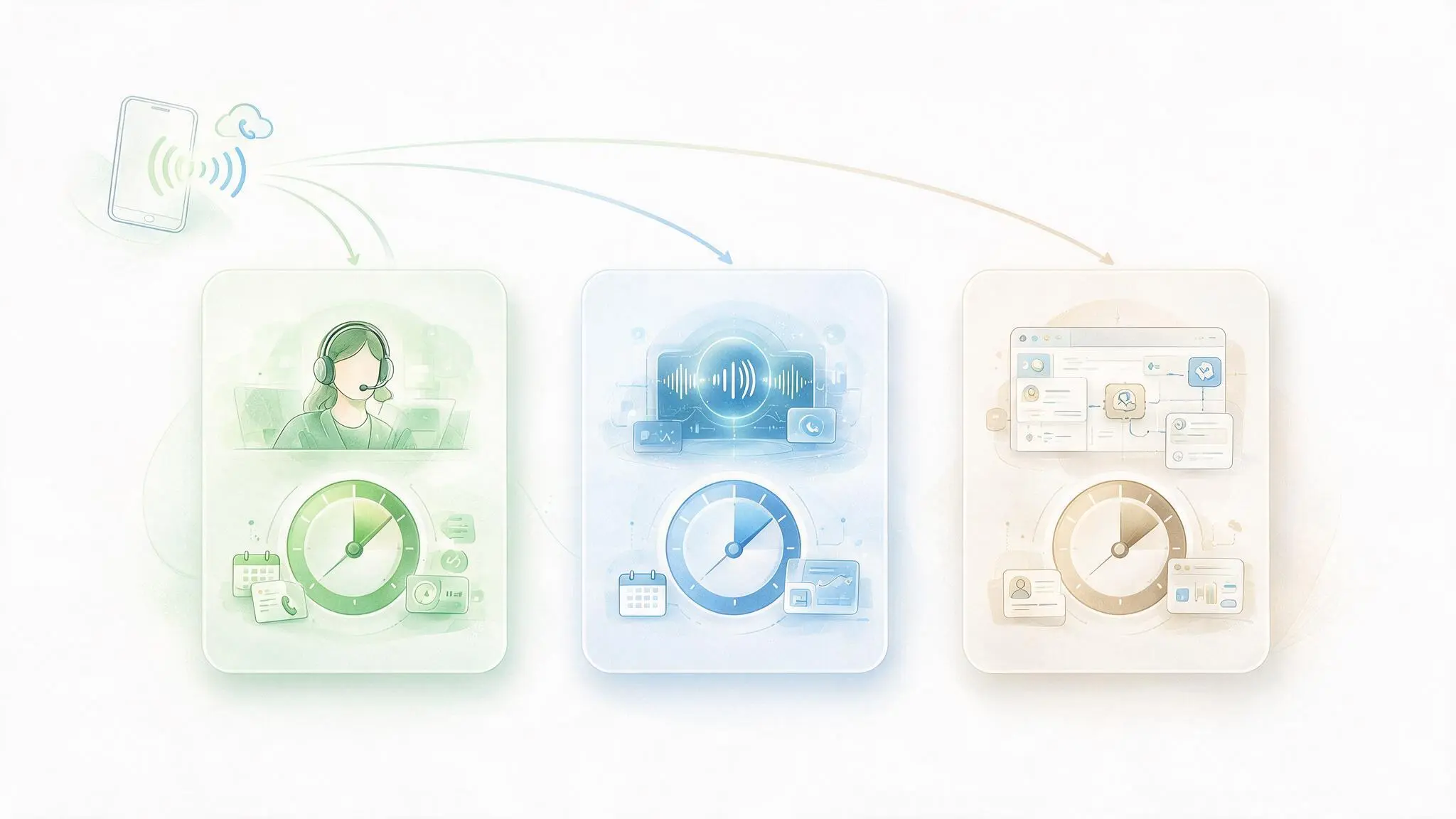
The category sells in three units that are not directly comparable, which is why a cost query keeps returning brochure copy.
Per minute. Budget providers list $0.75 to $0.95. Mid-range runs $0.90 to $1.25. Specialized providers run $1.25 to $2.00+ (Answering365, 2026 cost guide, accessed July 26, 2026). Nights, weekends and holidays commonly carry a surcharge, so the hours you are actually buying are the expensive ones.
Per call. Basic message-taking runs $0.75 to $2.50 per call, and plan-based per-call pricing runs far higher once you divide the monthly commitment by its included calls.
Per month against a block. This is what most providers actually sell. You commit to a fixed number of included minutes or calls and pay for the block whether the phone rings or not. Most small businesses land between $100 and $1,000 a month.
Two of the three highest-ranking pages for this query publish no price at all, and the third routes you to a quote form. A quote-only price cannot be compared to anything, which is the point of quoting it that way. Volume is what turns a unit rate into a real monthly number, the same discipline behind how high-volume teams capture every inbound lead.
Key takeaway: Three billing units dominate the category (per minute, per call, per month against a block), and a quote-only vendor is comparable to none of them. Demand a published unit price before you shortlist.
Why does "we'll call them back in the morning" quietly fail?
The fallback plan fails twice, and both failures are measurable.
First, the caller is already gone. A 2016 study of 85 businesses across 58 industries found only 37.8% of incoming calls were answered by a live person, and that test placed its calls during standard business hours (411 Locals, accessed via an industry aggregator, July 26, 2026). The commonly cited figure for what follows is that roughly 85% of people whose call goes unanswered never call back. In home services, over 55% of customers expect a response within the hour, and 28% of them expect it immediately (Jobber, 2026 Home Service Trends Report).
Second, your callback is the exact call people have trained themselves to ignore. Hiya's State of the Call 2026 puts unknown-call behavior at 86% of unknown calls going unanswered. Branded display helps, but branded display and spam labeling are two separate carrier systems, and branding alone does not stop a "Spam Likely" flag on a number with a poor reputation. STIR/SHAKEN attestation is signed at the originating service provider, not by your dialer, so the fix for a burned number is reputation management, not a setting in your phone app. That is why your morning callback shows up as an unknown number.
The same lead, before and after coverage:
- ❌ Before. 9:07pm call to voicemail. 8:40am callback from an unknown number, no answer. Second callback at 11:15am, voicemail. The lead signed with the plumber who picked up Saturday.
- ✅ After. 9:07pm call answered live. Problem captured, address captured, 7:30am appointment booked. The morning shift opens a contact record with a transcript instead of a phone number and a guess.
Key takeaway: The morning callback is a coin flip you mostly lose. 86% of unknown calls go unanswered, so the plan that depends on reaching someone tomorrow is the weakest part of your coverage strategy.
How does an AI voice agent handle the night shift?
An AI voice agent covers the window by attaching to a line and running on a schedule. Four mechanics matter.
It attaches to the line, not to a forwarded number. An inbound agent is selected in the line's routing settings, so the number your customers already dial keeps working exactly as it does today. Nothing leaves your phone system.
The coverage window is a schedule. You set working hours in your company's timezone and optionally disable the agent on national holidays. A human answers when someone is available; the agent covers the hours when nobody is.
It takes actions during the call. It can book, reschedule or cancel appointments against a calendar an admin configures, transfer warm or cold, write contact properties, apply tags and dispositions, enroll the contact into a follow-up sequence, and post a structured summary as a note. Operations an admin disables cannot run even if the caller asks.
Billing follows talk time. Inbound calls bill per minute from the moment the agent joins, rounded up to the next full minute with a 60-second minimum. Unanswered and voicemail calls are not billed as talk time. A quiet Tuesday night costs close to nothing, the structural opposite of a minute block bought in advance.
What it cannot do matters just as much. Concurrency has a ceiling: up to 40 concurrent AI calls across all accounts, inbound and outbound combined, and past that the agent waits and retries. Safety guardrails are permanently on and not configurable, and a triggered guardrail ends the call immediately with an audit log entry. A voice agent has no follow-up feature of its own, so multi-touch follow-up runs through Sequences.
Key takeaway: An AI voice agent covers hours the way a shift does, through a schedule on a line you already own, and bills on talk time instead of a block. Ask any vendor for the concurrency ceiling and what happens when you hit it.
Human service, AI receptionist, or AI inside your contact center: three ways to buy the same hours
List prices below were pulled July 26, 2026 from the live pricing pages of PATLive, Ruby Receptionists, Abby Connect and Smith.ai. The effective-cost column is our arithmetic (plan price divided by included minutes or calls), not a rate any of those vendors publishes.
Do not read that table as a verdict. Row one is staffed labor priced like labor, for businesses whose after-hours calls need a person on the line and whose volume keeps per-minute labor affordable. Row two is a block of AI minutes bought in advance for a number you forward away. A minute of a human is not the same product as a minute of an AI, and row three assumes you already pay for the platform it runs on. If you do not, add the seat plan and the credit minimum first.
The arithmetic still moves the decision. At 200 covered minutes a month, row one runs $460 to $720 at list, row two runs $299, and row three runs $20 to $100 of talk time. At 600 minutes the spread widens, because labor scales linearly and usage-priced AI does not. For the vendor-selection version of this question, which AI call-answering vendors teams shortlist is the page that answers it.
See what per-minute AI voice pricing looks like next to your seat plan
Key takeaway: In a common unit, human coverage runs $1.95 to $5.00 per covered minute, a standalone AI receptionist runs $1.38 to $1.98, and an AI voice agent on your own platform runs $0.10 to $0.50 per talk-minute plus the platform. Run the division yourself before you sign.
What does the after-hours call cost you after the call?
Price is half the bill. The other half arrives the next morning, and nobody quotes it.
A call answered by a third party comes back as a message. Somebody reads it, re-keys the name and number into the CRM, guesses at the disposition, and decides whether it earns a callback. No recording. No transcript. No sequence fired overnight. No owner assigned. In a real estate office that is the 10pm listing inquiry landing at 9:15am as a text with a misspelled last name. In home services it is the emergency where a message was taken and a callback promised, with nothing telling the morning dispatcher it already happened.
A call answered on your own line is the record. The transcript, the disposition, the contact properties the caller volunteered and the follow-up sequence all attach to the contact your morning shift already works. A law firm intake team opens the day with the caller's matter type captured as a contact property instead of a callback list. That gap is structural: a service whose product is a forwarded phone number cannot put the record in your CRM, because the record was created somewhere else by design.
Key takeaway: A forwarded call returns as a message someone re-keys; a call answered on your own line returns as a CRM record with a transcript and a disposition. Price the re-keying, because that bill repeats every morning.
The Aloware approach: running the night shift on the line you already own
Aloware treats after-hours as a schedule on an existing line rather than a second phone service. Four pieces do the work.
AloAi Voice Agent: an inbound voice agent attached to a line through that line's routing settings, gated by working hours in your company timezone with an optional holiday disable. It is an AI receptionist that answers on your existing line, not a number you forward away.
AI Call Rescue: an account-level setting that routes every missed inbound call, from any line or ring group, to a system-managed AloAi voice agent. It answers and holds a conversation, captures why the person called and how to reach them, and logs a transcript note that can trigger follow-up workflows. It is a voice agent, not a text-back. It supersedes each line's previous missed-call settings while on, and restores them the moment you switch it off.
IVR to IVA conversion: a wizard that reads your existing touch-tone menu, transcribes it, detects language and voice, maps each option to a conversational action, and generates an editable assistant script. It is non-destructive: the original menu is turned off rather than deleted, and one button reverts it.
The Actions layer: appointment booking, warm or cold transfer, contact-property writes that sync into HubSpot, Salesforce, Pipedrive, Zoho, HighLevel and Guesty where the integration allows, sequence enrollment, dispositions, tags, and a call summary posted as a note. This keeps the record continuous.
Pricing, stated plainly: AloAi Voice Agent bills per AI talk-minute from $0.10/min at the Basic model tier, about $0.20/min at Premium and $0.50/min at Ultra Premium. That rate sits on top of a seat plan (iPro $30, uPro $60, xPro $85 per user per month, billed quarterly) and requires a $250/mo minimum RCPA credit commitment. AI Voice Analytics minutes are a separate pool, not voice agent minutes.
Real limits: AI Call Rescue and the IVR conversion wizard are newer capabilities, so confirm the rollout scope for your account. Concurrency is capped at 40 calls account-wide. And this shape fits teams already running their calling on a platform; if the phone rings a handful of times a month after hours, a block plan is the simpler buy.
The daytime tie-in is what makes it hold together. The same platform dials out, so the 8am callback on a lead the agent captured overnight goes from a number whose reputation you manage. That is what the Pickup Stack (NumberGuard, Branded Calling and Local Presence) is for. It is an add-on, priced separately from any plan, and it is the difference between a callback that connects and one that gets screened.

Key takeaway: The strongest argument for running the night shift in your own platform is not the per-minute rate. It is that the call, the record and the morning callback all live in one system.
How to price your own coverage window: five questions before you buy
Run these against your own numbers. They work whether you buy a human service or an AI agent.
- How many hours a week is the line actually unstaffed? Count evenings, weekends, holidays, lunch and all-reps-busy. A good answer is a number, not "nights and weekends."
- How many calls land in those hours, and what is your average handle time? Pull 90 days of call logs and filter by hour. Calls per week multiplied by average minutes converts straight into the block sizes vendors sell.
- Are you paying for a block you will not use? Divide plan price by included minutes and compare to your actual usage. Use 40 of 100 included minutes and your real rate is 2.5x the advertised one.
- Where does the record land, and who works it at 8am? Ask the vendor to show you the CRM object an after-hours call creates. A good answer includes a transcript, a disposition and an owner. "We email you a message" tells you someone is re-keying it.
- What happens when volume spikes? A storm night for a home services company, a listing drop for a real estate team. A good answer names the overage rate or the concurrency ceiling and the behavior at that ceiling. "Unlimited" is not an answer.
Key takeaway: Five numbers decide this purchase: unstaffed hours per week, after-hours calls, average handle time, effective cost per covered minute, and where the record lands. Get all five before you take a demo.
Bottom line
After-hours coverage is not a service you buy. It is a window you configure, and nobody frames it that way because the pages ranking for this query sell forwarded phone numbers. Price the window in one unit and the choice sharpens: $1.95 to $5.00 per covered minute for staffed labor, $1.38 to $1.98 for a block of AI minutes at a third party, or $0.10 to $0.50 per talk-minute on the line you already own. Then price the second bill, the one that arrives at 8am.
The night shift is already on your calendar. Decide what it costs before it decides for you.
See an AI voice agent cover a night shift on a live line

Frequently Asked Questions
What is an after-hours answering service?
An after-hours answering service covers your business phone line during the hours your team is not at a desk: evenings, overnight, weekends and holidays. Traditionally it means forwarding your number to a third party staffed by live agents who greet callers in your company's name, take a message or book an appointment, and relay it to you by email, text or portal. The newer version of the same job is an AI voice agent that answers on your own line during a schedule you set, without the call ever leaving your system. Both cover the same window. They differ in what they cost, how they bill, and where the record ends up the next morning.
How much does an after-hours answering service cost?
Three billing models dominate, and they are not directly comparable. Per-minute human services run roughly $0.75 to $2.00 per minute, with budget tiers near $0.75 to $0.95 and specialized providers at $1.25 to $2.00+ (Answering365, 2026 cost guide). Per-call pricing for basic message-taking runs about $0.75 to $2.50 per call. Most providers actually sell monthly plans against a minute or call block. List prices pulled on July 26, 2026 ranged from $75 per month pay-as-you-go up to $2,100 per month, with most small businesses landing between $100 and $1,000. AI voice agents billed per talk-minute start far lower. Aloware's AloAi Voice Agent bills from $0.10 per minute at the Basic model tier, but sits on top of a platform seat plan rather than standing alone.
Is an AI answering service cheaper than a human one?
Per minute, consistently yes, but the comparison only means something once you convert everything into the same unit. Divide a human service's monthly plan by its included minutes and you usually land between roughly $1.95 and $5.00 per covered minute. Do the same division on a standalone AI receptionist plan and you land closer to $1.38 to $1.98. An AI voice agent billed purely on talk time starts at $0.10 per minute. The catch is what the number hides: a minute of a human is not the same product as a minute of an AI, and a per-minute AI rate usually assumes you already pay for the platform it runs on. Run the arithmetic on your own volume before you decide.
What is the difference between an answering service and an AI voice agent?
An answering service is a separate company with separate staff on a forwarded number. The call leaves your phone system, gets handled somewhere else, and comes back to you as a message. An AI voice agent answers on your own line, inside the platform you already run, on a schedule you configure. The practical difference shows up the next morning. A forwarded call gives you a message someone has to re-key by hand, with no recording and no disposition. An agent on your own line writes the transcript, the disposition and the contact properties straight into the CRM record your team already works, and can fire a follow-up sequence before anyone opens a laptop.
Can an AI voice agent book appointments after hours?
Yes. Aloware's AloAi Voice Agent can create, update, cancel and list appointments through its Manage Appointment action. The admin sets which calendar it books against, which slot durations are allowed, the timezone defaults, and whether duplicate bookings are blocked. Operations the admin disables cannot run even if the caller asks for them. The same conversation can also transfer a live call to a person, warm or cold, capture and write contact properties, apply tags and dispositions, enroll the contact into a follow-up sequence, and post a structured summary as a note on the contact's timeline. That is the difference between a booked 7:30am slot and a message someone reads at 9.
What happens to a missed call after hours if I do not have coverage?
It goes to voicemail or it rings out, and both outcomes rest on the same fragile assumption: that the caller will wait for you. The research is unflattering. A 2024 study of 85 businesses across 58 industries found only 37.8% of incoming calls were answered by a live person (411 Locals), and the commonly cited figure for what follows is that roughly 85% of people whose call goes unanswered never call back. The follow-up plan is weak too. Hiya's State of the Call 2026 puts unknown-call behavior at 86% of unknown calls going unanswered, so your morning callback competes with every spam call that person has trained themselves to ignore.
Does an AI answering service work on my existing phone number?
With a platform-based AI voice agent, yes. The agent attaches to a line inside your own phone system through that line's routing settings, so the number your customers already have keeps working exactly as it does today. Nothing gets forwarded to an outside company. You set the agent's schedule, which is working hours in your company's timezone with the option to disable it on national holidays, so a human answers when someone is available and the agent covers the window when nobody is. That is also why the record stays put: the call never leaves your system, so the transcript and the contact properties land on the contact your team already works.
What is AI Call Rescue?
AI Call Rescue is an account-level setting in Aloware that routes every missed inbound call, from any line or any ring group, to a system-managed AloAi voice agent. It is a voice agent, not a text-back. It answers the call and holds a conversation, greeting the caller, capturing why they called and how to reach them, and logging a transcript note that can trigger follow-up workflows. It records and transcribes every call it handles regardless of your other recording settings. Turning it on requires a one-time admin consent to the $0.10 per minute Basic voice rate, and it is fully reversible: each line's previous missed-call settings are preserved and restored the moment you switch it off. It is currently a Beta feature.
Can I turn my existing phone menu into an AI that answers at night?
Yes. Aloware's IVR-to-IVA conversion wizard reads your current touch-tone menu, either the recorded audio or the text, transcribes it, detects the language and voice, and maps each menu option to an equivalent conversational action, then generates an editable AI assistant script. It runs on the Basic voice tier at $0.10 per minute. The conversion is non-destructive: your original menu is turned off rather than deleted, and a single Revert to IVR button restores it instantly if you do not like the result. It requires an eligible Pro+AI plan, and it is currently a Beta feature, so confirm rollout scope for your account before you plan around it.
Do I pay for after-hours calls that go to voicemail?
With Aloware's per-minute AI voice billing, no. You are billed for actual AI conversation time. Inbound calls bill per minute from the moment the agent joins, rounded up to the next full minute with a 60-second minimum. Outbound calls only bill when a human answers and the agent connects; calls that reach voicemail or go unanswered carry a $0.02 connection cost rather than a per-minute charge. That is the structural difference from block-based plans. With a monthly minute block you pay for the block whether the phone rings that month or not, so a quiet month costs exactly what a busy one does.
Should an AI answer every call, or only after hours?
Only the calls a person cannot take. The sensible default is that a human answers whenever someone is available and the AI covers the window when nobody is: nights, weekends, holidays, and the overflow when every line is busy. That is a scheduling decision, not a philosophical one. You set the agent's working hours in your company timezone, and outside them it picks up. Handing the AI every call during staffed hours trades away the thing your callers actually want, which is a person. The AI's real value sits in the hours where the honest alternative is voicemail, because voicemail is what you are actually replacing.
How many after-hours calls can an AI voice agent handle at once?
More than a small team, but not unlimited, and the ceiling is worth asking any vendor about before you buy. Aloware's current system allows up to 40 concurrent AI calls across all accounts, inbound and outbound combined. Past that, the agent waits and retries. When you enroll a list of contacts for outbound calling, the agent works through them one at a time rather than in parallel. For a typical after-hours inbound window that is well clear of real volume, but if you are covering a spike event, such as a storm night for a home services company, ask the vendor for their concurrency number and their behavior at the ceiling. "Unlimited" is not an answer.
.png)

Ruby Kootval is Head of Product Marketing at Aloware. She has 12 years in digital marketing, including 8 in B2B SaaS and 5 in telecom, and writes about AI voice agents, dialers, CRM integrations, and contact center operations.
.webp)
