

Bilingual answering service: what it is and how to actually cover Spanish calls
TL;DR:
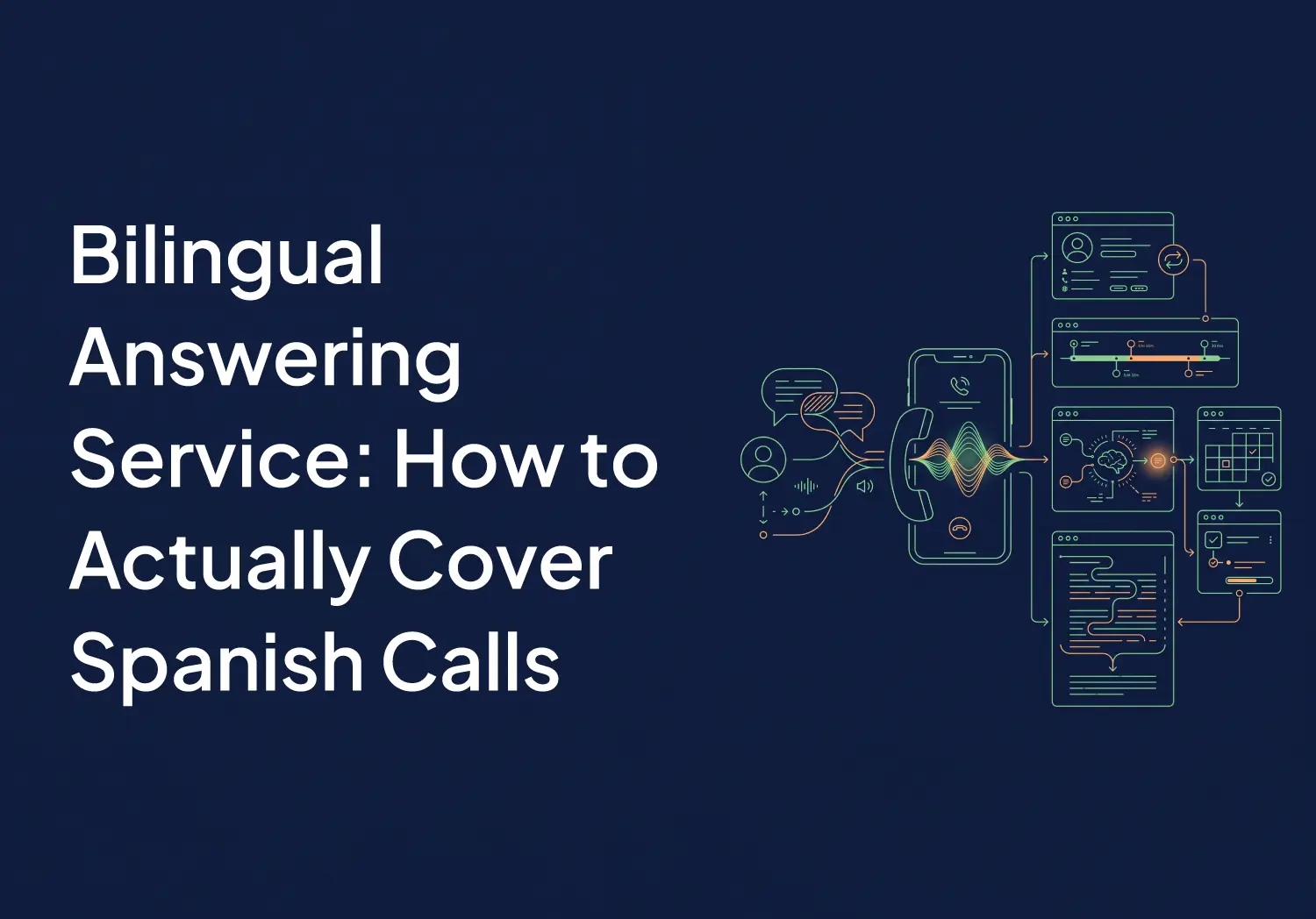
A bilingual answering service answers your inbound calls in two languages, almost always English and Spanish, so a caller who opens in Spanish gets handled in Spanish instead of being put on hold for someone who can help. You can buy that coverage three ways: hire bilingual staff, retain a human answering bureau, or run an AI voice agent configured for both. The right pick comes down to your call volume, your hours, and one thing buyers almost never check: what language your call records come back in.
Key facts:
- Spanish was the most common non-English language spoken in U.S. homes in 2019, at 62%, per the U.S. Census Bureau.
- Human bilingual bureaus bill per minute or per call and staff a shared pool, so after-hours Spanish coverage is where quality slips.
- AI voice agents handle Spanish and mixed English-Spanish calls at a per-minute rate, with no shift schedule to fill.
- A bilingual agent is configured once for both languages. The caller should never have to press 2 for Spanish.
- Transcription and summarization are separate capabilities with separate language coverage. Ask about both, because vendors quote you the first and let you assume the second.
A caller opens with "¿Hablas español?" and your rep says "one moment." Then comes the hold music, the scramble across the floor, and a callback that never happens.
That is not a staffing problem. That is a routing problem you have been solving with people. If a meaningful share of your inbound calls open in Spanish and your coverage plan is "Marisol usually picks those up," you do not have bilingual coverage. You have a single point of failure who takes lunch.
What is a bilingual answering service?
A bilingual answering service is a phone-answering solution that handles inbound calls in two languages, most commonly English and Spanish, either through human operators who speak both or through an AI voice agent configured for both. It picks up, identifies why the person is calling, and then routes, books, qualifies, or takes a message in whichever language the caller used.
The category grew up around human call bureaus. You forward your line to them, their operators answer with your business name, and you pay per minute or per call. That model still works. It is also why most of the buying advice you will find is written by bureaus, and why it all stops at the same question: how many bilingual operators do they have?
That is the wrong first question in 2026. The right one is what happens on the calls you are not awake for.

Key takeaway: A bilingual answering service is judged on coverage, not headcount. If Spanish coverage exists during business hours and evaporates at 6pm, you are paying for a half-solution.
Why does Spanish coverage change your close rate?
People buy in the language they think in. CSA Research, surveying 8,709 consumers across 29 countries with Kantar for its 2020 report "Can't Read, Won't Buy", found 76% of online shoppers prefer to buy with information in their native language, and 40% will never buy from sites in another language. That study measured online purchasing rather than phone support, so treat it as the principle and not as a call-center benchmark. The principle holds on the phone, and on the phone the stakes are higher, because a website visitor can leave and come back while a caller who gets stuck hangs up and dials your competitor.
The volume is not marginal. Per the U.S. Census Bureau's Language Use in the United States: 2019 report, "Spanish was the most common non-English language spoken in U.S. homes (62%) in 2019 – 12 times greater than the next four most common languages."
Across 221 recorded Aloware sales calls reviewed in July 2026, bilingual Spanish support came up as an explicit reason teams were switching tools. The verticals asking were consistent: immigration law, insurance, and moving and home services. All three share a profile. High-intent inbound, a caller under time pressure, and a first call that decides who gets the business.
- Immigration law: the intake call is the case. A caller who cannot describe their situation in Spanish gives you a thin intake and a bad fit assessment.
- Insurance: quoting requires specifics. Vehicle, coverage, prior claims. Approximate answers in a second language produce approximate quotes that fall apart at bind.
- Moving and home services: the job is scoped on the phone. Rooms, stairs, access, dates. Get it wrong and you eat the difference on moving day.
Key takeaway: Bilingual coverage is not a courtesy feature. In intake-driven verticals the first call in the caller's language is the difference between a qualified lead and a voicemail.
The three ways to cover Spanish calls
Most mid-market teams end up blending. Bilingual reps take the daytime calls they are good at, and something else covers nights, weekends, and overflow. The question is what that something else is.
Run the math on your own after-hours volume
The three options price on completely different units, which is why comparing them by sticker price is useless. Compare them on your actual after-hours Spanish volume instead.
Say you take 60 Spanish calls a month outside business hours, averaging 4 minutes. That is 240 minutes.
- AI voice agent: 240 minutes × $0.10 per minute on the Basic model tier is $24 a month. Move to a Premium model at $0.20 and it is $48. The cost scales with conversation, not with the clock.
- Human bureau: take their quoted per-minute rate and multiply by the same 240, then add the monthly minimum, which is the part that bites at low volume. Ask what happens on months you come in under the minimum.
- Bilingual staff: this one does not divide. An evening or weekend shift costs the same whether it fields 60 calls or 6, because you are buying hours, not conversations.
The threshold logic falls out of that. Low and unpredictable after-hours volume favors per-minute pricing, because you pay nothing on a quiet night. Steady, high daytime volume with complex calls favors staff, because a person who knows your business converts better than any script. A bureau sits between the two and is worth it when you need a human voice at 2am and cannot justify the shift.

Key takeaway: Do not compare a salary to a per-minute rate. Multiply each option out against your own after-hours minutes, then ask what each one costs on your quietest month.
What actually breaks in bilingual AI
Three failure modes, and vendors rarely volunteer any of them.
1. Making the caller choose. The legacy pattern pushes the work onto the caller: press 1 for English, press 2 for Spanish. That leaks people at the menu, because a caller who is already unsure whether you can help them now has to navigate English prompts to find out. The fix is configuration, not a menu. You set the agent's language once, and a bilingual market wants a genuine Multilingual (English + Spanish) mode rather than a Spanish-only agent.
❌ Fails: an IVR tree that makes a Spanish-speaking caller navigate two levels of English prompts before reaching the Spanish option.
✅ Wins: a multilingual agent that handles the call in the caller's language with no menu step at all.
2. Code-switching. Real bilingual callers do not stay in one language. They open in Spanish, drop an English product name, give an address in English, then return to Spanish. An agent locked to a single language stumbles at every switch. This is exactly what multilingual mode is for. Aloware's voice agent language options include Multilingual (English+Spanish) alongside dedicated Spanish for Latin America and Spain, so you pick based on whether your callers actually mix languages or stay in one.
❌ Fails: configuring a Spanish-only agent for a bilingual market, then wondering why it derails whenever the caller says "the Ridgeline apartments."
✅ Wins: a multilingual agent that follows the caller across both languages inside one call.
3. The records gap. This is the one nobody checks, and it is the subject of the next section.
Key takeaway: Ask any vendor two questions. Is there a true multilingual mode rather than separate single-language agents, and does it survive a caller switching languages mid-sentence? A demo in clean, single-language Spanish tells you nothing about either.
The records gap: transcription and summaries are not the same feature
One question comes up on sales calls more than any other on this topic, phrased almost identically every time: "Does it support Spanish transcription and summaries, and multiple voices and accents?"
Those are three separate questions wearing one coat, and they do not have the same answer.
Answering the call is one capability. Producing a usable record of it is a different one, and the two do not have the same language coverage. Transcription turns speech into text. Summarization reads that text and writes the short version your reps and managers actually read in the CRM. Vendors quote you the transcription language list and let you assume the rest follows.
It does not. We publish our own breakdown rather than let you find out in month two. Aloware's v11.4.0 release notes put it plainly: AloAi Voice Analytics is "supported in 20 different languages," and "additional feature benefits like call summaries, custom vocabulary and spelling, and PII redaction are available within a subsection of the languages covered."
Concretely, for Spanish calls in AloAi Voice Analytics:
So a Spanish call gets a full transcript, sensitive data tokenized out of it, and your custom spellings applied. It does not get an AI-written summary, and you cannot load a custom vocabulary list to sharpen recognition of your product names in Spanish. On the transcription side, which language a recording gets transcribed in is detected automatically, so nobody has to tag calls by hand.
❌ Fails: a QA process built entirely on skimming AI summaries, applied to a book of business that is 30% Spanish. The Spanish calls quietly never get reviewed.
✅ Wins: summary-driven review for English calls, plus a named bilingual lead who reads Spanish transcripts directly on a set cadence.
Plan for it deliberately. Compliance is unaffected either way, since PII redaction covers Spanish.
Every vendor in this category has a version of this boundary. Few will show it to you before you sign.

Key takeaway: Get the language matrix in writing, feature by feature, before you buy. "We support Spanish" is a sentence about transcription. It is almost never a sentence about summaries.
How to set up bilingual call coverage in Aloware
Three steps, assuming you are on iPro + AI, uPro + AI, or xPro + AI.
Step 1. Set the agent's language to Multilingual. When you configure an AloAi Voice Agent, set its language. For a mixed English and Spanish market choose Multilingual (English + Spanish) rather than Spanish-only, so the agent follows callers who switch. If your inbound is almost entirely Spanish, the dedicated Spanish option is the tighter fit. Result: the agent handles the call in the caller's language without an IVR menu.
Step 2. Pick the voice, then listen to it in Spanish. Aloware's voice library is mostly ElevenLabs plus OpenAI voices. Do not select a voice from an English sample. Play it reading your actual Spanish greeting, because voices that sound natural in English can land flat or wrong-accented in Spanish. Result: a greeting that does not signal "robot" in the first three seconds.
Step 3. Turn on transcription so the calls become records. Go to Accounts > AloAI Voice Analytics (or open app.aloware.com/account?tab=transcription-settings directly) and switch the transcription toggle to ON. While you are there, set your minimum talk-time threshold and, if you handle regulated data, enable PII redaction. Result: every call, Spanish included, produces a searchable transcript with sensitive data tokenized.
Then write the prompt properly. A bilingual agent inherits every weakness of a vague system prompt and adds a language dimension on top. Our guide on how to prompt your AI voice agent covers the structure. Plan details and per-minute rates sit on the Aloware pricing page.
Want to hear it handle a Spanish call before you commit? Book an AI voice agent demo and bring your own script.
Key takeaway: Multilingual mode, a voice auditioned in Spanish, and transcription switched on. Skip the third step and you have coverage with no record of what was said.
What to ask before you sign
Run this on any vendor in the category, us included.
- Is there a true multilingual mode, or only separate single-language agents?
- What happens when a caller switches languages mid-call? Ask for a recording, not an assurance.
- Does the caller have to pick a language from a menu, or is the agent configured to handle both?
- Which features work in Spanish specifically: transcription, summaries, custom vocabulary, redaction? Get the matrix.
- What language do CRM notes arrive in, and who on my team can read them?
- For human bureaus: are bilingual operators dedicated to my account or drawn from a shared pool, and does that change after hours?
- How is it billed, per minute, per call, or per seat, and what does my quietest month cost?
If a vendor answers the language-matrix question with "we support Spanish" and moves on, ask again. The ones who have thought it through will show you the table.
Key takeaway: The vendor who volunteers their limitations before you ask is the one who will not surprise you in month two.
The bottom line
Bilingual answering is not a headcount problem anymore, and it stopped being one the moment coverage started billing per minute instead of per shift. The hard part moved. It is no longer "can something answer in Spanish," because plenty of things can. It is whether the coverage holds when the caller switches languages, and whether you can still see what happened on the call afterward.
Get the language matrix in writing. Audition the voice in the language your callers actually use. Turn on transcription before you take the first live call, not after you need to review one.
If you are weighing this against a general-purpose setup, start with how AI answering services capture inbound leads and what a virtual receptionist actually does, then come back to the bilingual specifics here. For the cost side, our breakdown of what an AI voice agent costs goes deeper on the per-minute math.
See AloAi Voice Agent handle a bilingual call. Book a demo.

Frequently Asked Questions
What is a bilingual answering service?
A bilingual answering service is a phone-answering solution that handles inbound calls in two languages, most commonly English and Spanish. It answers with your business name, identifies why the person is calling, and then routes, books, qualifies, or takes a message in whichever language the caller used. You can buy that coverage three ways: hire bilingual staff, retain a human answering bureau that staffs bilingual operators, or run an AI voice agent configured for both languages. The right choice depends on your call volume, the hours you need covered, and how much of the call record you need afterward for coaching and CRM notes.
Does an AI voice agent really work in Spanish, or just English?
It works in Spanish. Aloware's AloAi Voice Agent language options include a dedicated Spanish setting for Latin American and European Spanish, plus a Multilingual mode that covers English and Spanish together. The multilingual mode matters more than most buyers realize, because real bilingual callers switch languages mid-call: they open in Spanish, give an address or product name in English, then switch back. An agent locked to a single language stumbles at each switch. If your inbound is mixed, choose Multilingual rather than Spanish-only.
Do I get AI call summaries for Spanish calls?
No. This is the limitation most vendors will not volunteer, so here is ours plainly. In AloAi Voice Analytics, Spanish calls get full transcription, custom spelling, and PII redaction. AI-generated call summarization and custom vocabulary are available only for the English variants. Practically, that means your managers can read, search, and audit Spanish calls, and compliance still gets sensitive data tokenized out of the transcript, but a coaching workflow that runs on skimming AI summaries will have a gap on Spanish calls. Plan around it by having a bilingual lead review Spanish transcripts directly.
Does the caller have to press a key to choose Spanish?
No. The agent is configured for both languages up front. You set it to Multilingual (English + Spanish) when you build it, so there is no press-2-for-Spanish step for the caller to navigate. That matters because a menu leaks callers: making a Spanish-speaking caller work through English prompts to reach the Spanish option adds friction at exactly the moment they are deciding whether you can help them at all. Separately, on the records side, which language a call recording gets transcribed in is detected automatically in AloAi Voice Analytics, so nobody has to tag calls by hand after the fact.
How much does bilingual AI call coverage cost?
AloAi Voice Agent is billed per minute of AI talk time rather than per seat. It starts at $0.10 per minute on the Basic model tier and runs up to $0.50 per minute on Ultra Premium, depending on which underlying model you choose. There is no separate surcharge for running the agent in Spanish or in multilingual mode. Because it prices by the minute of actual conversation, covering a Sunday at 2am costs the same per minute as covering a Tuesday at 10am, which is what changes the after-hours coverage math against staffing or a per-call bureau retainer.
Which industries need a bilingual answering service most?
Intake-driven verticals where the first call decides the deal. Immigration law is the clearest case, because the intake call effectively is the case and a caller who cannot describe their situation precisely gives you a thin, unreliable assessment. Insurance is next, since quoting depends on specifics like vehicle, coverage, and prior claims, and approximate answers produce quotes that fall apart at bind. Moving and home services scope the job on the phone, covering rooms, stairs, access, and dates, so a misunderstanding costs you real money on the day. Real estate and healthcare intake sit close behind.
What should I ask a bilingual answering service vendor before signing?
Seven questions. Does the caller have to pick a language from a menu, or is the agent configured to handle both? Is there a true multilingual mode or only separate single-language agents? What happens when a caller switches languages mid-call, and can you hear a recording of that rather than just an assurance? Which specific features work in Spanish: transcription, summaries, custom vocabulary, redaction? What language do CRM notes arrive in, and who on your team can read them? For human bureaus, are bilingual operators dedicated to your account or a shared pool, and does that change after hours? And how is it billed: per minute, per call, or per seat?
Are Spanish call transcripts safe to store with sensitive customer data?
PII redaction is supported for Spanish, not just English. With redaction enabled, AloAi Voice Analytics detects personal data in the transcript and replaces it with tokens, so a name appears as a placeholder rather than the actual value. The default categories cover names, email addresses, phone numbers, dates of birth, government ID numbers, credit card and banking details, and medical information. Enable it in your transcription settings before you take live calls, not after, since redaction applies as transcripts are produced.
.png)

Ruby Kootval is Head of Product Marketing at Aloware. She has 12 years in digital marketing, including 8 in B2B SaaS and 5 in telecom, and writes about AI voice agents, dialers, CRM integrations, and contact center operations.