


TL;DR
Missed call text back recovers the callers you route, not the ones you text. The automation itself is the easy half: your phone system spots an unanswered call and fires an SMS from your business number within seconds. What determines whether it produces revenue is the part almost nobody sets up, which is where the reply lands, who owns it, and what record it attaches to.
- Only 37.8% of incoming calls reach a live person, per a 2016 411 Locals analysis of 85 businesses across 58 industries.
- In a recent CallRail survey of 1,000 U.S. consumers, 78% said they have abandoned a business after an unanswered call, and 82% say they will call a competitor when no one picks up.
- A text reaches them on the device they already have in hand: 98% of U.S. adults own a cellphone and 91% own a smartphone, per Pew Research Center.
- The first message needs one job: start a conversation, not announce a delay.
- Reply routing is the difference between a recovered lead and an automated miss.
- Count booked conversations. Messages sent is a vanity number.
A plumber's phone rings at 4:50pm while both techs are under a sink. It rings out. Somewhere in the next ninety seconds that caller either gets a text back or dials the next result on the search page.
That window is the entire product category. Missed call text back exists because the caller has not moved on yet, and a text is the only channel that reaches them while the problem that made them dial is still urgent. Most teams buy the trigger, turn it on, watch the delivery counter climb, and never find out the replies are piling up in an inbox nobody owns.
What is missed call text back?
Missed call text back is an automation that sends an SMS to a caller when their call to a business goes unanswered. The phone system watches the outcome of each inbound call, and when that outcome is a miss, it fires a prewritten text from the same business number the person just dialed, so their reply comes back into a channel your team already monitors.
A "miss" is not one event. It is a set of them: the call rang out, it landed in voicemail, it arrived outside business hours, or it hit a ring group where no agent was available. Each deserves different copy, and a system that treats them identically will text a 2am caller the same words it texts someone who called during a busy lunch rush.
The distinction that decides whether the tool earns its keep:
- ❌ The dead-end autoresponder. Fires "Sorry we missed your call, we'll get back to you soon" from a number that cannot receive replies, or can receive them into a queue nobody watches. The caller is told to keep waiting. Nothing is recorded.
- ✅ The routed opener. Fires a text that names a person, states why, and asks one question. The reply lands with an owner, attaches to the caller's record, and starts a clock.
Key takeaway: missed call text back is not a message feature, it is a routing feature that happens to start with a message.
Why do missed calls cost more than most teams think?
Because the loss compounds in a direction most dashboards do not show. The 2016 411 Locals analysis found 37.8% of incoming business calls reached a live person, with 37.8% going to voicemail and 24.3% getting no response at all. Roughly three in five callers never spoke to anyone.
The second number is the expensive one. A recent CallRail survey of 1,000 U.S. consumers found 78% have abandoned a business after an unanswered call, 82% say they will call a competitor, and 21% call one immediately. A missed call is not a deferred conversation. For most of those people it is a finished one, decided in your competitor's favor, and your CRM will never record it happened.
The shape of the damage changes by industry:
- Legal intake. The caller is phoning three firms from the same search page, and first contact usually wins the signature.
- Home services and HVAC. Calls cluster into the exact hours technicians cannot answer them, and a no-heat call in January goes to whoever picks up.
- Insurance. Quote shopping happens in one sitting across several agencies, so an unanswered call drops you out of a comparison you never knew you were in.
- Real estate. A buyer calling about a listing is standing in front of it, and the window is measured in minutes.
Worth separating from the pickup problem: this article is about calls that reach you and go unanswered. If your outbound calls are the ones going unanswered, that is a caller ID reputation issue and a different fix, covered in why your callbacks get ignored in the first place. For the full accounting of what inbound misses drain from a pipeline, see what those missed calls actually cost you.
Key takeaway: three in five callers never reach a person, and most of them never try again, so the miss is usually the end of the relationship rather than a pause in it.
How does missed call text back actually work, step by step?
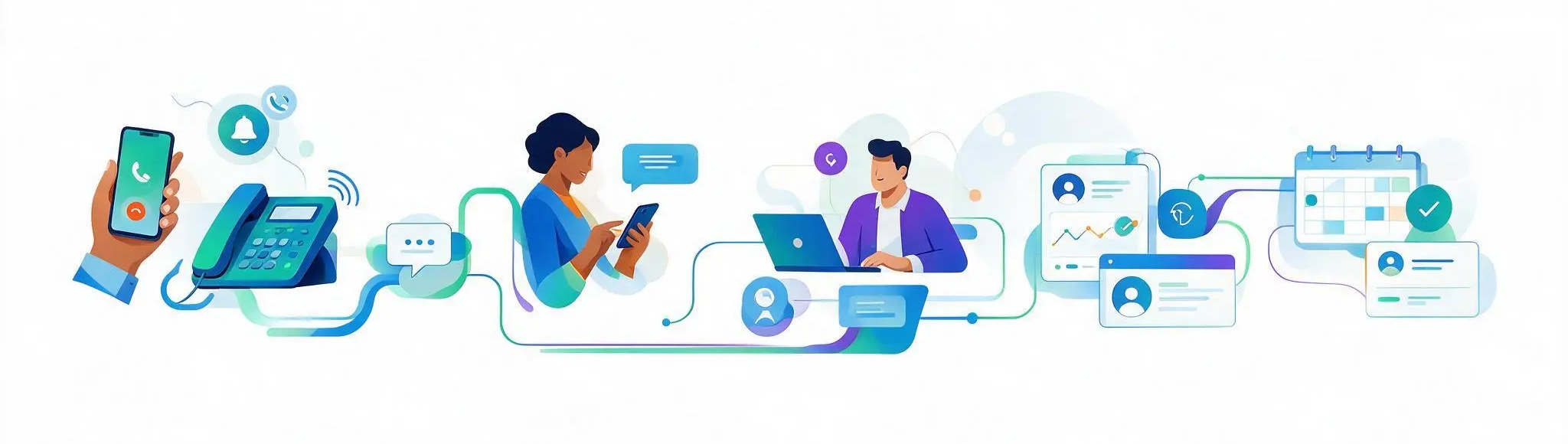
Five stages. Every vendor guide covers the first two and stops.
Stage 1: Detect the miss. Decide which call outcomes trigger the automation, and configure them per line rather than globally. A single generic trigger produces a single generic text.
Stage 2: Send the text. Within seconds, from the number they dialed, and it must be a two-way number. A text the caller cannot answer is a slower voicemail.
Stage 3: Route the reply. The response needs a destination chosen in advance: a named owner, or a queue with an assignment rule. This stage determines the outcome, and most setups skip it entirely.
Stage 4: Own the conversation. The thread attaches to the caller's contact record, so whoever picks it up sees that this person called at 4:50pm, got the auto-text, and answered. Without that, your rep is answering a stranger.
Stage 5: Measure the recovery. Reply rate, human response time, and how many threads became booked conversations. Delivery counts only tell you the trigger fired, which was never in doubt.
Stages one and two are a configuration task you finish in an afternoon. Stages three through five are an operational design decision, and they are why two businesses running identical software get opposite results from it.
Key takeaway: the setup guide ends at stage two, and the revenue starts at stage three.
What should the first text actually say?
Three things and nothing else: who you are, why you are texting, and one question that takes five seconds to answer. Every word past that reduces the reply rate.
Compare the two versions most businesses choose between:
- ❌ "Thank you for calling Ridgeline Heating & Air. We are currently assisting other customers. A representative will return your call as soon as possible." This asks the caller to wait, gives them nothing to respond to, and reads like a recording. They are already dialing the next company.
- ✅ "This is Dana at Ridgeline Heating & Air, sorry we missed you. Are you calling about a repair or a new install?" A named human, an apology, and a binary question. Most people answer it reflexively, and now you have a conversation with an owner attached.
Three patterns worth keeping in rotation:
- The triage question. "Repair or install?" "New matter or existing case?" Sorts the lead and signals competence in one line.
- The scheduling offer. "I can call you back at 5:30 or first thing tomorrow, which is better?" Converts the miss into a calendar slot.
- The after-hours variant. "We're closed until 8am, but I'm here now if you want to send details."
Skip pricing, promotions, and links in the first message. The caller phoned about a specific problem, and a discount code answers a question they did not ask.
Key takeaway: a first text that cannot be replied to in one tap is a voicemail with extra steps.
Where does the reply go?
This is where the money is made or lost, and it is the stage no comparison article covers.
When the caller texts back, three things need to already be true. The message needs an owner, a specific person or a queue with an assignment rule, because a thread that belongs to everyone belongs to nobody. It needs a record, so the rep who answers sees the missed call, the auto-text, and any prior history in one place. And it needs a clock, an escalation that fires if the reply sits unanswered past a few minutes, because the caller who answered in thirty seconds has not become patient.
The failure mode is quiet and common. The automation performs perfectly, replies accumulate in a shared inbox, and the team assumes someone else is handling them. Delivery metrics look excellent. The business has automated the miss instead of fixing it, and now it happens faster.
A useful diagnostic: open your text-back inbox and find the oldest unanswered reply. If that timestamp is measured in hours, the trigger is not your problem. Handling reply volume is exactly the job an AI text agent that handles the replies at scale is built for, qualifying and holding the thread until a human takes over.
Key takeaway: if the reply has no owner, no record, and no clock, the automation moved the miss downstream rather than recovering it.

When does an auto-reply become marketing you need consent for?
Answering a call someone just made you is a different act from starting a campaign, and the safe operating practice is to treat them differently. Treat a single responsive text that identifies your business and asks how you can help as answering the call they made. Treat anything that pitches, discounts, or drips over several days as marketing, and be able to evidence consent for it.
The stakes are statutory. Under 47 U.S.C. § 227, the TCPA provides for $500 in damages per violation, and a court that finds a violation willful or knowing may increase the award to as much as three times that amount. There are timing rules too: 47 CFR 64.1200 restricts telephone solicitation to residential subscribers before 8am and after 9pm in the called party's local time, and extends that treatment to texts sent to wireless numbers. Where your specific sequences fall is a question for your own counsel, not a formatting preference.
Two operational rules that keep the boundary clean:
- Keep the responsive text responsive. One message, tied to the call they made, no offer attached. The moment message two starts selling, treat the whole thread as marketing.
- Honor stops at the contact level, not the number level. A STOP reply should suppress texts to every number on that person's record. Suppressing only the number that received it leaves a second saved mobile able to text someone who already opted out.
Worth knowing that opting out of texts and asking not to be called are separate states. Someone who replies STOP has told you to stop texting, which does not by itself mean stop calling, and a contact marked do-not-contact should receive neither. Systems that collapse the two get one of them wrong.
Key takeaway: the first text answers a call they made, and everything after it is marketing until you can show consent.
How do you measure whether it's working?
Replace the delivery metric. Messages sent confirms your trigger is configured, which you check once and never again.
Four numbers worth a dashboard:
- Reply rate on auto-texts. Your copy grade. A low rate means the message is a dead end, and rewriting it is a same-day fix.
- Median human response time to replies. Your routing grade. Anything past five minutes means ownership is unclear.
- Conversations reaching a booked appointment or qualified handoff. The actual outcome.
- Recovery rate. Booked conversations divided by total missed calls. This is the number to report upward.
The diagnostics write themselves. Healthy reply rate with flat bookings means the copy works and the routing is broken. Poor reply rate with fast response times means your team is ready and the message is wasting them.
Key takeaway: recovery rate is the only number that answers whether the tool paid for itself.
How Aloware wires missed calls into your CRM
The mechanism above is only as good as the system underneath it, and this is where a phone platform that lives inside your CRM does something a standalone text-back tool structurally cannot.
At the simplest level, Aloware's per-line missed call settings let each line decide what happens on a miss, including sending an SMS after a missed call, so an after-hours line and a sales ring group can behave differently.
The part that solves stages three and four is the CRM path. Aloware emits call outcomes to HubSpot as contact-level App Events, including a call_outcome value of missed on the Call Ended and Call Disposed events. Those events are available as HubSpot workflow enrollment triggers, which means a missed call can enroll the caller in a workflow that sends the text through Aloware's Send a Text action, attributed to the HubSpot contact owner or deal owner rather than an anonymous number, logs the message to the contact record, and creates the follow-up task. Because the events are emitted server-side, this needs no webhook engineering and no Operations Hub tier. The reply arrives with an owner and a history already attached, which is the whole argument of this article expressed as configuration. If you already run speed-to-lead built on HubSpot workflows, the missed call becomes one more enrollment trigger alongside your form fills, Form2Text fires on the form submission, and the same workflow pattern fires the text-back when a missed-call event lands.
There is also the layer above all of this, which is not missing the call. AI Call Rescue, currently in beta, routes missed inbound calls to an AloAi voice agent that greets the caller, captures intent and contact details, and writes a transcript note to the record, billed from $0.10 per minute for the basic voice model. Text-back recovers a call that was already lost. A voice agent stops it from being lost.
These two are an either/or on any given line, not a stack, and that trips people up. AI Call Rescue is an account-level switch: while it is on, it intercepts every missed inbound call and the per-line missed-call settings become read-only. A call the voice agent answers is no longer a missed call, which is the point of it, and also means it is no longer the trigger your text-back automation was listening for. Pick per line based on what the caller needs: voice where a live answer closes the business, text-back where a thread is the faster path.
Honest limits before you evaluate: Aloware is a full contact center platform, so adopting it for missed-call recovery alone is more system than that job requires. The deepest CRM integration is HubSpot, and while Salesforce, Pipedrive, Zoho, HighLevel, and Guesty are all supported natively, the depth varies by CRM. Advanced workflow configuration carries a learning curve, which is why onboarding includes a free webinar for everyone and training sessions that scale with team size.
Key takeaway: the reason to run this inside your CRM is not the text, it is that the missed call becomes an event your workflows can act on.
Bottom line
Missed call text back is not a lead recovery tool. It is a lead recovery opportunity, and the software only delivers the first ninety seconds of it. The businesses that get paid for the setup are the ones that decided in advance who owns the reply, where it gets recorded, and which number tells them it worked.
Turn on the trigger this week. Then spend the following week on stages three through five, which is the work your competitors running the same software have not done.
Stop losing leads to slow follow-up.Book a 20-minute demo and we'll show Form2Text and missed-call routing running in your CRM.
Frequently Asked Questions
What is missed call text back?
Missed call text back is an automation that sends an SMS to a caller when their call to a business goes unanswered. The phone system watches the call outcome (rang out, hit voicemail, arrived outside business hours, or reached a ring group with nobody available) and fires a prewritten text from the same business number so the caller can reply instead of calling back. The value is not the message itself but the reply path it opens: the caller answers on a channel they check within minutes, and a rep picks the conversation up from there.
Does missed call text back actually recover lost sales?
It recovers the ones you route. The mechanism is real, because a large majority of people who fail to reach a business never call back and many contact a competitor instead. But the recovery happens when someone owns the reply, not when the text sends. A text-back wired to a shared inbox nobody watches produces delivery receipts, not revenue. Measure booked conversations rather than messages sent, and if your reply rate is healthy while bookings stay flat, the copy is working and the routing is broken.
Is it legal to text someone automatically after they call you?
Replying to a person who just called your business is a different act from starting a marketing campaign, and the two are governed differently. A single responsive text that identifies you and asks how you can help is answering a call they made. A follow-up sequence that pitches, discounts, or drips is marketing, and marketing needs consent you can evidence. The TCPA provides for $500 in damages per violation, and a court that finds a violation willful or knowing may increase the award up to three times that amount, so draw the boundary carefully with your own counsel.
What should the first missed-call text say?
Three things and nothing else: who you are, why you are texting, and one question that takes five seconds to answer. "This is Dana at Ridgeline Heating and Air, sorry we missed you. Are you calling about a repair or a new install?" beats "We missed your call and will get back to you soon," because the second one asks the caller to wait while the first one starts a conversation. Skip pricing, promotions, and links in the first message, and never send a text the caller cannot reply to.
How fast does the missed-call text need to go out?
Immediately, within seconds of the call ending. The caller is still holding the phone and still has the problem that made them dial. Once they have moved to the next search result, the same message arrives as an interruption from a business they already dismissed rather than a rescue of a call they just made. Speed is also the cheapest variable to fix: it is a configuration setting, not a staffing decision, and it costs nothing to send in five seconds instead of five minutes.
What happens when someone replies to the automated text?
That depends entirely on how you wired it, and it is the part most setups get wrong. The reply needs a destination (a specific owner or a queue with an assignment rule), a record (attached to the contact so the next person sees the history), and a clock (an escalation if nobody answers within minutes). If the reply lands in a general inbox with no assignment rule, the automation has moved the miss downstream rather than fixing it, and it now happens faster and at higher volume.
Can missed call text back work with a CRM?
Yes, and it changes what the tool is. When the missed call is a structured event your CRM can see, it can enroll the caller in a workflow: send the text under a named owner, log it on the contact record, notify the rep, and create the follow-up task. Aloware emits call outcomes to HubSpot as contact-level App Events, including a missed call outcome on the Call Ended and Call Disposed events, so a missed call can trigger a HubSpot workflow with no webhook engineering and no Operations Hub tier required.
What is the difference between missed call text back and an AI answering service?
Text-back is reactive and asynchronous: the call is already missed, and you are opening a text thread to recover it. An AI voice agent is preventive and synchronous: it answers the call so it never becomes a miss at all. They solve different halves of the same problem, and most teams eventually run both, with the voice agent covering calls worth answering live and the text-back covering everything that still slips through. Aloware's AI Call Rescue handles the voice side, billed from $0.10 per minute for the basic voice model.
How do I measure whether missed call text back is working?
Stop counting messages sent. Track four numbers instead: the reply rate on auto-texts (your copy grade), the median human response time to those replies (your routing grade), the number of conversations that reached a booked appointment or qualified handoff, and recovery rate, which is booked conversations divided by total missed calls. Recovery rate is the figure to report upward, because it is the only one that answers whether the tool paid for itself.
Does an auto-text stop if someone opts out?
It must. A STOP reply suppresses further texts to that contact, and a do-not-contact flag is what stops calls. Those are two separate states and the distinction matters operationally: someone who opts out of texts has not necessarily asked you to stop calling, and a contact marked do-not-contact should receive neither. Enforce both at the contact level rather than the phone-number level, so a second saved number on the same person's record cannot reopen a channel they already closed.
.png)

Ruby Kootval is Head of Product Marketing at Aloware. She has 12 years in digital marketing, including 8 in B2B SaaS and 5 in telecom, and writes about AI voice agents, dialers, CRM integrations, and contact center operations.
.webp)

.webp)
.webp)