

TL;DR
An AI appointment setter holds the conversation itself: it answers or messages a lead, qualifies against criteria you define, and puts a slot on a calendar without a rep touching it. What most of them do not do is carry that conversation into your CRM, dial a no-show back, or leave the rep a record worth reading. Buy one for coverage, not for replacement, and judge it on the handoff rather than the booking.
Key facts:
- Two different products share the name: chat and DM setters that work inside messaging threads, and voice setters that answer or place phone calls.
- Booking is the easy part. The controls that decide whether it works are calendar assignment, allowed slot durations, time-zone defaults, and duplicate-booking prevention.
- More than 71% of sales professionals already spend at least ten minutes preparing for every customer call, so a booking with no context attached hands that work straight back to the rep.
- Almost none of them dial. Rescheduling a no-show by text is common; calling that person back requires a dialer the setter usually does not have.
- The three placements that pay: after-hours inbound, instant response on fresh inbound leads, and no-show recall.
Your AI setter booked eleven meetings last week. Your reps walked into all eleven cold, with a calendar invite, a phone number, and no idea what the prospect actually said.
That gap is the whole story of this category. The demos all end at the same moment, the one where the slot lands on the calendar and everyone claps. The part that decides whether those meetings turn into pipeline happens after the AI hangs up, and it is the part nobody sells you.
What is an AI appointment setter?
An AI appointment setter is software that holds a real conversation with a lead over voice or text, qualifies them against criteria you define, and books a time on a calendar without a human involved. It differs from a scheduling link because it talks first and books second, and it differs from an old-style chatbot because it works toward a goal instead of walking a fixed decision tree.
The category name covers two products that barely overlap. Chat and DM setters live inside messaging threads: a web widget, Instagram, WhatsApp, SMS. Voice setters answer the phone or place the call. Both book meetings. Only one of them is any use when a lead calls your main line at 7pm, and only one of them is any use when you need to reach someone who has stopped replying.
The good ones are goal-driven rather than script-bound: you define the objective, the agent decides how to get there, asking identifying questions (name, policy number, address), qualifying questions (timeline, budget, whether they own the property), and answering from a knowledge base you supply. If you want a fuller picture of how these agents behave on a live call, our guide to what AI voice agents actually do on a call covers the mechanics.
Key takeaway: an AI appointment setter qualifies through conversation and books the result. The name covers both messaging bots and phone agents, and the difference between them decides which half of your pipeline it can actually serve.
What does an AI appointment setter actually book?
Three jobs, and it does all three genuinely well.
After-hours and overflow inbound. A lead calls a law firm at 8:40pm about a car accident. Nobody is there. The alternative to an AI answering is a voicemail box that gets checked at 9am, by which point that caller has phoned two other firms. Home services runs the same pattern: the furnace fails on a Sunday, the homeowner calls four numbers, and the first one that produces a human voice or a booked slot wins the job. Insurance agencies see it on quote requests that arrive at lunch and on weekends.
Instant qualification on fresh leads. Speed matters most in the first minutes after a form fill, and an AI setter answers in seconds at 2am the same way it answers at 2pm. It asks the same three qualifying questions every time, without the fatigue that makes a human setter skip one on the fortieth dial.
Clean slot management. This is unglamorous and it is where cheap tools fall over. A competent setter respects working hours, time zones, allowed appointment lengths, and refuses to double-book. Ask any vendor how their tool prevents a duplicate booking. The pause before the answer tells you how mature the product is.
Key takeaway: AI appointment setters earn their keep on coverage. They answer at hours you do not staff, they respond in seconds, and they never get tired of asking the qualifying question.
What does an AI appointment setter miss?
Wrong question: can it book? Right question: what does that booking carry?
Three things go missing, and they are the three that determine whether the meeting was worth booking.
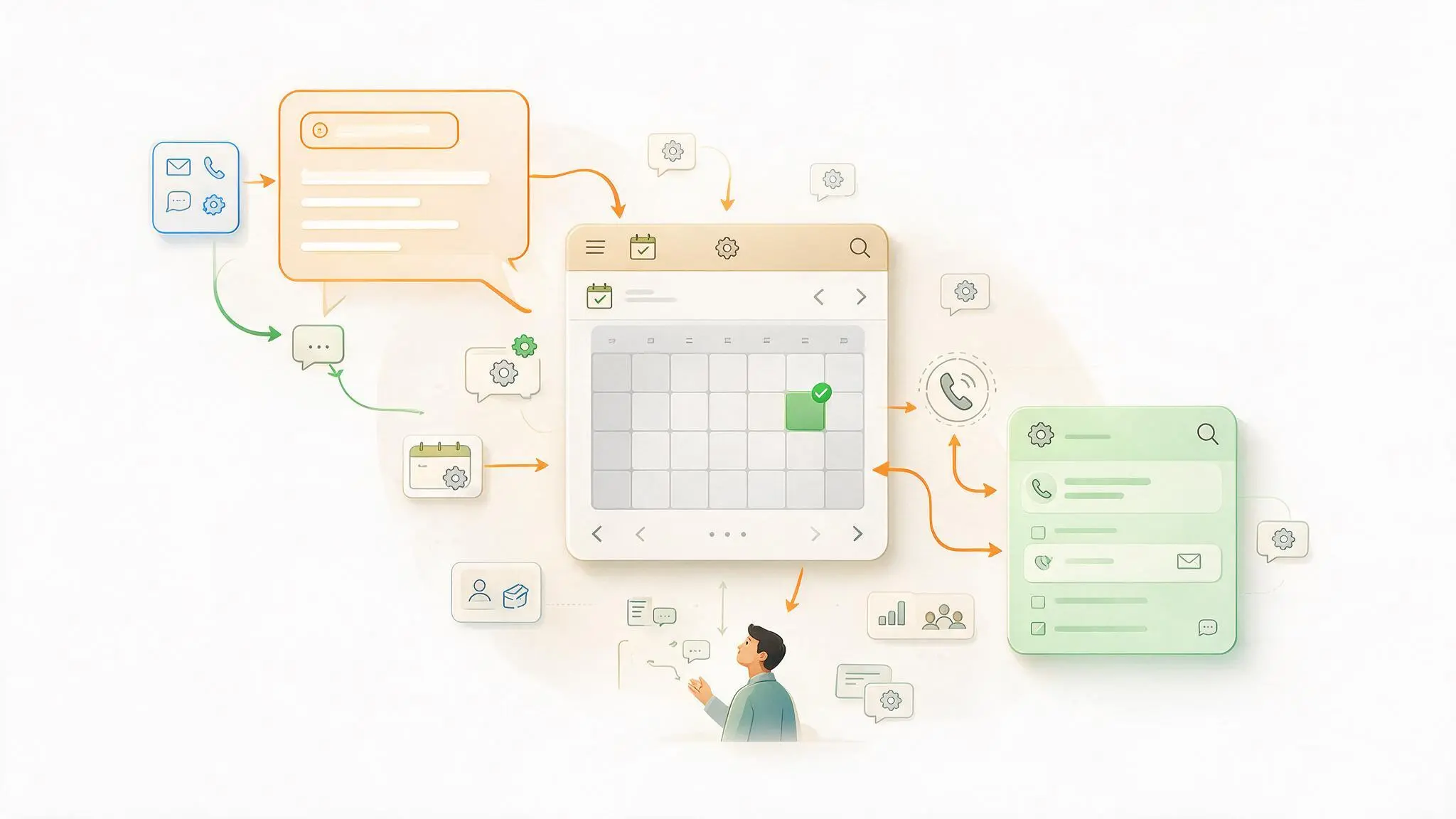
1. The conversation itself. The lead told your AI they are replacing a 14-year-old system, that they have two competing quotes, and that the decision sits with a spouse who is out of town until Thursday. Unless the setter writes that into the CRM record, it evaporates. The rep gets a name and a time slot.
2. The no-show. A meaningful share of booked meetings never happen, and the share climbs the further out the slot sits. Most setters will text a reschedule link. Very few will do anything else.
3. The dial. A no-show who ignores the reschedule text needs a phone call. That requires an outbound dialer, and a messaging-based setter simply does not have one. This is the structural limit of the whole category: booking tools were built to receive, not to reach.
Read the buying guides that rank for this term and you will notice they all stop in the same place. They compare qualification depth, integrations, and price. They do not tell you what lands on the record when the AI hangs up, and they do not tell you who calls the no-show back.
Key takeaway: the category reliably drops the conversation context, the no-show, and the outbound dial. Those three are the difference between a booked calendar and a working pipeline.
Why does a booking without call context cost more than it saves?
Because the work does not disappear. It moves to the rep, who is worse positioned to do it.
In a July 2026 Pipedrive survey of 1,000 employed adults, more than 71% of respondents said they spend at least ten minutes preparing for every customer call, nearly 47.2% said follow-ups or CRM updates take longer than 24 hours to complete, and nearly 58% said they lose at least three hours a week to administrative work that pulls them away from customers. Now hand that same rep a meeting booked by a machine that told them nothing.
Before: the rep books the meeting themselves, so the qualification lives in their head and the notes land on the record while the call is fresh.
After a context-free AI booking: the rep opens a calendar invite and sees a name and a number. Say the meeting is booked for twenty minutes. The opening stretch of it goes on re-asking questions the prospect already answered, and the CRM gets updated tomorrow, if at all.
This is not a hypothetical failure mode. It is one of the most common complaints in our own recorded sales conversations: prospects describe manual entry into HubSpot because their current tool has no real integration, so every conversation gets retyped or lost. Adding an AI that books meetings on top of that problem multiplies it, because now the conversations nobody logged are conversations nobody even heard.
Key takeaway: an AI setter that books without writing back does not remove the admin tax. It relocates it to the rep and charges interest, because the person doing the work was not in the conversation.
Where does an AI appointment setter sit in your pipeline?
Three placements are worth the money. Everything else is a science project.
Notice what is not on that list: complex B2B deals with a buying committee, high-trust conversations in medical or legal matters where the person needs a human, and any motion where the qualification requires judgment you cannot write down. An AI should take the calls a human is not available for, not every call.
Key takeaway: place an AI setter where coverage is the constraint. After hours, first response, and the follow-up nobody has time to make.
How do you wire the handoff so a booking becomes a working record?
The fix is to stop treating the booking as the output. The output is a CRM record a rep can act on, plus a next action that fires without anyone remembering to set it.
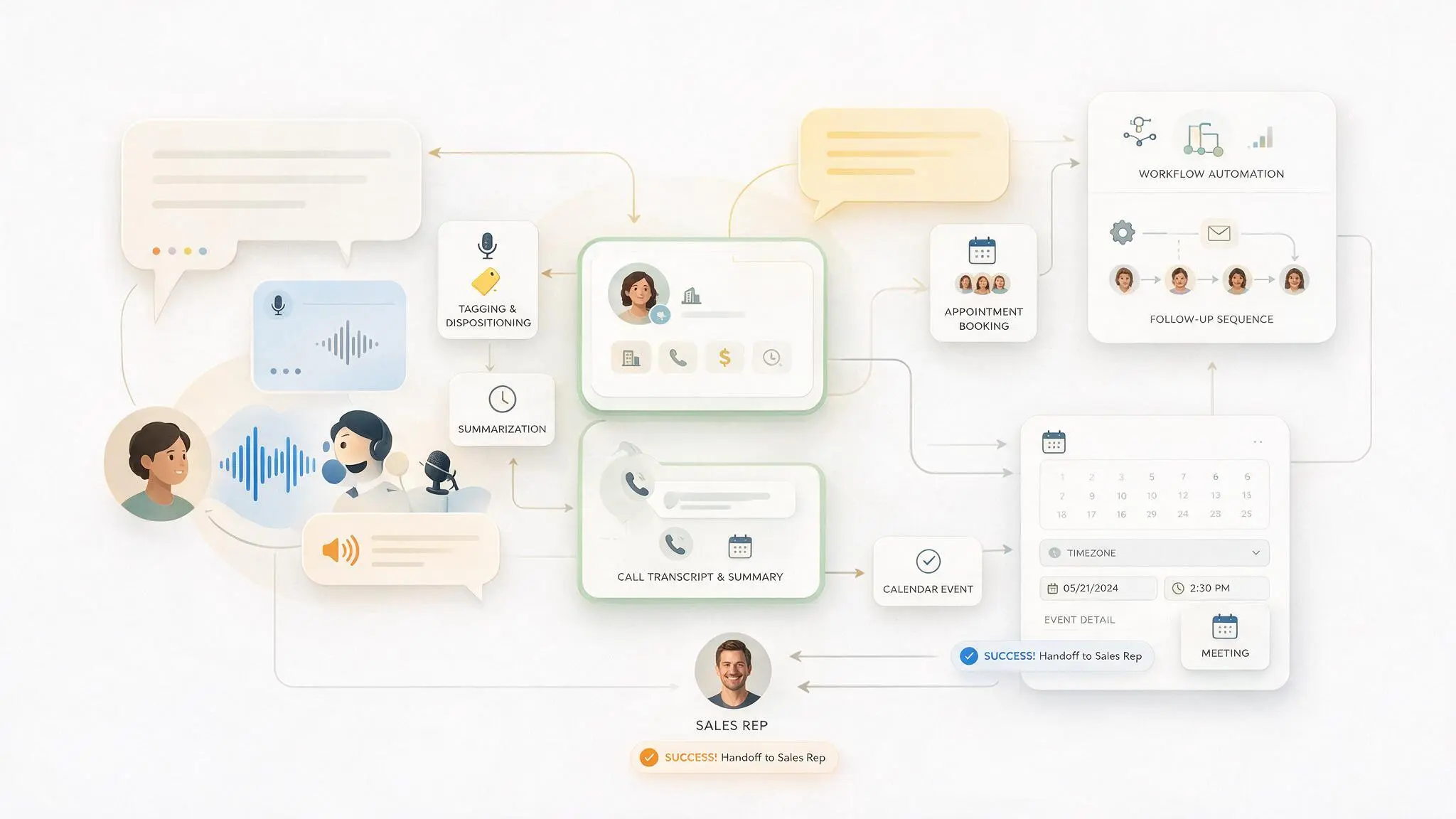
That is the design behind AloAi Voice Agent, which runs inside the same platform as the dialer and the CRM integration rather than beside them. Four things happen during the conversation, not after it:
- The appointment is booked under controls you set. The Manage Appointment action is configured at the admin level: which user or calendar receives the booking, which slot durations are allowed, time-zone defaults, title format, duplicate-booking prevention, and which operations the agent may perform at all. If you do not want the AI cancelling anything, it cannot cancel, even when the contact asks.
- The record updates while the call is live. Contact properties captured in conversation sync out to HubSpot, Salesforce, Pipedrive, Zoho, HighLevel, or Guesty where the integration allows it, so the qualification lands on the contact rather than in a transcript nobody opens.
- The outcome becomes readable data. The agent sets a contact disposition and a call disposition, applies tags, and writes a structured summary as a note on the contact timeline. Your reporting can see it and your automation can branch on it.
- The next step fires itself. The agent enrolls the contact into a sequence, or transfers the call warm to a person, and on HubSpot it can identify the deal or contact owner and route the call to that specific rep.
Because it is the same platform, the no-show is not a dead end either. A missed meeting can be dialed back, which is where answer rate starts to matter: Hiya's State of the Call 2026 puts unanswered unknown calls at 86%. Getting a callback picked up is a separate discipline from booking it, covered in our breakdown of whether your callback even gets answered. The reputation and branded-identity layer that protects that number is sold separately from the seat plan, and it is not optional if you intend to dial consistently over months rather than weeks.
Pricing follows the model you pick rather than a flat rate: AloAi Voice Agent runs from $0.10 per minute on the Basic tier up to $0.50 per minute on Ultra Premium, so a short qualification call and a long consultative one cost very different amounts. Vertical patterns differ too, and how insurance agencies run intake with a voice agent is a useful template if your qualification is form-shaped. For teams running everything through one CRM, the same conversation data lands on the right HubSpot record automatically.
Key takeaway: judge an AI appointment setter on four outputs, not one. What lands on the record, who sets the disposition, what fires next, and who dials the no-show back.
What should you test before you buy an AI appointment setter?
Run this on any demo. It takes fifteen minutes and it separates a booking layer from a pipeline layer faster than any feature list.
- Book a meeting on the demo, then open the CRM record. Do not let them show you the calendar. Ask to see the contact. Look for the summary, the disposition, and the properties the conversation captured.
- Ask what happens 20 minutes after a no-show. Listen for whether anything places a call, or whether the answer stops at a reschedule text.
- Try to double-book the same slot. Ask the agent for a time it already holds and watch what it does.
- Ask it something off-script. Interrupt it, change your mind mid-sentence, ask for a human. A setter that only survives the happy path will meet your real leads on Monday.
- Test the transfer. Ask to speak to someone and see whether it reaches a person, a ring group, or a voicemail box.
- Ask which operations you can disable. If the AI can cancel and reschedule appointments with no admin control over it, you have handed your calendar to a stranger.
- Ask how the meeting gets attributed. If the booking does not carry a source, you will never know whether the tool paid for itself.
Key takeaway: test the handoff, not the booking. Every vendor can put a slot on a calendar; few can hand a rep a record worth reading.
The bottom line
An AI appointment setter is a coverage tool wearing a replacement tool's marketing. Bought as coverage, it is one of the better purchases available to a sales team right now: it answers at 9pm, it responds in seconds, and it never forgets to ask the qualifying question. Bought as a replacement for the humans who set meetings, it produces a fuller calendar and the same pipeline, because a meeting nobody prepared for converts about as well as a meeting nobody booked.
The booking was never the hard part. The handoff is.
See AloAi Voice Agent answer a real lead in under 60 seconds. Book a 20-minute AloAi Voice Agent demo and we will customize it to your vertical.

.png)

Ruby Kootval is Head of Product Marketing at Aloware. She has 12 years in digital marketing, including 8 in B2B SaaS and 5 in telecom, and writes about AI voice agents, dialers, CRM integrations, and contact center operations.